Visionary people with Ownership & Leadership skills including Accountability creates Nexus of Success & Yearn for innovative Solutions
Session 10 : SDN (Software Defined Networking)
NSIG (Network Special Interest Group)
Session Owner : Aalok Shah
Agenda
What is SDN?
SDN Framework
Contents
Demystifying SDN Definition
Why SDN is Required?
Benefits of SDN
Quick Brush-up
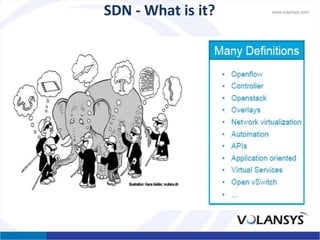
SDN - What is it?
Demystifying SDN Definition
As per Wikipedia,
Software-defined networking (SDN) technology is an approach to computer networking
that allows network administrators to programmatically initialize, control, change, and
manage network behavior dynamically via open interfaces and provide abstraction of
lower-level functionality.
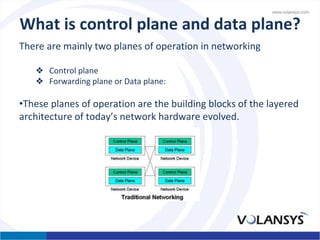
The physical separation of
the network control plane
from the data plane, and
where a control plane
controls several devices.
What is control plane and data plane?
There are mainly two planes of operation in networking
❖ Control plane
❖ Forwarding plane or Data plane:
•These planes of operation are the building blocks of the layered
architecture of today’s network hardware evolved.
✓ It is the part of the network device architecture that is concerned with the drawing
network topology or the information in routing table that defines what to do with the
incoming packet.
✓ It makes the decision about the traffic sent.
✓ Control plane packets are destined to or locally originated by the device itself.
✓ It is the signaling of the networks.
✓ All control plane activities are handled by CPU and it is not time constraint or
critical. So it is slow path.
Control plane:
✓ It is the part of the networks which carries the user traffic as per the logic of control
plane.
✓ It actually moving the packet based on what device learned.
✓ Data plane traffic travel through the device, rather than to or from them.
✓ It involves activities like forwarding, fragmentation and reassembly , or replication
for multicasting.
✓ Data plane runs at line rate,
E.g. 100 Gbps for 100 Gbps Ethernet => Fast path
=> Typically implemented using special hardware.
Forwarding plane
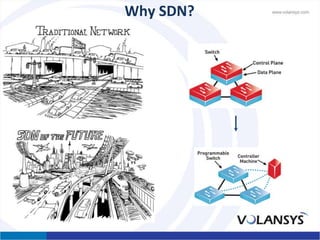
Why SDN?
With SDN…..
1.Centralized network provisioning:
Software defined networks provide a centralized view of the entire network,
making it easier to centralize enterprise management and provisioning. For
example, more VLANs are becoming part of physical LANs.
2.Holistic enterprise management.
SDN allows IT managers to experiment with network configuration without
impacting the network. SDN also supports management of both physical and
virtual switches and network devices from a central controller.
3. Content delivery
Controlling data traffic is one of the primary advantages of software
defined networking. The ability to direct and automate data traffic makes
implementing quality of services (QoS) for voice over IP (VOIP), video and
audio transmissions much easier
4. Reduced operating costs.
Centralized management, operational efficiency and better hardware use
all enable reduced costs.
5. Enhanced security.
While virtualization has made management more complex, having a
centralized network controller can bring the reins of control back to IT
professionals’ hands and create a central point of control to distribute security
and policy information consistently throughout the enterprise.
6.Reduced hardware management and costs.
You can extend the life of existing hardware because you have shifted
the decision making to the SDN controller.
7. Open standards-based and vendor-neutral:
When implemented through open standards, SDN simplifies network
design and operation because instructions are provided by SDN controllers
instead of multiple, vendor-specific devices and protocols.
With SDN...
SDN Framework
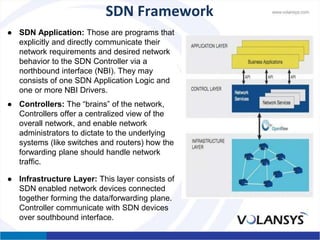
● SDN Application: Those are programs that
explicitly and directly communicate their
network requirements and desired network
behavior to the SDN Controller via a
northbound interface (NBI). They may
consists of one SDN Application Logic and
one or more NBI Drivers.
● Controllers: The “brains” of the network,
Controllers offer a centralized view of the
overall network, and enable network
administrators to dictate to the underlying
systems (like switches and routers) how the
forwarding plane should handle network
traffic.
● Infrastructure Layer: This layer consists of
SDN enabled network devices connected
together forming the data/forwarding plane.
Controller communicate with SDN devices
over southbound interface.
SDN Framework
● Southbound APIs:
Southbound APIs are used
to relay information to the
switches and routers
“below.” OpenFlow,
considered the first standard
in SDN, was the original
southbound API and
remains as one of the most
common protocols.
● Northbound APIs:
Northbound APIs are used
to communicate with the
applications and business
logic “above.” These help
network administrators to
programmatically shape
traffic and deploy services.
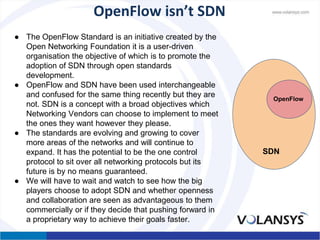
OpenFlow isn’t SDN
● The OpenFlow Standard is an initiative created by the
Open Networking Foundation it is a user-driven
organisation the objective of which is to promote the
adoption of SDN through open standards
development.
● OpenFlow and SDN have been used interchangeable
and confused for the same thing recently but they are
not. SDN is a concept with a broad objectives which
Networking Vendors can choose to implement to meet
the ones they want however they please.
● The standards are evolving and growing to cover
more areas of the networks and will continue to
expand. It has the potential to be the one control
protocol to sit over all networking protocols but its
future is by no means guaranteed.
● We will have to wait and watch to see how the big
players choose to adopt SDN and whether openness
and collaboration are seen as advantageous to them
commercially or if they decide that pushing forward in
a proprietary way to achieve their goals faster.
OpenFlow
SDN
SDN Benefits
● Directly Programmable: Network directly programmable because the control
functions are decoupled from forwarding functions, which enable the network
to be programmatically configured by proprietary or open source automation
tools, including OpenStack, Puppet, and Chef.
● Centralized Management: Network intelligence is logically centralized in
SDN controller software that maintains a global view of the network, which
appears to applications and policy engines as a single, logical switch.
● Reduce CapEx: SDN potentially limits the need to purchase purpose-built,
ASIC-based networking hardware.
● Reduce OpEX: SDN enables algorithmic control of the network of network
elements (such as hardware or software switches / routers that are
increasingly programmable, making it easier to design, deploy, manage, and
scale networks. The ability to automate orchestration optimizes service
availability and reliability by reducing overall management time and the chance
for human error.
● Deliver Agility and Flexibility: SDN helps organizations rapidly deploy new
applications, services, and infrastructure to quickly meet changing business
goals and objectives.
● Enable Innovation: SDN enables organizations to create new types of
applications, services, and business models that can offer new revenue
streams and more value from the network.
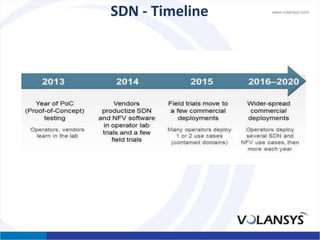
SDN - Timeline
SDN - Communities and Resources
References
● https://tools.ietf.org/html/rfc7426
● https://en.wikipedia.org/wiki/Software-defined_networking
● https://turbonomic.com/blog/on-technology/sdn-software-defined-
networking-primer-and-why-we-need-sdn/
● http://opennetsummit.org/archives/mar14/site/why-sdn.html
● https://www.sdxcentral.com/sdn/definitions/what-the-definition-of-
software-defined-networking-sdn/
Contact Us:
India Office
Block A – 7th Floor, Safal Profitaire,
Corporate Road, Prahaladnagar,
Ahmedabad – 380015
Phone + 91-79-40041994
business@volansys.com
Q & A
Thank You
18
Innovation to Realization

Software Defined Networking (SDN)

  • 1.
    Visionary people withOwnership & Leadership skills including Accountability creates Nexus of Success & Yearn for innovative Solutions Session 10 : SDN (Software Defined Networking) NSIG (Network Special Interest Group) Session Owner : Aalok Shah
  • 2.
    Agenda What is SDN? SDNFramework Contents Demystifying SDN Definition Why SDN is Required? Benefits of SDN Quick Brush-up
  • 3.
    SDN - Whatis it?
  • 4.
    Demystifying SDN Definition Asper Wikipedia, Software-defined networking (SDN) technology is an approach to computer networking that allows network administrators to programmatically initialize, control, change, and manage network behavior dynamically via open interfaces and provide abstraction of lower-level functionality. The physical separation of the network control plane from the data plane, and where a control plane controls several devices.
  • 5.
    What is controlplane and data plane? There are mainly two planes of operation in networking ❖ Control plane ❖ Forwarding plane or Data plane: •These planes of operation are the building blocks of the layered architecture of today’s network hardware evolved.
  • 6.
    ✓ It isthe part of the network device architecture that is concerned with the drawing network topology or the information in routing table that defines what to do with the incoming packet. ✓ It makes the decision about the traffic sent. ✓ Control plane packets are destined to or locally originated by the device itself. ✓ It is the signaling of the networks. ✓ All control plane activities are handled by CPU and it is not time constraint or critical. So it is slow path. Control plane:
  • 7.
    ✓ It isthe part of the networks which carries the user traffic as per the logic of control plane. ✓ It actually moving the packet based on what device learned. ✓ Data plane traffic travel through the device, rather than to or from them. ✓ It involves activities like forwarding, fragmentation and reassembly , or replication for multicasting. ✓ Data plane runs at line rate, E.g. 100 Gbps for 100 Gbps Ethernet => Fast path => Typically implemented using special hardware. Forwarding plane
  • 8.
  • 9.
    With SDN….. 1.Centralized networkprovisioning: Software defined networks provide a centralized view of the entire network, making it easier to centralize enterprise management and provisioning. For example, more VLANs are becoming part of physical LANs. 2.Holistic enterprise management. SDN allows IT managers to experiment with network configuration without impacting the network. SDN also supports management of both physical and virtual switches and network devices from a central controller. 3. Content delivery Controlling data traffic is one of the primary advantages of software defined networking. The ability to direct and automate data traffic makes implementing quality of services (QoS) for voice over IP (VOIP), video and audio transmissions much easier
  • 10.
    4. Reduced operatingcosts. Centralized management, operational efficiency and better hardware use all enable reduced costs. 5. Enhanced security. While virtualization has made management more complex, having a centralized network controller can bring the reins of control back to IT professionals’ hands and create a central point of control to distribute security and policy information consistently throughout the enterprise. 6.Reduced hardware management and costs. You can extend the life of existing hardware because you have shifted the decision making to the SDN controller. 7. Open standards-based and vendor-neutral: When implemented through open standards, SDN simplifies network design and operation because instructions are provided by SDN controllers instead of multiple, vendor-specific devices and protocols. With SDN...
  • 11.
    SDN Framework ● SDNApplication: Those are programs that explicitly and directly communicate their network requirements and desired network behavior to the SDN Controller via a northbound interface (NBI). They may consists of one SDN Application Logic and one or more NBI Drivers. ● Controllers: The “brains” of the network, Controllers offer a centralized view of the overall network, and enable network administrators to dictate to the underlying systems (like switches and routers) how the forwarding plane should handle network traffic. ● Infrastructure Layer: This layer consists of SDN enabled network devices connected together forming the data/forwarding plane. Controller communicate with SDN devices over southbound interface.
  • 12.
    SDN Framework ● SouthboundAPIs: Southbound APIs are used to relay information to the switches and routers “below.” OpenFlow, considered the first standard in SDN, was the original southbound API and remains as one of the most common protocols. ● Northbound APIs: Northbound APIs are used to communicate with the applications and business logic “above.” These help network administrators to programmatically shape traffic and deploy services.
  • 13.
    OpenFlow isn’t SDN ●The OpenFlow Standard is an initiative created by the Open Networking Foundation it is a user-driven organisation the objective of which is to promote the adoption of SDN through open standards development. ● OpenFlow and SDN have been used interchangeable and confused for the same thing recently but they are not. SDN is a concept with a broad objectives which Networking Vendors can choose to implement to meet the ones they want however they please. ● The standards are evolving and growing to cover more areas of the networks and will continue to expand. It has the potential to be the one control protocol to sit over all networking protocols but its future is by no means guaranteed. ● We will have to wait and watch to see how the big players choose to adopt SDN and whether openness and collaboration are seen as advantageous to them commercially or if they decide that pushing forward in a proprietary way to achieve their goals faster. OpenFlow SDN
  • 14.
    SDN Benefits ● DirectlyProgrammable: Network directly programmable because the control functions are decoupled from forwarding functions, which enable the network to be programmatically configured by proprietary or open source automation tools, including OpenStack, Puppet, and Chef. ● Centralized Management: Network intelligence is logically centralized in SDN controller software that maintains a global view of the network, which appears to applications and policy engines as a single, logical switch. ● Reduce CapEx: SDN potentially limits the need to purchase purpose-built, ASIC-based networking hardware. ● Reduce OpEX: SDN enables algorithmic control of the network of network elements (such as hardware or software switches / routers that are increasingly programmable, making it easier to design, deploy, manage, and scale networks. The ability to automate orchestration optimizes service availability and reliability by reducing overall management time and the chance for human error. ● Deliver Agility and Flexibility: SDN helps organizations rapidly deploy new applications, services, and infrastructure to quickly meet changing business goals and objectives. ● Enable Innovation: SDN enables organizations to create new types of applications, services, and business models that can offer new revenue streams and more value from the network.
  • 15.
  • 16.
    SDN - Communitiesand Resources
  • 17.
    References ● https://tools.ietf.org/html/rfc7426 ● https://en.wikipedia.org/wiki/Software-defined_networking ●https://turbonomic.com/blog/on-technology/sdn-software-defined- networking-primer-and-why-we-need-sdn/ ● http://opennetsummit.org/archives/mar14/site/why-sdn.html ● https://www.sdxcentral.com/sdn/definitions/what-the-definition-of- software-defined-networking-sdn/
  • 18.
    Contact Us: India Office BlockA – 7th Floor, Safal Profitaire, Corporate Road, Prahaladnagar, Ahmedabad – 380015 Phone + 91-79-40041994 business@volansys.com Q & A Thank You 18 Innovation to Realization