• Fabian Schneider, NEC
• Nabil Damouny, Netronome
1
Architecture of OpenFlow SDNs
© 2013 Open Networking Foundation
Topics
• ONF Architecture overview
• NBI study
• L4-7 aspects
• NFV
2
© 2013 Open Networking Foundation
ONF Architecture Overview
ONF ArchWG (Fabian Schneider)
© 2013 Open Networking Foundation
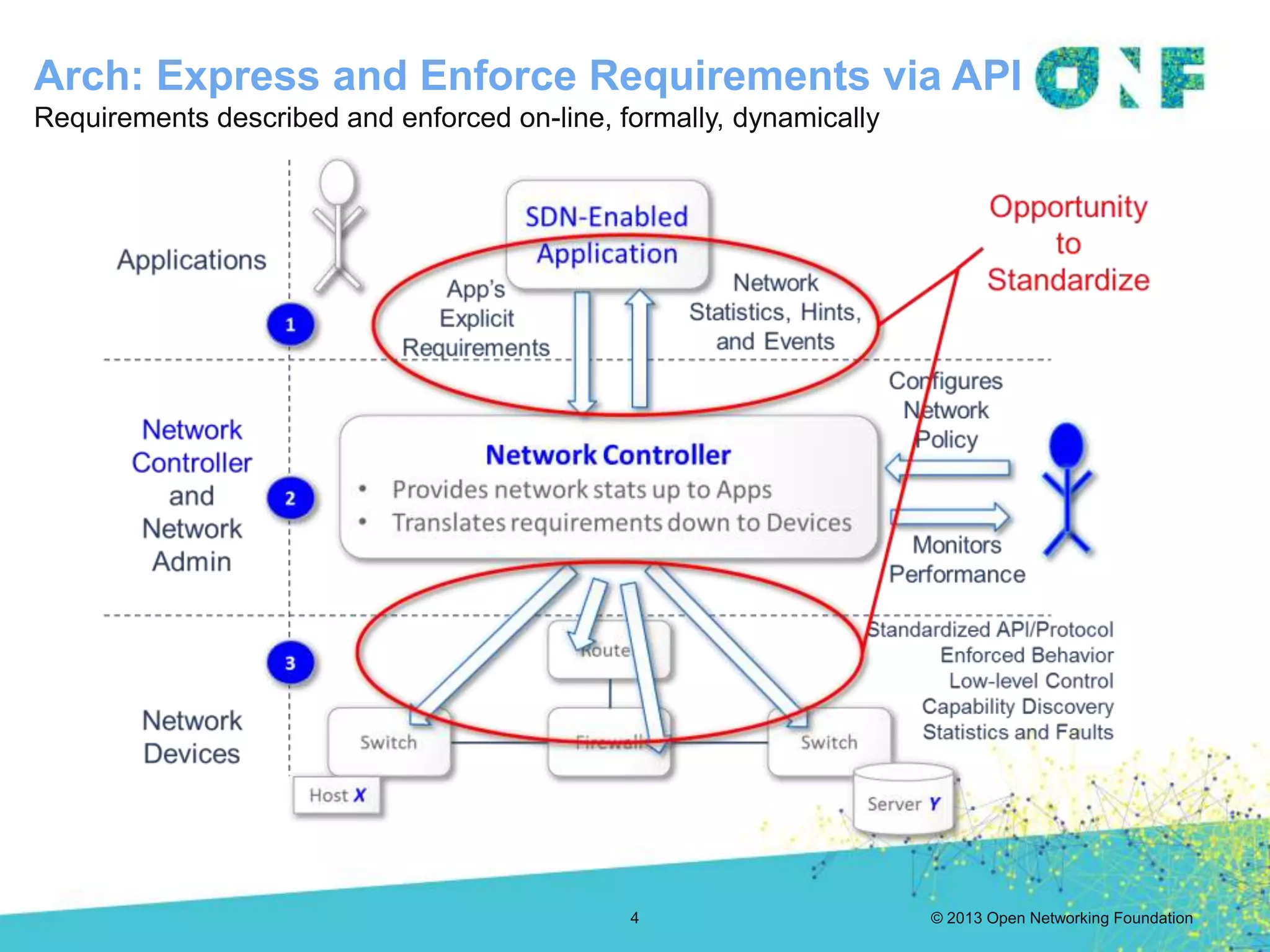
Arch: Express and Enforce Requirements via API
Requirements described and enforced on-line, formally, dynamically
4
© 2013 Open Networking Foundation
Three Critical Properties of this Architecture
5
1. Applications are network aware: SDN-enabled Applications
– Communicate their requirements/polices to the network
– Can monitor network state and adapt accordingly
2. Network is logically centralized: SDN Network Controller
– Controller translates from app requirement to low-level rules
– Controller summarizes the network state for applications
3. Well-understood driver-like model for devices: SDN Datapath
– Programmatic low-level control of all fwd’ing and configuration
– API for Capabilities advertisement and publishing statistics
– No resource contention with other entities
→ Controller “owns” this device, subject to capabilities
advertisement/negotiation
© 2013 Open Networking Foundation
Topics currently worked on
6
• Service chaining, L4-7 support, NFV
• Controller to controller interface: Need for standard?
• Network virtualization on an architectural level
• Tying Arch with use-cases
• Architectural split between OF-switch and OF-config
• Datapath diversity: SW vs. HW
• Interworking with legacy network and protocols
• North-bound interface study
© 2013 Open Networking Foundation
NBI study
ONF ArchWG (Fabian Schneider)
© 2013 Open Networking Foundation
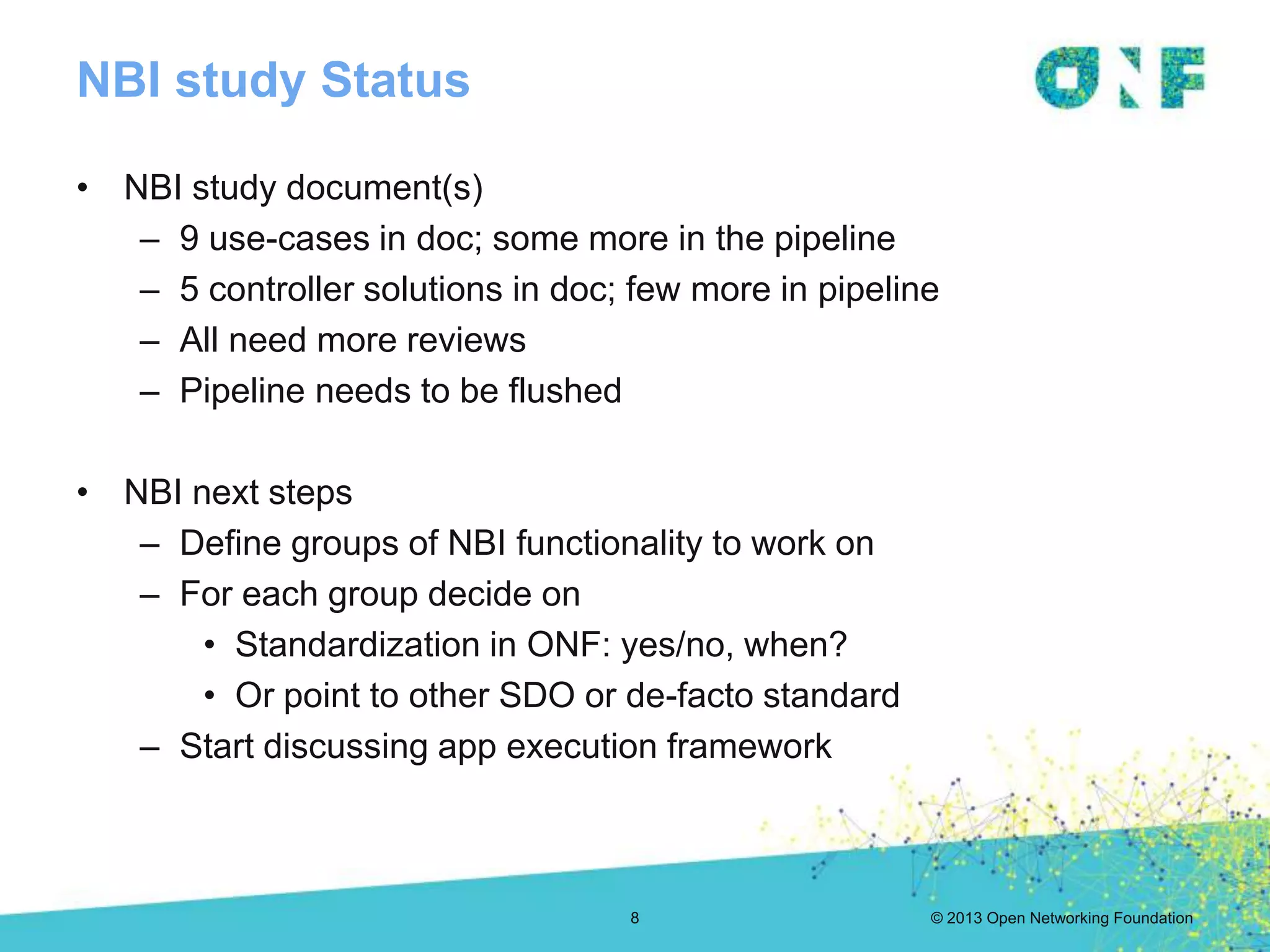
NBI study Status
• NBI study document(s)
– 9 use-cases in doc; some more in the pipeline
– 5 controller solutions in doc; few more in pipeline
– All need more reviews
– Pipeline needs to be flushed
• NBI next steps
– Define groups of NBI functionality to work on
– For each group decide on
• Standardization in ONF: yes/no, when?
• Or point to other SDO or de-facto standard
– Start discussing app execution framework
8
© 2013 Open Networking Foundation
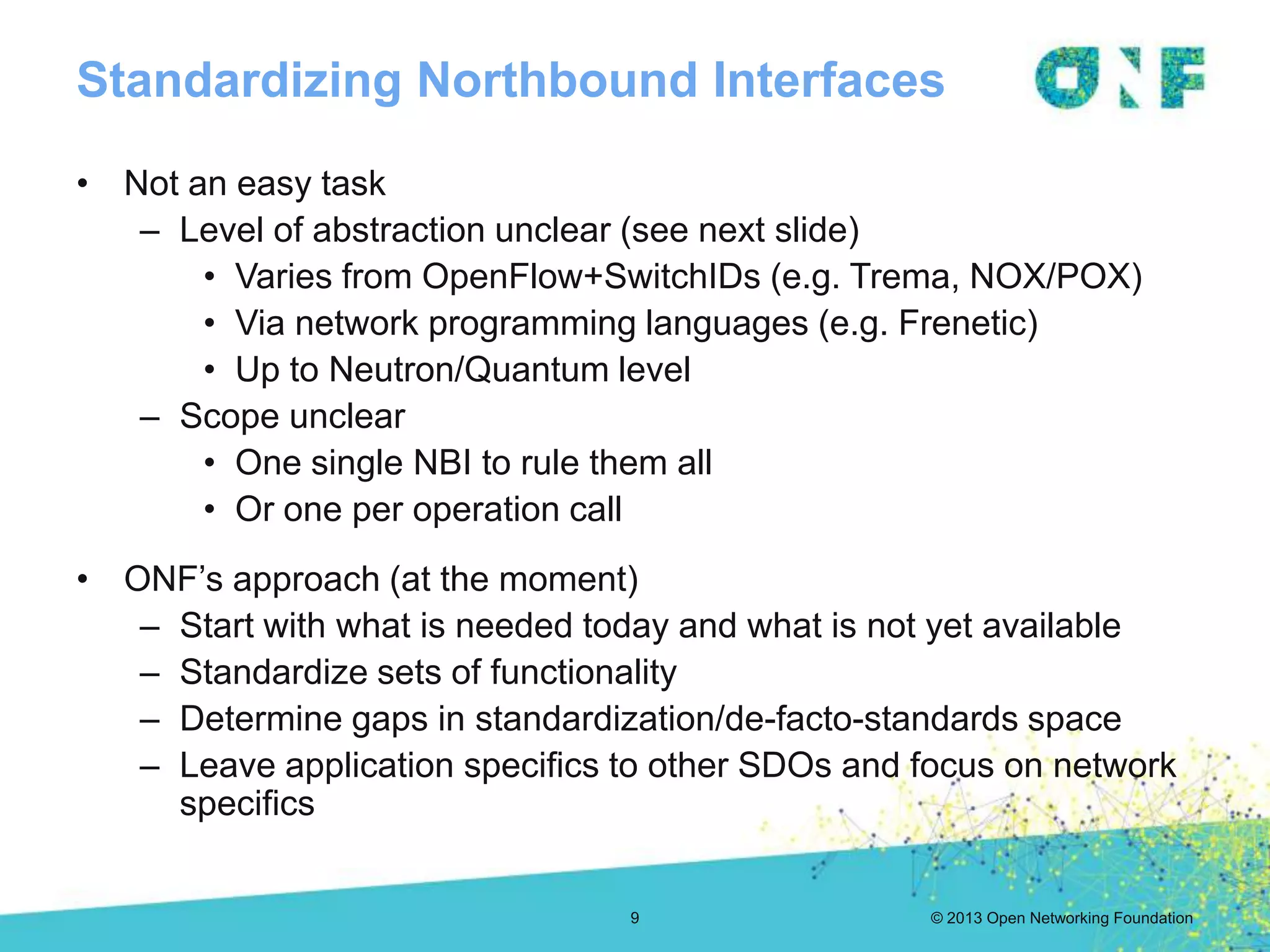
Standardizing Northbound Interfaces
9
• Not an easy task
– Level of abstraction unclear (see next slide)
• Varies from OpenFlow+SwitchIDs (e.g. Trema, NOX/POX)
• Via network programming languages (e.g. Frenetic)
• Up to Neutron/Quantum level
– Scope unclear
• One single NBI to rule them all
• Or one per operation call
• ONF’s approach (at the moment)
– Start with what is needed today and what is not yet available
– Standardize sets of functionality
– Determine gaps in standardization/de-facto-standards space
– Leave application specifics to other SDOs and focus on network
specifics
© 2013 Open Networking Foundation
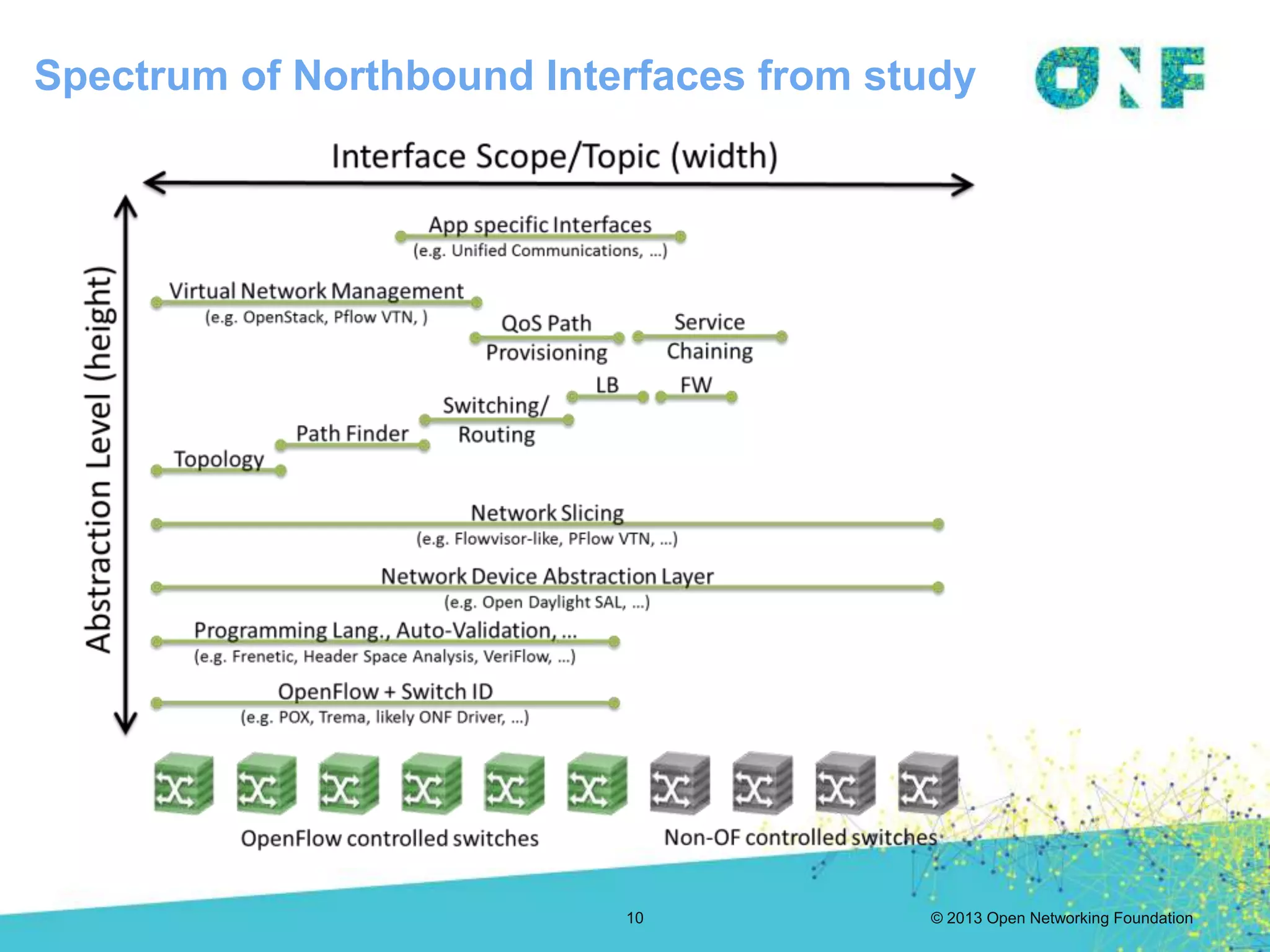
Spectrum of Northbound Interfaces from study
10
© 2013 Open Networking Foundation
Enhancing OpenFlow to Support Layer 4 through 7
ONF MEC L4-L7 Study Group (Nabil Damouny, Sharad Alawat)
© 2013 Open Networking Foundation
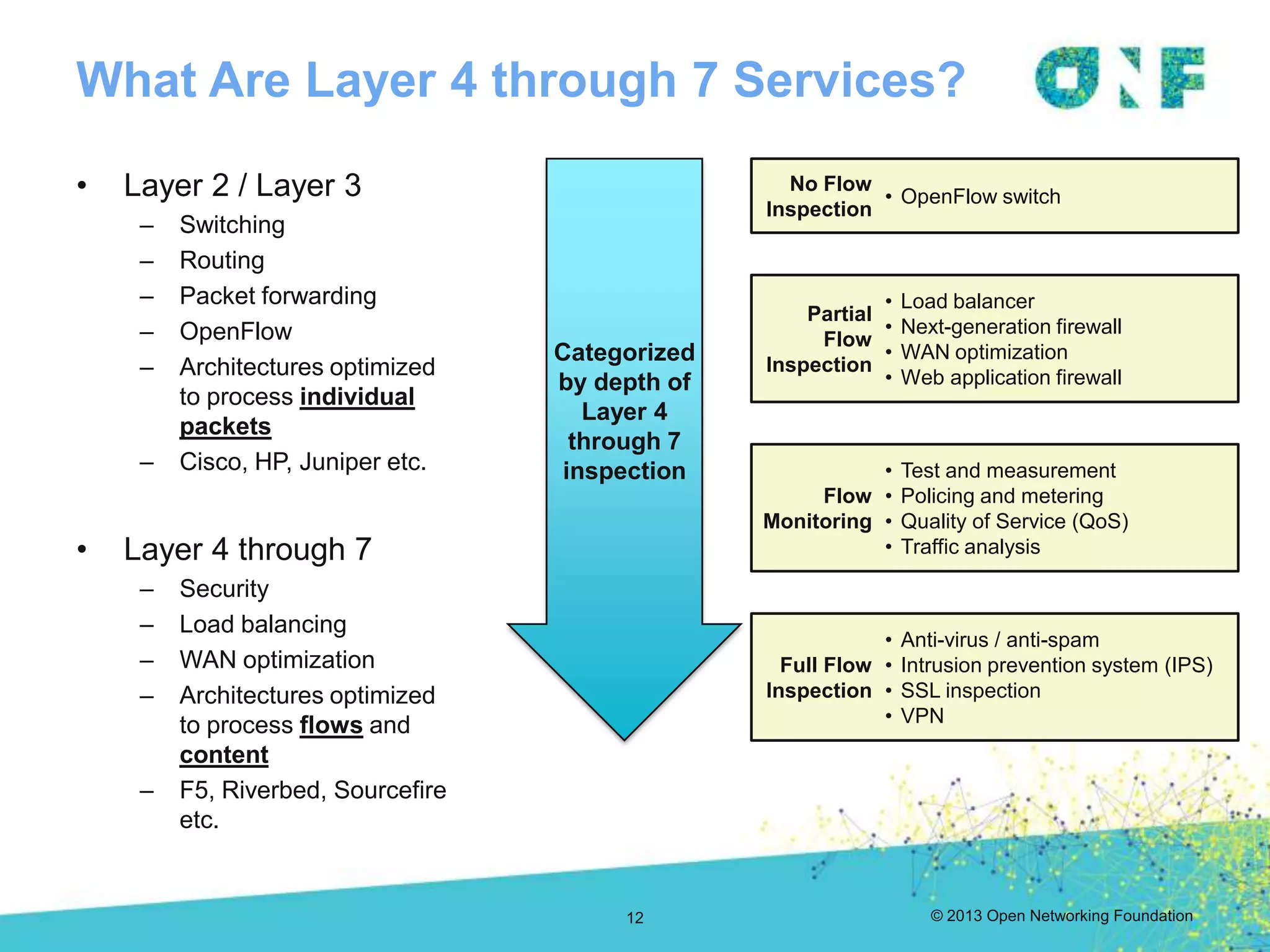
• Layer 2 / Layer 3
– Switching
– Routing
– Packet forwarding
– OpenFlow
– Architectures optimized
to process individual
packets
– Cisco, HP, Juniper etc.
• Layer 4 through 7
– Security
– Load balancing
– WAN optimization
– Architectures optimized
to process flows and
content
– F5, Riverbed, Sourcefire
etc.
What Are Layer 4 through 7 Services?
Categorized
by depth of
Layer 4
through 7
inspection
• OpenFlow switch
No Flow
Inspection
• Load balancer
• Next-generation firewall
• WAN optimization
• Web application firewall
Partial
Flow
Inspection
• Test and measurement
• Policing and metering
• Quality of Service (QoS)
• Traffic analysis
Flow
Monitoring
• Anti-virus / anti-spam
• Intrusion prevention system (IPS)
• SSL inspection
• VPN
Full Flow
Inspection
12
© 2013 Open Networking Foundation
Challenges with L4-L7 Services in
SDN Environment
13
• Inefficient use of network bandwidth and compute resources due to
lack of L4-L7 visibility
• Bottlenecks and lack of coverage due to inability to rapidly respond
to new networking and application requirements
• Hosting on controllers results in reduced throughput, increased
latency and limited scalability of the network, due to limited compute
resources
• Lack of feedback from L4-L7 services which could potentially
reprogram network paths based on L4-L7 analysis
© 2013 Open Networking Foundation
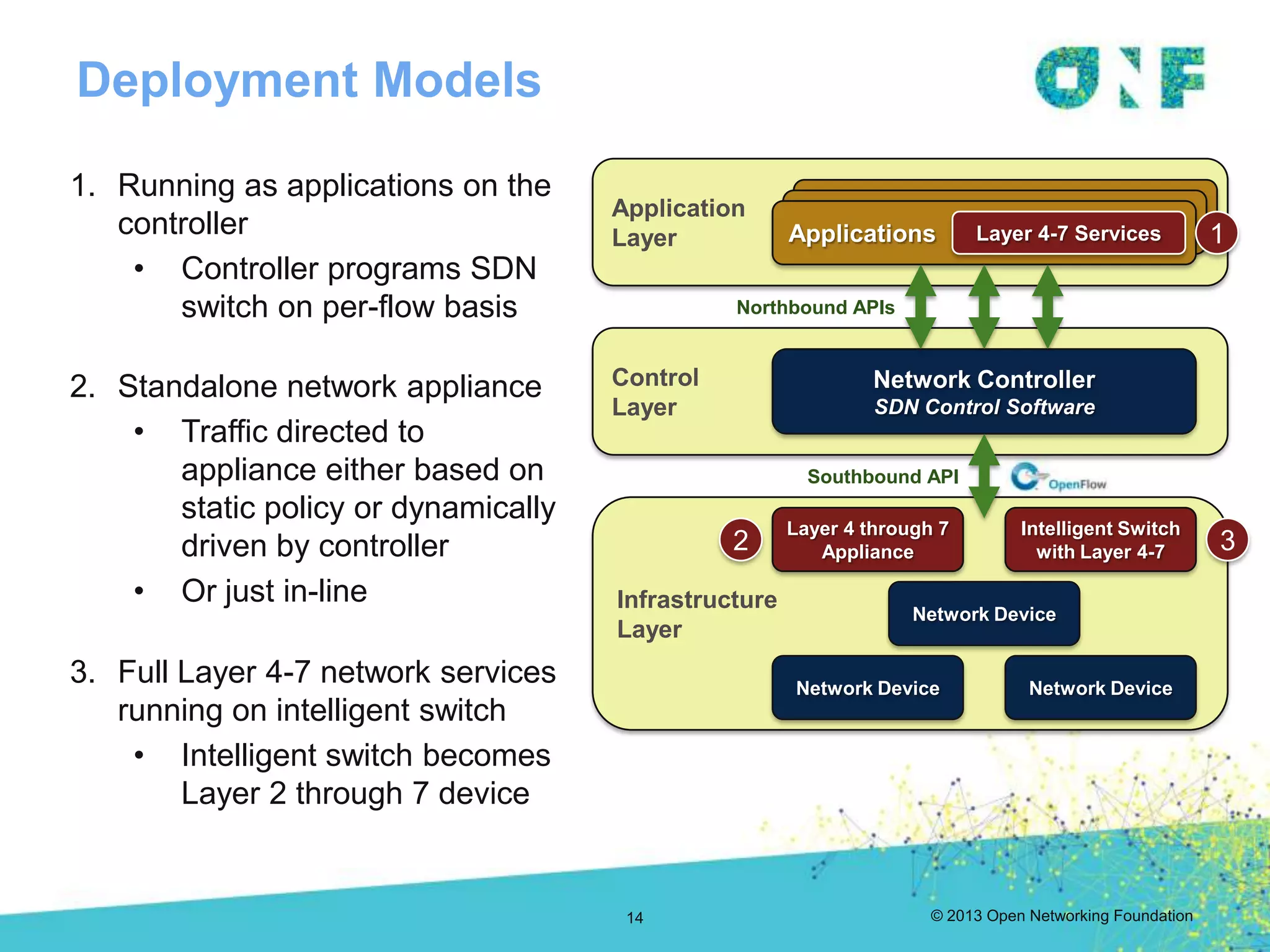
Deployment Models
Application
Layer Applications
Control
Layer
Network Controller
SDN Control Software
Infrastructure
Layer
Network Device
Network Device Network Device
Layer 4-7 Services 1
3
Intelligent Switch
with Layer 4-7
Layer 4 through 7
Appliance2
1. Running as applications on the
controller
• Controller programs SDN
switch on per-flow basis Northbound APIs
Southbound API
2. Standalone network appliance
• Traffic directed to
appliance either based on
static policy or dynamically
driven by controller
• Or just in-line
3. Full Layer 4-7 network services
running on intelligent switch
• Intelligent switch becomes
Layer 2 through 7 device
14
© 2013 Open Networking Foundation
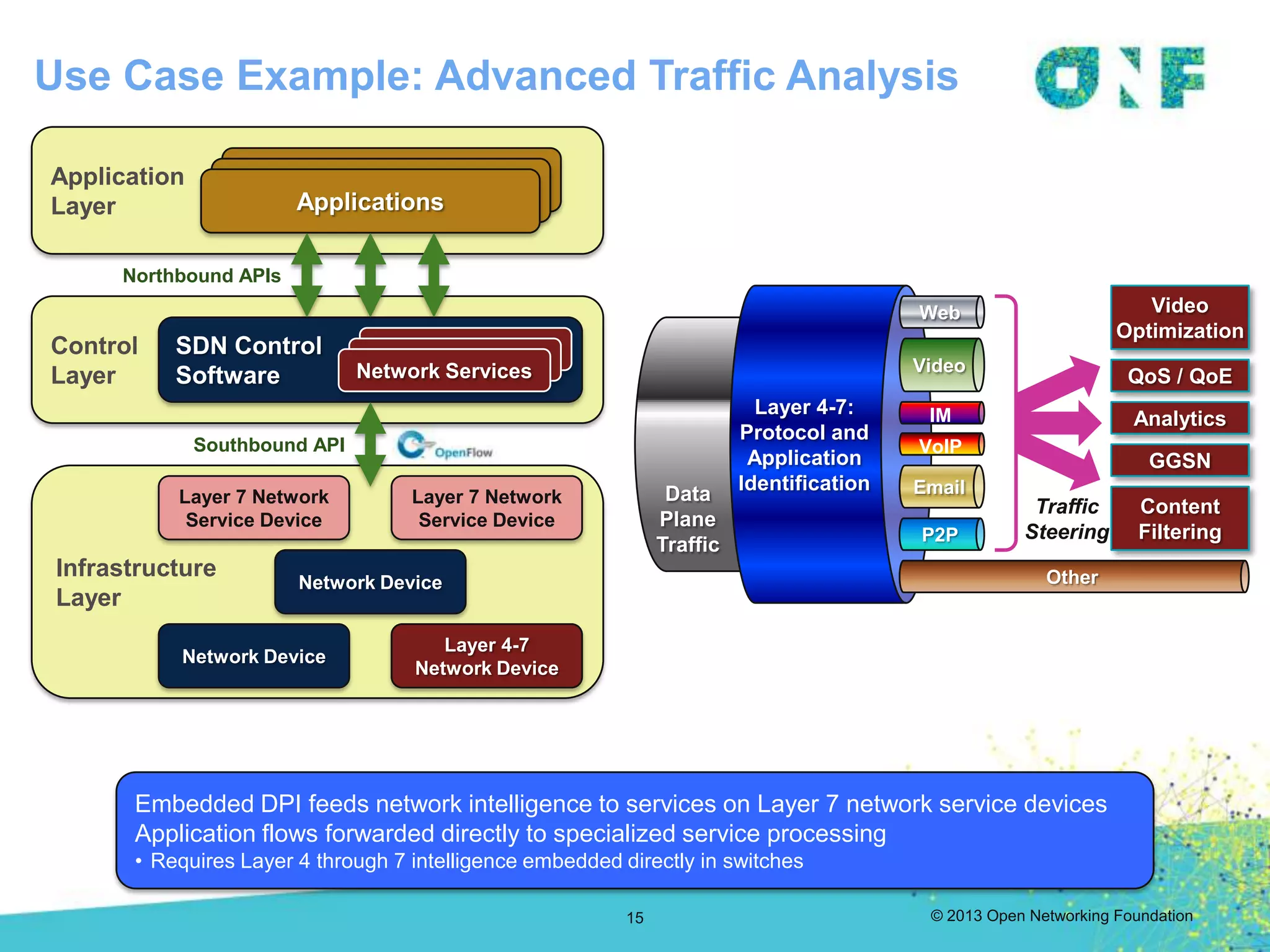
Use Case Example: Advanced Traffic Analysis
Embedded DPI feeds network intelligence to services on Layer 7 network service devices
Application flows forwarded directly to specialized service processing
• Requires Layer 4 through 7 intelligence embedded directly in switches
Application
Layer Applications
Control
Layer
SDN Control
Software
Infrastructure
Layer
Network Device
Network Device
Layer 4-7
Network Device
Layer 7 Network
Service Device
Northbound APIs
Southbound API
Network Services
Layer 7 Network
Service Device
VoIP
P2P
Video
Email
Web
Data
Plane
Traffic
Layer 4-7:
Protocol and
Application
Identification
IM
Other
Traffic
Steering
Video
Optimization
QoS / QoE
Analytics
GGSN
Content
Filtering
15
© 2013 Open Networking Foundation
NFV – Network Function Virtualization
Using COTS Server Architecture to Implement Network Functions
Nabil Damouny
© 2013 Open Networking Foundation
ETSI NFV
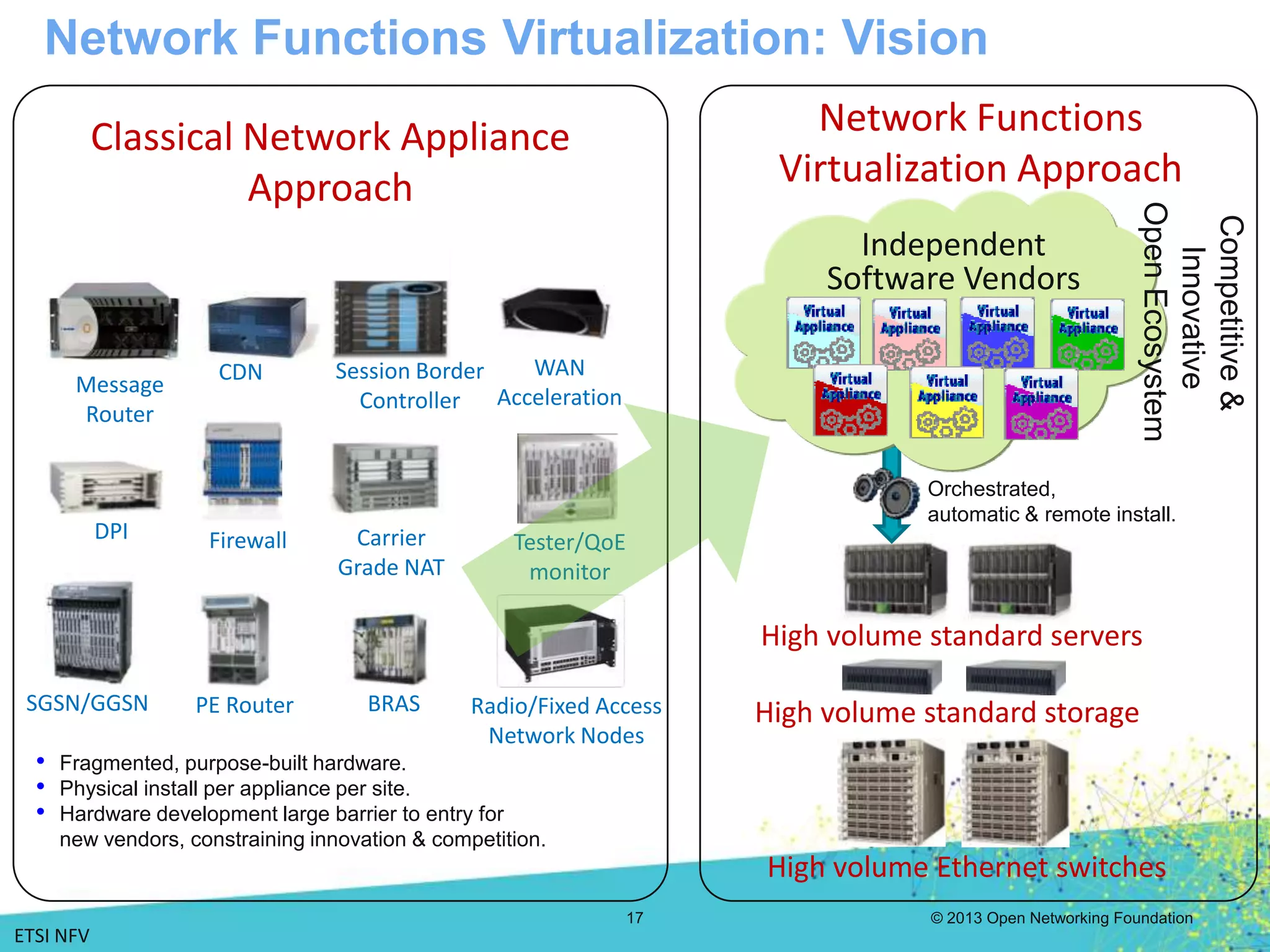
Network Functions Virtualization: Vision
Classical Network Appliance
Approach
BRAS
FirewallDPI
CDN
Tester/QoE
monitor
WAN
Acceleration
Message
Router
Radio/Fixed Access
Network Nodes
Carrier
Grade NAT
Session Border
Controller
PE RouterSGSN/GGSN
• Fragmented, purpose-built hardware.
• Physical install per appliance per site.
• Hardware development large barrier to entry for
new vendors, constraining innovation & competition.
Network Functions
Virtualization Approach
High volume Ethernet switches
High volume standard servers
High volume standard storage
Orchestrated,
automatic & remote install.
Independent
Software Vendors
Competitive&
Innovative
OpenEcosystem
17
© 2013 Open Networking Foundation
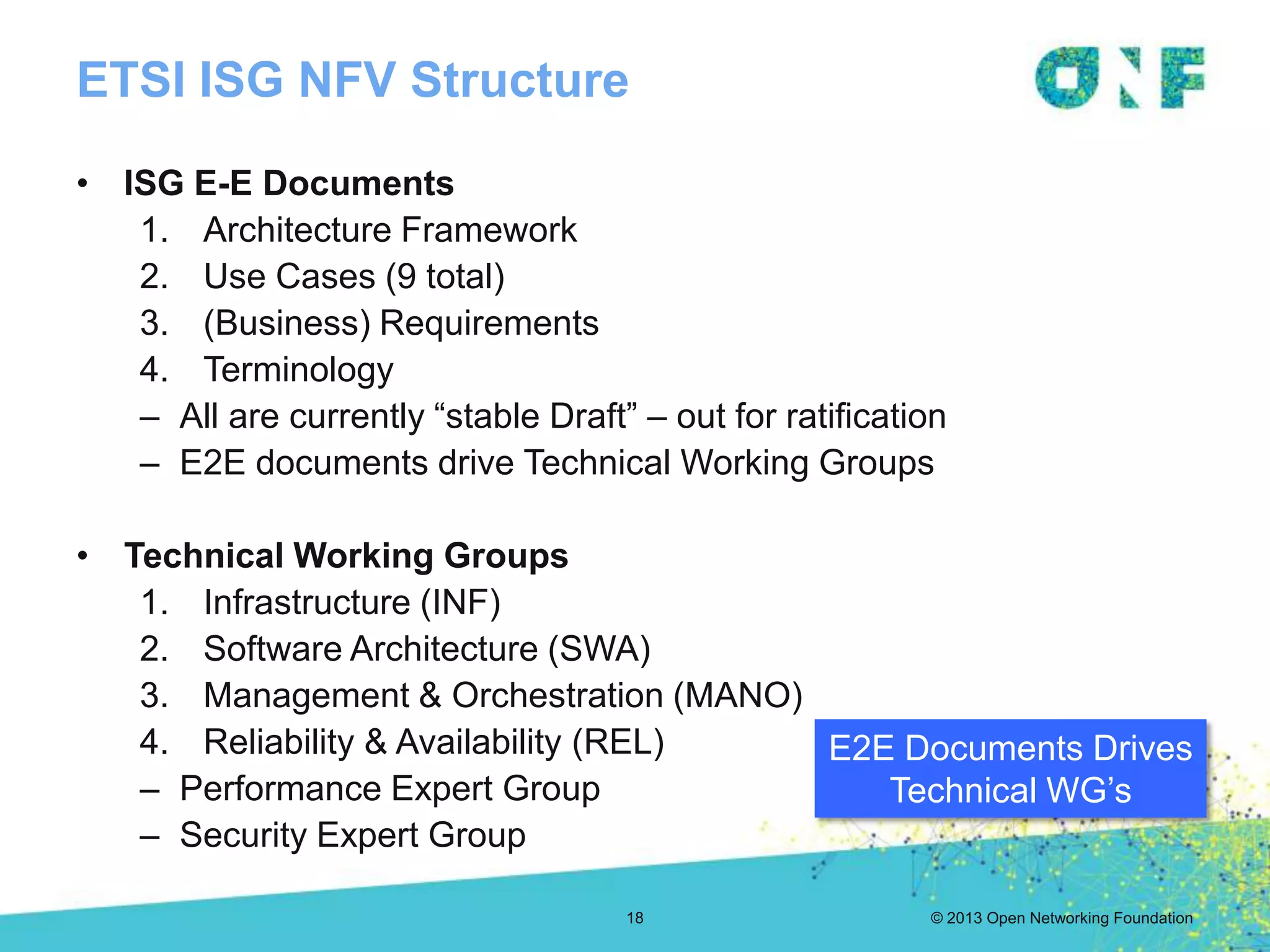
ETSI ISG NFV Structure
• ISG E-E Documents
1. Architecture Framework
2. Use Cases (9 total)
3. (Business) Requirements
4. Terminology
– All are currently “stable Draft” – out for ratification
– E2E documents drive Technical Working Groups
• Technical Working Groups
1. Infrastructure (INF)
2. Software Architecture (SWA)
3. Management & Orchestration (MANO)
4. Reliability & Availability (REL)
– Performance Expert Group
– Security Expert Group
E2E Documents Drives
Technical WG’s
18
© 2013 Open Networking Foundation
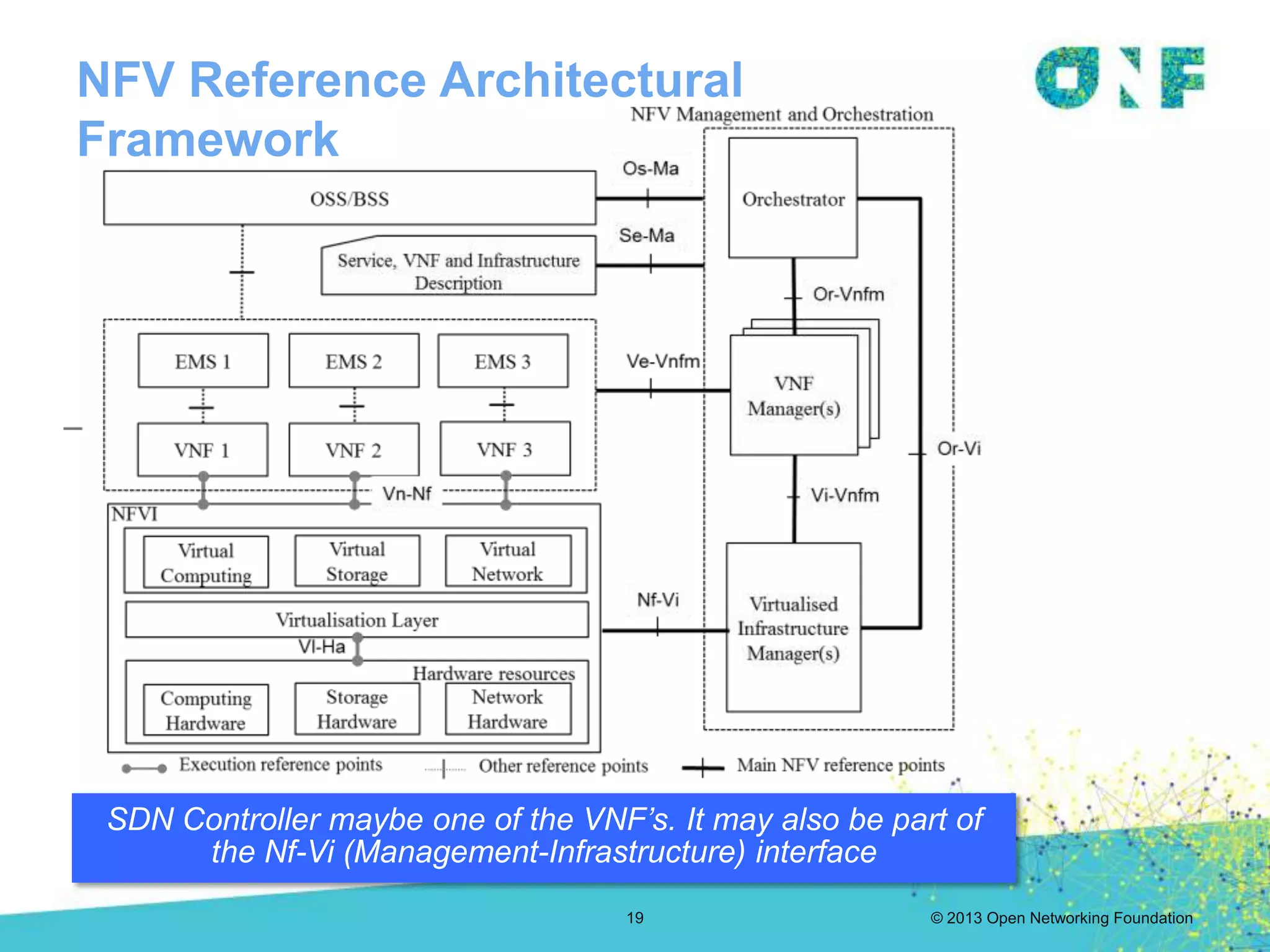
NFV Reference Architectural
Framework
19
SDN Controller maybe one of the VNF’s. It may also be part of
the Nf-Vi (Management-Infrastructure) interface
© 2013 Open Networking Foundation
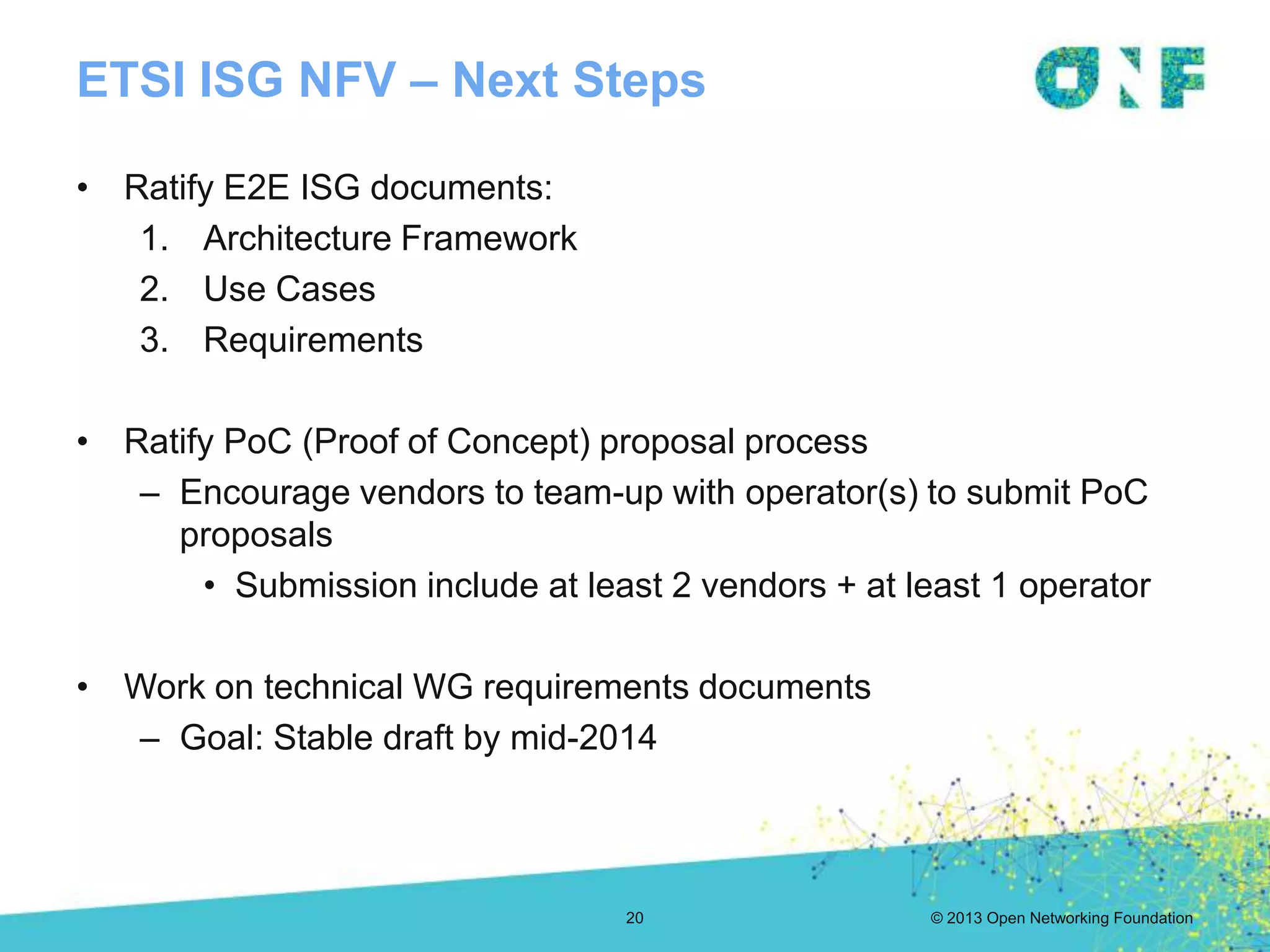
ETSI ISG NFV – Next Steps
20
• Ratify E2E ISG documents:
1. Architecture Framework
2. Use Cases
3. Requirements
• Ratify PoC (Proof of Concept) proposal process
– Encourage vendors to team-up with operator(s) to submit PoC
proposals
• Submission include at least 2 vendors + at least 1 operator
• Work on technical WG requirements documents
– Goal: Stable draft by mid-2014

Architecture of OpenFlow SDNs

  • 1.
    • Fabian Schneider,NEC • Nabil Damouny, Netronome 1 Architecture of OpenFlow SDNs
  • 2.
    © 2013 OpenNetworking Foundation Topics • ONF Architecture overview • NBI study • L4-7 aspects • NFV 2
  • 3.
    © 2013 OpenNetworking Foundation ONF Architecture Overview ONF ArchWG (Fabian Schneider)
  • 4.
    © 2013 OpenNetworking Foundation Arch: Express and Enforce Requirements via API Requirements described and enforced on-line, formally, dynamically 4
  • 5.
    © 2013 OpenNetworking Foundation Three Critical Properties of this Architecture 5 1. Applications are network aware: SDN-enabled Applications – Communicate their requirements/polices to the network – Can monitor network state and adapt accordingly 2. Network is logically centralized: SDN Network Controller – Controller translates from app requirement to low-level rules – Controller summarizes the network state for applications 3. Well-understood driver-like model for devices: SDN Datapath – Programmatic low-level control of all fwd’ing and configuration – API for Capabilities advertisement and publishing statistics – No resource contention with other entities → Controller “owns” this device, subject to capabilities advertisement/negotiation
  • 6.
    © 2013 OpenNetworking Foundation Topics currently worked on 6 • Service chaining, L4-7 support, NFV • Controller to controller interface: Need for standard? • Network virtualization on an architectural level • Tying Arch with use-cases • Architectural split between OF-switch and OF-config • Datapath diversity: SW vs. HW • Interworking with legacy network and protocols • North-bound interface study
  • 7.
    © 2013 OpenNetworking Foundation NBI study ONF ArchWG (Fabian Schneider)
  • 8.
    © 2013 OpenNetworking Foundation NBI study Status • NBI study document(s) – 9 use-cases in doc; some more in the pipeline – 5 controller solutions in doc; few more in pipeline – All need more reviews – Pipeline needs to be flushed • NBI next steps – Define groups of NBI functionality to work on – For each group decide on • Standardization in ONF: yes/no, when? • Or point to other SDO or de-facto standard – Start discussing app execution framework 8
  • 9.
    © 2013 OpenNetworking Foundation Standardizing Northbound Interfaces 9 • Not an easy task – Level of abstraction unclear (see next slide) • Varies from OpenFlow+SwitchIDs (e.g. Trema, NOX/POX) • Via network programming languages (e.g. Frenetic) • Up to Neutron/Quantum level – Scope unclear • One single NBI to rule them all • Or one per operation call • ONF’s approach (at the moment) – Start with what is needed today and what is not yet available – Standardize sets of functionality – Determine gaps in standardization/de-facto-standards space – Leave application specifics to other SDOs and focus on network specifics
  • 10.
    © 2013 OpenNetworking Foundation Spectrum of Northbound Interfaces from study 10
  • 11.
    © 2013 OpenNetworking Foundation Enhancing OpenFlow to Support Layer 4 through 7 ONF MEC L4-L7 Study Group (Nabil Damouny, Sharad Alawat)
  • 12.
    © 2013 OpenNetworking Foundation • Layer 2 / Layer 3 – Switching – Routing – Packet forwarding – OpenFlow – Architectures optimized to process individual packets – Cisco, HP, Juniper etc. • Layer 4 through 7 – Security – Load balancing – WAN optimization – Architectures optimized to process flows and content – F5, Riverbed, Sourcefire etc. What Are Layer 4 through 7 Services? Categorized by depth of Layer 4 through 7 inspection • OpenFlow switch No Flow Inspection • Load balancer • Next-generation firewall • WAN optimization • Web application firewall Partial Flow Inspection • Test and measurement • Policing and metering • Quality of Service (QoS) • Traffic analysis Flow Monitoring • Anti-virus / anti-spam • Intrusion prevention system (IPS) • SSL inspection • VPN Full Flow Inspection 12
  • 13.
    © 2013 OpenNetworking Foundation Challenges with L4-L7 Services in SDN Environment 13 • Inefficient use of network bandwidth and compute resources due to lack of L4-L7 visibility • Bottlenecks and lack of coverage due to inability to rapidly respond to new networking and application requirements • Hosting on controllers results in reduced throughput, increased latency and limited scalability of the network, due to limited compute resources • Lack of feedback from L4-L7 services which could potentially reprogram network paths based on L4-L7 analysis
  • 14.
    © 2013 OpenNetworking Foundation Deployment Models Application Layer Applications Control Layer Network Controller SDN Control Software Infrastructure Layer Network Device Network Device Network Device Layer 4-7 Services 1 3 Intelligent Switch with Layer 4-7 Layer 4 through 7 Appliance2 1. Running as applications on the controller • Controller programs SDN switch on per-flow basis Northbound APIs Southbound API 2. Standalone network appliance • Traffic directed to appliance either based on static policy or dynamically driven by controller • Or just in-line 3. Full Layer 4-7 network services running on intelligent switch • Intelligent switch becomes Layer 2 through 7 device 14
  • 15.
    © 2013 OpenNetworking Foundation Use Case Example: Advanced Traffic Analysis Embedded DPI feeds network intelligence to services on Layer 7 network service devices Application flows forwarded directly to specialized service processing • Requires Layer 4 through 7 intelligence embedded directly in switches Application Layer Applications Control Layer SDN Control Software Infrastructure Layer Network Device Network Device Layer 4-7 Network Device Layer 7 Network Service Device Northbound APIs Southbound API Network Services Layer 7 Network Service Device VoIP P2P Video Email Web Data Plane Traffic Layer 4-7: Protocol and Application Identification IM Other Traffic Steering Video Optimization QoS / QoE Analytics GGSN Content Filtering 15
  • 16.
    © 2013 OpenNetworking Foundation NFV – Network Function Virtualization Using COTS Server Architecture to Implement Network Functions Nabil Damouny
  • 17.
    © 2013 OpenNetworking Foundation ETSI NFV Network Functions Virtualization: Vision Classical Network Appliance Approach BRAS FirewallDPI CDN Tester/QoE monitor WAN Acceleration Message Router Radio/Fixed Access Network Nodes Carrier Grade NAT Session Border Controller PE RouterSGSN/GGSN • Fragmented, purpose-built hardware. • Physical install per appliance per site. • Hardware development large barrier to entry for new vendors, constraining innovation & competition. Network Functions Virtualization Approach High volume Ethernet switches High volume standard servers High volume standard storage Orchestrated, automatic & remote install. Independent Software Vendors Competitive& Innovative OpenEcosystem 17
  • 18.
    © 2013 OpenNetworking Foundation ETSI ISG NFV Structure • ISG E-E Documents 1. Architecture Framework 2. Use Cases (9 total) 3. (Business) Requirements 4. Terminology – All are currently “stable Draft” – out for ratification – E2E documents drive Technical Working Groups • Technical Working Groups 1. Infrastructure (INF) 2. Software Architecture (SWA) 3. Management & Orchestration (MANO) 4. Reliability & Availability (REL) – Performance Expert Group – Security Expert Group E2E Documents Drives Technical WG’s 18
  • 19.
    © 2013 OpenNetworking Foundation NFV Reference Architectural Framework 19 SDN Controller maybe one of the VNF’s. It may also be part of the Nf-Vi (Management-Infrastructure) interface
  • 20.
    © 2013 OpenNetworking Foundation ETSI ISG NFV – Next Steps 20 • Ratify E2E ISG documents: 1. Architecture Framework 2. Use Cases 3. Requirements • Ratify PoC (Proof of Concept) proposal process – Encourage vendors to team-up with operator(s) to submit PoC proposals • Submission include at least 2 vendors + at least 1 operator • Work on technical WG requirements documents – Goal: Stable draft by mid-2014

Editor's Notes

  • #16 Within a telecom network, where do these functions actually happen?