Software Defined Networking (SDN)
– A brief introduction
– SDN promises and challenges
What and Why “software defined?”
• “Software defined” becomes very popular words
– Software defined networking, software defined storage,
software defined radio, etc.
• What is it?
– Underlying system feature is exposed to the upper layer
application developer through an API.
– System functionality is implemented over the API as an
app.
• Another word for “Software defined” is
“Programmable.”
Software defined networking
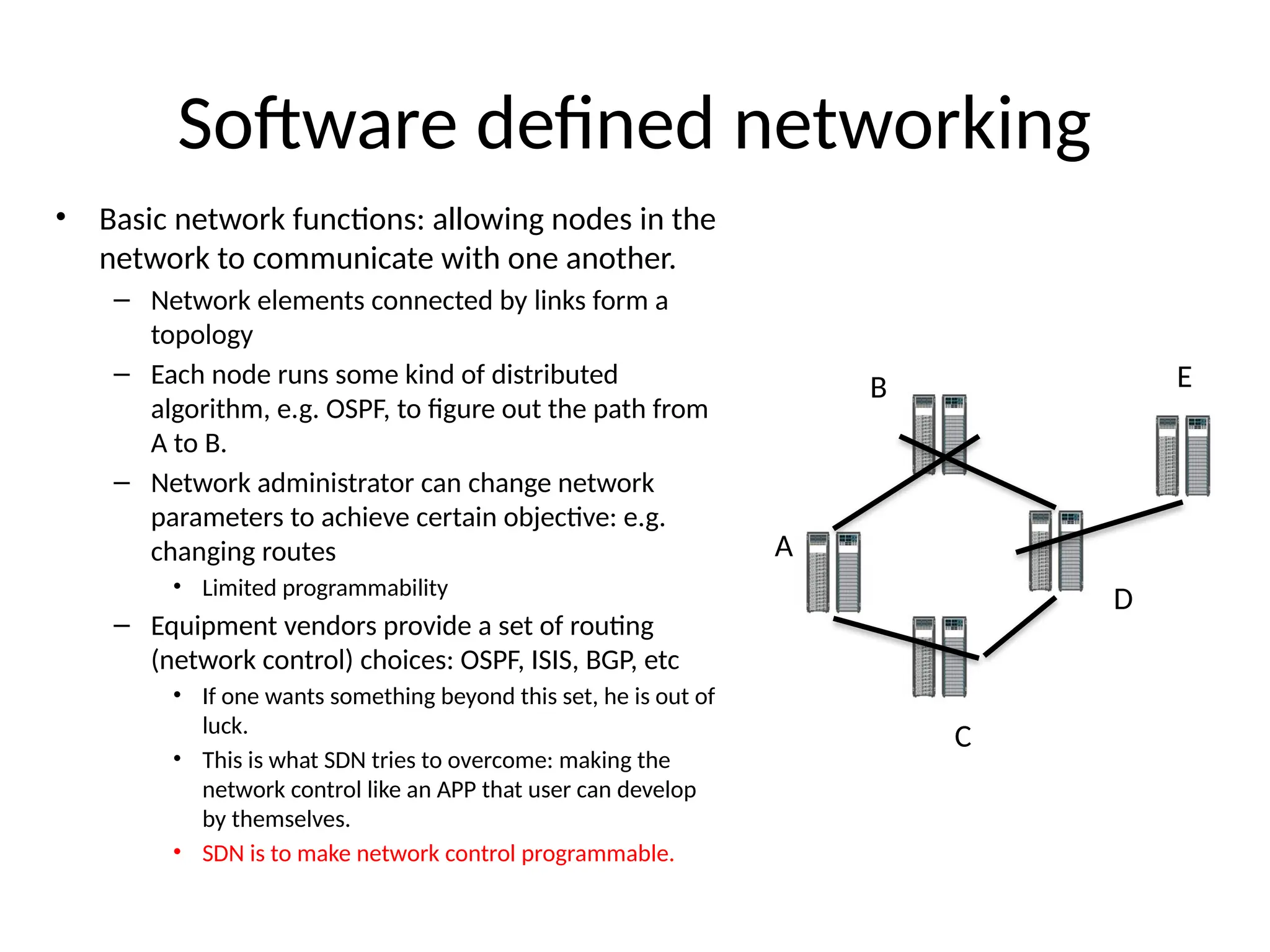
• Basic network functions: allowing nodes in the
network to communicate with one another.
– Network elements connected by links form a
topology
– Each node runs some kind of distributed
algorithm, e.g. OSPF, to figure out the path from
A to B.
– Network administrator can change network
parameters to achieve certain objective: e.g.
changing routes
• Limited programmability
– Equipment vendors provide a set of routing
(network control) choices: OSPF, ISIS, BGP, etc
• If one wants something beyond this set, he is out of
luck.
• This is what SDN tries to overcome: making the
network control like an APP that user can develop
by themselves.
• SDN is to make network control programmable.
A
B
C
D
E
SDN motivation
• Why do we want to make network control programmable?
– Short term:
• Existing network control is no longer sufficient in several important
areas, need innovation here!
– Data centers, Wireless, network security
• Existing network control is getting too complicated.
– A lot of different middleboxes, each speaks its own language, and interferences
with one another
» NAT, firewall, IDS, WAN optimizer, load balancer, traffic shapers,
transparent web proxy, application accelerators
– Would be nice to provide a unified mechanism to deploy and manage these
middleboxes
– SDN promises this.
– Long term: innovation is good for the networking industry.
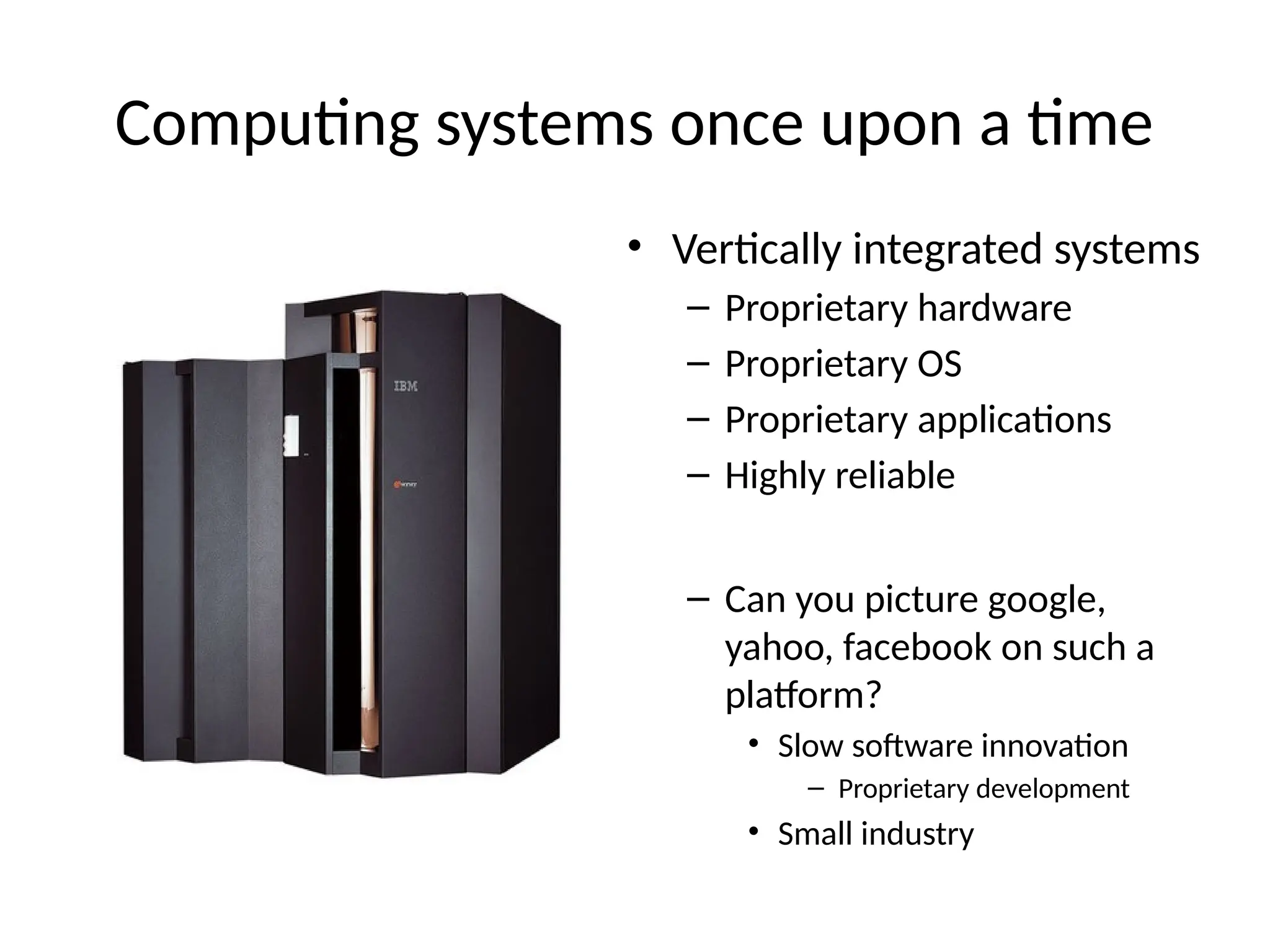
Computing systems once upon a time
• Vertically integrated systems
– Proprietary hardware
– Proprietary OS
– Proprietary applications
– Highly reliable
– Can you picture google,
yahoo, facebook on such a
platform?
• Slow software innovation
– Proprietary development
• Small industry
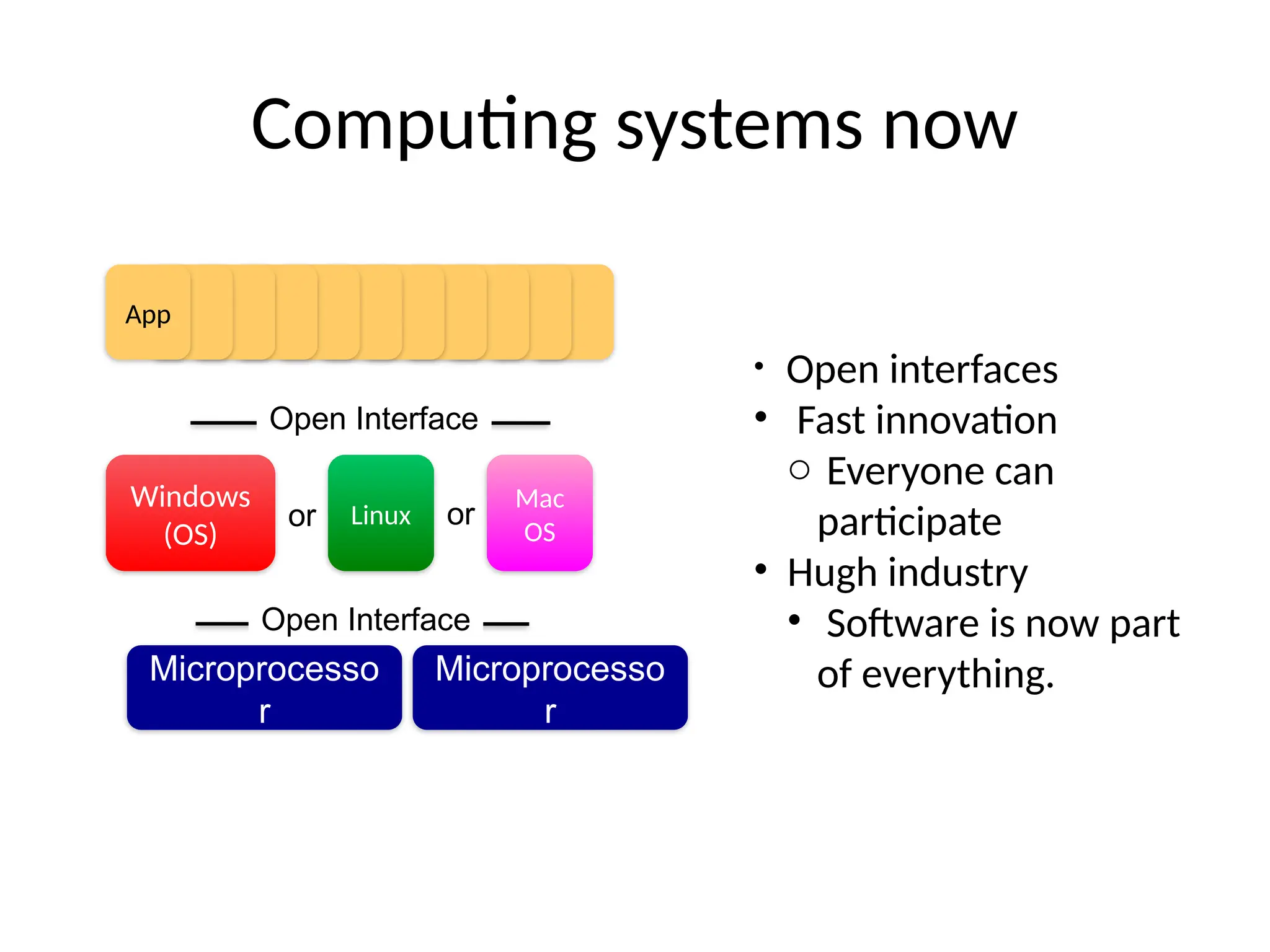
Computing systems now
App
App
App
App
App
App
App
App
App
App
App
Microprocesso
r
Open Interface
Linux
Mac
OS
Windows
(OS)
or or
Open Interface
Microprocesso
r
• Open interfaces
• Fast innovation
o Everyone can
participate
• Hugh industry
• Software is now part
of everything.
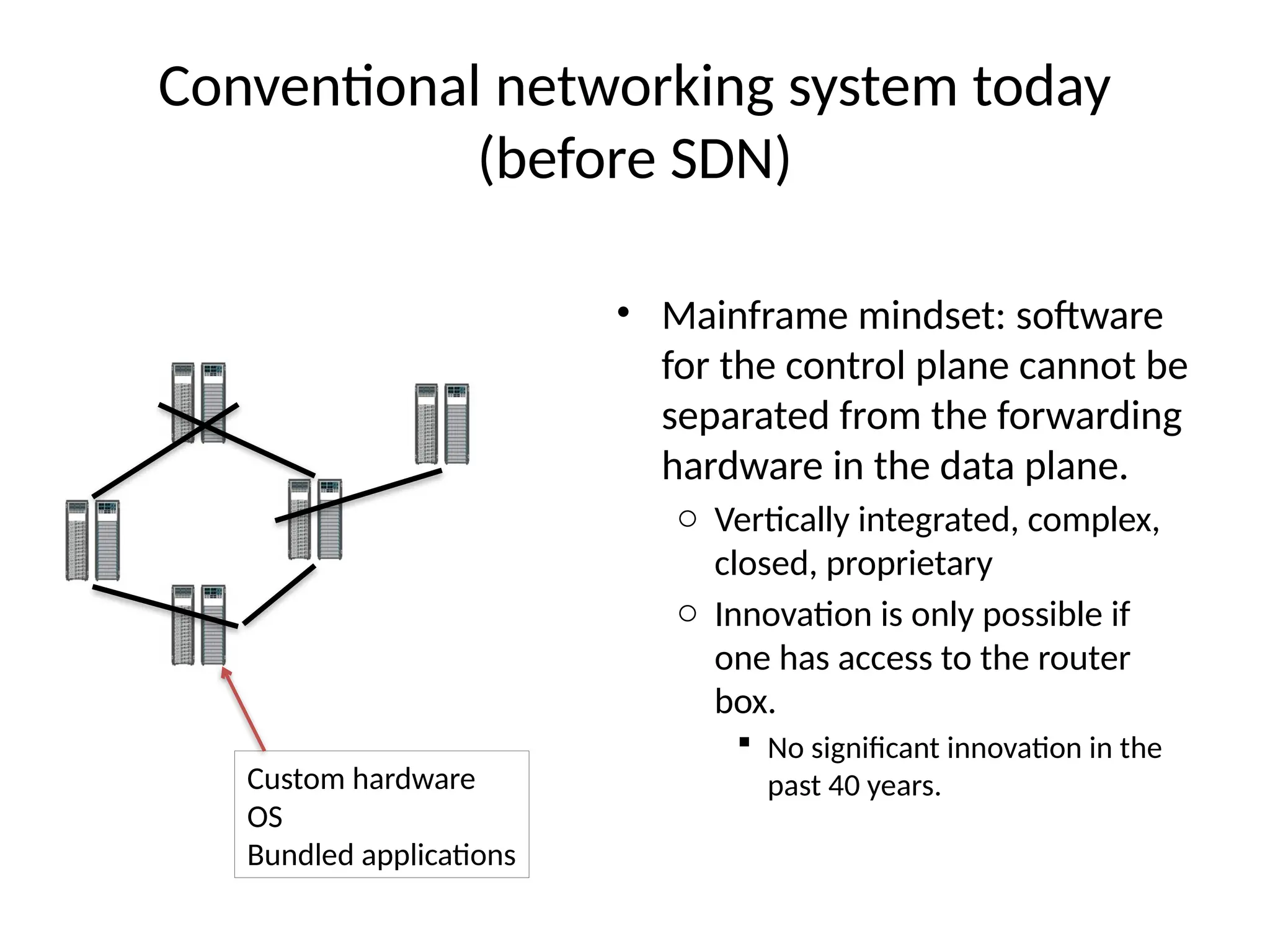
Conventional networking system today
(before SDN)
• Mainframe mindset: software
for the control plane cannot be
separated from the forwarding
hardware in the data plane.
o Vertically integrated, complex,
closed, proprietary
o Innovation is only possible if
one has access to the router
box.
 No significant innovation in the
past 40 years.
Custom hardware
OS
Bundled applications
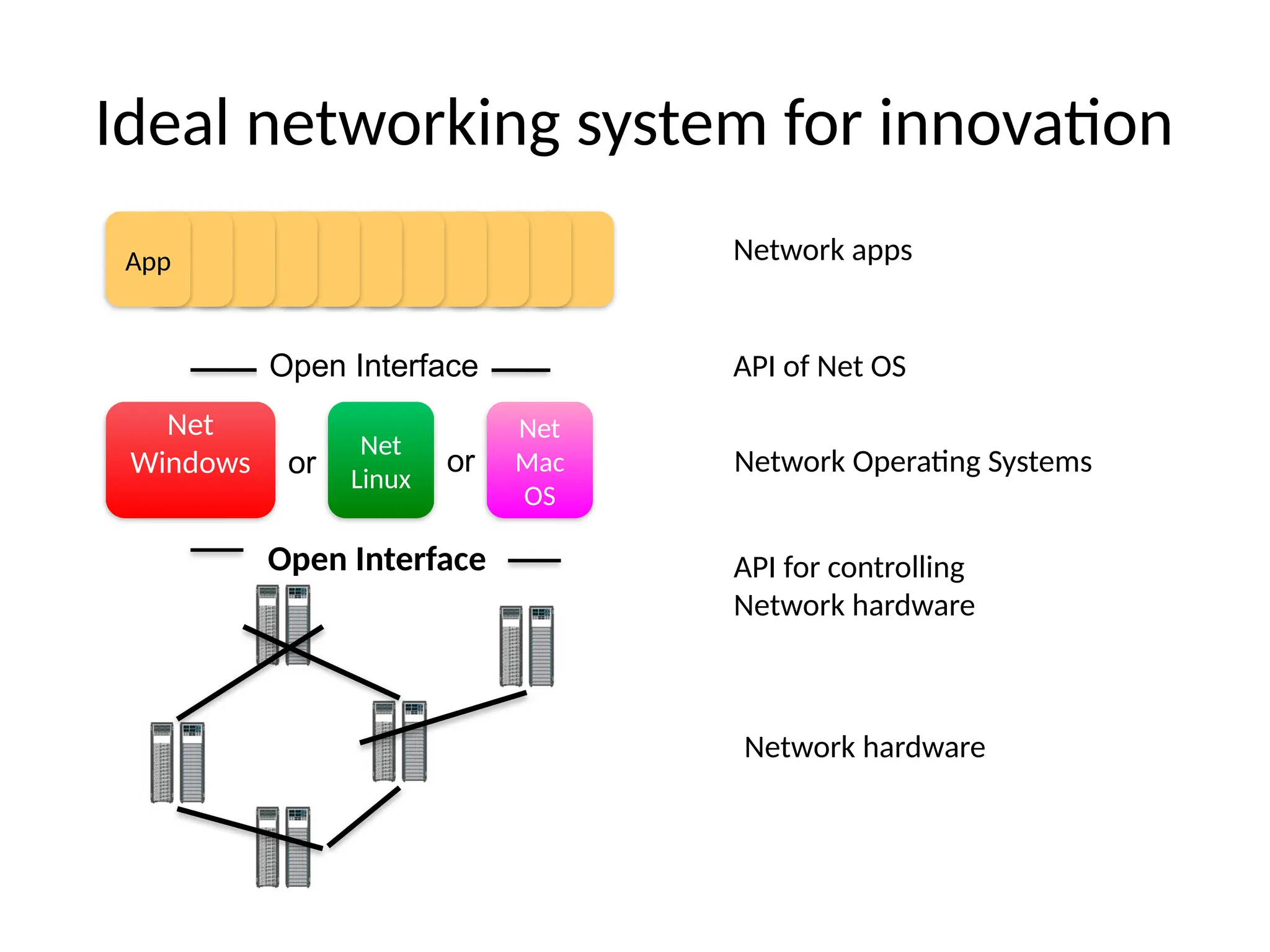
Ideal networking system for innovation
App
App
App
App
App
App
App
App
App
App
App
Net
Linux
Net
Mac
OS
Net
Windows or or
Open Interface
Open Interface
Network hardware
API for controlling
Network hardware
Network Operating Systems
API of Net OS
Network apps
Control plane and data plane
• Control plane of a network
– The functions of a network that control the behavior of the network
• E.g.: Which path to take for a packet? Which port to forward a packet?
Should the packet be dropped?
– Control plane functions are typically realized by software such as
routing protocols, firewall code, etc.
• Data plane of a network
– The functions of a network that actually forward or drop packets.
– Data plane functions are typically realized by hardware
• Control plane and data plane are vertically integrated in
traditional networking equipment
– Separating software from hardware  separating control plane
from data plane.
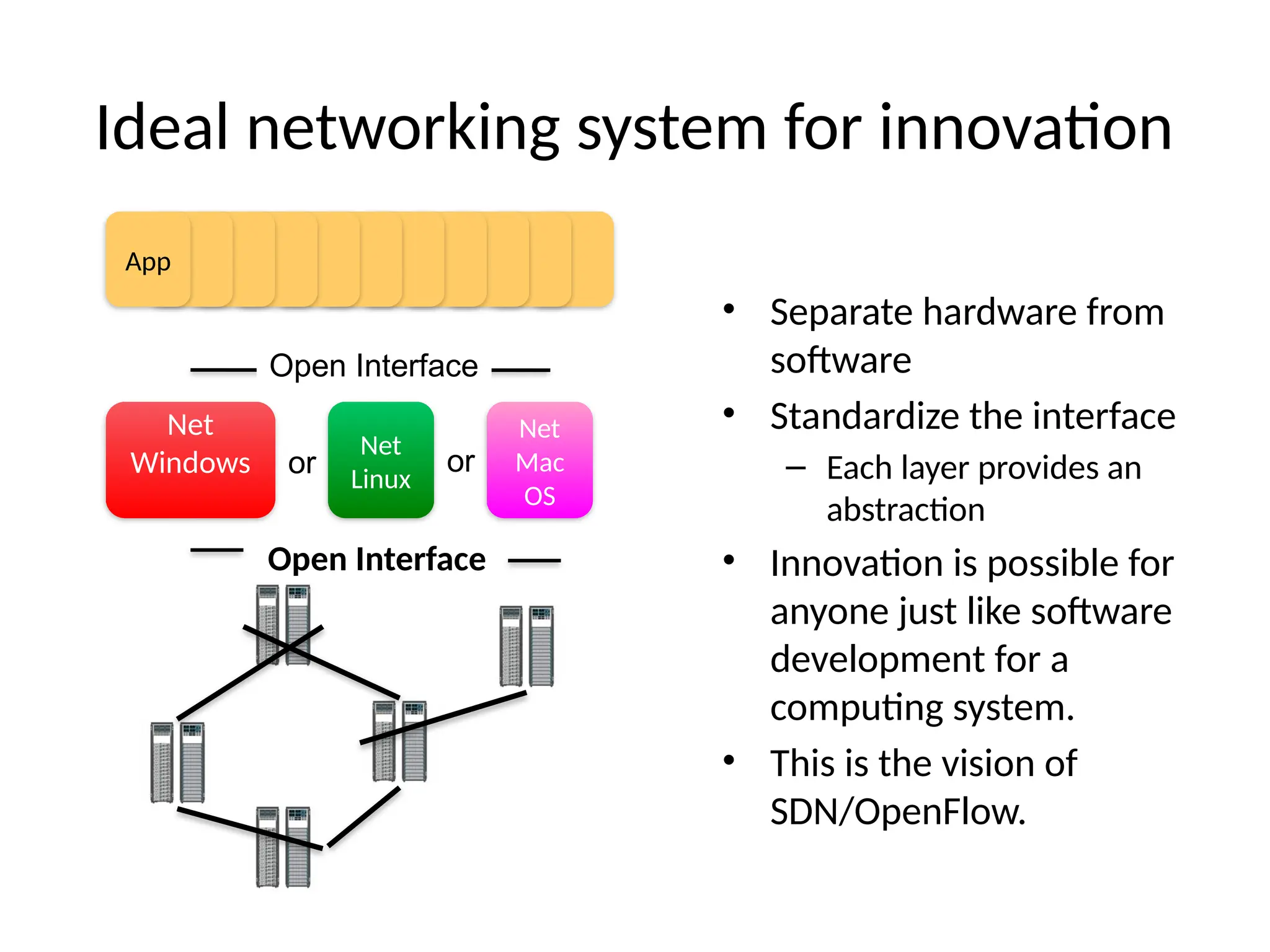
Ideal networking system for innovation
• Separate hardware from
software
• Standardize the interface
– Each layer provides an
abstraction
• Innovation is possible for
anyone just like software
development for a
computing system.
• This is the vision of
SDN/OpenFlow.
App
App
App
App
App
App
App
App
App
App
App
Net
Linux
Net
Mac
OS
Net
Windows or or
Open Interface
Open Interface
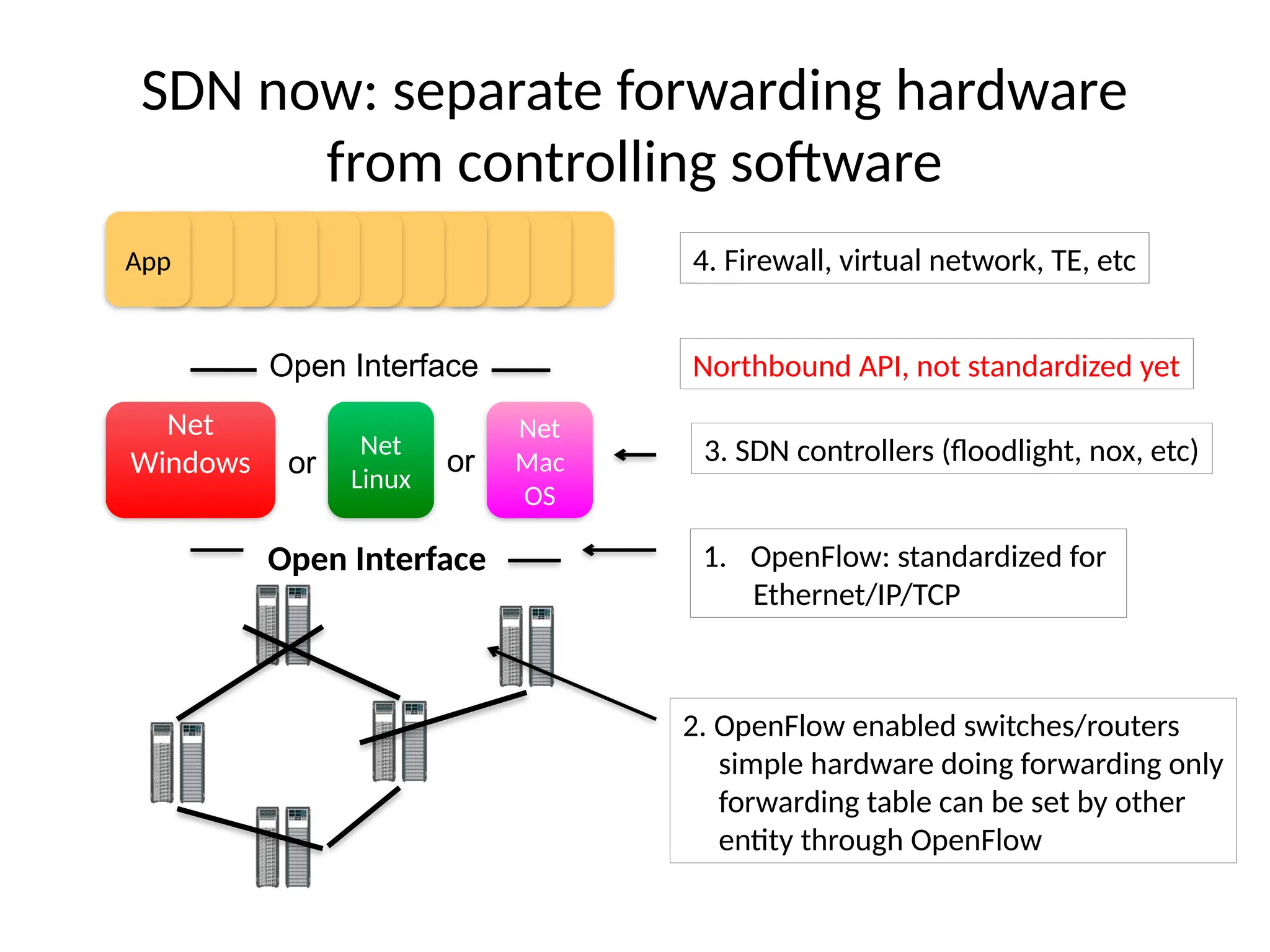
SDN now: separate forwarding hardware
from controlling software
App
App
App
App
App
App
App
App
App
App
App
Net
Linux
Net
Mac
OS
Net
Windows or or
Open Interface
Open Interface 1. OpenFlow: standardized for
Ethernet/IP/TCP
2. OpenFlow enabled switches/routers
simple hardware doing forwarding only
forwarding table can be set by other
entity through OpenFlow
3. SDN controllers (floodlight, nox, etc)
4. Firewall, virtual network, TE, etc
Northbound API, not standardized yet
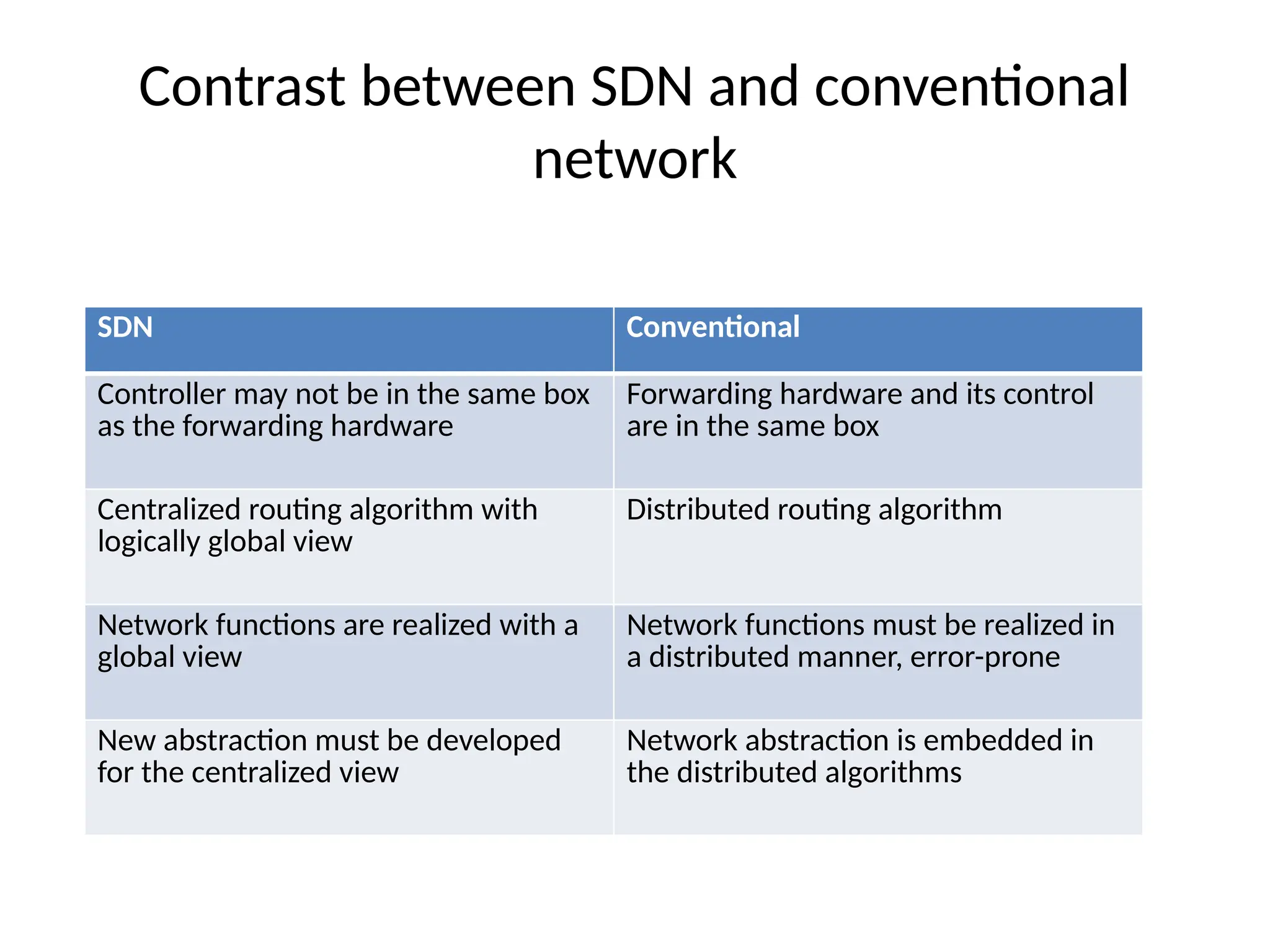
Contrast between SDN and conventional
network
SDN Conventional
Controller may not be in the same box
as the forwarding hardware
Forwarding hardware and its control
are in the same box
Centralized routing algorithm with
logically global view
Distributed routing algorithm
Network functions are realized with a
global view
Network functions must be realized in
a distributed manner, error-prone
New abstraction must be developed
for the centralized view
Network abstraction is embedded in
the distributed algorithms
Major paradigm shift with SDN
• No longer use distributed control protocols
– Design one distributed system (NOS) with the global view of the network
– Use for all control functions
• Now just defining a centralized control function
Configuration = Function(global view)
•This may look easier, but this is not how it used to work, everything is
new – innovation at all levels for this to happen.
–High level programming languages to describe network configuration
–Compiling and runtime system to realize the program efficiently, correctly, and
safely.
–Abstraction design
–
Debugging infrastructure
–network OS design
–etc.
How an SDN operates?
• Network applications specification the network functions (not
the detailed implementation on the physical devices):
– Access control: who can talk to who
– Isolation: who can hear my broadcasts
– Routing: only specify routing to the degree you care
• Some flows over satellite, others over landline
– TE: specify in terms of quality of service, not routes
• Network OS (or something like a compiler) compiles the
network application and computes the configurations on
physical devices based on the global view
• Network OS distributes the configuration to physical devices
through OpenFlow.
SDN promises
• A lower-entry point for innovation in the
network control.
• Solve the issues in the current network
configuration challenges.
– data plane interacts with many control entities
– Configure locally to achieve a global network
function.
Some SDN issues
• Abstraction
– A new programming system to specify network functions
(programming SDN)
– An API that provides network abstraction to network application (SDN
controller design)
• Performance (scalability)
– Controller
– Communication between controller and devices
– Forwarding
• Correctness and debugging – A SDN program has a higher bar
than a typical program, multiple levels
• Security

lect1_intro_SDN introductionpptnew1.pptx

  • 1.
    Software Defined Networking(SDN) – A brief introduction – SDN promises and challenges
  • 2.
    What and Why“software defined?” • “Software defined” becomes very popular words – Software defined networking, software defined storage, software defined radio, etc. • What is it? – Underlying system feature is exposed to the upper layer application developer through an API. – System functionality is implemented over the API as an app. • Another word for “Software defined” is “Programmable.”
  • 3.
    Software defined networking •Basic network functions: allowing nodes in the network to communicate with one another. – Network elements connected by links form a topology – Each node runs some kind of distributed algorithm, e.g. OSPF, to figure out the path from A to B. – Network administrator can change network parameters to achieve certain objective: e.g. changing routes • Limited programmability – Equipment vendors provide a set of routing (network control) choices: OSPF, ISIS, BGP, etc • If one wants something beyond this set, he is out of luck. • This is what SDN tries to overcome: making the network control like an APP that user can develop by themselves. • SDN is to make network control programmable. A B C D E
  • 4.
    SDN motivation • Whydo we want to make network control programmable? – Short term: • Existing network control is no longer sufficient in several important areas, need innovation here! – Data centers, Wireless, network security • Existing network control is getting too complicated. – A lot of different middleboxes, each speaks its own language, and interferences with one another » NAT, firewall, IDS, WAN optimizer, load balancer, traffic shapers, transparent web proxy, application accelerators – Would be nice to provide a unified mechanism to deploy and manage these middleboxes – SDN promises this. – Long term: innovation is good for the networking industry.
  • 5.
    Computing systems onceupon a time • Vertically integrated systems – Proprietary hardware – Proprietary OS – Proprietary applications – Highly reliable – Can you picture google, yahoo, facebook on such a platform? • Slow software innovation – Proprietary development • Small industry
  • 6.
    Computing systems now App App App App App App App App App App App Microprocesso r OpenInterface Linux Mac OS Windows (OS) or or Open Interface Microprocesso r • Open interfaces • Fast innovation o Everyone can participate • Hugh industry • Software is now part of everything.
  • 7.
    Conventional networking systemtoday (before SDN) • Mainframe mindset: software for the control plane cannot be separated from the forwarding hardware in the data plane. o Vertically integrated, complex, closed, proprietary o Innovation is only possible if one has access to the router box.  No significant innovation in the past 40 years. Custom hardware OS Bundled applications
  • 8.
    Ideal networking systemfor innovation App App App App App App App App App App App Net Linux Net Mac OS Net Windows or or Open Interface Open Interface Network hardware API for controlling Network hardware Network Operating Systems API of Net OS Network apps
  • 9.
    Control plane anddata plane • Control plane of a network – The functions of a network that control the behavior of the network • E.g.: Which path to take for a packet? Which port to forward a packet? Should the packet be dropped? – Control plane functions are typically realized by software such as routing protocols, firewall code, etc. • Data plane of a network – The functions of a network that actually forward or drop packets. – Data plane functions are typically realized by hardware • Control plane and data plane are vertically integrated in traditional networking equipment – Separating software from hardware  separating control plane from data plane.
  • 10.
    Ideal networking systemfor innovation • Separate hardware from software • Standardize the interface – Each layer provides an abstraction • Innovation is possible for anyone just like software development for a computing system. • This is the vision of SDN/OpenFlow. App App App App App App App App App App App Net Linux Net Mac OS Net Windows or or Open Interface Open Interface
  • 11.
    SDN now: separateforwarding hardware from controlling software App App App App App App App App App App App Net Linux Net Mac OS Net Windows or or Open Interface Open Interface 1. OpenFlow: standardized for Ethernet/IP/TCP 2. OpenFlow enabled switches/routers simple hardware doing forwarding only forwarding table can be set by other entity through OpenFlow 3. SDN controllers (floodlight, nox, etc) 4. Firewall, virtual network, TE, etc Northbound API, not standardized yet
  • 12.
    Contrast between SDNand conventional network SDN Conventional Controller may not be in the same box as the forwarding hardware Forwarding hardware and its control are in the same box Centralized routing algorithm with logically global view Distributed routing algorithm Network functions are realized with a global view Network functions must be realized in a distributed manner, error-prone New abstraction must be developed for the centralized view Network abstraction is embedded in the distributed algorithms
  • 13.
    Major paradigm shiftwith SDN • No longer use distributed control protocols – Design one distributed system (NOS) with the global view of the network – Use for all control functions • Now just defining a centralized control function Configuration = Function(global view) •This may look easier, but this is not how it used to work, everything is new – innovation at all levels for this to happen. –High level programming languages to describe network configuration –Compiling and runtime system to realize the program efficiently, correctly, and safely. –Abstraction design – Debugging infrastructure –network OS design –etc.
  • 14.
    How an SDNoperates? • Network applications specification the network functions (not the detailed implementation on the physical devices): – Access control: who can talk to who – Isolation: who can hear my broadcasts – Routing: only specify routing to the degree you care • Some flows over satellite, others over landline – TE: specify in terms of quality of service, not routes • Network OS (or something like a compiler) compiles the network application and computes the configurations on physical devices based on the global view • Network OS distributes the configuration to physical devices through OpenFlow.
  • 15.
    SDN promises • Alower-entry point for innovation in the network control. • Solve the issues in the current network configuration challenges. – data plane interacts with many control entities – Configure locally to achieve a global network function.
  • 16.
    Some SDN issues •Abstraction – A new programming system to specify network functions (programming SDN) – An API that provides network abstraction to network application (SDN controller design) • Performance (scalability) – Controller – Communication between controller and devices – Forwarding • Correctness and debugging – A SDN program has a higher bar than a typical program, multiple levels • Security