
Software Defined Network
(SDN)
ENG AHMED AYMAN FAHMY
outline
 Introduction
 Traditional Networks
 Disadvantages of traditional networks
 Definition of Software-Defined Networking (SDN)
 Architecture of SDN
 SDN layers
 Open flow protocol
 Advantages and disadvantages of SDN
 conclusion
2
Introduction
 5G networks is going to be designed to be open, more flexible, and
able to evolve more easily than the traditional networks.
 They will be able to provide convergent network communication
across multi-technologies networks.
 It will provide open communication system to deal with satellite,
mobile network, clouds, more and more networks so it will not be
based on traditional routing and switching technologies
3
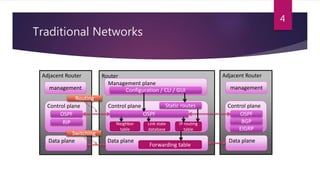
Traditional Networks
Adjacent Router Router
Management plane
Configuration / CLI / GUI
Static routesControl plane
OSPF
Neighbor
table
Link state
database
IP routing
table
Forwarding table
Data planeData plane
Control plane
OSPF
Adjacent Router
Data plane
Control plane
OSPF
Routing
Switching
managementmanagement
BGP
EIGRP
RIP
4
Disadvantages of traditional networks
 Manual configuration
 Error-prone
 Low performance
 Time consuming
 Limit innovation
 Difficult troubleshooting
 High cost
5
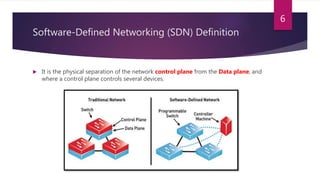
Software-Defined Networking (SDN) Definition
 It is the physical separation of the network control plane from the Data plane, and
where a control plane controls several devices.
6
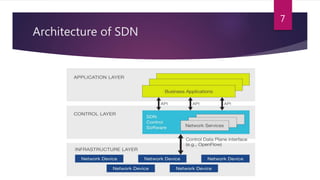
Architecture of SDN
7
Infrastructure Layer
 It consists of switches, routers, load balancers, …..
 It is responsible for
 Collect network status.
 processing packets.
8
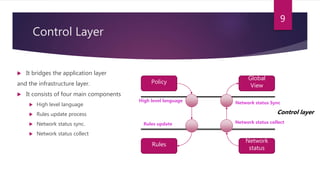
Control Layer
Global
View
Rules
Policy
Network
status
Network status Sync
Network status collect
High level language
Rules update
Control layer
 It bridges the application layer
and the infrastructure layer.
 It consists of four main components
 High level language
 Rules update process
 Network status sync.
 Network status collect
9
SDN Infrastructure
10
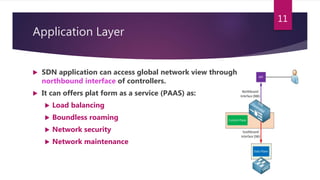
Application Layer
11
 SDN application can access global network view through
northbound interface of controllers.
 It can offers plat form as a service (PAAS) as:
 Load balancing
 Boundless roaming
 Network security
 Network maintenance
Open flow protocol
12
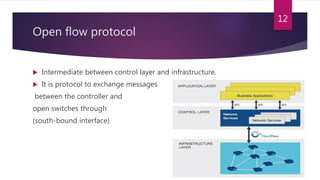
 Intermediate between control layer and infrastructure.
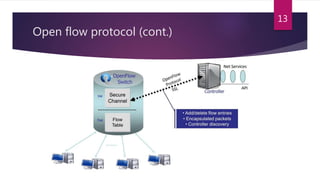
 It is protocol to exchange messages
between the controller and
open switches through
(south-bound interface)
Open flow protocol (cont.)
13
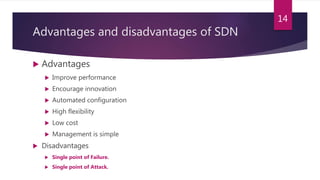
Advantages and disadvantages of SDN
 Advantages
 Improve performance
 Encourage innovation
 Automated configuration
 High flexibility
 Low cost
 Management is simple
 Disadvantages
 Single point of Failure.
 Single point of Attack.
14
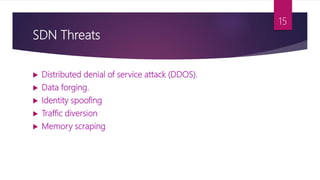
SDN Threats
 Distributed denial of service attack (DDOS).
 Data forging.
 Identity spoofing
 Traffic diversion
 Memory scraping
15
conclusion
 SDN is the main component of providing faster and more
reliant base for 5G wireless networks.
 The 5G network will contain a lot of devices, applications and
technologies so SDN will enhance the configuration, optimize
the performance.
 It will provide real time control of the network based on the
instantaneous network status information collected by its
layer.
16
“
”
Thank you
17

Software Defined Network (SDN)

  • 1.
  • 2.
    outline  Introduction  TraditionalNetworks  Disadvantages of traditional networks  Definition of Software-Defined Networking (SDN)  Architecture of SDN  SDN layers  Open flow protocol  Advantages and disadvantages of SDN  conclusion 2
  • 3.
    Introduction  5G networksis going to be designed to be open, more flexible, and able to evolve more easily than the traditional networks.  They will be able to provide convergent network communication across multi-technologies networks.  It will provide open communication system to deal with satellite, mobile network, clouds, more and more networks so it will not be based on traditional routing and switching technologies 3
  • 4.
    Traditional Networks Adjacent RouterRouter Management plane Configuration / CLI / GUI Static routesControl plane OSPF Neighbor table Link state database IP routing table Forwarding table Data planeData plane Control plane OSPF Adjacent Router Data plane Control plane OSPF Routing Switching managementmanagement BGP EIGRP RIP 4
  • 5.
    Disadvantages of traditionalnetworks  Manual configuration  Error-prone  Low performance  Time consuming  Limit innovation  Difficult troubleshooting  High cost 5
  • 6.
    Software-Defined Networking (SDN)Definition  It is the physical separation of the network control plane from the Data plane, and where a control plane controls several devices. 6
  • 7.
  • 8.
    Infrastructure Layer  Itconsists of switches, routers, load balancers, …..  It is responsible for  Collect network status.  processing packets. 8
  • 9.
    Control Layer Global View Rules Policy Network status Network statusSync Network status collect High level language Rules update Control layer  It bridges the application layer and the infrastructure layer.  It consists of four main components  High level language  Rules update process  Network status sync.  Network status collect 9
  • 10.
  • 11.
    Application Layer 11  SDNapplication can access global network view through northbound interface of controllers.  It can offers plat form as a service (PAAS) as:  Load balancing  Boundless roaming  Network security  Network maintenance
  • 12.
    Open flow protocol 12 Intermediate between control layer and infrastructure.  It is protocol to exchange messages between the controller and open switches through (south-bound interface)
  • 13.
  • 14.
    Advantages and disadvantagesof SDN  Advantages  Improve performance  Encourage innovation  Automated configuration  High flexibility  Low cost  Management is simple  Disadvantages  Single point of Failure.  Single point of Attack. 14
  • 15.
    SDN Threats  Distributeddenial of service attack (DDOS).  Data forging.  Identity spoofing  Traffic diversion  Memory scraping 15
  • 16.
    conclusion  SDN isthe main component of providing faster and more reliant base for 5G wireless networks.  The 5G network will contain a lot of devices, applications and technologies so SDN will enhance the configuration, optimize the performance.  It will provide real time control of the network based on the instantaneous network status information collected by its layer. 16
  • 17.

Editor's Notes

  • #12 It can implement strategies to manipulate the underplaying physical network through the high level language provided by the control layer.
  • #13 Most of modern routers and switches contain flow table for essential routing func. Like routing, subneting, FW protection and statistical analysis. In open flow switches each entry has Header, Action and statistics