Network File SystemNetwork File System
(NFS)(NFS)
Submitted To:Submitted To: Rachana KamaliyaRachana Kamaliya
PPresented Byresented By: Krupa Shingala: Krupa Shingala
Index
What is File System?
What is Network File System?
Version of NFS
NFS Architecture
Advantages of NFS
Disadvantages of NFS
Conclusion
References
What is File System?
• A file system is a hierarchical structure (file tree) of
files and directories.
• This file tree uses directories to organize data and
programs into groups, allowing the management of
several directories and files at one time.
• Some tasks are performed more efficiently on a file
system than on each directory within the file
system.
What is Network File System?What is Network File System?
• NFS developed by SUN Microsystems for use on its
UNIX-based workstations.
• A distributed file system
• Allows users to access files and directories located
on remote computers
• But, data potentially stored on another machine.
• NFS builds on the Open Network Computing
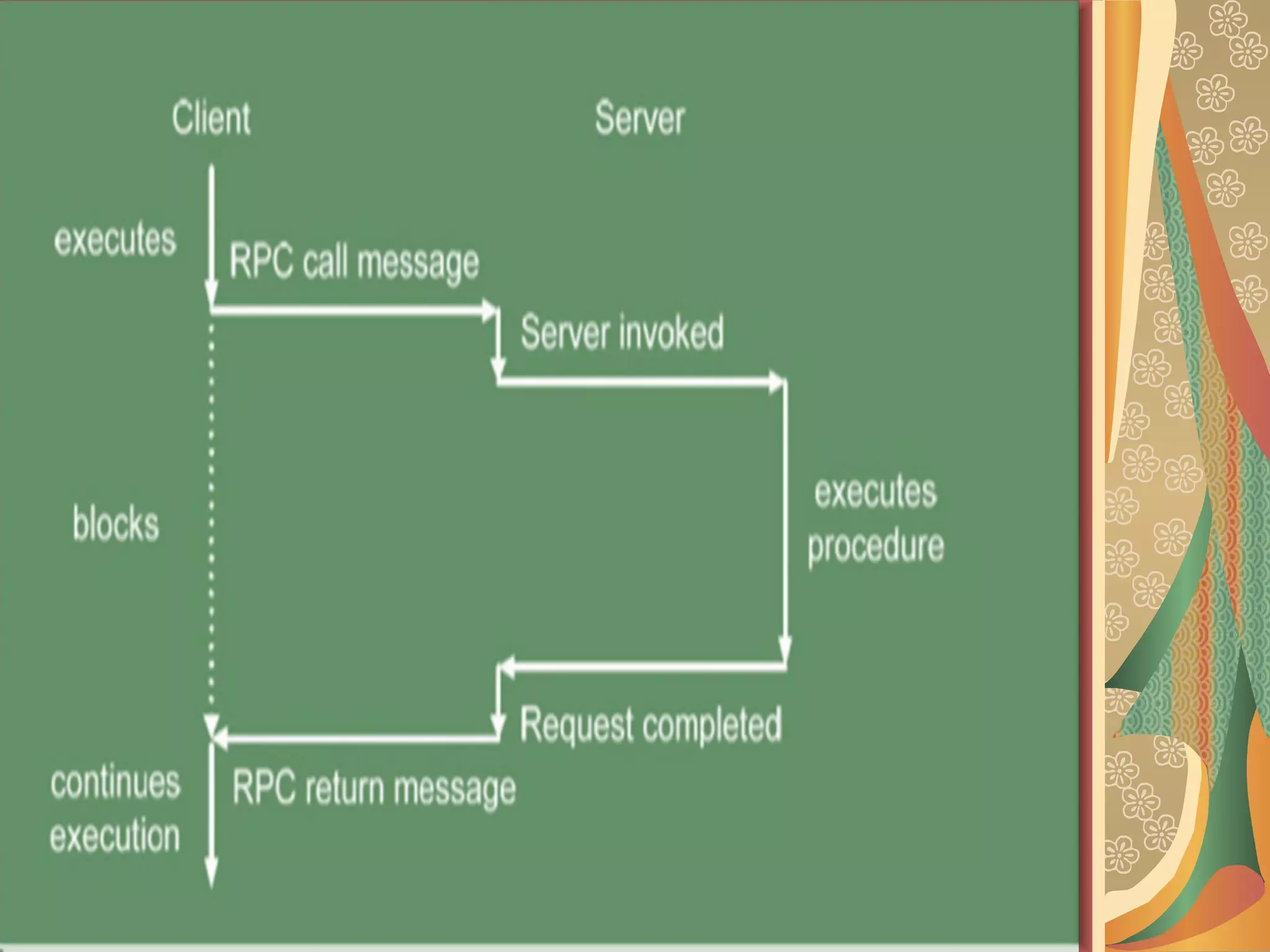
Remote Procedure Call (ONC RPC) system
Continue…Continue…
Mechanism for storing files on a network.
Allows users to ‘Share’ a directory.
NFS most commonly used with UNIX systems.
Other software platforms:
-Mac OS, Microsoft Windows, Novell NetWare, etc.
Major Goals:
-simple crash recovery
-reasonable performance :80% of a local drive
Versions and Variations
Version 1 and Version 2
V1 Sun used only for in-house experimental
purposes
Did not release it to the public
V2 of the protocol originally operated entirely
over UDP and was meant to keep the protocol
stateless, with locking (for example)
implemented outside of the core protocol.
Both suffered from performance problems
Both suffered from security problems
security dependant upon IP address
Version 3
NFS v3 can operate across TCP as well as
UDP
Support for asynchronous writes on the server
Obtains multiple file name, handles and
attributes
Support for 64-bit file sizes and offsets
Handle files larger than 4 gigabytes (GB)
Improves performance, and allowed it to work
more reliably across the Internet
Version 4
Currently version 2 and version 3
protocols are in use with version 4 under
consideration for a standard
includes more performance
improvements
Mandates strong security
introduces a stateful protocol
developed with the IETF (Internet
Engineering Task Force)
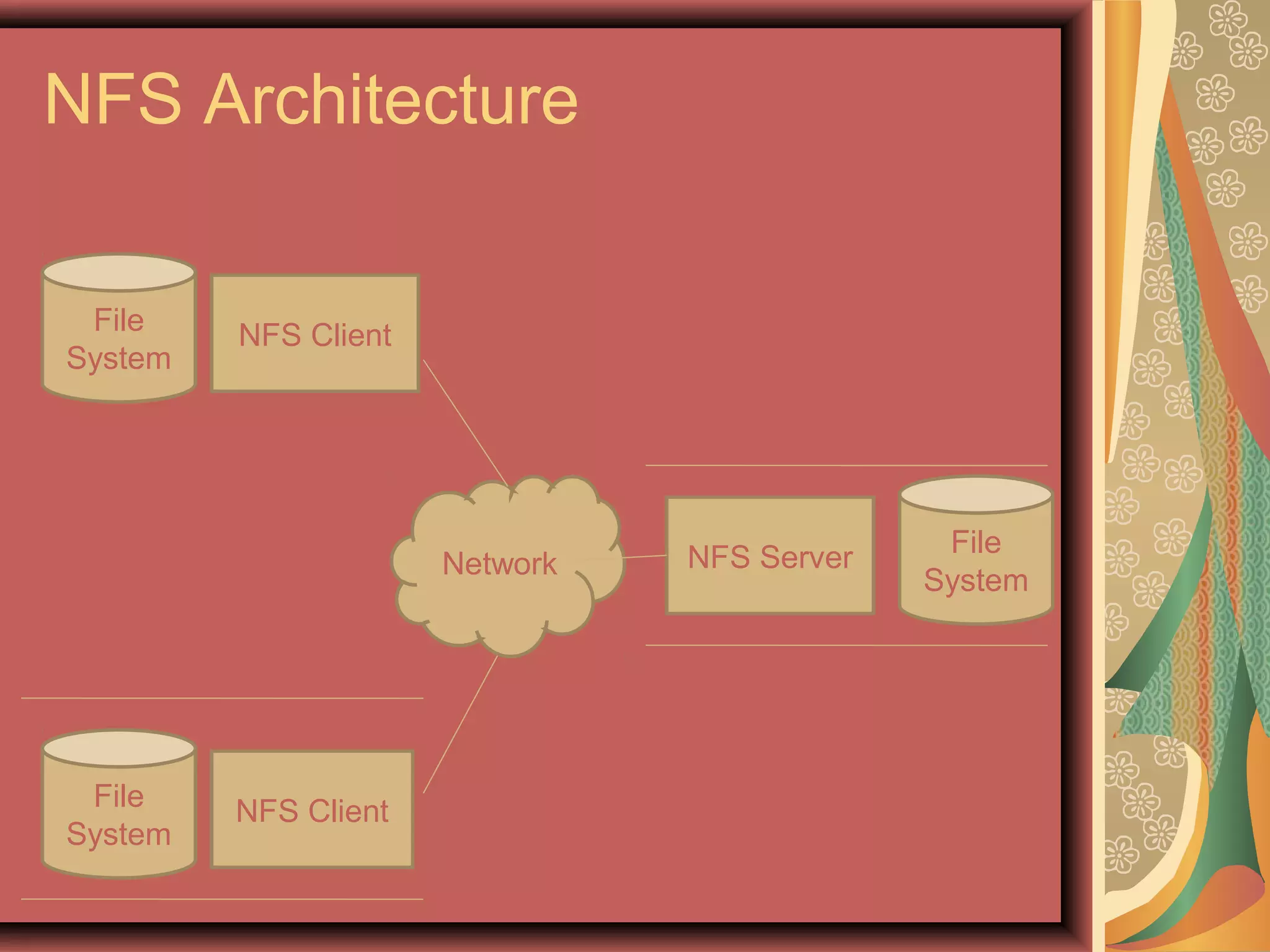
File
System
File
System
NFS Client
NFS Client
Network NFS Server File
System
NFS Architecture
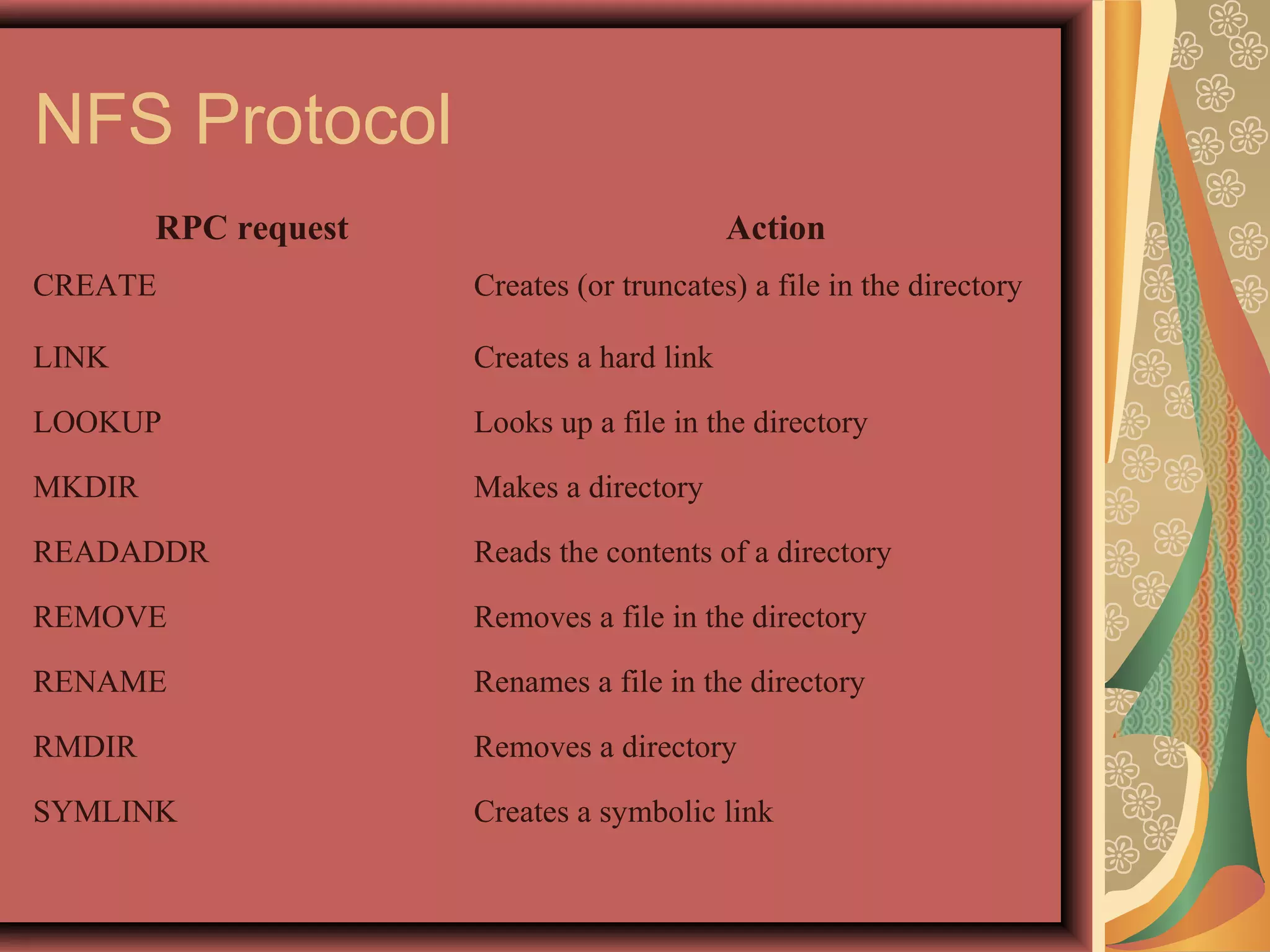
RPC request Action
CREATE Creates (or truncates) a file in the directory
LINK Creates a hard link
LOOKUP Looks up a file in the directory
MKDIR Makes a directory
READADDR Reads the contents of a directory
REMOVE Removes a file in the directory
RENAME Renames a file in the directory
RMDIR Removes a directory
SYMLINK Creates a symbolic link
NFS Protocol
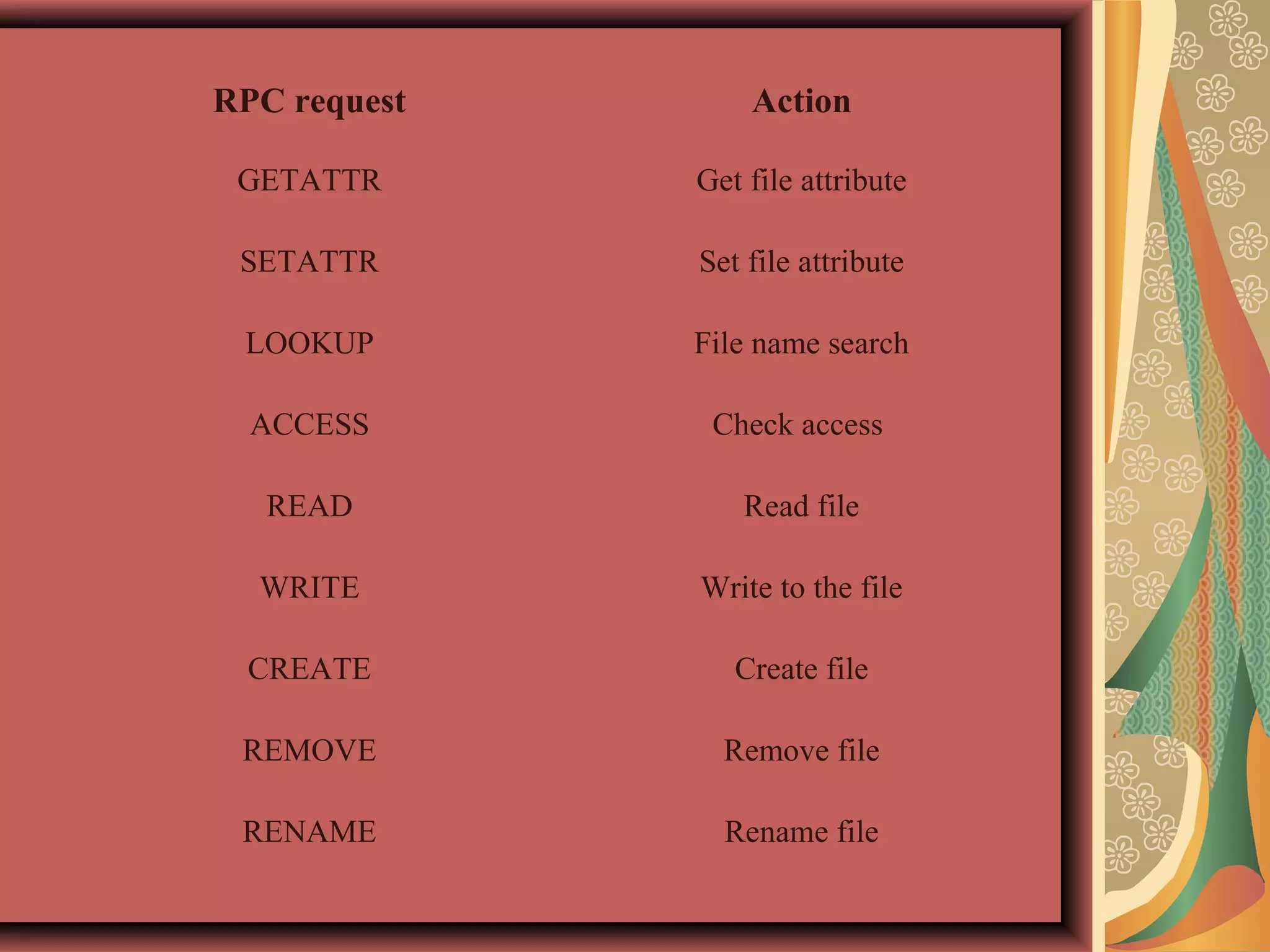
RPC request Action
GETATTR Get file attribute
SETATTR Set file attribute
LOOKUP File name search
ACCESS Check access
READ Read file
WRITE Write to the file
CREATE Create file
REMOVE Remove file
RENAME Rename file
stateless server and client
server can be rebooted and user on client
might be unaware of the reboot
client/server distinction occurs at the
application/user level not the system level
highly flexible, so we need to be disciplined
in our administration/configuration
Advantages
Disadvantage
uses RPC authentication
easily spoofed
filesystem data is transmitted in cleartext
Data could be copied
Network slower than local disk
Complexity, Security issues.
Conclusion
New technologies open up new
possibilities for network file systems
Cost of increased traffic over Ethernet
may cause problems for xFS,
cooperative caching.
References
www.compnetworking.com
www.internetslang.com
www.linux.com
Nfs

Nfs

  • 1.
    Network File SystemNetworkFile System (NFS)(NFS) Submitted To:Submitted To: Rachana KamaliyaRachana Kamaliya PPresented Byresented By: Krupa Shingala: Krupa Shingala
  • 2.
    Index What is FileSystem? What is Network File System? Version of NFS NFS Architecture Advantages of NFS Disadvantages of NFS Conclusion References
  • 3.
    What is FileSystem? • A file system is a hierarchical structure (file tree) of files and directories. • This file tree uses directories to organize data and programs into groups, allowing the management of several directories and files at one time. • Some tasks are performed more efficiently on a file system than on each directory within the file system.
  • 4.
    What is NetworkFile System?What is Network File System? • NFS developed by SUN Microsystems for use on its UNIX-based workstations. • A distributed file system • Allows users to access files and directories located on remote computers • But, data potentially stored on another machine. • NFS builds on the Open Network Computing Remote Procedure Call (ONC RPC) system
  • 5.
    Continue…Continue… Mechanism for storingfiles on a network. Allows users to ‘Share’ a directory. NFS most commonly used with UNIX systems. Other software platforms: -Mac OS, Microsoft Windows, Novell NetWare, etc. Major Goals: -simple crash recovery -reasonable performance :80% of a local drive
  • 6.
    Versions and Variations Version1 and Version 2 V1 Sun used only for in-house experimental purposes Did not release it to the public V2 of the protocol originally operated entirely over UDP and was meant to keep the protocol stateless, with locking (for example) implemented outside of the core protocol. Both suffered from performance problems Both suffered from security problems security dependant upon IP address
  • 7.
    Version 3 NFS v3can operate across TCP as well as UDP Support for asynchronous writes on the server Obtains multiple file name, handles and attributes Support for 64-bit file sizes and offsets Handle files larger than 4 gigabytes (GB) Improves performance, and allowed it to work more reliably across the Internet
  • 8.
    Version 4 Currently version2 and version 3 protocols are in use with version 4 under consideration for a standard includes more performance improvements Mandates strong security introduces a stateful protocol developed with the IETF (Internet Engineering Task Force)
  • 9.
    File System File System NFS Client NFS Client NetworkNFS Server File System NFS Architecture
  • 11.
    RPC request Action CREATECreates (or truncates) a file in the directory LINK Creates a hard link LOOKUP Looks up a file in the directory MKDIR Makes a directory READADDR Reads the contents of a directory REMOVE Removes a file in the directory RENAME Renames a file in the directory RMDIR Removes a directory SYMLINK Creates a symbolic link NFS Protocol
  • 12.
    RPC request Action GETATTRGet file attribute SETATTR Set file attribute LOOKUP File name search ACCESS Check access READ Read file WRITE Write to the file CREATE Create file REMOVE Remove file RENAME Rename file
  • 13.
    stateless server andclient server can be rebooted and user on client might be unaware of the reboot client/server distinction occurs at the application/user level not the system level highly flexible, so we need to be disciplined in our administration/configuration Advantages
  • 14.
    Disadvantage uses RPC authentication easilyspoofed filesystem data is transmitted in cleartext Data could be copied Network slower than local disk Complexity, Security issues.
  • 15.
    Conclusion New technologies openup new possibilities for network file systems Cost of increased traffic over Ethernet may cause problems for xFS, cooperative caching.
  • 16.