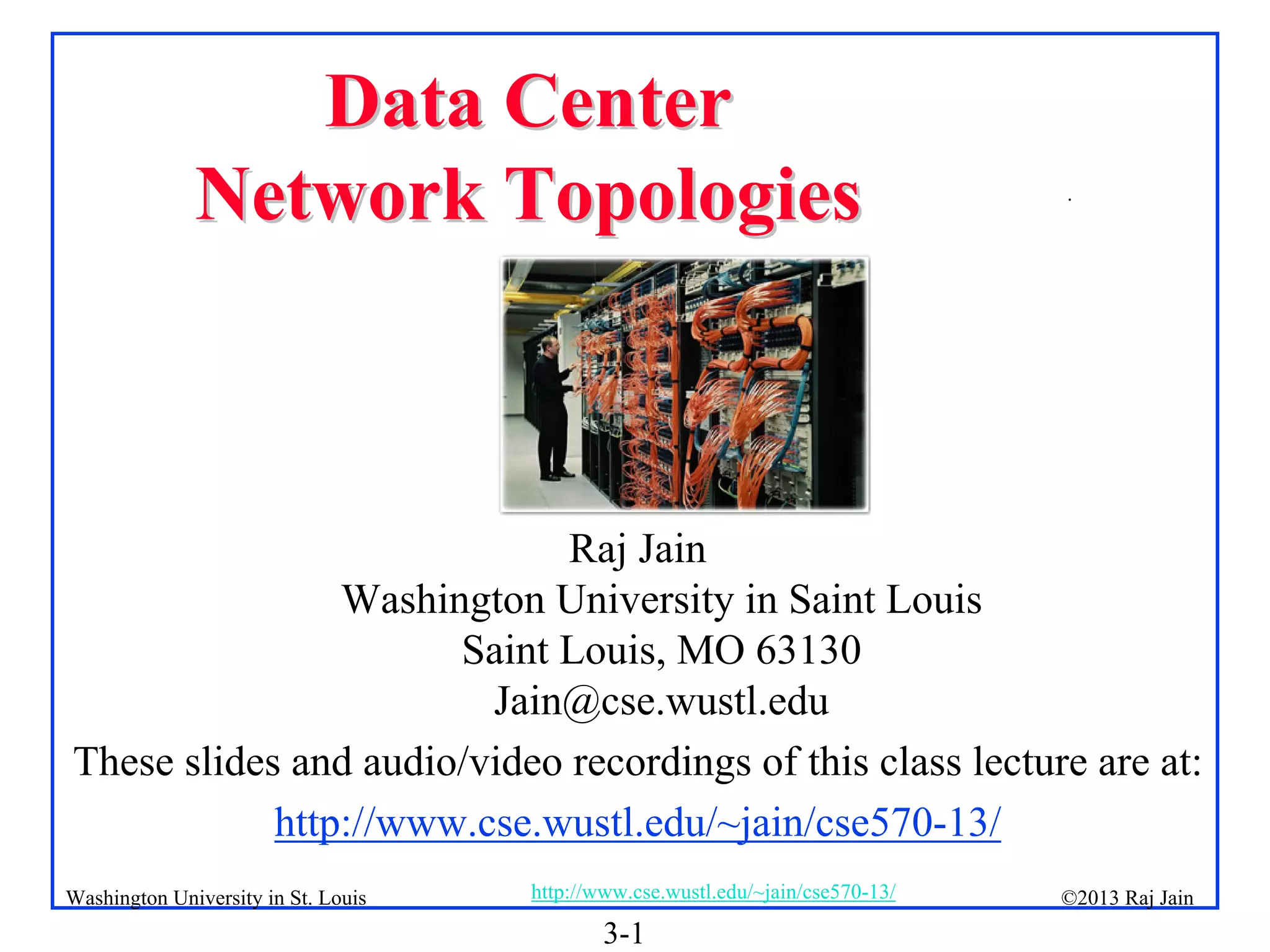
Data Center
Network Topologies

.

Raj Jain
Washington University in Saint Louis
Saint Louis, MO 63130
Jain@cse.wustl.edu
These slides and audio/video recordings of this class lecture are at:
http://www.cse.wustl.edu/~jain/cse570-13/
Washington University in St. Louis

http://www.cse.wustl.edu/~jain/cse570-13/

3-1

©2013 Raj Jain
Overview
1.
2.
3.
4.
5.

Data Center Physical Layout
Data Center Network Topologies
ToR vs. EoR
Data Center Networking Issues
Data Center Networking Requirements

Washington University in St. Louis

http://www.cse.wustl.edu/~jain/cse570-13/

3-2

©2013 Raj Jain
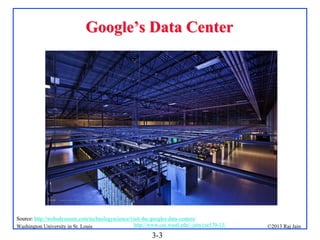
Google’s Data Center

Source: http://webodysseum.com/technologyscience/visit-the-googles-data-centers/
http://www.cse.wustl.edu/~jain/cse570-13/
Washington University in St. Louis

3-3

©2013 Raj Jain
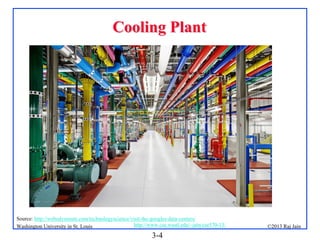
Cooling Plant

Source: http://webodysseum.com/technologyscience/visit-the-googles-data-centers/
http://www.cse.wustl.edu/~jain/cse570-13/
Washington University in St. Louis

3-4

©2013 Raj Jain
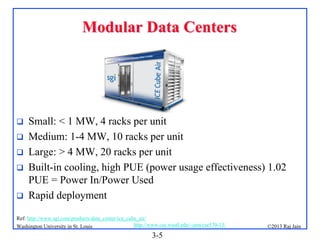
Modular Data Centers







Small: < 1 MW, 4 racks per unit
Medium: 1-4 MW, 10 racks per unit
Large: > 4 MW, 20 racks per unit
Built-in cooling, high PUE (power usage effectiveness) 1.02
PUE = Power In/Power Used
Rapid deployment

Ref: http://www.sgi.com/products/data_center/ice_cube_air/
http://www.cse.wustl.edu/~jain/cse570-13/
Washington University in St. Louis

3-5

©2013 Raj Jain
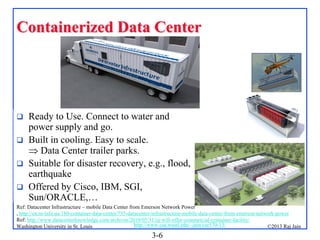
Containerized Data Center






Ready to Use. Connect to water and
power supply and go.
Built in cooling. Easy to scale.
 Data Center trailer parks.
Suitable for disaster recovery, e.g., flood,
earthquake
Offered by Cisco, IBM, SGI,
Sun/ORACLE,…

Ref: Datacenter Infrastructure – mobile Data Center from Emerson Network Power
, http://en.m-info.ua/180-container-data-center/755-datacenter-infrastructure-mobile-data-center-from-emerson-network-power
Ref: http://www.datacenterknowledge.com/archives/2010/05/31/iij-will-offer-commercial-container-facility/
http://www.cse.wustl.edu/~jain/cse570-13/
Washington University in St. Louis
©2013 Raj Jain

3-6
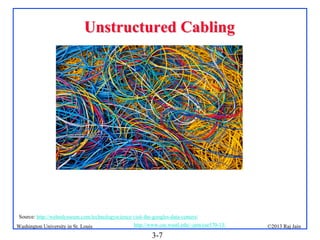
Unstructured Cabling

Source: http://webodysseum.com/technologyscience/visit-the-googles-data-centers/
Washington University in St. Louis

http://www.cse.wustl.edu/~jain/cse570-13/

3-7

©2013 Raj Jain
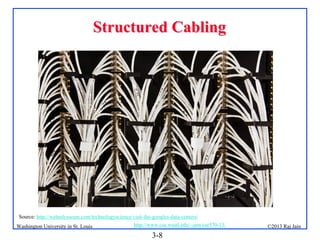
Structured Cabling

Source: http://webodysseum.com/technologyscience/visit-the-googles-data-centers/
Washington University in St. Louis

http://www.cse.wustl.edu/~jain/cse570-13/

3-8

©2013 Raj Jain
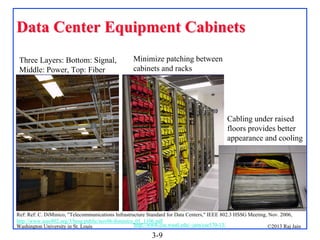
Data Center Equipment Cabinets
Three Layers: Bottom: Signal,
Middle: Power, Top: Fiber

Minimize patching between
cabinets and racks

Cabling under raised
floors provides better
appearance and cooling

Ref: Ref: C. DiMinico, "Telecommunications Infrastructure Standard for Data Centers," IEEE 802.3 HSSG Meeting, Nov. 2006,
http://www.ieee802.org/3/hssg/public/nov06/diminico_01_1106.pdf
http://www.cse.wustl.edu/~jain/cse570-13/
Washington University in St. Louis
©2013 Raj Jain

3-9
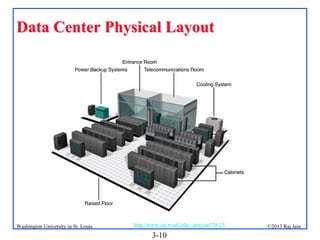
Data Center Physical Layout

Washington University in St. Louis

http://www.cse.wustl.edu/~jain/cse570-13/

3-10

©2013 Raj Jain
ANSI/TIA-942-2005 Standard







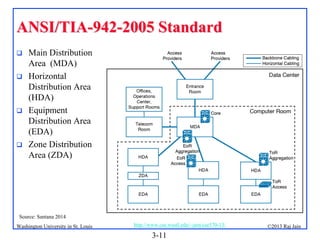
Main Distribution
Area (MDA)
Horizontal
Distribution Area
(HDA)
Equipment
Distribution Area
(EDA)
Zone Distribution
Area (ZDA)

Source: Santana 2014
Washington University in St. Louis

http://www.cse.wustl.edu/~jain/cse570-13/

3-11

©2013 Raj Jain
ANSI/TIA-942-2005 Standard
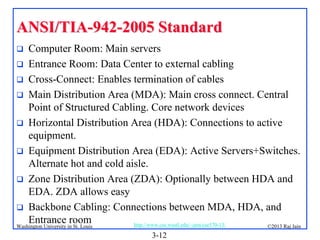
Computer Room: Main servers
 Entrance Room: Data Center to external cabling
 Cross-Connect: Enables termination of cables
 Main Distribution Area (MDA): Main cross connect. Central
Point of Structured Cabling. Core network devices
 Horizontal Distribution Area (HDA): Connections to active
equipment.
 Equipment Distribution Area (EDA): Active Servers+Switches.
Alternate hot and cold aisle.
 Zone Distribution Area (ZDA): Optionally between HDA and
EDA. ZDA allows easy
 Backbone Cabling: Connections between MDA, HDA, and
Entrance room
http://www.cse.wustl.edu/~jain/cse570-13/
Washington University in St. Louis
©2013 Raj Jain


3-12
Zone Distribution Area



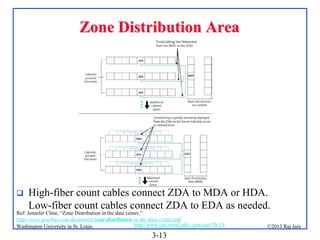
High-fiber count cables connect ZDA to MDA or HDA.
Low-fiber count cables connect ZDA to EDA as needed.

Ref: Jennifer Cline, “Zone Distribution in the data center,”
http://www.graybar.com/documents/zone-distribution-in-the-data-center.pdf
http://www.cse.wustl.edu/~jain/cse570-13/
Washington University in St. Louis

3-13

©2013 Raj Jain
Data Center Network Topologies


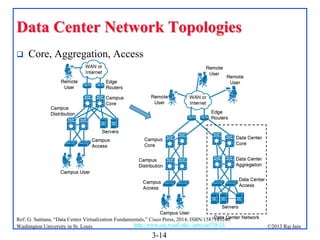
Core, Aggregation, Access

Ref: G. Santana, “Data Center Virtualization Fundamentals,” Cisco Press, 2014, ISBN:1587143240
http://www.cse.wustl.edu/~jain/cse570-13/
Washington University in St. Louis

3-14

©2013 Raj Jain
Data Center Networks








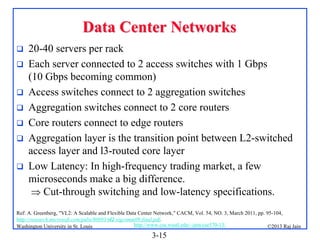
20-40 servers per rack
Each server connected to 2 access switches with 1 Gbps
(10 Gbps becoming common)
Access switches connect to 2 aggregation switches
Aggregation switches connect to 2 core routers
Core routers connect to edge routers
Aggregation layer is the transition point between L2-switched
access layer and l3-routed core layer
Low Latency: In high-frequency trading market, a few
microseconds make a big difference.
 Cut-through switching and low-latency specifications.

Ref: A. Greenberg, "VL2: A Scalable and Flexible Data Center Network," CACM, Vol. 54, NO. 3, March 2011, pp. 95-104,
http://research.microsoft.com/pubs/80693/vl2-sigcomm09-final.pdf.
http://www.cse.wustl.edu/~jain/cse570-13/
Washington University in St. Louis
©2013 Raj Jain

3-15
Data Center Networks (Cont)







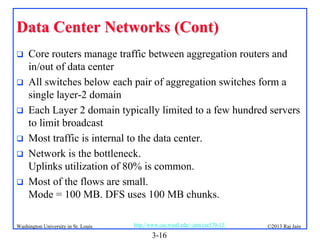
Core routers manage traffic between aggregation routers and
in/out of data center
All switches below each pair of aggregation switches form a
single layer-2 domain
Each Layer 2 domain typically limited to a few hundred servers
to limit broadcast
Most traffic is internal to the data center.
Network is the bottleneck.
Uplinks utilization of 80% is common.
Most of the flows are small.
Mode = 100 MB. DFS uses 100 MB chunks.

Washington University in St. Louis

http://www.cse.wustl.edu/~jain/cse570-13/

3-16

©2013 Raj Jain
Switch Locations
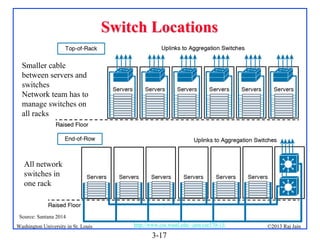
Smaller cable
between servers and
switches
Network team has to
manage switches on
all racks

All network
switches in
one rack

Source: Santana 2014
Washington University in St. Louis

http://www.cse.wustl.edu/~jain/cse570-13/

3-17

©2013 Raj Jain
ToR vs EoR


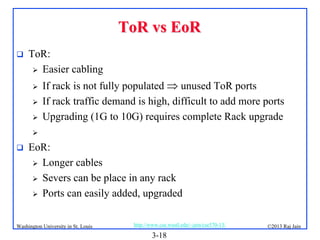
ToR:
 Easier cabling




If rack is not fully populated  unused ToR ports
If rack traffic demand is high, difficult to add more ports
Upgrading (1G to 10G) requires complete Rack upgrade





EoR:
 Longer cables
 Severs can be place in any rack
 Ports can easily added, upgraded

Washington University in St. Louis

http://www.cse.wustl.edu/~jain/cse570-13/

3-18

©2013 Raj Jain
Hierarchical Network Design







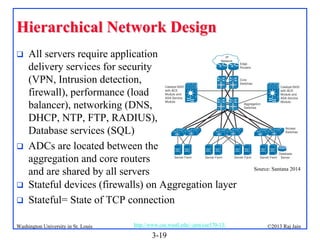
All servers require application
delivery services for security
(VPN, Intrusion detection,
firewall), performance (load
balancer), networking (DNS,
DHCP, NTP, FTP, RADIUS),
Database services (SQL)
ADCs are located between the
aggregation and core routers
and are shared by all servers
Stateful devices (firewalls) on Aggregation layer
Stateful= State of TCP connection

Washington University in St. Louis

http://www.cse.wustl.edu/~jain/cse570-13/

3-19

Source: Santana 2014

©2013 Raj Jain
Access Aggregation Connections
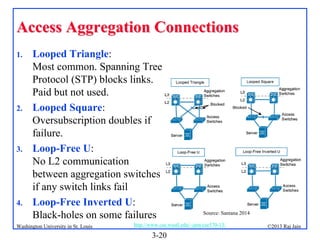
1.

2.

3.

4.

Looped Triangle:
Most common. Spanning Tree
Protocol (STP) blocks links.
Paid but not used.
Looped Square:
Oversubscription doubles if
failure.
Loop-Free U:
No L2 communication
between aggregation switches
if any switch links fail
Loop-Free Inverted U:
Black-holes on some failures

Washington University in St. Louis

Source: Santana 2014

http://www.cse.wustl.edu/~jain/cse570-13/

3-20

©2013 Raj Jain
Data Center Networking Issues






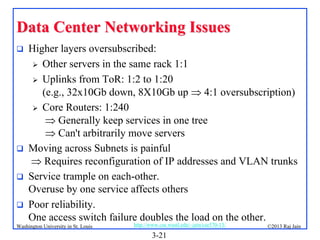
Higher layers oversubscribed:
 Other servers in the same rack 1:1
 Uplinks from ToR: 1:2 to 1:20
(e.g., 32x10Gb down, 8X10Gb up  4:1 oversubscription)
 Core Routers: 1:240
 Generally keep services in one tree
 Can't arbitrarily move servers
Moving across Subnets is painful
 Requires reconfiguration of IP addresses and VLAN trunks
Service trample on each-other.
Overuse by one service affects others
Poor reliability.
One access switch failure doubles the load on the other.

Washington University in St. Louis

http://www.cse.wustl.edu/~jain/cse570-13/

3-21

©2013 Raj Jain
Data Center Networking Issues (Cont)



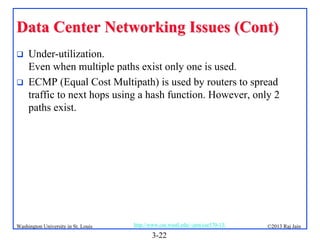
Under-utilization.
Even when multiple paths exist only one is used.
ECMP (Equal Cost Multipath) is used by routers to spread
traffic to next hops using a hash function. However, only 2
paths exist.

Washington University in St. Louis

http://www.cse.wustl.edu/~jain/cse570-13/

3-22

©2013 Raj Jain
DCN Requirements


Needs to be Scalable, Secure, Shared, Standardized,
and Simplified (5 S's)



Converged Infrastructure: Servers, storage, and network have
to work together
Workload Mobility: Large L2 domains required for VM
mobility
East-West Traffic: Significant server-to-server traffic as
compared to server to user. One Facebook request required 88
cache looks, 35 database lookups, 392 backend RPC calls.
Internet traffic 935X the http request/response [Farrington]
Storage traffic on Ethernet: Congestion management on
Ethernet






Ref: A. Kindlness, "The Forester Wave: Data Center Networking Hardware," Jan 23, 2013,
http://ca.westcon.com/documents/46488/forrester_wave_data_cetner_networking_hw_q1_2013.pdf
Ref: N. Farringon and A. Andreyev, “Facebook’s Data Center Network Architecture,” 2013 IEEE Optical Interconnect Conference,
http://nathanfarrington.com/papers/facebook-oic13.pdf
http://www.cse.wustl.edu/~jain/cse570-13/
Washington University in St. Louis
©2013 Raj Jain

3-23
4-Post Architecture at Facebook






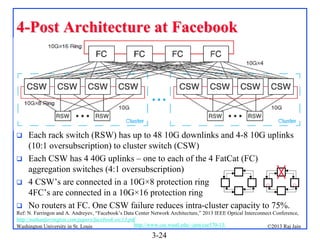
Each rack switch (RSW) has up to 48 10G downlinks and 4-8 10G uplinks
(10:1 oversubscription) to cluster switch (CSW)
Each CSW has 4 40G uplinks – one to each of the 4 FatCat (FC)
aggregation switches (4:1 oversubscription)
4 CSW’s are connected in a 10G×8 protection ring
4FC’s are connected in a 10G×16 protection ring
No routers at FC. One CSW failure reduces intra-cluster capacity to 75%.

Ref: N. Farringon and A. Andreyev, “Facebook’s Data Center Network Architecture,” 2013 IEEE Optical Interconnect Conference,
http://nathanfarrington.com/papers/facebook-oic13.pdf
http://www.cse.wustl.edu/~jain/cse570-13/
Washington University in St. Louis
©2013 Raj Jain

3-24
Clos Networks








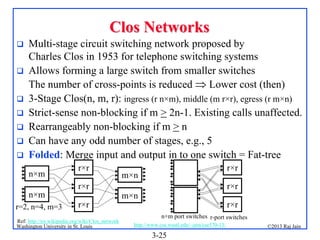
Multi-stage circuit switching network proposed by
Charles Clos in 1953 for telephone switching systems
Allows forming a large switch from smaller switches
The number of cross-points is reduced  Lower cost (then)
3-Stage Clos(n, m, r): ingress (r n×m), middle (m r×r), egress (r m×n)
Strict-sense non-blocking if m > 2n-1. Existing calls unaffected.
Rearrangeably non-blocking if m > n
Can have any odd number of stages, e.g., 5
Folded: Merge input and output in to one switch = Fat-tree
n×m
n×m

r=2, n=4, m=3

r×r
r×r
r×r

Ref: http://en.wikipedia.org/wiki/Clos_network
Washington University in St. Louis

r×r

m×n

r×r

m×n

r×r
n+m port switches r-port switches

http://www.cse.wustl.edu/~jain/cse570-13/

3-25

©2013 Raj Jain
Fat-Tree DCN Example
Core
9

Edge
Servers





…

…

…

…

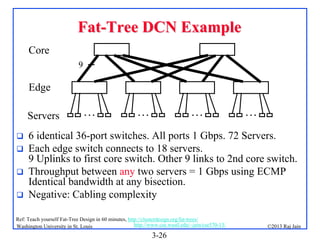
6 identical 36-port switches. All ports 1 Gbps. 72 Servers.
Each edge switch connects to 18 servers.
9 Uplinks to first core switch. Other 9 links to 2nd core switch.
Throughput between any two servers = 1 Gbps using ECMP
Identical bandwidth at any bisection.
Negative: Cabling complexity

Ref: Teach yourself Fat-Tree Design in 60 minutes, http://clusterdesign.org/fat-trees/
http://www.cse.wustl.edu/~jain/cse570-13/
Washington University in St. Louis

3-26

©2013 Raj Jain
Summary

1.
2.
3.
4.
5.

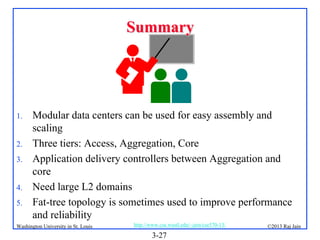
Modular data centers can be used for easy assembly and
scaling
Three tiers: Access, Aggregation, Core
Application delivery controllers between Aggregation and
core
Need large L2 domains
Fat-tree topology is sometimes used to improve performance
and reliability

Washington University in St. Louis

http://www.cse.wustl.edu/~jain/cse570-13/

3-27

©2013 Raj Jain
Homework 3


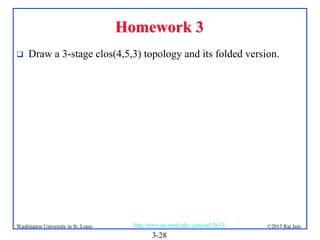
Draw a 3-stage clos(4,5,3) topology and its folded version.

Washington University in St. Louis

http://www.cse.wustl.edu/~jain/cse570-13/

3-28

©2013 Raj Jain
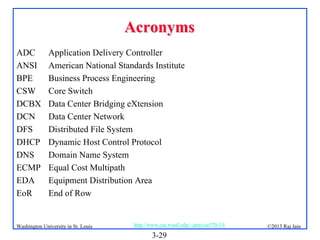
Acronyms
ADC
ANSI
BPE
CSW
DCBX
DCN
DFS
DHCP
DNS
ECMP
EDA
EoR

Application Delivery Controller
American National Standards Institute
Business Process Engineering
Core Switch
Data Center Bridging eXtension
Data Center Network
Distributed File System
Dynamic Host Control Protocol
Domain Name System
Equal Cost Multipath
Equipment Distribution Area
End of Row

Washington University in St. Louis

http://www.cse.wustl.edu/~jain/cse570-13/

3-29

©2013 Raj Jain
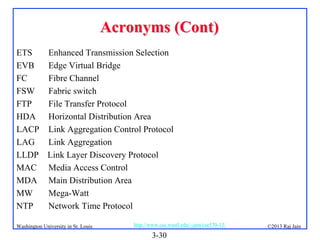
Acronyms (Cont)
ETS
Enhanced Transmission Selection
EVB
Edge Virtual Bridge
FC
Fibre Channel
FSW
Fabric switch
FTP
File Transfer Protocol
HDA Horizontal Distribution Area
LACP Link Aggregation Control Protocol
LAG
Link Aggregation
LLDP Link Layer Discovery Protocol
MAC Media Access Control
MDA Main Distribution Area
MW
Mega-Watt
NTP
Network Time Protocol
Washington University in St. Louis

http://www.cse.wustl.edu/~jain/cse570-13/

3-30

©2013 Raj Jain
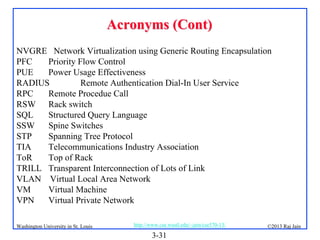
Acronyms (Cont)
NVGRE Network Virtualization using Generic Routing Encapsulation
PFC
Priority Flow Control
PUE
Power Usage Effectiveness
RADIUS
Remote Authentication Dial-In User Service
RPC
Remote Procedue Call
RSW Rack switch
SQL
Structured Query Language
SSW
Spine Switches
STP
Spanning Tree Protocol
TIA
Telecommunications Industry Association
ToR
Top of Rack
TRILL Transparent Interconnection of Lots of Link
VLAN Virtual Local Area Network
VM
Virtual Machine
VPN
Virtual Private Network
Washington University in St. Louis

http://www.cse.wustl.edu/~jain/cse570-13/

3-31

©2013 Raj Jain
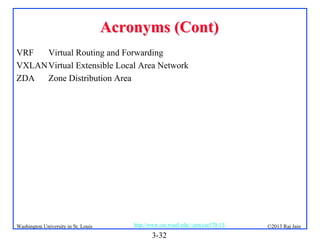
Acronyms (Cont)
VRF
Virtual Routing and Forwarding
VXLANVirtual Extensible Local Area Network
ZDA
Zone Distribution Area

Washington University in St. Louis

http://www.cse.wustl.edu/~jain/cse570-13/

3-32

©2013 Raj Jain
Reading List











http://webodysseum.com/technologyscience/visit-the-googles-data-centers/
http://www.sgi.com/products/data_center/ice_cube_air/
Datacenter Infrastructure - mobile Data Center from Emerson Network
Power, http://www.datacenterknowledge.com/archives/2010/05/31/iij-willoffer-commercial-container-facility/
C. DiMinico, "Telecommunications Infrastructure Standard for Data
Centers," IEEE 802.3 HSSG Meeting, Nov. 2006,
http://www.ieee802.org/3/hssg/public/nov06/diminico_01_1106.pdf
Jennifer Cline, “Zone Distribution in the data center,”
http://www.graybar.com/documents/zone-distribution-in-the-datacenter.pdf
G. Santana, “Data Center Virtualization Fundamentals,” Cisco Press, 2014,
ISBN:1587143240 (Safari book)
A. Greenberg, "VL2: A Scalable and Flexible Data Center Network,"
CACM, Vol. 54, NO. 3, March 2011, pp. 95-104,
http://research.microsoft.com/pubs/80693/vl2-sigcomm09-final.pdf

Washington University in St. Louis

http://www.cse.wustl.edu/~jain/cse570-13/

3-33

©2013 Raj Jain
Reading List (Cont)








A. Kindlness, "The Forester Wave: Data Center Networking Hardware," Jan
23, 2013,
http://ca.westcon.com/documents/46488/forrester_wave_data_cetner_netwo
rking_hw_q1_2013.pdf
N. Farringon and A. Andreyev, “Facebook’s Data Center Network
Architecture,” 2013 IEEE Optical Interconnect Conference,
http://nathanfarrington.com/papers/facebook-oic13.pdf
http://en.wikipedia.org/wiki/Clos_network
Teach yourself Fat-Tree Design in 60 minutes, http://clusterdesign.org/fattrees/
M. Al-Fares, et al, "A scalable, commodity data center network
architecture," ACM SIGCOMM, 2008.

Washington University in St. Louis

http://www.cse.wustl.edu/~jain/cse570-13/

3-34

©2013 Raj Jain
Wikipedia Links










http://en.wikipedia.org/wiki/Modular_data_center
http://en.wikipedia.org/wiki/Data_center
http://en.wikipedia.org/wiki/Structured_cabling
http://en.wikipedia.org/wiki/Cable_management
http://en.wikipedia.org/wiki/Raised_floor
http://en.wikipedia.org/wiki/Data_center_environmental_contr
ol
http://en.wikipedia.org/wiki/Fat_tree
http://en.wikipedia.org/wiki/Hierarchical_internetworking_mod
el
http://en.wikipedia.org/wiki/Clos_network

Washington University in St. Louis

http://www.cse.wustl.edu/~jain/cse570-13/

3-35

©2013 Raj Jain

Data Center Network Topologies

  • 1.
    Data Center Network Topologies . RajJain Washington University in Saint Louis Saint Louis, MO 63130 Jain@cse.wustl.edu These slides and audio/video recordings of this class lecture are at: http://www.cse.wustl.edu/~jain/cse570-13/ Washington University in St. Louis http://www.cse.wustl.edu/~jain/cse570-13/ 3-1 ©2013 Raj Jain
  • 2.
    Overview 1. 2. 3. 4. 5. Data Center PhysicalLayout Data Center Network Topologies ToR vs. EoR Data Center Networking Issues Data Center Networking Requirements Washington University in St. Louis http://www.cse.wustl.edu/~jain/cse570-13/ 3-2 ©2013 Raj Jain
  • 3.
    Google’s Data Center Source:http://webodysseum.com/technologyscience/visit-the-googles-data-centers/ http://www.cse.wustl.edu/~jain/cse570-13/ Washington University in St. Louis 3-3 ©2013 Raj Jain
  • 4.
  • 5.
    Modular Data Centers      Small:< 1 MW, 4 racks per unit Medium: 1-4 MW, 10 racks per unit Large: > 4 MW, 20 racks per unit Built-in cooling, high PUE (power usage effectiveness) 1.02 PUE = Power In/Power Used Rapid deployment Ref: http://www.sgi.com/products/data_center/ice_cube_air/ http://www.cse.wustl.edu/~jain/cse570-13/ Washington University in St. Louis 3-5 ©2013 Raj Jain
  • 6.
    Containerized Data Center     Readyto Use. Connect to water and power supply and go. Built in cooling. Easy to scale.  Data Center trailer parks. Suitable for disaster recovery, e.g., flood, earthquake Offered by Cisco, IBM, SGI, Sun/ORACLE,… Ref: Datacenter Infrastructure – mobile Data Center from Emerson Network Power , http://en.m-info.ua/180-container-data-center/755-datacenter-infrastructure-mobile-data-center-from-emerson-network-power Ref: http://www.datacenterknowledge.com/archives/2010/05/31/iij-will-offer-commercial-container-facility/ http://www.cse.wustl.edu/~jain/cse570-13/ Washington University in St. Louis ©2013 Raj Jain 3-6
  • 7.
    Unstructured Cabling Source: http://webodysseum.com/technologyscience/visit-the-googles-data-centers/ WashingtonUniversity in St. Louis http://www.cse.wustl.edu/~jain/cse570-13/ 3-7 ©2013 Raj Jain
  • 8.
    Structured Cabling Source: http://webodysseum.com/technologyscience/visit-the-googles-data-centers/ WashingtonUniversity in St. Louis http://www.cse.wustl.edu/~jain/cse570-13/ 3-8 ©2013 Raj Jain
  • 9.
    Data Center EquipmentCabinets Three Layers: Bottom: Signal, Middle: Power, Top: Fiber Minimize patching between cabinets and racks Cabling under raised floors provides better appearance and cooling Ref: Ref: C. DiMinico, "Telecommunications Infrastructure Standard for Data Centers," IEEE 802.3 HSSG Meeting, Nov. 2006, http://www.ieee802.org/3/hssg/public/nov06/diminico_01_1106.pdf http://www.cse.wustl.edu/~jain/cse570-13/ Washington University in St. Louis ©2013 Raj Jain 3-9
  • 10.
    Data Center PhysicalLayout Washington University in St. Louis http://www.cse.wustl.edu/~jain/cse570-13/ 3-10 ©2013 Raj Jain
  • 11.
    ANSI/TIA-942-2005 Standard     Main Distribution Area(MDA) Horizontal Distribution Area (HDA) Equipment Distribution Area (EDA) Zone Distribution Area (ZDA) Source: Santana 2014 Washington University in St. Louis http://www.cse.wustl.edu/~jain/cse570-13/ 3-11 ©2013 Raj Jain
  • 12.
    ANSI/TIA-942-2005 Standard Computer Room:Main servers  Entrance Room: Data Center to external cabling  Cross-Connect: Enables termination of cables  Main Distribution Area (MDA): Main cross connect. Central Point of Structured Cabling. Core network devices  Horizontal Distribution Area (HDA): Connections to active equipment.  Equipment Distribution Area (EDA): Active Servers+Switches. Alternate hot and cold aisle.  Zone Distribution Area (ZDA): Optionally between HDA and EDA. ZDA allows easy  Backbone Cabling: Connections between MDA, HDA, and Entrance room http://www.cse.wustl.edu/~jain/cse570-13/ Washington University in St. Louis ©2013 Raj Jain  3-12
  • 13.
    Zone Distribution Area  High-fibercount cables connect ZDA to MDA or HDA. Low-fiber count cables connect ZDA to EDA as needed. Ref: Jennifer Cline, “Zone Distribution in the data center,” http://www.graybar.com/documents/zone-distribution-in-the-data-center.pdf http://www.cse.wustl.edu/~jain/cse570-13/ Washington University in St. Louis 3-13 ©2013 Raj Jain
  • 14.
    Data Center NetworkTopologies  Core, Aggregation, Access Ref: G. Santana, “Data Center Virtualization Fundamentals,” Cisco Press, 2014, ISBN:1587143240 http://www.cse.wustl.edu/~jain/cse570-13/ Washington University in St. Louis 3-14 ©2013 Raj Jain
  • 15.
    Data Center Networks        20-40servers per rack Each server connected to 2 access switches with 1 Gbps (10 Gbps becoming common) Access switches connect to 2 aggregation switches Aggregation switches connect to 2 core routers Core routers connect to edge routers Aggregation layer is the transition point between L2-switched access layer and l3-routed core layer Low Latency: In high-frequency trading market, a few microseconds make a big difference.  Cut-through switching and low-latency specifications. Ref: A. Greenberg, "VL2: A Scalable and Flexible Data Center Network," CACM, Vol. 54, NO. 3, March 2011, pp. 95-104, http://research.microsoft.com/pubs/80693/vl2-sigcomm09-final.pdf. http://www.cse.wustl.edu/~jain/cse570-13/ Washington University in St. Louis ©2013 Raj Jain 3-15
  • 16.
    Data Center Networks(Cont)       Core routers manage traffic between aggregation routers and in/out of data center All switches below each pair of aggregation switches form a single layer-2 domain Each Layer 2 domain typically limited to a few hundred servers to limit broadcast Most traffic is internal to the data center. Network is the bottleneck. Uplinks utilization of 80% is common. Most of the flows are small. Mode = 100 MB. DFS uses 100 MB chunks. Washington University in St. Louis http://www.cse.wustl.edu/~jain/cse570-13/ 3-16 ©2013 Raj Jain
  • 17.
    Switch Locations Smaller cable betweenservers and switches Network team has to manage switches on all racks All network switches in one rack Source: Santana 2014 Washington University in St. Louis http://www.cse.wustl.edu/~jain/cse570-13/ 3-17 ©2013 Raj Jain
  • 18.
    ToR vs EoR  ToR: Easier cabling    If rack is not fully populated  unused ToR ports If rack traffic demand is high, difficult to add more ports Upgrading (1G to 10G) requires complete Rack upgrade   EoR:  Longer cables  Severs can be place in any rack  Ports can easily added, upgraded Washington University in St. Louis http://www.cse.wustl.edu/~jain/cse570-13/ 3-18 ©2013 Raj Jain
  • 19.
    Hierarchical Network Design     Allservers require application delivery services for security (VPN, Intrusion detection, firewall), performance (load balancer), networking (DNS, DHCP, NTP, FTP, RADIUS), Database services (SQL) ADCs are located between the aggregation and core routers and are shared by all servers Stateful devices (firewalls) on Aggregation layer Stateful= State of TCP connection Washington University in St. Louis http://www.cse.wustl.edu/~jain/cse570-13/ 3-19 Source: Santana 2014 ©2013 Raj Jain
  • 20.
    Access Aggregation Connections 1. 2. 3. 4. LoopedTriangle: Most common. Spanning Tree Protocol (STP) blocks links. Paid but not used. Looped Square: Oversubscription doubles if failure. Loop-Free U: No L2 communication between aggregation switches if any switch links fail Loop-Free Inverted U: Black-holes on some failures Washington University in St. Louis Source: Santana 2014 http://www.cse.wustl.edu/~jain/cse570-13/ 3-20 ©2013 Raj Jain
  • 21.
    Data Center NetworkingIssues     Higher layers oversubscribed:  Other servers in the same rack 1:1  Uplinks from ToR: 1:2 to 1:20 (e.g., 32x10Gb down, 8X10Gb up  4:1 oversubscription)  Core Routers: 1:240  Generally keep services in one tree  Can't arbitrarily move servers Moving across Subnets is painful  Requires reconfiguration of IP addresses and VLAN trunks Service trample on each-other. Overuse by one service affects others Poor reliability. One access switch failure doubles the load on the other. Washington University in St. Louis http://www.cse.wustl.edu/~jain/cse570-13/ 3-21 ©2013 Raj Jain
  • 22.
    Data Center NetworkingIssues (Cont)   Under-utilization. Even when multiple paths exist only one is used. ECMP (Equal Cost Multipath) is used by routers to spread traffic to next hops using a hash function. However, only 2 paths exist. Washington University in St. Louis http://www.cse.wustl.edu/~jain/cse570-13/ 3-22 ©2013 Raj Jain
  • 23.
    DCN Requirements  Needs tobe Scalable, Secure, Shared, Standardized, and Simplified (5 S's)  Converged Infrastructure: Servers, storage, and network have to work together Workload Mobility: Large L2 domains required for VM mobility East-West Traffic: Significant server-to-server traffic as compared to server to user. One Facebook request required 88 cache looks, 35 database lookups, 392 backend RPC calls. Internet traffic 935X the http request/response [Farrington] Storage traffic on Ethernet: Congestion management on Ethernet    Ref: A. Kindlness, "The Forester Wave: Data Center Networking Hardware," Jan 23, 2013, http://ca.westcon.com/documents/46488/forrester_wave_data_cetner_networking_hw_q1_2013.pdf Ref: N. Farringon and A. Andreyev, “Facebook’s Data Center Network Architecture,” 2013 IEEE Optical Interconnect Conference, http://nathanfarrington.com/papers/facebook-oic13.pdf http://www.cse.wustl.edu/~jain/cse570-13/ Washington University in St. Louis ©2013 Raj Jain 3-23
  • 24.
    4-Post Architecture atFacebook     Each rack switch (RSW) has up to 48 10G downlinks and 4-8 10G uplinks (10:1 oversubscription) to cluster switch (CSW) Each CSW has 4 40G uplinks – one to each of the 4 FatCat (FC) aggregation switches (4:1 oversubscription) 4 CSW’s are connected in a 10G×8 protection ring 4FC’s are connected in a 10G×16 protection ring No routers at FC. One CSW failure reduces intra-cluster capacity to 75%. Ref: N. Farringon and A. Andreyev, “Facebook’s Data Center Network Architecture,” 2013 IEEE Optical Interconnect Conference, http://nathanfarrington.com/papers/facebook-oic13.pdf http://www.cse.wustl.edu/~jain/cse570-13/ Washington University in St. Louis ©2013 Raj Jain 3-24
  • 25.
    Clos Networks        Multi-stage circuitswitching network proposed by Charles Clos in 1953 for telephone switching systems Allows forming a large switch from smaller switches The number of cross-points is reduced  Lower cost (then) 3-Stage Clos(n, m, r): ingress (r n×m), middle (m r×r), egress (r m×n) Strict-sense non-blocking if m > 2n-1. Existing calls unaffected. Rearrangeably non-blocking if m > n Can have any odd number of stages, e.g., 5 Folded: Merge input and output in to one switch = Fat-tree n×m n×m r=2, n=4, m=3 r×r r×r r×r Ref: http://en.wikipedia.org/wiki/Clos_network Washington University in St. Louis r×r m×n r×r m×n r×r n+m port switches r-port switches http://www.cse.wustl.edu/~jain/cse570-13/ 3-25 ©2013 Raj Jain
  • 26.
    Fat-Tree DCN Example Core 9 Edge Servers     … … … … 6identical 36-port switches. All ports 1 Gbps. 72 Servers. Each edge switch connects to 18 servers. 9 Uplinks to first core switch. Other 9 links to 2nd core switch. Throughput between any two servers = 1 Gbps using ECMP Identical bandwidth at any bisection. Negative: Cabling complexity Ref: Teach yourself Fat-Tree Design in 60 minutes, http://clusterdesign.org/fat-trees/ http://www.cse.wustl.edu/~jain/cse570-13/ Washington University in St. Louis 3-26 ©2013 Raj Jain
  • 27.
    Summary 1. 2. 3. 4. 5. Modular data centerscan be used for easy assembly and scaling Three tiers: Access, Aggregation, Core Application delivery controllers between Aggregation and core Need large L2 domains Fat-tree topology is sometimes used to improve performance and reliability Washington University in St. Louis http://www.cse.wustl.edu/~jain/cse570-13/ 3-27 ©2013 Raj Jain
  • 28.
    Homework 3  Draw a3-stage clos(4,5,3) topology and its folded version. Washington University in St. Louis http://www.cse.wustl.edu/~jain/cse570-13/ 3-28 ©2013 Raj Jain
  • 29.
    Acronyms ADC ANSI BPE CSW DCBX DCN DFS DHCP DNS ECMP EDA EoR Application Delivery Controller AmericanNational Standards Institute Business Process Engineering Core Switch Data Center Bridging eXtension Data Center Network Distributed File System Dynamic Host Control Protocol Domain Name System Equal Cost Multipath Equipment Distribution Area End of Row Washington University in St. Louis http://www.cse.wustl.edu/~jain/cse570-13/ 3-29 ©2013 Raj Jain
  • 30.
    Acronyms (Cont) ETS Enhanced TransmissionSelection EVB Edge Virtual Bridge FC Fibre Channel FSW Fabric switch FTP File Transfer Protocol HDA Horizontal Distribution Area LACP Link Aggregation Control Protocol LAG Link Aggregation LLDP Link Layer Discovery Protocol MAC Media Access Control MDA Main Distribution Area MW Mega-Watt NTP Network Time Protocol Washington University in St. Louis http://www.cse.wustl.edu/~jain/cse570-13/ 3-30 ©2013 Raj Jain
  • 31.
    Acronyms (Cont) NVGRE NetworkVirtualization using Generic Routing Encapsulation PFC Priority Flow Control PUE Power Usage Effectiveness RADIUS Remote Authentication Dial-In User Service RPC Remote Procedue Call RSW Rack switch SQL Structured Query Language SSW Spine Switches STP Spanning Tree Protocol TIA Telecommunications Industry Association ToR Top of Rack TRILL Transparent Interconnection of Lots of Link VLAN Virtual Local Area Network VM Virtual Machine VPN Virtual Private Network Washington University in St. Louis http://www.cse.wustl.edu/~jain/cse570-13/ 3-31 ©2013 Raj Jain
  • 32.
    Acronyms (Cont) VRF Virtual Routingand Forwarding VXLANVirtual Extensible Local Area Network ZDA Zone Distribution Area Washington University in St. Louis http://www.cse.wustl.edu/~jain/cse570-13/ 3-32 ©2013 Raj Jain
  • 33.
    Reading List        http://webodysseum.com/technologyscience/visit-the-googles-data-centers/ http://www.sgi.com/products/data_center/ice_cube_air/ Datacenter Infrastructure- mobile Data Center from Emerson Network Power, http://www.datacenterknowledge.com/archives/2010/05/31/iij-willoffer-commercial-container-facility/ C. DiMinico, "Telecommunications Infrastructure Standard for Data Centers," IEEE 802.3 HSSG Meeting, Nov. 2006, http://www.ieee802.org/3/hssg/public/nov06/diminico_01_1106.pdf Jennifer Cline, “Zone Distribution in the data center,” http://www.graybar.com/documents/zone-distribution-in-the-datacenter.pdf G. Santana, “Data Center Virtualization Fundamentals,” Cisco Press, 2014, ISBN:1587143240 (Safari book) A. Greenberg, "VL2: A Scalable and Flexible Data Center Network," CACM, Vol. 54, NO. 3, March 2011, pp. 95-104, http://research.microsoft.com/pubs/80693/vl2-sigcomm09-final.pdf Washington University in St. Louis http://www.cse.wustl.edu/~jain/cse570-13/ 3-33 ©2013 Raj Jain
  • 34.
    Reading List (Cont)      A.Kindlness, "The Forester Wave: Data Center Networking Hardware," Jan 23, 2013, http://ca.westcon.com/documents/46488/forrester_wave_data_cetner_netwo rking_hw_q1_2013.pdf N. Farringon and A. Andreyev, “Facebook’s Data Center Network Architecture,” 2013 IEEE Optical Interconnect Conference, http://nathanfarrington.com/papers/facebook-oic13.pdf http://en.wikipedia.org/wiki/Clos_network Teach yourself Fat-Tree Design in 60 minutes, http://clusterdesign.org/fattrees/ M. Al-Fares, et al, "A scalable, commodity data center network architecture," ACM SIGCOMM, 2008. Washington University in St. Louis http://www.cse.wustl.edu/~jain/cse570-13/ 3-34 ©2013 Raj Jain
  • 35.