
WWW.GTRI.COM
Software Defined Networking
(SDN) Technology Brief
Scott Hogg, Chief Technology Officer, GTRI
CCIE #5133, CISSP #4610
© 2016 Global Technology Resources, Inc.
All rights reserved.
Agenda
• SDN Introduction and Overview
• Benefits and Drivers for SDN
• SDN Use Cases
• SDN Industry Organizations
• Challenges and Objections to SDN, Industry
Outlook
• GTRI’s Solution Methodology
• GTRI’s SDN Solutions and Services
Software’s Influence on IT Infrastructure
• “The Times They are a-Changin’”, Bob Dylan
• Movement toward virtualization, multi-tenancy,
cloud services, the third platform, and influenced
by consumption economics
• “Why Software Is Eating The World”, by Marc
Andreessen, (WSJ, Aug 20, 2011)
• DevOps isn’t just a popular digital-age
portmanteau, its a movement of IT de-siloization
that is also coming to data-networking
Benefits of Virtualization and Software’s
Influence
• Servers have transformed from bare-metal to
virtualized OSs, and now applications are moving to
software containers (LXC, Docker, etc.).
• Storage systems now have dynamic features like
automatic tiering, thin-provisioning, de-duplication,
backups and replication.
• Networking is beginning to be influenced by software
Today’s Network Limitations
• Networking hasn’t changed substantially in 15 years
• Most network devices are manually configured one-at-a-time
• QoS and other policies are configured manually on each
individual device, not tied to current application traffic mix
or security policies
• IP routing protocols do not take traffic load into consideration
• Network Admins have only managed to moved from Telnet
to SSH
# telnet 10.2.6.9 # ssh –l cisco 10.2.6.9
What is SDN?
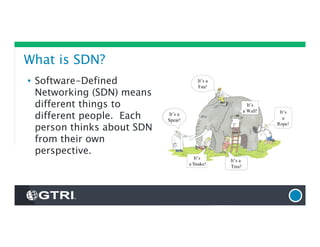
• Software-Defined
Networking (SDN) means
different things to
different people. Each
person thinks about SDN
from their own
perspective.
What is SDN?
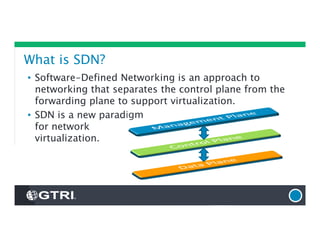
• Software-Defined Networking is an approach to
networking that separates the control plane from the
forwarding plane to support virtualization.
• SDN is a new paradigm
for network
virtualization.
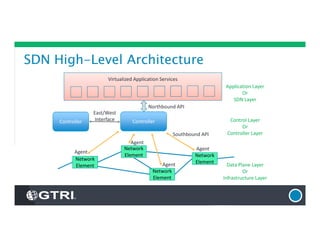
SDN High-Level Architecture
Controller
Network
Element
Network
Element
Network
Element
Network
Element
Network
Element
Network
Element
Network
Element
Network
Element
Application Layer
Or
SDN Layer
Virtualized Application Services
Northbound API
Southbound API
Control Layer
Or
Controller Layer
Data Plane Layer
Or
Infrastructure Layer
Agent
Agent
Agent
Agent
Controller
East/West
Interface
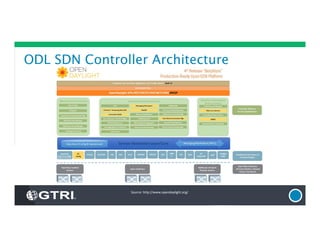
ODL SDN Controller Architecture
Source: http://www.opendaylight.org/
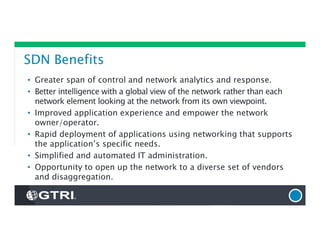
SDN Benefits
• Greater span of control and network analytics and response.
• Better intelligence with a global view of the network rather than each
network element looking at the network from its own viewpoint.
• Improved application experience and empower the network
owner/operator.
• Rapid deployment of applications using networking that supports
the application’s specific needs.
• Simplified and automated IT administration.
• Opportunity to open up the network to a diverse set of vendors
and disaggregation.
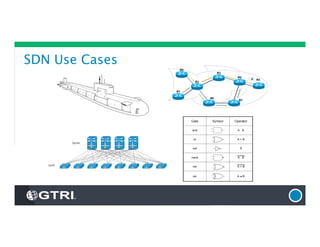
SDN Use Cases
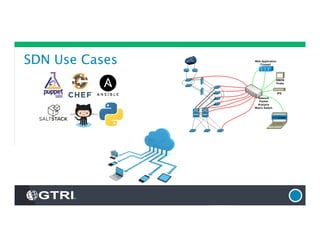
SDN Use Cases
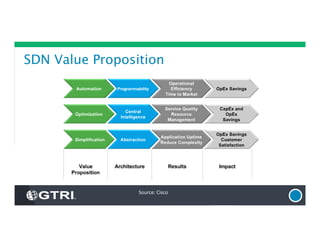
SDN Value Proposition
Source: Cisco
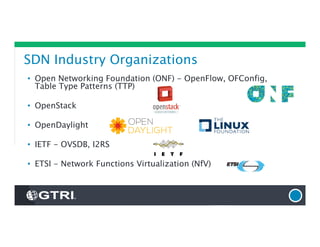
SDN Industry Organizations
• Open Networking Foundation (ONF) - OpenFlow, OFConfig,
Table Type Patterns (TTP)
• OpenStack
• OpenDaylight
• IETF - OVSDB, I2RS
• ETSI - Network Functions Virtualization (NfV)
Objections and Challenges
• SDN Controller redundancy, security
o What happens if the controller fails?
• Central controller needs to be notified of any network failure
o How does this happen when the network is down?
o Latency for TCP/SSL control signaling – detect sub-ms failures
• Speed of flow setup
o Controllers will need to support many flows/second
• Vendor interoperability between controllers
o Do different vendors controllers interoperate?
o Current vendors have “Proprietary Openness”
Objections and Challenges (Cont.)
• SDN Internet extensibility
o How does the SDN controller interface to the Internet?
• Human factors
o Humans configure routers/switches manually and humans will configure
the controller manually
o SDN transcends IT group silos (networking, security, servers, …)
• SDN is an unproven technology
o Industry in its infancy, many small vendors, some vendors are not
shipping orderable products, lack of standards for controller interface
o Current IT staff has 25% of their time for new projects
• ROI/TCO analysis for enterprise deployments
o SDN deployments must preserve current IT investments
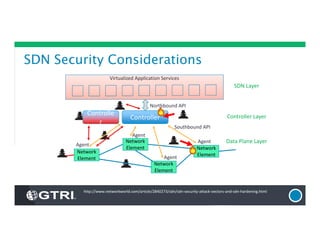
SDN Security Considerations
Controller
Network
Element
Network
Element
Network
Element
Network
Element
Network
Element
Network
Element
Network
Element
Network
Element
SDN Layer
Virtualized Application Services
Northbound API
Southbound API
Controller Layer
Data Plane Layer
Agent
Agent
Agent
Agent
Controlle
r
Controlle
r
http://www.networkworld.com/article/2840273/sdn/sdn-security-attack-vectors-and-sdn-hardening.html
SDN Operational Model
• Network and security administrators are sometimes threatened by
network programmability and software-defined networking.
• The truth is, your networking skills and knowledge is transferable to a
software-driven/defined world.
• Operational issues can arise in the new SDDC environment when groups
don’t cooperate well.
• Silos of IT operations don’t lend themselves to NFV and SDN and virtual
security policy enforcement.
• The traditional physical demarcations and lines of responsibility blur with
SDN and NFV.
• Cross-function and interdisciplinary DevOps teams are needed to make
SDN and NFV systems viable.
Elusive SDN Deployments
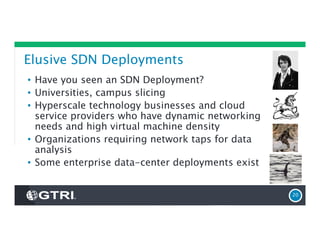
• Have you seen an SDN Deployment?
• Universities, campus slicing
• Hyperscale technology businesses and cloud
service providers who have dynamic networking
needs and high virtual machine density
• Organizations requiring network taps for data
analysis
• Some enterprise data-center deployments exist
20
SDN Industry Outlook
• More SDN deployments will emerge as solutions mature.
• We will see consolidation of vendors in this space
(major/larger vendors will absorb the best-of-breed).
• Larger vendors will include native SDN APIs to preserve
organization’s investment in networking products.
• Standards will emerge and the market will drive a
winning technology.
GTRI SDN Solutions
• GTRI’s Virtualization and Advanced Networking Professional Services (PS)
practice has expertise with SDN vendor solutions.
• GTRI has top-tier partner status with the most relevant long-term vendors
in the IT virtualization market.
• GTRI offers an SDN readiness assessment service to assess your
infrastructure, your applications, and the benefits to your business gained
from using SDN.
• GTRI has a SDN test bed where we can learn and teach SDN solutions and
help validate solutions prior to deployment.
• GTRI is performing SDN deployments and we will freely share the latest
vendor and industry information with you.
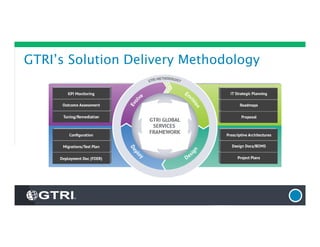
GTRI’s Solution Delivery Methodology
FREE SDN Technology Review
• We are offering a FREE 3-hour (~1/2 day) SDN
technology review for your company
• Bring your networking, security, DevOps, and other
technology teams together
• Review SDN capabilities within your existing
networked infrastructure
• Discuss SDN architecture and design options
• Review network automation and network
programmability potential
WWW.GTRI.COM
Questions and Answers
Next Steps
SummarySummarySummarySummary
SHogg@GTRI.com
303-949-4865
@scotthogg

Software Defined Networking (SDN) Technology Brief

  • 1.
    WWW.GTRI.COM Software Defined Networking (SDN)Technology Brief Scott Hogg, Chief Technology Officer, GTRI CCIE #5133, CISSP #4610 © 2016 Global Technology Resources, Inc. All rights reserved.
  • 2.
    Agenda • SDN Introductionand Overview • Benefits and Drivers for SDN • SDN Use Cases • SDN Industry Organizations • Challenges and Objections to SDN, Industry Outlook • GTRI’s Solution Methodology • GTRI’s SDN Solutions and Services
  • 3.
    Software’s Influence onIT Infrastructure • “The Times They are a-Changin’”, Bob Dylan • Movement toward virtualization, multi-tenancy, cloud services, the third platform, and influenced by consumption economics • “Why Software Is Eating The World”, by Marc Andreessen, (WSJ, Aug 20, 2011) • DevOps isn’t just a popular digital-age portmanteau, its a movement of IT de-siloization that is also coming to data-networking
  • 4.
    Benefits of Virtualizationand Software’s Influence • Servers have transformed from bare-metal to virtualized OSs, and now applications are moving to software containers (LXC, Docker, etc.). • Storage systems now have dynamic features like automatic tiering, thin-provisioning, de-duplication, backups and replication. • Networking is beginning to be influenced by software
  • 5.
    Today’s Network Limitations •Networking hasn’t changed substantially in 15 years • Most network devices are manually configured one-at-a-time • QoS and other policies are configured manually on each individual device, not tied to current application traffic mix or security policies • IP routing protocols do not take traffic load into consideration • Network Admins have only managed to moved from Telnet to SSH # telnet 10.2.6.9 # ssh –l cisco 10.2.6.9
  • 7.
    What is SDN? •Software-Defined Networking (SDN) means different things to different people. Each person thinks about SDN from their own perspective.
  • 8.
    What is SDN? •Software-Defined Networking is an approach to networking that separates the control plane from the forwarding plane to support virtualization. • SDN is a new paradigm for network virtualization.
  • 9.
    SDN High-Level Architecture Controller Network Element Network Element Network Element Network Element Network Element Network Element Network Element Network Element ApplicationLayer Or SDN Layer Virtualized Application Services Northbound API Southbound API Control Layer Or Controller Layer Data Plane Layer Or Infrastructure Layer Agent Agent Agent Agent Controller East/West Interface
  • 10.
    ODL SDN ControllerArchitecture Source: http://www.opendaylight.org/
  • 11.
    SDN Benefits • Greaterspan of control and network analytics and response. • Better intelligence with a global view of the network rather than each network element looking at the network from its own viewpoint. • Improved application experience and empower the network owner/operator. • Rapid deployment of applications using networking that supports the application’s specific needs. • Simplified and automated IT administration. • Opportunity to open up the network to a diverse set of vendors and disaggregation.
  • 12.
  • 13.
  • 14.
  • 15.
    SDN Industry Organizations •Open Networking Foundation (ONF) - OpenFlow, OFConfig, Table Type Patterns (TTP) • OpenStack • OpenDaylight • IETF - OVSDB, I2RS • ETSI - Network Functions Virtualization (NfV)
  • 16.
    Objections and Challenges •SDN Controller redundancy, security o What happens if the controller fails? • Central controller needs to be notified of any network failure o How does this happen when the network is down? o Latency for TCP/SSL control signaling – detect sub-ms failures • Speed of flow setup o Controllers will need to support many flows/second • Vendor interoperability between controllers o Do different vendors controllers interoperate? o Current vendors have “Proprietary Openness”
  • 17.
    Objections and Challenges(Cont.) • SDN Internet extensibility o How does the SDN controller interface to the Internet? • Human factors o Humans configure routers/switches manually and humans will configure the controller manually o SDN transcends IT group silos (networking, security, servers, …) • SDN is an unproven technology o Industry in its infancy, many small vendors, some vendors are not shipping orderable products, lack of standards for controller interface o Current IT staff has 25% of their time for new projects • ROI/TCO analysis for enterprise deployments o SDN deployments must preserve current IT investments
  • 18.
    SDN Security Considerations Controller Network Element Network Element Network Element Network Element Network Element Network Element Network Element Network Element SDNLayer Virtualized Application Services Northbound API Southbound API Controller Layer Data Plane Layer Agent Agent Agent Agent Controlle r Controlle r http://www.networkworld.com/article/2840273/sdn/sdn-security-attack-vectors-and-sdn-hardening.html
  • 19.
    SDN Operational Model •Network and security administrators are sometimes threatened by network programmability and software-defined networking. • The truth is, your networking skills and knowledge is transferable to a software-driven/defined world. • Operational issues can arise in the new SDDC environment when groups don’t cooperate well. • Silos of IT operations don’t lend themselves to NFV and SDN and virtual security policy enforcement. • The traditional physical demarcations and lines of responsibility blur with SDN and NFV. • Cross-function and interdisciplinary DevOps teams are needed to make SDN and NFV systems viable.
  • 20.
    Elusive SDN Deployments •Have you seen an SDN Deployment? • Universities, campus slicing • Hyperscale technology businesses and cloud service providers who have dynamic networking needs and high virtual machine density • Organizations requiring network taps for data analysis • Some enterprise data-center deployments exist 20
  • 21.
    SDN Industry Outlook •More SDN deployments will emerge as solutions mature. • We will see consolidation of vendors in this space (major/larger vendors will absorb the best-of-breed). • Larger vendors will include native SDN APIs to preserve organization’s investment in networking products. • Standards will emerge and the market will drive a winning technology.
  • 22.
    GTRI SDN Solutions •GTRI’s Virtualization and Advanced Networking Professional Services (PS) practice has expertise with SDN vendor solutions. • GTRI has top-tier partner status with the most relevant long-term vendors in the IT virtualization market. • GTRI offers an SDN readiness assessment service to assess your infrastructure, your applications, and the benefits to your business gained from using SDN. • GTRI has a SDN test bed where we can learn and teach SDN solutions and help validate solutions prior to deployment. • GTRI is performing SDN deployments and we will freely share the latest vendor and industry information with you.
  • 23.
  • 24.
    FREE SDN TechnologyReview • We are offering a FREE 3-hour (~1/2 day) SDN technology review for your company • Bring your networking, security, DevOps, and other technology teams together • Review SDN capabilities within your existing networked infrastructure • Discuss SDN architecture and design options • Review network automation and network programmability potential
  • 25.
    WWW.GTRI.COM Questions and Answers NextSteps SummarySummarySummarySummary SHogg@GTRI.com 303-949-4865 @scotthogg