LYMPHOPOIESIS
Developed by Dr.
Abdulrazzak Othman Alagbare- Clinical Pathologist -Hematology Lecturer _
MD-CMP
NON-GRANULAR CELLS (LYMPHOID
GROUP)
Lymphoid stem cells:
 These divide to form lymphoid progenitor
cells which differentiate into B & T
lymphocytes.
 Early development of B lymphocytes takes
place in the bone marrow and lymphoid
tissues,
 and development of T lymphocytes in the
LYMPHOID GROUP
Origin:
1-bone marrow and thymus
2-lymphoid tissue (spleen, lymphnodes,)
Lymphoid group regulation
 Regulated by: Inter-Leukines (IL 1 up to 21).
DEVELOPMENT STEPS
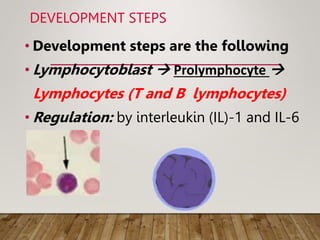
• Development steps are the following
• Lymphocytoblast  Prolymphocyte 
Lymphocytes (T and B lymphocytes)
• Regulation: by interleukin (IL)-1 and IL-6
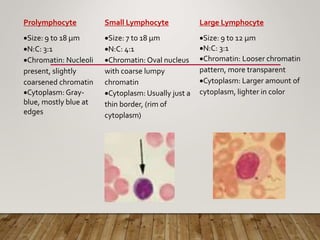
Prolymphocyte
Size: 9 to 18 μm
N:C: 3:1
Chromatin: Nucleoli
present, slightly
coarsened chromatin
Cytoplasm: Gray-
blue, mostly blue at
edges
Small Lymphocyte
Size: 7 to 18 μm
N:C: 4:1
Chromatin: Oval nucleus
with coarse lumpy
chromatin
Cytoplasm: Usually just a
thin border, (rim of
cytoplasm)
Large Lymphocyte
Size: 9 to 12 μm
N:C: 3:1
Chromatin: Looser chromatin
pattern, more transparent
Cytoplasm: Larger amount of
cytoplasm, lighter in color
PLASMA CELLS
 They are type of B lymphocyte
 Their function to produce antibodies after B cells
stimulation with antigen
 Origin: Bone marrow not found in the peripheral blood
1- Plasma blast:- 2- Proplasma cells: 3- Plasma
cells
-This appearance is not found
in peripheral blood or bone
marrow
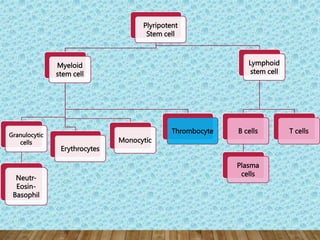
Plyripotent
Stem cell
Myeloid
stem cell
Granulocytic
cells
Neutr-
Eosin-
Basophil
Erythrocytes
Monocytic
Thrombocyte
Lymphoid
stem cell
B cells
Plasma
cells
T cells
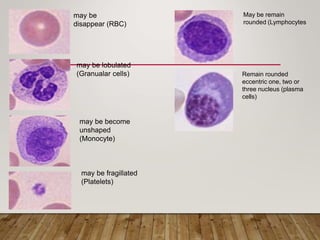
Changes
during cells
maturation
may be
disappear (RBC)
may be lobulated
(Granualar cells)
may be fragillated
(Platelets)
May be remain
rounded (Lymphocytes
may be become
unshaped
(Monocyte)
Remain rounded
eccentric one, two or
three nucleus (plasma
cells)
CHANGES OF THE PLASMA
1-may be
contain visible
granules
(Granular cells)
2-may be
contain no
visible
granules
(monocyte)
3-may be non
contain granules
(RBC)
4-decrease in
volume (lymphocyte
END OF THE LESSON
THANK U

Lymphopoiesis-.ppt

  • 1.
    LYMPHOPOIESIS Developed by Dr. AbdulrazzakOthman Alagbare- Clinical Pathologist -Hematology Lecturer _ MD-CMP
  • 2.
    NON-GRANULAR CELLS (LYMPHOID GROUP) Lymphoidstem cells:  These divide to form lymphoid progenitor cells which differentiate into B & T lymphocytes.  Early development of B lymphocytes takes place in the bone marrow and lymphoid tissues,  and development of T lymphocytes in the
  • 3.
    LYMPHOID GROUP Origin: 1-bone marrowand thymus 2-lymphoid tissue (spleen, lymphnodes,) Lymphoid group regulation  Regulated by: Inter-Leukines (IL 1 up to 21).
  • 4.
    DEVELOPMENT STEPS • Developmentsteps are the following • Lymphocytoblast  Prolymphocyte  Lymphocytes (T and B lymphocytes) • Regulation: by interleukin (IL)-1 and IL-6
  • 5.
    Prolymphocyte Size: 9 to18 μm N:C: 3:1 Chromatin: Nucleoli present, slightly coarsened chromatin Cytoplasm: Gray- blue, mostly blue at edges Small Lymphocyte Size: 7 to 18 μm N:C: 4:1 Chromatin: Oval nucleus with coarse lumpy chromatin Cytoplasm: Usually just a thin border, (rim of cytoplasm) Large Lymphocyte Size: 9 to 12 μm N:C: 3:1 Chromatin: Looser chromatin pattern, more transparent Cytoplasm: Larger amount of cytoplasm, lighter in color
  • 6.
    PLASMA CELLS  Theyare type of B lymphocyte  Their function to produce antibodies after B cells stimulation with antigen  Origin: Bone marrow not found in the peripheral blood 1- Plasma blast:- 2- Proplasma cells: 3- Plasma cells -This appearance is not found in peripheral blood or bone marrow
  • 7.
  • 9.
  • 10.
    may be disappear (RBC) maybe lobulated (Granualar cells) may be fragillated (Platelets) May be remain rounded (Lymphocytes may be become unshaped (Monocyte) Remain rounded eccentric one, two or three nucleus (plasma cells)
  • 11.
    CHANGES OF THEPLASMA 1-may be contain visible granules (Granular cells) 2-may be contain no visible granules (monocyte) 3-may be non contain granules (RBC) 4-decrease in volume (lymphocyte
  • 12.
    END OF THELESSON THANK U