The essential substances for erythrocytes
production
Iron metabolism
Prepared by
Dr. Abdulrazzaq Alagbare- MD-Clinical pathologist
Lecturer of hematology
Requirements for Red Blood Cell
Production
 Erythropoeitin
 Proteins, required for globin synthesis
 Iron
 Vitamin B12 and folic acid
 Vitamin B6
 Vitamin C
 Thyroid hormones, estrogens and androgens
2-drugs
1-foods such as meat, eggs, fishes
Iron sources
Introduction
Iron is essential to life due to its unusual flexibility to serve as both
an electron donor and acceptor.
Iron can also be potentially toxic.
When it is Fe2 and free in the plasma can cause damage to a wide
variety of cellular structures
To prevent that kind of damage iron bind the iron atoms to proteins
such as
• Apoferritin
• Transfeerin
• Ferritin
This binding allows cells to benefit from iron while also limiting its
ability to do harm
Iron
• The human body needs iron for oxygen transport.
• That oxygen is required for the production and survival of almost all
cells in our bodies (mature erythrocytes being one exception).
• Human bodies tightly regulate iron absorption and recycling.
• Iron is such an essential element of human life, in fact, that humans
have no physiologic regulatory mechanism for excreting iron.
• Most humans prevent iron overload only by regulating iron
absorption.
• Those who cannot regulate absorption well enough get disorders of
iron overload.
• In these diseases, the toxicity of iron starts overpowering the
body's ability to bind and store
Iron storage --1
 Storage irons occur in two forms- (about 1-2 g )
 ferritin and hemosiderin
Ferritin
Ferritin is normally predominant and store at
1-Bone marrow (the main place for iron storage)
2-Liver
The liver's stores of ferritin are the primary physiologic
source of reserve iron in the body
3-Kidneys and spleen
In the normal person, storage iron is divided about equally
between the reticuloendothelial cells (mainly in spleen, liver
and bone marrow),hepatic parenchyma cells and skeletal
muscle
Iron storage -Hemosidern - 2
Hemosidern
 If the main storage organ are full with iron
the body storage the iron in different tissues
as hemosidern
Hemosiderin, the main storage form in
reticuloendothelial cells, is more stable and
less readily mobilized for hemoglobin
formation than ferritin, which predominates in
hepatocyte
 Iron recycled
Iron recycled
Iron is recycled and thus conserved by the
body
Free iron in the body not exist
Free iron is very toxic
Iron forms in the body:
1-Fe2 active ferrous (Fe2 )
2-Fe3 - ferric (Fe3 )
 Fe3 converted to Fe2
Fe3 converted to Fe2 by the Ceruloplasmin protein
which acts as a ferroxidase, oxidizing iron from Fe3+ to
Fe2+. This may serve as a means of releasing iron from
ferritin for binding to transferrin
The circulation of the body's Red cells
The bone marrow
mass 3.000gr-
Produce 2,8 million
RBC per second-
6,4gr Hb per day,
using 21 mg Fe2+
The circulation contain
about 25 trillion RBC and
770 gr Hb
The spleen mass
300gr- it destroy
2,5 million RBC per
second and
degrades 6.4 gr Hb
per day, releasing
21 mg Fe2+
Iron pool
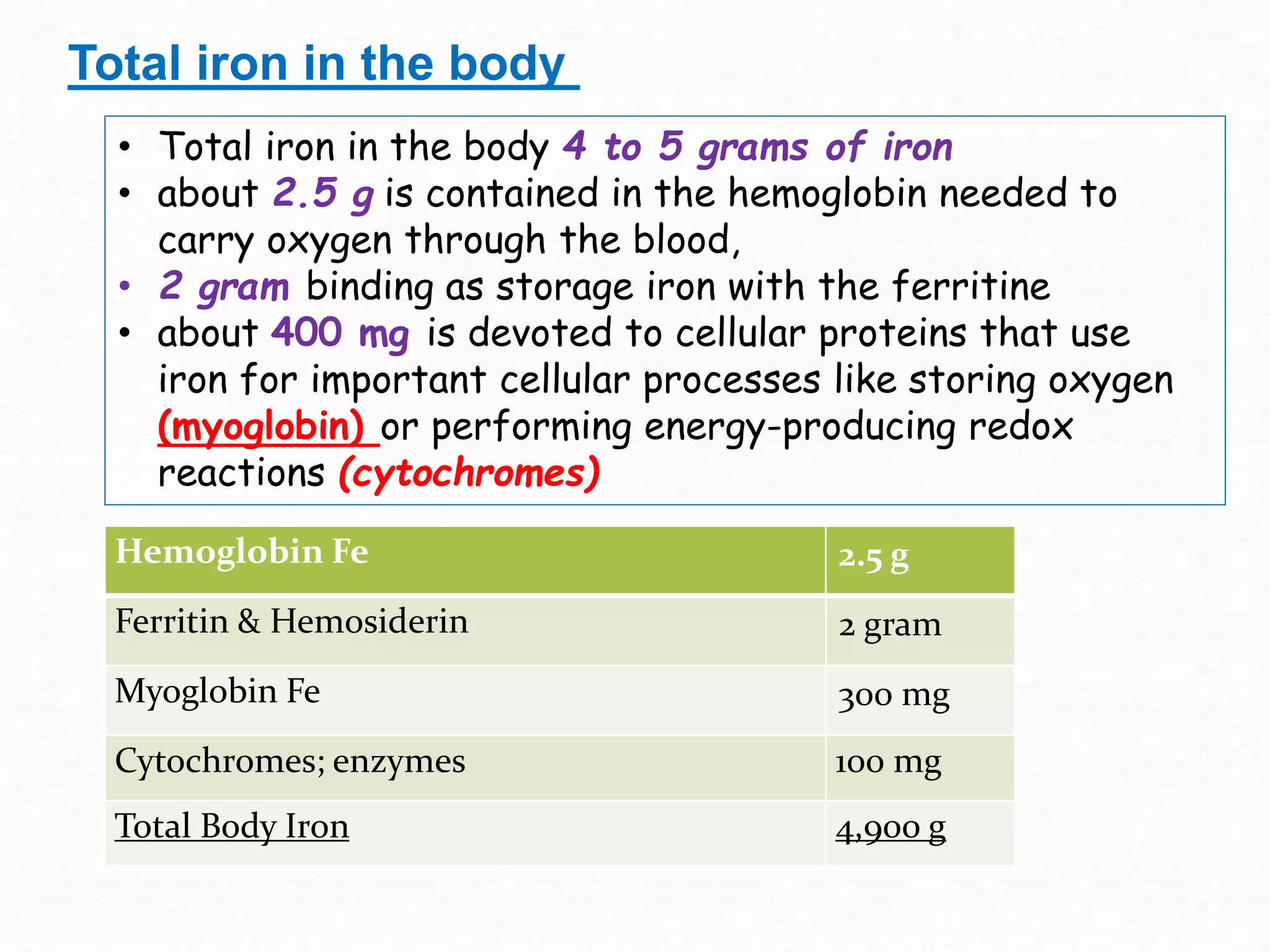
• Total iron in the body 4 to 5 grams of iron
• about 2.5 g is contained in the hemoglobin needed to
carry oxygen through the blood,
• 2 gram binding as storage iron with the ferritine
• about 400 mg is devoted to cellular proteins that use
iron for important cellular processes like storing oxygen
(myoglobin) or performing energy-producing redox
reactions (cytochromes)
Total iron in the body
Hemoglobin Fe 2.5 g
Ferritin & Hemosiderin 2 gram
Myoglobin Fe 300 mg
Cytochromes; enzymes 100 mg
Total Body Iron 4,900 g
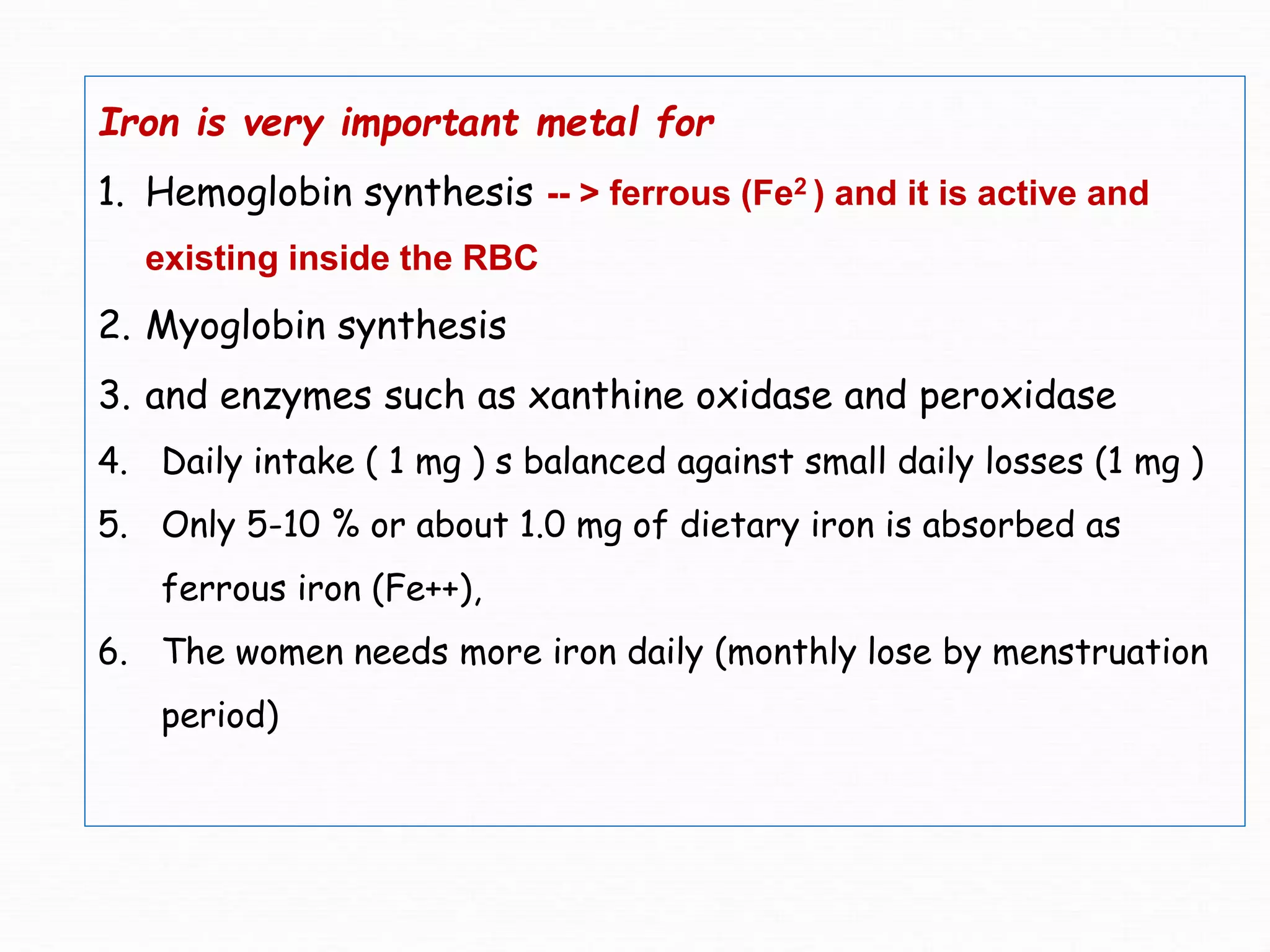
Iron is very important metal for
1. Hemoglobin synthesis -- > ferrous (Fe2 ) and it is active and
existing inside the RBC
2. Myoglobin synthesis
3. and enzymes such as xanthine oxidase and peroxidase
4. Daily intake ( 1 mg ) s balanced against small daily losses (1 mg )
5. Only 5-10 % or about 1.0 mg of dietary iron is absorbed as
ferrous iron (Fe++),
6. The women needs more iron daily (monthly lose by menstruation
period)
Methemoglobin
Methemoglobin
• The functional Hb the ferrous is on (Fe2+)
state.
• The iron atom can be oxidized to the ferric
(Fe3+) state with the production of
methemoglobin and superoxide (O2 –) as
pathological case
• It is useless as an oxygen carrier.If not
reduced to Fe2 the RBC destroyed (Hemolysis)
Diurnal variation:
 It is the case of level of the iron in the body. In the
morning the serum iron is higher, and lower in the
afternoon
 Iron excretion:
 Minimal amount (1mg) is loss by faecal or urinary
excretion as well as through sweating and
desquamating skin.
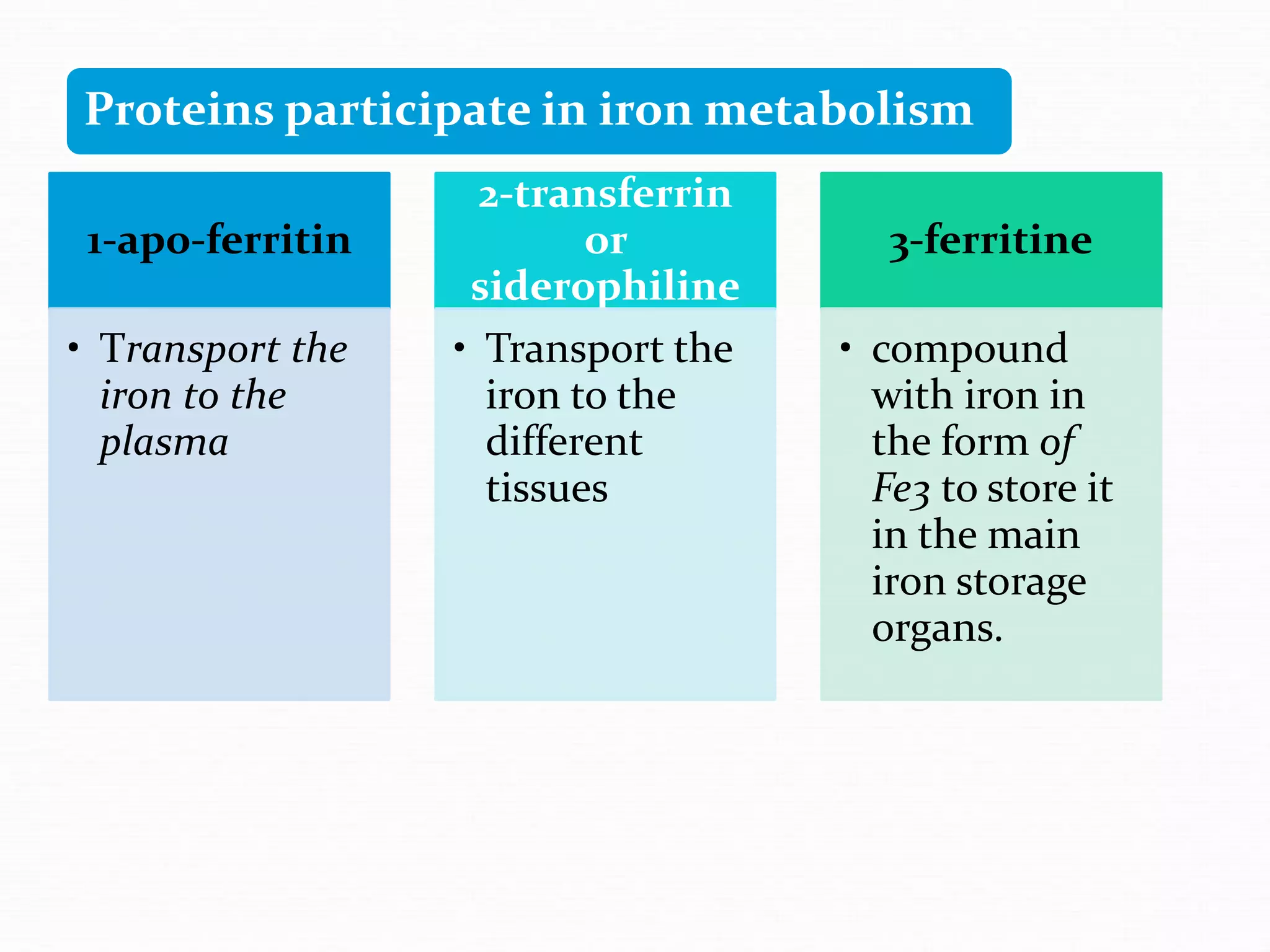
Proteins participate in iron metabolism
1-apo-ferritin
• Transport the
iron to the
plasma
2-transferrin
or
siderophiline
• Transport the
iron to the
different
tissues
3-ferritine
• compound
with iron in
the form of
Fe3 to store it
in the main
iron storage
organs.
Plasma (transport) Iron---1
 Each molecule of transferrin binds one or two atoms of
ferric iron Fe++.
 The function of transferrin is the transport of iron.
 It is the means by which iron absorbed from the
alimentary tract is transported to the tissue stores,
from tissue stores to bone marrow erythroblasts, and
from one storage site to another.
 When transferrin reaches the storage sites or the
bone marrow, it attaches to specific receptors on the
cells and liberates its ferric ions, which pass into the
cell to be stored or utilized.
Plasma (transport) Iron--- 2
 The total amount of transferrin in the plasma is about
8 g in the extracellular fluid.
 This value is known as the total iron binding capacity
of the serum (TIBC).
 The level of serum iron in normal subjects averages
about 20 umol (men > women).
 Transferrin is a glycoprotein present in the serum in
concentration, which enables it to combine with 44-80
umol of iron per litre.
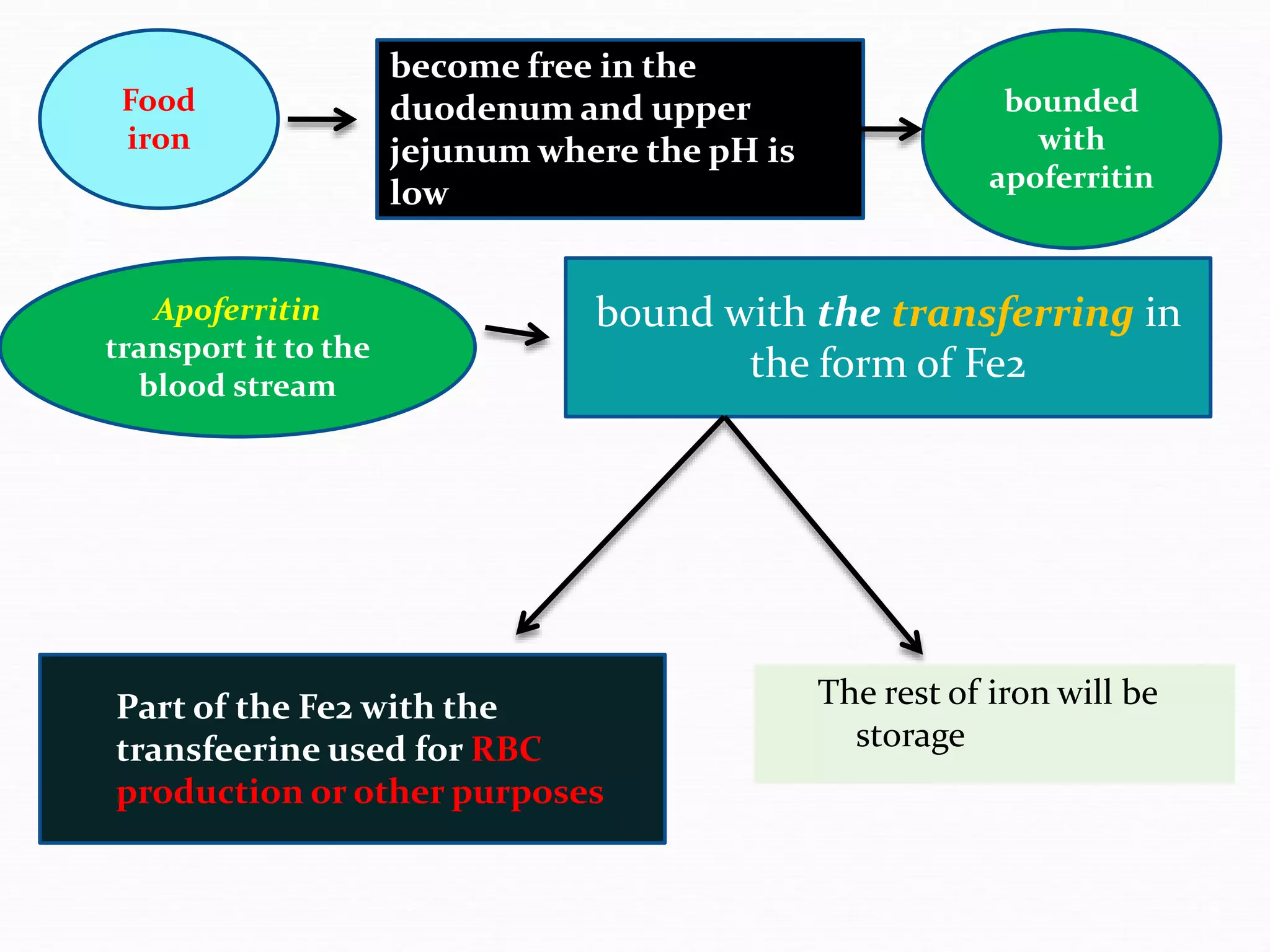
The rest of iron will be
storage
Food
iron
become free in the
duodenum and upper
jejunum where the pH is
low
bounded
with
apoferritin
Apoferritin
transport it to the
blood stream
bound with the transferring in
the form of Fe2
Part of the Fe2 with the
transfeerine used for RBC
production or other purposes
Summary points
 Iron is essential metal for life
 Iron existing in the body on tow forms
 Fe2 is active iron existing inside the Hb
 Fe3 non active and existing in the storage
 The main iron storage organs are B, marrow, liver,
kidneys and spleen
 Three proteins take place in the iron metabolism
 Apoferitine transport iron (Fe3) into plasma
 Transfeering transport iron (Fe2) into bone marrow
to make RBC
 Ferritine storage the iron in the form Fe3
Summary points
The excess iron storage in the tissue as ferritine called
hemosiderine
Free iron in the plasma not exist
The free iron is high toxic and must be removed from the
plasma
Daily iron intake is 1 mg and losing 1mg
Diurinal variation of iron is high in the morning low afternoon
The iron excreted by the stool, urine and sweating
Iron Metabolism .ppt

Iron Metabolism .ppt

  • 1.
    The essential substancesfor erythrocytes production Iron metabolism Prepared by Dr. Abdulrazzaq Alagbare- MD-Clinical pathologist Lecturer of hematology
  • 2.
    Requirements for RedBlood Cell Production  Erythropoeitin  Proteins, required for globin synthesis  Iron  Vitamin B12 and folic acid  Vitamin B6  Vitamin C  Thyroid hormones, estrogens and androgens
  • 3.
    2-drugs 1-foods such asmeat, eggs, fishes Iron sources
  • 4.
    Introduction Iron is essentialto life due to its unusual flexibility to serve as both an electron donor and acceptor. Iron can also be potentially toxic. When it is Fe2 and free in the plasma can cause damage to a wide variety of cellular structures To prevent that kind of damage iron bind the iron atoms to proteins such as • Apoferritin • Transfeerin • Ferritin This binding allows cells to benefit from iron while also limiting its ability to do harm Iron
  • 5.
    • The humanbody needs iron for oxygen transport. • That oxygen is required for the production and survival of almost all cells in our bodies (mature erythrocytes being one exception). • Human bodies tightly regulate iron absorption and recycling. • Iron is such an essential element of human life, in fact, that humans have no physiologic regulatory mechanism for excreting iron. • Most humans prevent iron overload only by regulating iron absorption. • Those who cannot regulate absorption well enough get disorders of iron overload. • In these diseases, the toxicity of iron starts overpowering the body's ability to bind and store
  • 6.
    Iron storage --1 Storage irons occur in two forms- (about 1-2 g )  ferritin and hemosiderin Ferritin Ferritin is normally predominant and store at 1-Bone marrow (the main place for iron storage) 2-Liver The liver's stores of ferritin are the primary physiologic source of reserve iron in the body 3-Kidneys and spleen In the normal person, storage iron is divided about equally between the reticuloendothelial cells (mainly in spleen, liver and bone marrow),hepatic parenchyma cells and skeletal muscle
  • 7.
    Iron storage -Hemosidern- 2 Hemosidern  If the main storage organ are full with iron the body storage the iron in different tissues as hemosidern Hemosiderin, the main storage form in reticuloendothelial cells, is more stable and less readily mobilized for hemoglobin formation than ferritin, which predominates in hepatocyte
  • 8.
     Iron recycled Ironrecycled Iron is recycled and thus conserved by the body Free iron in the body not exist Free iron is very toxic Iron forms in the body: 1-Fe2 active ferrous (Fe2 ) 2-Fe3 - ferric (Fe3 )
  • 9.
     Fe3 convertedto Fe2 Fe3 converted to Fe2 by the Ceruloplasmin protein which acts as a ferroxidase, oxidizing iron from Fe3+ to Fe2+. This may serve as a means of releasing iron from ferritin for binding to transferrin
  • 10.
    The circulation ofthe body's Red cells The bone marrow mass 3.000gr- Produce 2,8 million RBC per second- 6,4gr Hb per day, using 21 mg Fe2+ The circulation contain about 25 trillion RBC and 770 gr Hb The spleen mass 300gr- it destroy 2,5 million RBC per second and degrades 6.4 gr Hb per day, releasing 21 mg Fe2+ Iron pool
  • 11.
    • Total ironin the body 4 to 5 grams of iron • about 2.5 g is contained in the hemoglobin needed to carry oxygen through the blood, • 2 gram binding as storage iron with the ferritine • about 400 mg is devoted to cellular proteins that use iron for important cellular processes like storing oxygen (myoglobin) or performing energy-producing redox reactions (cytochromes) Total iron in the body Hemoglobin Fe 2.5 g Ferritin & Hemosiderin 2 gram Myoglobin Fe 300 mg Cytochromes; enzymes 100 mg Total Body Iron 4,900 g
  • 12.
    Iron is veryimportant metal for 1. Hemoglobin synthesis -- > ferrous (Fe2 ) and it is active and existing inside the RBC 2. Myoglobin synthesis 3. and enzymes such as xanthine oxidase and peroxidase 4. Daily intake ( 1 mg ) s balanced against small daily losses (1 mg ) 5. Only 5-10 % or about 1.0 mg of dietary iron is absorbed as ferrous iron (Fe++), 6. The women needs more iron daily (monthly lose by menstruation period)
  • 13.
    Methemoglobin Methemoglobin • The functionalHb the ferrous is on (Fe2+) state. • The iron atom can be oxidized to the ferric (Fe3+) state with the production of methemoglobin and superoxide (O2 –) as pathological case • It is useless as an oxygen carrier.If not reduced to Fe2 the RBC destroyed (Hemolysis)
  • 14.
    Diurnal variation:  Itis the case of level of the iron in the body. In the morning the serum iron is higher, and lower in the afternoon  Iron excretion:  Minimal amount (1mg) is loss by faecal or urinary excretion as well as through sweating and desquamating skin.
  • 15.
    Proteins participate iniron metabolism 1-apo-ferritin • Transport the iron to the plasma 2-transferrin or siderophiline • Transport the iron to the different tissues 3-ferritine • compound with iron in the form of Fe3 to store it in the main iron storage organs.
  • 16.
    Plasma (transport) Iron---1 Each molecule of transferrin binds one or two atoms of ferric iron Fe++.  The function of transferrin is the transport of iron.  It is the means by which iron absorbed from the alimentary tract is transported to the tissue stores, from tissue stores to bone marrow erythroblasts, and from one storage site to another.  When transferrin reaches the storage sites or the bone marrow, it attaches to specific receptors on the cells and liberates its ferric ions, which pass into the cell to be stored or utilized.
  • 17.
    Plasma (transport) Iron---2  The total amount of transferrin in the plasma is about 8 g in the extracellular fluid.  This value is known as the total iron binding capacity of the serum (TIBC).  The level of serum iron in normal subjects averages about 20 umol (men > women).  Transferrin is a glycoprotein present in the serum in concentration, which enables it to combine with 44-80 umol of iron per litre.
  • 18.
    The rest ofiron will be storage Food iron become free in the duodenum and upper jejunum where the pH is low bounded with apoferritin Apoferritin transport it to the blood stream bound with the transferring in the form of Fe2 Part of the Fe2 with the transfeerine used for RBC production or other purposes
  • 19.
    Summary points  Ironis essential metal for life  Iron existing in the body on tow forms  Fe2 is active iron existing inside the Hb  Fe3 non active and existing in the storage  The main iron storage organs are B, marrow, liver, kidneys and spleen  Three proteins take place in the iron metabolism  Apoferitine transport iron (Fe3) into plasma  Transfeering transport iron (Fe2) into bone marrow to make RBC  Ferritine storage the iron in the form Fe3
  • 20.
    Summary points The excessiron storage in the tissue as ferritine called hemosiderine Free iron in the plasma not exist The free iron is high toxic and must be removed from the plasma Daily iron intake is 1 mg and losing 1mg Diurinal variation of iron is high in the morning low afternoon The iron excreted by the stool, urine and sweating