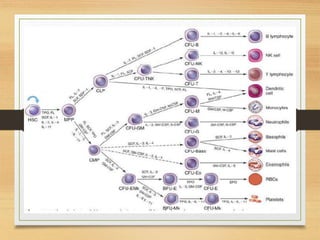
Hematopoiesis
By
Fayyaz Ahmad
Lecturer –ICBS, Lahore.
Hematopoiesis
• Hemato = Blood, Poiesis=Formation.
• In simple word it is called “formation of blood.”
• Hematopoiesis is also defined as the “production,
development, differentiation, and maturation of all
blood cells”e.g. RBCs,WBCs,Platletes
• There are two types of Hematopoiesis
1. Intrauterine/extramedullary
2. Extrauterine/ medullary
1.Intrauterine (extra medullary)
Hematopoiesis
• “Formation of blood in side uterus (embryonic)”
• Hematopoietic stem cells originate in the yolk sac,
migrate to the fetal liver and then to the bone marrow.
Three phases
1. Mesoblastic
2. Hepatic
3. Myeloid/medullary
1.1 Mesoblastic Phase:
• In first 19-20 days of embryonic stage, blood cells are formed in
the wall of the yolk sac.
• These cells are mesodermal in origin hence this phase is called
Mesoblastic phase.
• Mesoblastic phase only produces RBCs.
• The hemoglobin in these RBCs is called Embryonic Hemoglobin.
1.2 Hepatic Phase:
• The liver is the main site of hemopoiesis in the fetus from
5th to 30th week of intra-uterine life This is termed as
hepatic phase
• All type of blood cells are produced in later part of this
phase
• RBCs produced at this stage are larger than adult RBCs.
• The RBCs contain hemoglobin at this stage is called fetal
hemoglobin.
1.3 Medullary Hemopoiesis:
• The bone marrow gradually takes over hemopoietic
function from the 5th month until when the bone marrow
is the only major site for blood cells formation
• Lymphocytes precursors are formed in liver and bone
marrow but the main sites for lymphocytes development
are spleen, lymph nodes and other lymphoid tissues.
• Initially hemopoiesis takes place in the marrow of all
bones but after birth it slowly and gradually reduces to get
confined to marrow of flat bones and vertebrae.
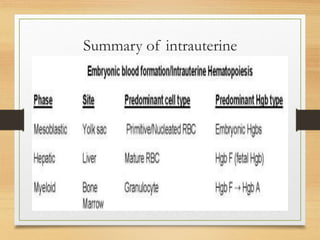
Summary of intrauterine
Hematopoiesis
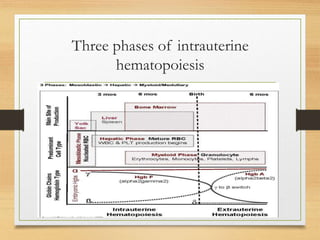
Three phases of intrauterine
hematopoiesis
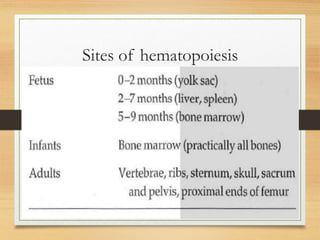
Sites of hematopoiesis
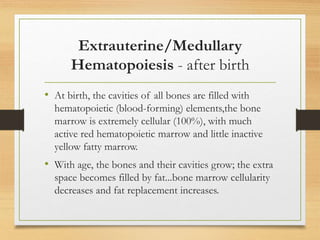
Extrauterine/Medullary
Hematopoiesis - after birth
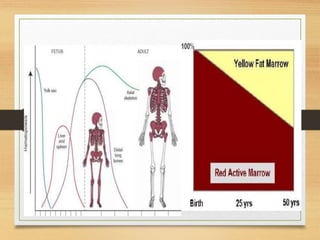
• At birth, the cavities of all bones are filled with
hematopoietic (blood-forming) elements,the bone
marrow is extremely cellular (100%), with much
active red hematopoietic marrow and little inactive
yellow fatty marrow.
• With age, the bones and their cavities grow; the extra
space becomes filled by fat...bone marrow cellularity
decreases and fat replacement increases.
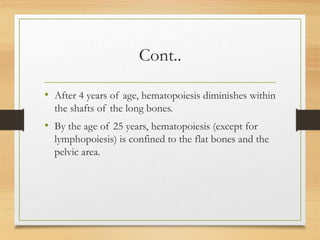
Cont..
• After 4 years of age, hematopoiesis diminishes within
the shafts of the long bones.
• By the age of 25 years, hematopoiesis (except for
lymphopoiesis) is confined to the flat bones and the
pelvic area.
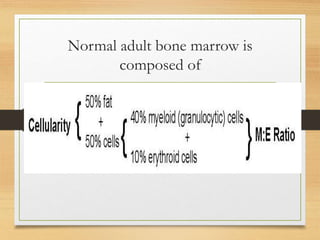
Normal adult bone marrow is
composed of
Bone marrow stroma
• The bone marrow forms a suitable microenviroment for stem cell
survival, growth and development.
• It is composed of
• 1) stromal cells
• 2) micro vascular network.
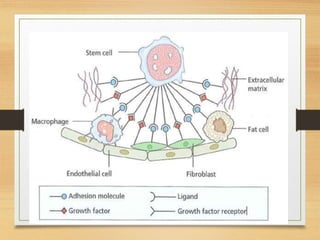
• The stromal cells include adipocytes, fibroblasts, endothelial cells
and macrophages.
• They secrete extracellular molecules such as collagen,
glycoproteins (fibronectin and thrombospondin) and
glycosaminoglycans (hyaluronic acid and chondroitin
derivatives) to form an extracellular matrix.
• In addition, stromal cells secrete several growth
factors necessary for stem cell survival.
• Mesenchymal stem cells are thought to be critical in
stromal cell formation.
Hematopoietic precursors cells
Hematopoietic precursors cells can be divided into
three cellular compartments.
1. Hematopoietic stem cells
2. Progenitor cells
3. Maturing cells
1. Hematopoietic stem cells
• All hematopoiesis derives from a pool of
undifferentiated cells, hematopoietic stem cells,
• This give rise to all of the bone marrow cells by the
process of proliferation and differentiation.
1. Hematopoietic stem cells
Characteristics
• 0.5% of total hematopoietic cells
• Multilineage differentiation potential
• Population maintained by self renewal
• Quiescent cell population
• Stable population/size
• Not morphological recognizable
• Measured by functional clonal assays in vivo and in vitro
2. Progenitor cells
• 3 % of total hematopoietic precursor cells
• Restricted developmental potential multipotential----
unipotential
• Transit population with restricted self-renewal
• Population amplified by proliferation
• Not morphologically recognizable
• Measured by clonal assays in vitro
3. Maturing cells
• Less than 95% of total hematopoietic precursor cells
• Transit population, numerically amplified by
proliferation
• Proliferative sequence complete before full
maturation
• Morphologically recognizable
Hematopoiesis

Hematopoiesis

  • 1.
  • 2.
    Hematopoiesis • Hemato =Blood, Poiesis=Formation. • In simple word it is called “formation of blood.” • Hematopoiesis is also defined as the “production, development, differentiation, and maturation of all blood cells”e.g. RBCs,WBCs,Platletes • There are two types of Hematopoiesis 1. Intrauterine/extramedullary 2. Extrauterine/ medullary
  • 3.
    1.Intrauterine (extra medullary) Hematopoiesis •“Formation of blood in side uterus (embryonic)” • Hematopoietic stem cells originate in the yolk sac, migrate to the fetal liver and then to the bone marrow. Three phases 1. Mesoblastic 2. Hepatic 3. Myeloid/medullary
  • 4.
    1.1 Mesoblastic Phase: •In first 19-20 days of embryonic stage, blood cells are formed in the wall of the yolk sac. • These cells are mesodermal in origin hence this phase is called Mesoblastic phase. • Mesoblastic phase only produces RBCs. • The hemoglobin in these RBCs is called Embryonic Hemoglobin.
  • 5.
    1.2 Hepatic Phase: •The liver is the main site of hemopoiesis in the fetus from 5th to 30th week of intra-uterine life This is termed as hepatic phase • All type of blood cells are produced in later part of this phase • RBCs produced at this stage are larger than adult RBCs. • The RBCs contain hemoglobin at this stage is called fetal hemoglobin.
  • 6.
    1.3 Medullary Hemopoiesis: •The bone marrow gradually takes over hemopoietic function from the 5th month until when the bone marrow is the only major site for blood cells formation • Lymphocytes precursors are formed in liver and bone marrow but the main sites for lymphocytes development are spleen, lymph nodes and other lymphoid tissues. • Initially hemopoiesis takes place in the marrow of all bones but after birth it slowly and gradually reduces to get confined to marrow of flat bones and vertebrae.
  • 7.
  • 8.
    Three phases ofintrauterine hematopoiesis
  • 9.
  • 10.
    Extrauterine/Medullary Hematopoiesis - afterbirth • At birth, the cavities of all bones are filled with hematopoietic (blood-forming) elements,the bone marrow is extremely cellular (100%), with much active red hematopoietic marrow and little inactive yellow fatty marrow. • With age, the bones and their cavities grow; the extra space becomes filled by fat...bone marrow cellularity decreases and fat replacement increases.
  • 11.
    Cont.. • After 4years of age, hematopoiesis diminishes within the shafts of the long bones. • By the age of 25 years, hematopoiesis (except for lymphopoiesis) is confined to the flat bones and the pelvic area.
  • 13.
    Normal adult bonemarrow is composed of
  • 14.
    Bone marrow stroma •The bone marrow forms a suitable microenviroment for stem cell survival, growth and development. • It is composed of • 1) stromal cells • 2) micro vascular network. • The stromal cells include adipocytes, fibroblasts, endothelial cells and macrophages.
  • 15.
    • They secreteextracellular molecules such as collagen, glycoproteins (fibronectin and thrombospondin) and glycosaminoglycans (hyaluronic acid and chondroitin derivatives) to form an extracellular matrix. • In addition, stromal cells secrete several growth factors necessary for stem cell survival. • Mesenchymal stem cells are thought to be critical in stromal cell formation.
  • 17.
    Hematopoietic precursors cells Hematopoieticprecursors cells can be divided into three cellular compartments. 1. Hematopoietic stem cells 2. Progenitor cells 3. Maturing cells
  • 18.
    1. Hematopoietic stemcells • All hematopoiesis derives from a pool of undifferentiated cells, hematopoietic stem cells, • This give rise to all of the bone marrow cells by the process of proliferation and differentiation.
  • 19.
    1. Hematopoietic stemcells Characteristics • 0.5% of total hematopoietic cells • Multilineage differentiation potential • Population maintained by self renewal • Quiescent cell population • Stable population/size • Not morphological recognizable • Measured by functional clonal assays in vivo and in vitro
  • 20.
    2. Progenitor cells •3 % of total hematopoietic precursor cells • Restricted developmental potential multipotential---- unipotential • Transit population with restricted self-renewal • Population amplified by proliferation • Not morphologically recognizable • Measured by clonal assays in vitro
  • 21.
    3. Maturing cells •Less than 95% of total hematopoietic precursor cells • Transit population, numerically amplified by proliferation • Proliferative sequence complete before full maturation • Morphologically recognizable