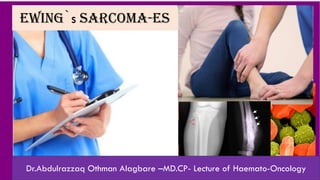
Ewing`s Sarcoma-es
Dr.Abdulrazzaq Othman Alagbare –MD.CP- Lecture of Haemato-Oncology
Ewing`s Sarcoma-es
Ewing`s
Sarcoma-
es
Ewing`s Sarcoma-es
INTRODUCTION
❖ Ewing sarcoma is a rare type of cancer that occurs in bones or
in the soft tissue around the bones.
❖ It is an aggressive bone and soft-tissue cancer
In 1920,Dr,James Ewing described an unusual tumor in a 14-
year-old girl as a “diffuse endothelioma of bone.
Ewing sarcoma sites
❖ most often begins in the leg bones and in
the pelvis, but it can occur in any bone.
Bone (80%)
❖ Axial skeleton (45%) - Pelvis (20%) - Ribs
(10%)
Other axial bones (15%)
Distal skeleton (35%)
❖ Femur (12%) -Humerus (4%) - Other distal
bones (19%)
Ewing sarcoma sites-Metastasis
Main metastatic site are
❖ • Lungs
❖ • Bone
❖ • Bone marrow
Ewing sarcoma sites-Metastasis
❖ Ewing sarcoma affects males more often than females.
It occurs primarily in
❖ children 0-10 yrs.
❖ and young adults, up to 20yrs.
❖ Consist 1% of all cancers in children and adolescents younger
than 15
❖ and 2% of all cancers in teens aged 15 to 19.
Ewing sarcoma incidence
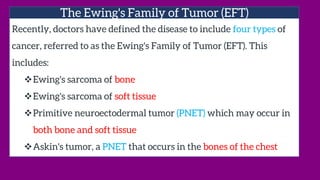
Recently, doctors have defined the disease to include four types of
cancer, referred to as the Ewing's Family of Tumor (EFT). This
includes:
❖Ewing's sarcoma of bone
❖Ewing's sarcoma of soft tissue
❖Primitive neuroectodermal tumor (PNET) which may occur in
both bone and soft tissue
❖Askin's tumor, a PNET that occurs in the bones of the chest
The Ewing's Family of Tumor (EFT)
❖ There is no known cause of Ewing's sarcoma.
The Ewing's Sarcoma Causes
Predispose by
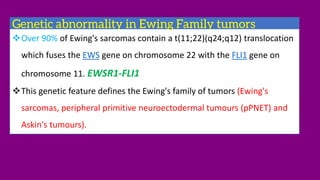
❖Over 90% of Ewing's sarcomas contain a t(11;22)(q24;q12) translocation
which fuses the EWS gene on chromosome 22 with the FLI1 gene on
chromosome 11. EWSR1-FLI1
❖This genetic feature defines the Ewing's family of tumors (Ewing's
sarcomas, peripheral primitive neuroectodermal tumours (pPNET) and
Askin's tumours).
Genetic abnormality in Ewing Family tumors
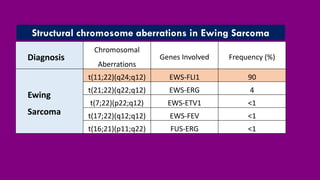
Diagnosis
Chromosomal
Aberrations
Genes Involved Frequency (%)
Ewing
Sarcoma
t(11;22)(q24;q12) EWS-FLI1 90
t(21;22)(q22;q12) EWS-ERG 4
t(7;22)(p22;q12) EWS-ETV1 <1
t(17;22)(q12;q12) EWS-FEV <1
t(16;21)(p11;q22) FUS-ERG <1
Structural chromosome aberrations in Ewing Sarcoma
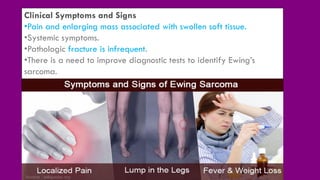
Clinical Symptoms and Signs
•Pain and enlarging mass associated with swollen soft tissue.
•Systemic symptoms.
•Pathologic fracture is infrequent.
•There is a need to improve diagnostic tests to identify Ewing’s
sarcoma.
Ewing sarcoma Diagnostic panel
❖Patient history
❖Clinical examination
❖CBC-ESR
❖Blood Tests- LFT,RFT.Mg++,Ca++,ALK. etc.
❖Cytogenetic tests-FISH,Karyotyping test
❖Molecular genetic tests-PCR
❖Biopsy
❖Radiological investigation
➢X-ray
➢CT Features
➢MRI Features
➢Bone Scan - Tumor and metastasis
➢Positron emission tomography (PET) scan
Ewing sarcoma
❖Patient history
❖Clinical examination
Ewing sarcoma - Cytogenetic tests-FISH,Karyotyping test
t(11;22)(q24;q12) EWS-FLI1 90
Ewing sarcoma Patient history- Cytogenetic tests-FISH
t(11;22)(q24;q12) EWS-FLI1 90
. (A) Atypical (large cell)
Histologic variation in Ewing sarcoma
(B) Areas with extensive
spindle cell features
may be seen
Spindle cell sarcoma is a soft
tissue tumor usually found in the
arm or leg bones, or in the
pelvis.
Radiographic Features
❖X-ray
❖CT Features
❖MRI Features
❖Bone Scan - Tumor and metastasis
❖Positron emission tomography (PET) scan.
The Ewing's Sarcoma Image Diagnosis
Ewing sarcoma of bone in a child. Plain radiograph shows
a mass in the metadiaphyseal region of the distal humerus.
Ewing sarcoma - Radiological investigation
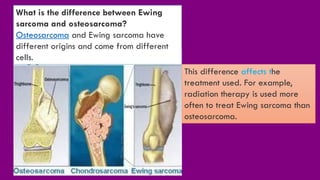
What is the difference between Ewing
sarcoma and osteosarcoma?
Osteosarcoma and Ewing sarcoma have
different origins and come from different
cells.
This difference affects the
treatment used. For example,
radiation therapy is used more
often to treat Ewing sarcoma than
osteosarcoma.
Bones Cancers- Ewing`s Sarcoma.pdf

Bones Cancers- Ewing`s Sarcoma.pdf

  • 1.
    Ewing`s Sarcoma-es Dr.Abdulrazzaq OthmanAlagbare –MD.CP- Lecture of Haemato-Oncology
  • 2.
  • 3.
  • 4.
    INTRODUCTION ❖ Ewing sarcomais a rare type of cancer that occurs in bones or in the soft tissue around the bones. ❖ It is an aggressive bone and soft-tissue cancer In 1920,Dr,James Ewing described an unusual tumor in a 14- year-old girl as a “diffuse endothelioma of bone.
  • 5.
    Ewing sarcoma sites ❖most often begins in the leg bones and in the pelvis, but it can occur in any bone. Bone (80%) ❖ Axial skeleton (45%) - Pelvis (20%) - Ribs (10%) Other axial bones (15%) Distal skeleton (35%) ❖ Femur (12%) -Humerus (4%) - Other distal bones (19%) Ewing sarcoma sites-Metastasis
  • 6.
    Main metastatic siteare ❖ • Lungs ❖ • Bone ❖ • Bone marrow Ewing sarcoma sites-Metastasis
  • 7.
    ❖ Ewing sarcomaaffects males more often than females. It occurs primarily in ❖ children 0-10 yrs. ❖ and young adults, up to 20yrs. ❖ Consist 1% of all cancers in children and adolescents younger than 15 ❖ and 2% of all cancers in teens aged 15 to 19. Ewing sarcoma incidence
  • 8.
    Recently, doctors havedefined the disease to include four types of cancer, referred to as the Ewing's Family of Tumor (EFT). This includes: ❖Ewing's sarcoma of bone ❖Ewing's sarcoma of soft tissue ❖Primitive neuroectodermal tumor (PNET) which may occur in both bone and soft tissue ❖Askin's tumor, a PNET that occurs in the bones of the chest The Ewing's Family of Tumor (EFT)
  • 9.
    ❖ There isno known cause of Ewing's sarcoma. The Ewing's Sarcoma Causes Predispose by
  • 10.
    ❖Over 90% ofEwing's sarcomas contain a t(11;22)(q24;q12) translocation which fuses the EWS gene on chromosome 22 with the FLI1 gene on chromosome 11. EWSR1-FLI1 ❖This genetic feature defines the Ewing's family of tumors (Ewing's sarcomas, peripheral primitive neuroectodermal tumours (pPNET) and Askin's tumours). Genetic abnormality in Ewing Family tumors
  • 11.
    Diagnosis Chromosomal Aberrations Genes Involved Frequency(%) Ewing Sarcoma t(11;22)(q24;q12) EWS-FLI1 90 t(21;22)(q22;q12) EWS-ERG 4 t(7;22)(p22;q12) EWS-ETV1 <1 t(17;22)(q12;q12) EWS-FEV <1 t(16;21)(p11;q22) FUS-ERG <1 Structural chromosome aberrations in Ewing Sarcoma
  • 12.
    Clinical Symptoms andSigns •Pain and enlarging mass associated with swollen soft tissue. •Systemic symptoms. •Pathologic fracture is infrequent. •There is a need to improve diagnostic tests to identify Ewing’s sarcoma.
  • 13.
    Ewing sarcoma Diagnosticpanel ❖Patient history ❖Clinical examination ❖CBC-ESR ❖Blood Tests- LFT,RFT.Mg++,Ca++,ALK. etc. ❖Cytogenetic tests-FISH,Karyotyping test ❖Molecular genetic tests-PCR ❖Biopsy ❖Radiological investigation ➢X-ray ➢CT Features ➢MRI Features ➢Bone Scan - Tumor and metastasis ➢Positron emission tomography (PET) scan
  • 14.
  • 15.
  • 16.
    Ewing sarcoma -Cytogenetic tests-FISH,Karyotyping test t(11;22)(q24;q12) EWS-FLI1 90
  • 17.
    Ewing sarcoma Patienthistory- Cytogenetic tests-FISH t(11;22)(q24;q12) EWS-FLI1 90
  • 18.
    . (A) Atypical(large cell) Histologic variation in Ewing sarcoma (B) Areas with extensive spindle cell features may be seen Spindle cell sarcoma is a soft tissue tumor usually found in the arm or leg bones, or in the pelvis.
  • 19.
    Radiographic Features ❖X-ray ❖CT Features ❖MRIFeatures ❖Bone Scan - Tumor and metastasis ❖Positron emission tomography (PET) scan. The Ewing's Sarcoma Image Diagnosis
  • 20.
    Ewing sarcoma ofbone in a child. Plain radiograph shows a mass in the metadiaphyseal region of the distal humerus. Ewing sarcoma - Radiological investigation
  • 21.
    Ewing sarcoma -Radiological investigation
  • 22.
    What is thedifference between Ewing sarcoma and osteosarcoma? Osteosarcoma and Ewing sarcoma have different origins and come from different cells. This difference affects the treatment used. For example, radiation therapy is used more often to treat Ewing sarcoma than osteosarcoma.