What is Systemic Lupus
Erythematosus (SLE)?
S.L.E. Lupus Foundation
Educational Program
Laura Geraldino, MD
January 16th. 2013
• Introduction
– Immune system
– Autoimmunity
• Common manifestations:
– Skin and mucosas
– Musculo-skeletal
– Serositis
– Kidneys
– Nervous system
• Morbidity and mortality
Outline
• Complex collection of organs, cells and cell
products that work together to protect the body
from foreign substances and disease, caused
mainly by pathogens.
• Plays a direct role in immunization, infectious
diseases, allergies and autoimmune diseases.
Immune System
• Disarray in the immune system can lead to an
attack of self.
• Illnesses that occur when the body tissues are
attacked by its own immune system.
Autoimmune Diseases
SLE
• Complex autoimmune disease characterized by
“self-attacking” antibodies.
• Symptoms vary from individual to individual.
• Unpredictable course and prognosis.
Ruiz-Irastorza G, Khamashta MA, Castellino G, Hughes GR. Systemic lupus erythematosus. Lancet 2001;357:1027–32.
SLE is…
SLE
SLE is not…
• NOT curable but controlled:
– Flares (exacerbation) vs. remission (very few or no
symptoms).
• NOT transmittable.
Manifestations
ACR Classification Criteria
• Malar rash
• Discoid rash
• Sensitivity to the sun
• Ulcers in mouth and nose
• Arthritis
• Pericarditis/pleuritis
• Glomerulonephritis (kidney)
• Neuropsychiatric Lupus
(brain)
• Low blood cell counts
• Positive ANA
• Other antibodies:
– Smith Ab, dsDNA Ab,
– anti-Cardiolipin Ig
Rheumatology e-dition, 4th Edition. Marc C. Hochberg, MD, MPH, Alan J. Silman, MD, Josef S. Smolen, MD, Michael E. Weinblatt, MD and Michael H. Weisman, MD
Malar Rash
Rheumatology e-dition, 4th Edition. Marc C. Hochberg, MD, MPH, Alan J. Silman, MD, Josef S. Smolen, MD, Michael E. Weinblatt, MD and Michael H. Weisman, MD
Cutaneous
Oral Ulcers
Discoid lesions
Rheumatology e-dition, 4th Edition. Marc C. Hochberg, MD, MPH, Alan J. Silman, MD, Josef S. Smolen, MD, Michael E. Weinblatt, MD and Michael H. Weisman, MD
• Joint pain
constitute the
most common
presenting
manifestation of
SLE.
Arthritis
“Serositis”
• Inflammation of the membranes covering
the lungs, heart and abdominal cavity.
Lupus Pleuritis
• Recurrent chest pain with breathing occurs
in 45% pts.
• Pleural effusion (fluid around the lungs) in
30%. Bilateral in 50%. Usually small.
• Chest pain and pleural effusions are the
initial manifestation in 3% and 1% of pts,
respectively.
Diagnosis and management of lupus pleuritis. Der-Yuan Wang, MD, FCCP. Current Opinion in Pulmonary Medicine
Lupus Pleuritis
• Attacks of this chest pain often lasts
several days to several weeks.
• Most patients have fever, cough and
difficulty breathing.
Diagnosis and management of lupus pleuritis. Der-Yuan Wang, MD, FCCP. Current Opinion in Pulmonary Medicine 2002, 8:312–316
• Involvement of the kidneys during the course
of the disease occurs in up to 60% of cases,
resulting in worsening morbidity and
mortality.
Houssiau FA. Management of lupus nephritis: an update. J Am Soc Nephrol 2004;15:2694–704.
Lupus nephritis
• A major feature of lupus in the kidneys is the
considerable degree of variation in severity.
• Nearly 1/3 progressing to advanced kidney
disease, while the others either respond to therapy
and follow a milder course.
• The course, response to therapy, and outcome are
heterogeneous among affected individuals.
Characterization of heterogeneity in the molecular pathogenesis of lupus nephritis from transcriptional profiles of laser-captured glomeruli.
Peterson KS, Huang JF, Zhu J, D'Agati V, Liu X, Miller N, Erlander MG, Jackson MR, Winchester RJ. J Clin Invest. 2004 Jun;113(12):1722-33.
Lupus nephritis
Lupus Nephritis Classes
Class II (mesangial) Class III (focal proliferative) Class IV (diffuse proliferative)
Class V (membranous) Class VI (advanced sclerosis)
WHO Classification
• Severe nervous system involvement in lupus is
relatively uncommon but can lead to
significant morbidity and mortality if not
managed adequately.
• It has been reported to occur in 14% to 80% of
lupus patients.
Muscal E, Brey RL . Neurologic manifestations of systemic lupus erythematosus in children and adults. Neurol Clin. 2010 Feb;28(1):61-73.
KY Fong, J Thumboo. Neuropsychiatric lupus: clinical challenges, brain-reactive autoantibodies and treatment strategies. Lupus 2010 19: 1399
Lupus in the Nervous System
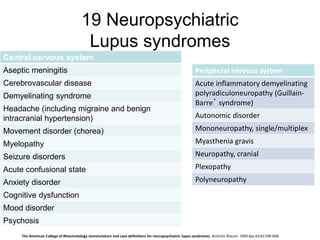
19 Neuropsychiatric
Lupus syndromes
Central nervous system
Aseptic meningitis
Cerebrovascular disease
Demyelinating syndrome
Headache (including migraine and benign
intracranial hypertension)
Movement disorder (chorea)
Myelopathy
Seizure disorders
Acute confusional state
Anxiety disorder
Cognitive dysfunction
Mood disorder
Psychosis
Peripheral nervous system
Acute inflammatory demyelinating
polyradiculoneuropathy (Guillain-
Barre´ syndrome)
Autonomic disorder
Mononeuropathy, single/multiplex
Myasthenia gravis
Neuropathy, cranial
Plexopathy
Polyneuropathy
The American College of Rheumatology nomenclature and case definitions for neuropsychiatric lupus syndromes. Arthritis Rheum. 1999 Apr;42(4):599-608.
•Does NOT mean you have lupus.
•Good screening test- practically all patients
with lupus. BUT not a specific test.
“Positive ANA”
•Fatigue
•Fever
•Hair loss
•Purple fingers in the cold
•Blood clots
Other manifestations…
•Leading cause of kidney disease, strokes and
heart disease in childbearing age women.
•35-44 y/o lupus patients are 50 times more
likely to have a heart attack.
•2X increased risk for carotid plaque
(atherosclerosis). (<40y/o)
•Disability.
Morbidity
(1) Manzi S. et al. Am J Epidemiol. 1997;145;408-415. (2) Esdaile JM et al. Arthritis Rheum. 2001; 44 (10):2331-2337 (3) Roman MJ et al. N Engl J Med. 2003; 349: 2399-2406
Mortality
• Over the past 50y, 5y-
survival in lupus pts
improved from 50% in
1955 to 82-95% in
1990s.
•However, lupus
patients have a 3-5X
increased mortality
compared to the
general population.
Trends in the incidence and mortality of systemic lupus erythematosus, 1950-1992. Uramoto KM, Michet CJ Jr, Thumboo J, Sunku J, O'Fallon WM, Gabriel SE. Arthritis Rheum.
1999 Jan;42(1):46-50.
SLE pts in the 1980–1992 cohort.
Mortality
SLE pts in the 1950–1979 cohort. Pop=population; MN-W=Minnesota whites
• SLE (lupus) is a complex autoimmune disease
that can affect a large variety of organs and
have different manifestations from patient to
patient.
• Most common initial symptoms are rashes and
joint pains.
• About 2/3 of patients with lupus have kidney
involvement.
NP SLE Related Abs
Take home points
• The course of the disease and prognosis are
unpredictable.
• Morbidity and mortality is increased in lupus
patients.
• Early diagnosis and close disease activity
monitoring are essential to achieve better
outcomes.
NP SLE Related Abs
Take home points
Lupus Clinic Contact Info:
1150 St. Nicholas, 1st. Level
New York, NY 10032
T- (212) 851-5350

Lupus foundation educational program 2013

  • 1.
    What is SystemicLupus Erythematosus (SLE)? S.L.E. Lupus Foundation Educational Program Laura Geraldino, MD January 16th. 2013
  • 2.
    • Introduction – Immunesystem – Autoimmunity • Common manifestations: – Skin and mucosas – Musculo-skeletal – Serositis – Kidneys – Nervous system • Morbidity and mortality Outline
  • 3.
    • Complex collectionof organs, cells and cell products that work together to protect the body from foreign substances and disease, caused mainly by pathogens. • Plays a direct role in immunization, infectious diseases, allergies and autoimmune diseases. Immune System
  • 4.
    • Disarray inthe immune system can lead to an attack of self. • Illnesses that occur when the body tissues are attacked by its own immune system. Autoimmune Diseases
  • 5.
    SLE • Complex autoimmunedisease characterized by “self-attacking” antibodies. • Symptoms vary from individual to individual. • Unpredictable course and prognosis. Ruiz-Irastorza G, Khamashta MA, Castellino G, Hughes GR. Systemic lupus erythematosus. Lancet 2001;357:1027–32. SLE is…
  • 6.
    SLE SLE is not… •NOT curable but controlled: – Flares (exacerbation) vs. remission (very few or no symptoms). • NOT transmittable.
  • 7.
  • 8.
    ACR Classification Criteria •Malar rash • Discoid rash • Sensitivity to the sun • Ulcers in mouth and nose • Arthritis • Pericarditis/pleuritis • Glomerulonephritis (kidney) • Neuropsychiatric Lupus (brain) • Low blood cell counts • Positive ANA • Other antibodies: – Smith Ab, dsDNA Ab, – anti-Cardiolipin Ig
  • 9.
    Rheumatology e-dition, 4thEdition. Marc C. Hochberg, MD, MPH, Alan J. Silman, MD, Josef S. Smolen, MD, Michael E. Weinblatt, MD and Michael H. Weisman, MD Malar Rash
  • 10.
    Rheumatology e-dition, 4thEdition. Marc C. Hochberg, MD, MPH, Alan J. Silman, MD, Josef S. Smolen, MD, Michael E. Weinblatt, MD and Michael H. Weisman, MD Cutaneous Oral Ulcers Discoid lesions
  • 11.
    Rheumatology e-dition, 4thEdition. Marc C. Hochberg, MD, MPH, Alan J. Silman, MD, Josef S. Smolen, MD, Michael E. Weinblatt, MD and Michael H. Weisman, MD • Joint pain constitute the most common presenting manifestation of SLE. Arthritis
  • 12.
    “Serositis” • Inflammation ofthe membranes covering the lungs, heart and abdominal cavity.
  • 13.
    Lupus Pleuritis • Recurrentchest pain with breathing occurs in 45% pts. • Pleural effusion (fluid around the lungs) in 30%. Bilateral in 50%. Usually small. • Chest pain and pleural effusions are the initial manifestation in 3% and 1% of pts, respectively. Diagnosis and management of lupus pleuritis. Der-Yuan Wang, MD, FCCP. Current Opinion in Pulmonary Medicine
  • 14.
    Lupus Pleuritis • Attacksof this chest pain often lasts several days to several weeks. • Most patients have fever, cough and difficulty breathing. Diagnosis and management of lupus pleuritis. Der-Yuan Wang, MD, FCCP. Current Opinion in Pulmonary Medicine 2002, 8:312–316
  • 15.
    • Involvement ofthe kidneys during the course of the disease occurs in up to 60% of cases, resulting in worsening morbidity and mortality. Houssiau FA. Management of lupus nephritis: an update. J Am Soc Nephrol 2004;15:2694–704. Lupus nephritis
  • 16.
    • A majorfeature of lupus in the kidneys is the considerable degree of variation in severity. • Nearly 1/3 progressing to advanced kidney disease, while the others either respond to therapy and follow a milder course. • The course, response to therapy, and outcome are heterogeneous among affected individuals. Characterization of heterogeneity in the molecular pathogenesis of lupus nephritis from transcriptional profiles of laser-captured glomeruli. Peterson KS, Huang JF, Zhu J, D'Agati V, Liu X, Miller N, Erlander MG, Jackson MR, Winchester RJ. J Clin Invest. 2004 Jun;113(12):1722-33. Lupus nephritis
  • 17.
    Lupus Nephritis Classes ClassII (mesangial) Class III (focal proliferative) Class IV (diffuse proliferative) Class V (membranous) Class VI (advanced sclerosis) WHO Classification
  • 18.
    • Severe nervoussystem involvement in lupus is relatively uncommon but can lead to significant morbidity and mortality if not managed adequately. • It has been reported to occur in 14% to 80% of lupus patients. Muscal E, Brey RL . Neurologic manifestations of systemic lupus erythematosus in children and adults. Neurol Clin. 2010 Feb;28(1):61-73. KY Fong, J Thumboo. Neuropsychiatric lupus: clinical challenges, brain-reactive autoantibodies and treatment strategies. Lupus 2010 19: 1399 Lupus in the Nervous System
  • 19.
    19 Neuropsychiatric Lupus syndromes Centralnervous system Aseptic meningitis Cerebrovascular disease Demyelinating syndrome Headache (including migraine and benign intracranial hypertension) Movement disorder (chorea) Myelopathy Seizure disorders Acute confusional state Anxiety disorder Cognitive dysfunction Mood disorder Psychosis Peripheral nervous system Acute inflammatory demyelinating polyradiculoneuropathy (Guillain- Barre´ syndrome) Autonomic disorder Mononeuropathy, single/multiplex Myasthenia gravis Neuropathy, cranial Plexopathy Polyneuropathy The American College of Rheumatology nomenclature and case definitions for neuropsychiatric lupus syndromes. Arthritis Rheum. 1999 Apr;42(4):599-608.
  • 20.
    •Does NOT meanyou have lupus. •Good screening test- practically all patients with lupus. BUT not a specific test. “Positive ANA”
  • 21.
    •Fatigue •Fever •Hair loss •Purple fingersin the cold •Blood clots Other manifestations…
  • 22.
    •Leading cause ofkidney disease, strokes and heart disease in childbearing age women. •35-44 y/o lupus patients are 50 times more likely to have a heart attack. •2X increased risk for carotid plaque (atherosclerosis). (<40y/o) •Disability. Morbidity (1) Manzi S. et al. Am J Epidemiol. 1997;145;408-415. (2) Esdaile JM et al. Arthritis Rheum. 2001; 44 (10):2331-2337 (3) Roman MJ et al. N Engl J Med. 2003; 349: 2399-2406
  • 23.
    Mortality • Over thepast 50y, 5y- survival in lupus pts improved from 50% in 1955 to 82-95% in 1990s. •However, lupus patients have a 3-5X increased mortality compared to the general population. Trends in the incidence and mortality of systemic lupus erythematosus, 1950-1992. Uramoto KM, Michet CJ Jr, Thumboo J, Sunku J, O'Fallon WM, Gabriel SE. Arthritis Rheum. 1999 Jan;42(1):46-50. SLE pts in the 1980–1992 cohort. Mortality SLE pts in the 1950–1979 cohort. Pop=population; MN-W=Minnesota whites
  • 24.
    • SLE (lupus)is a complex autoimmune disease that can affect a large variety of organs and have different manifestations from patient to patient. • Most common initial symptoms are rashes and joint pains. • About 2/3 of patients with lupus have kidney involvement. NP SLE Related Abs Take home points
  • 25.
    • The courseof the disease and prognosis are unpredictable. • Morbidity and mortality is increased in lupus patients. • Early diagnosis and close disease activity monitoring are essential to achieve better outcomes. NP SLE Related Abs Take home points
  • 26.
    Lupus Clinic ContactInfo: 1150 St. Nicholas, 1st. Level New York, NY 10032 T- (212) 851-5350