Presented by
Monika Devi
Msc(N)1st year
HCN ,SRHU
Systemic Lupus Erythematosus
Definition
• Systemic lupus erythematosus is an autoimmune
disease of the body's connective tissues.
• Autoimmune means that the immune system attacks
the tissues of the body. Attacks parts of the cell
nucleus.
• Between the ages of 15 and 40, although it can show
up at any age.
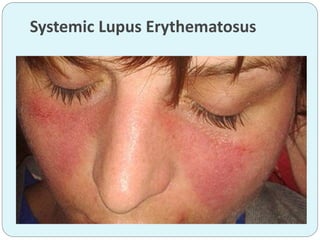
Systemic Lupus Erythematosus
Pathogenesis
 A healthy immune system produces proteins
called antibodies and specific cells called
lymphocytes.
 That help fight and destroy viruses, bacteria, and
other foreign substances that invade the body.
 In lupus, the immune system produces antibodies
against the body's healthy cells and tissues.
Cont..
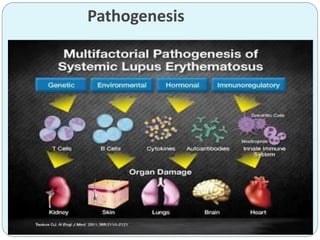
• These antibodies, contribute to the inflammation of
various parts of the body and can cause damage to
organs and tissues.
• Lupus can affect :-
-joints, skin, kidneys, heart, lungs, blood vessels, and
brain.
Pathogenesis
Causes
 The exact causes is not known.
 Inherited genes, viruses, ultraviolet light, and
drugs may all play some role.
 Genetic factors increase the tendency of
developing autoimmune diseases
Cont..
 Hormones play an important role in the expression
of SLE.
 A genetic mutation
 Drug-induced lupus.
Types Of Lupus Erythematosus
1. Discoid lupus erythematosus :-
is a chronic skin disorder, red, raised rash appears on
the face, scalp, or elsewhere. The rash may last for
days or years .
2. Sub acute cutaneous lupus erythematosus:-
refers to skin lesions that appear on parts of the body
exposed to sun. The lesions do not cause scarring.
Cont…
3. Drug-induced lupus :-
is a form of lupus caused by medications. Many
different drugs can cause drug induced lupus.
4. Neonatal lupus :-
is a rare disease that can occur in newborn babies of
women with SLE .
Cont..
5. Sjögren's syndrome is an autoimmune disorder in
which immune cells attack and destroy the exocrine
glands that produce tears and saliva.
Secondary sjogren’s syndrome
1. Dry eyes
2. Dry mouth
Clinical Manifestation
• The symptoms of SLE come on in waves, called flares
or flare-ups.
• general discomfort, extreme fatigue, fever, and
weight loss at some point.
Common Symptoms of Lupus
1. Painful or swollen joints and muscle pain
2. Unexplained fever
3. Red rashes, most commonly on the face
4. Chest pain upon deep breathing
5. Unusual loss of hair
6. Pale or purple fingers or toes from cold or stress .
Cont..
7. Sensitivity to the sun
8. Swelling (edema) in legs or around eyes
9. Swollen glands
10. Extreme fatigue
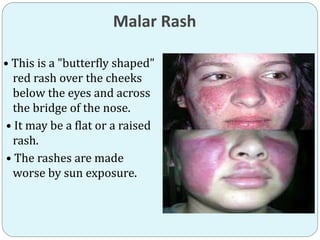
Malar Rash
• This is a "butterfly shaped"
red rash over the cheeks
below the eyes and across
the bridge of the nose.
• It may be a flat or a raised
rash.
• The rashes are made
worse by sun exposure.
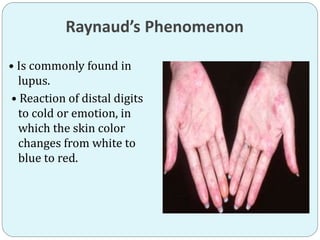
Raynaud’s Phenomenon
• Is commonly found in
lupus.
• Reaction of distal digits
to cold or emotion, in
which the skin color
changes from white to
blue to red.
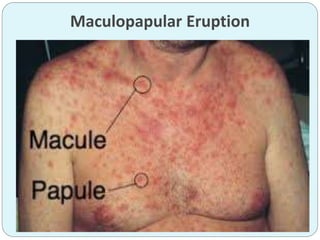
Maculopapular Eruption
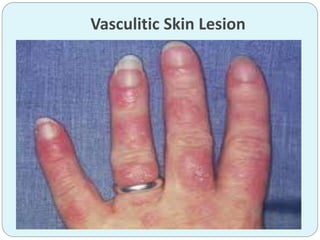
Vasculitic Skin Lesion
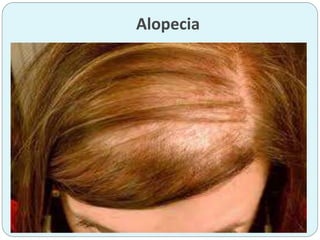
Alopecia
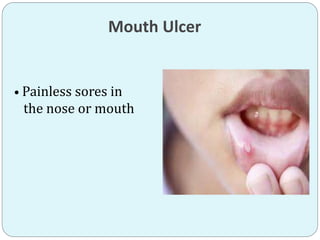
Mouth Ulcer
• Painless sores in
the nose or mouth
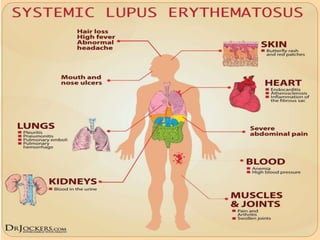
Different Symptoms In
Different Body Systems
Diagnostic studies
 Complete blood count (CBC)
–Erythrocyte sedimentation rate (ESR)
–Urinalysis
–Blood chemistries
–Antinuclear antibody test (ANA)
–Other autoantibody tests (anti-DNA
 Skin biopsy
 Kidney biopsy
Complication
 Blood clots and inflammation of blood vessels.
 Pericarditis
 Heart attack
 Stroke
 Memory change
 Behavioral changes
 Seizures
Treatment
1. A conservative regimen of physical and emotional
rest is required.
2. protection from direct sunlight.
3. A healthful diet.
4. prompt treatment of infections.
5. Pregnancy must be planned for times when the
disease is under control, and the patient is on
allowable medications.
Medication
1-NSAIDs:
 Non steroidal anti-inflammatory drugs (NSAIDs) such as ibuprofen
and naproxen.
2- Anti-malarials:
 (Plaque nil) It may be used alone or in combination with other drug.
 hydroxychloroquine, quinacrine (available compounded), chloroquine
 Used in lupus over 50 years
 Mildest immunosuppressant
 Very safe, risk of retinal toxicity low
 Eye exam once year
Cont..
3. Corticosteroid:-
4- Immunosuppressive : -
 For some patients whose kidneys or central nervous
system are affected by lupus, such as
cyclophosphamide (Cytoxan)
 Restrain the overactive immune system by blocking
the production of immune cells.
Other Therapy
1. Plasma exchange
2. Intravenous Immunoglobulin
3. Stem cell transplantation
4. Immune therapy
Nursing Management
1. Minimize appearance of lesions.
2. Alleviate discomfort
3. Minimize fatigue.
4. Maintain weight at optimal range
5. Teach the patient to recognize fever and signs and
symptoms of infection.
6. Maintain joint function and increase muscle
strength.
Cont..
7. Recognize anemia and develop a plan of care
8. Minimize episodes of bleeding.
9. Minimize incidence of infection.
10. Educate the patient about immunizations
11. Educate patient nutritional status.
NURSING DIAGNOSIS
1. Impaired skin integrity related to inflammation as
evidence by skin rash.
INTERVENTION
1. Wear protective eyewear.
2. Wear a wide-brimmed hat and carry an umbrella.3
3. Wear maximum protection sunscreen (SPF 15 or above)
in the sun. Sunbathing is contraindicated.
4. Avoid ultraviolet ray.
Nursing Diagnosis
2. Acute pain related to inflammation as evidence by
Verbalized complaint of joint pain or stiffness.
INTERVENTION
 Assess for the signs of joint inflammation (warmth,
redness, swelling) or decreased motion
 Encourage the use of ambulation aids when pain is related
to weight-bearing.
 Encourage the use of nonpharmacological measures of
pain control such as relaxation, distraction, or guided
imagery.
 Consult an occupational therapist for the proper splinting
of affected joints.
Nursing Diagnosis
3. Imbalance nutrition: less than body requirement
related to poor appetite.
INTERVENTION
 Monitor calorie intake, weight.
 Provide menu suggestion for high protein & calorie foods
 Give high protein and calorie diet.
 Provide liquid and frequent diet.
 Plan periods of rest after food intake.
Nursing Diagnosis
4. Deficient knowledge about self-management to be
performed at home.
INTERVENTION
 Teach the patient about self-care.
 Give strong message to stop smoking
 Advise the patient to take regular treatment
 Teach about exercise.
Summary
Reference
 Systemic lupus erythematosus Lewis’s medical
surgical nursing assessment and clinical practice
second edition.
 Systemic lupus erythematosus Brunner and
suddartha’s medical surgical nursing twelfth
edition.
 Systemic lupus erythematosus, www.Medicine.
net.com
 Systemic lupus erythematosus en.m wikipedia .org.
 Systemic lupus erythematosus,nurseslabs.com

Systemic lupus erythematosus

  • 1.
    Presented by Monika Devi Msc(N)1styear HCN ,SRHU Systemic Lupus Erythematosus
  • 2.
    Definition • Systemic lupuserythematosus is an autoimmune disease of the body's connective tissues. • Autoimmune means that the immune system attacks the tissues of the body. Attacks parts of the cell nucleus. • Between the ages of 15 and 40, although it can show up at any age.
  • 3.
  • 4.
    Pathogenesis  A healthyimmune system produces proteins called antibodies and specific cells called lymphocytes.  That help fight and destroy viruses, bacteria, and other foreign substances that invade the body.  In lupus, the immune system produces antibodies against the body's healthy cells and tissues.
  • 5.
    Cont.. • These antibodies,contribute to the inflammation of various parts of the body and can cause damage to organs and tissues. • Lupus can affect :- -joints, skin, kidneys, heart, lungs, blood vessels, and brain.
  • 6.
  • 7.
    Causes  The exactcauses is not known.  Inherited genes, viruses, ultraviolet light, and drugs may all play some role.  Genetic factors increase the tendency of developing autoimmune diseases
  • 8.
    Cont..  Hormones playan important role in the expression of SLE.  A genetic mutation  Drug-induced lupus.
  • 9.
    Types Of LupusErythematosus 1. Discoid lupus erythematosus :- is a chronic skin disorder, red, raised rash appears on the face, scalp, or elsewhere. The rash may last for days or years . 2. Sub acute cutaneous lupus erythematosus:- refers to skin lesions that appear on parts of the body exposed to sun. The lesions do not cause scarring.
  • 10.
    Cont… 3. Drug-induced lupus:- is a form of lupus caused by medications. Many different drugs can cause drug induced lupus. 4. Neonatal lupus :- is a rare disease that can occur in newborn babies of women with SLE .
  • 11.
    Cont.. 5. Sjögren's syndromeis an autoimmune disorder in which immune cells attack and destroy the exocrine glands that produce tears and saliva. Secondary sjogren’s syndrome 1. Dry eyes 2. Dry mouth
  • 12.
    Clinical Manifestation • Thesymptoms of SLE come on in waves, called flares or flare-ups. • general discomfort, extreme fatigue, fever, and weight loss at some point.
  • 13.
    Common Symptoms ofLupus 1. Painful or swollen joints and muscle pain 2. Unexplained fever 3. Red rashes, most commonly on the face 4. Chest pain upon deep breathing 5. Unusual loss of hair 6. Pale or purple fingers or toes from cold or stress .
  • 14.
    Cont.. 7. Sensitivity tothe sun 8. Swelling (edema) in legs or around eyes 9. Swollen glands 10. Extreme fatigue
  • 15.
    Malar Rash • Thisis a "butterfly shaped" red rash over the cheeks below the eyes and across the bridge of the nose. • It may be a flat or a raised rash. • The rashes are made worse by sun exposure.
  • 16.
    Raynaud’s Phenomenon • Iscommonly found in lupus. • Reaction of distal digits to cold or emotion, in which the skin color changes from white to blue to red.
  • 17.
  • 18.
  • 19.
  • 20.
    Mouth Ulcer • Painlesssores in the nose or mouth
  • 21.
  • 23.
    Diagnostic studies  Completeblood count (CBC) –Erythrocyte sedimentation rate (ESR) –Urinalysis –Blood chemistries –Antinuclear antibody test (ANA) –Other autoantibody tests (anti-DNA  Skin biopsy  Kidney biopsy
  • 24.
    Complication  Blood clotsand inflammation of blood vessels.  Pericarditis  Heart attack  Stroke  Memory change  Behavioral changes  Seizures
  • 25.
    Treatment 1. A conservativeregimen of physical and emotional rest is required. 2. protection from direct sunlight. 3. A healthful diet. 4. prompt treatment of infections. 5. Pregnancy must be planned for times when the disease is under control, and the patient is on allowable medications.
  • 26.
    Medication 1-NSAIDs:  Non steroidalanti-inflammatory drugs (NSAIDs) such as ibuprofen and naproxen. 2- Anti-malarials:  (Plaque nil) It may be used alone or in combination with other drug.  hydroxychloroquine, quinacrine (available compounded), chloroquine  Used in lupus over 50 years  Mildest immunosuppressant  Very safe, risk of retinal toxicity low  Eye exam once year
  • 27.
    Cont.. 3. Corticosteroid:- 4- Immunosuppressive: -  For some patients whose kidneys or central nervous system are affected by lupus, such as cyclophosphamide (Cytoxan)  Restrain the overactive immune system by blocking the production of immune cells.
  • 28.
    Other Therapy 1. Plasmaexchange 2. Intravenous Immunoglobulin 3. Stem cell transplantation 4. Immune therapy
  • 29.
    Nursing Management 1. Minimizeappearance of lesions. 2. Alleviate discomfort 3. Minimize fatigue. 4. Maintain weight at optimal range 5. Teach the patient to recognize fever and signs and symptoms of infection. 6. Maintain joint function and increase muscle strength.
  • 30.
    Cont.. 7. Recognize anemiaand develop a plan of care 8. Minimize episodes of bleeding. 9. Minimize incidence of infection. 10. Educate the patient about immunizations 11. Educate patient nutritional status.
  • 31.
    NURSING DIAGNOSIS 1. Impairedskin integrity related to inflammation as evidence by skin rash. INTERVENTION 1. Wear protective eyewear. 2. Wear a wide-brimmed hat and carry an umbrella.3 3. Wear maximum protection sunscreen (SPF 15 or above) in the sun. Sunbathing is contraindicated. 4. Avoid ultraviolet ray.
  • 32.
    Nursing Diagnosis 2. Acutepain related to inflammation as evidence by Verbalized complaint of joint pain or stiffness. INTERVENTION  Assess for the signs of joint inflammation (warmth, redness, swelling) or decreased motion  Encourage the use of ambulation aids when pain is related to weight-bearing.  Encourage the use of nonpharmacological measures of pain control such as relaxation, distraction, or guided imagery.  Consult an occupational therapist for the proper splinting of affected joints.
  • 33.
    Nursing Diagnosis 3. Imbalancenutrition: less than body requirement related to poor appetite. INTERVENTION  Monitor calorie intake, weight.  Provide menu suggestion for high protein & calorie foods  Give high protein and calorie diet.  Provide liquid and frequent diet.  Plan periods of rest after food intake.
  • 34.
    Nursing Diagnosis 4. Deficientknowledge about self-management to be performed at home. INTERVENTION  Teach the patient about self-care.  Give strong message to stop smoking  Advise the patient to take regular treatment  Teach about exercise.
  • 36.
  • 37.
    Reference  Systemic lupuserythematosus Lewis’s medical surgical nursing assessment and clinical practice second edition.  Systemic lupus erythematosus Brunner and suddartha’s medical surgical nursing twelfth edition.  Systemic lupus erythematosus, www.Medicine. net.com  Systemic lupus erythematosus en.m wikipedia .org.  Systemic lupus erythematosus,nurseslabs.com