Systemic Lupus Erythematosus

               Safaa EID
    Medical surgical and critical care
              department
Definition
• is an autoimmune disease of the body's
  connective tissues.

• Autoimmune means that the immune system
  attacks the tissues of the body.
• attacks parts of the cell nucleus.

• between the ages of 15 and 40, although it
  can show up at any age.
Pathogenesis

• A healthy immune system produces
  proteins called antibodies and specific cells
  called lymphocytes.

• that help fight and destroy viruses, bacteria,
  and other foreign substances that invade the
  body.
• In lupus, the immune system produces
  antibodies against the body's healthy cells
  and tissues.
• These antibodies, contribute to the
  inflammation of various parts of the body
  and can cause damage to organs and tissues.
• Lupus can affect
-joints, skin, kidneys, heart, lungs, blood
  vessels, and brain.
Causes
            • The exact causes is not known.

• Inherited genes, viruses, ultraviolet light,
  and drugs may all play some role.

• Genetic factors increase the tendency of
  developing autoimmune diseases
•   female hormones play an important role in
    the expression of SLE.
•   a key enzyme's failure to dispose of dying
    cells may contribute the development of
    SLE.

•   a genetic mutation

•   Drug-induced lupus. ( hydralazine, beta-
    blokers, isoniazid) .
There are several kinds of lupus:
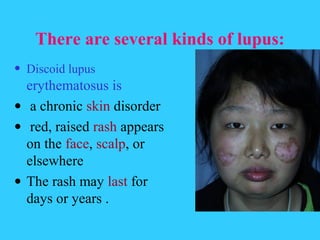
• Discoid lupus
  erythematosus is
• a chronic skin disorder
• red, raised rash appears
  on the face, scalp, or
  elsewhere
• The rash may last for
  days or years .
• Sub acute cutaneous lupus erythematosus refers
     to skin lesions that appear on parts of the body
  exposed to sun. The lesions do not cause scarring.

• Drug-induced lupus is a form of lupus caused by
 medications. Many different drugs can cause drug-
                                    induced lupus

• Neonatal lupus is a rare disease that can occur in
            newborn babies of women with SLE
• Sjögren's syndrome is an autoimmune
  disorder in which immune cells attack and
     destroy the excroin glands that produce
                            tears and saliva.

• Sjögren's syndrome is also associated with
     rheumatic disorders such as rheumatoid
                                     arthritis
Secondary sjogren’s syndrome
• Dry eyes
• Dry mouth
Clinical manifestations

• The symptoms of SLE come on in
  waves, called flares or flare-ups. In
  between flares, patients may have
  almost no symptoms.
• general discomfort, extreme fatigue,
  fever, and weight loss at some point.
“Common Symptoms of Lupus

•   Painful or swollen joints and muscle pain
•   Unexplained fever
•   Red rashes, most commonly on the face
•   Chest pain upon deep breathing
•   Unusual loss of hair
•   Pale or purple fingers or toes from cold or
    stress .
•   Sensitivity to the sun
•   Swelling (edema) in legs or around eyes
•   Swollen glands
•   Extreme fatigue
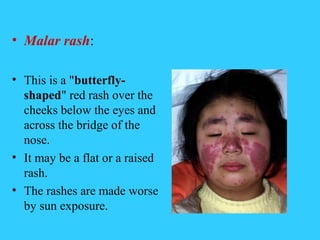
• Malar rash:

• This is a "butterfly-
  shaped" red rash over the
  cheeks below the eyes and
  across the bridge of the
  nose.
• It may be a flat or a raised
  rash.
• The rashes are made worse
  by sun exposure.
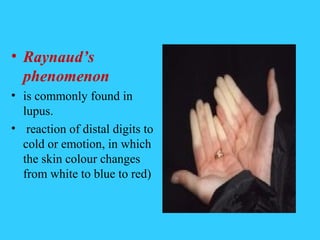
• Raynaud’s
  phenomenon
• is commonly found in
  lupus.
• reaction of distal digits to
  cold or emotion, in which
  the skin colour changes
  from white to blue to red)
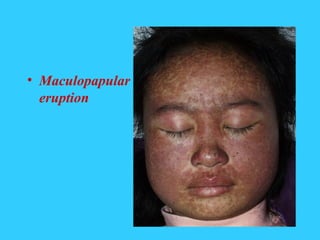
• Maculopapular
  eruption
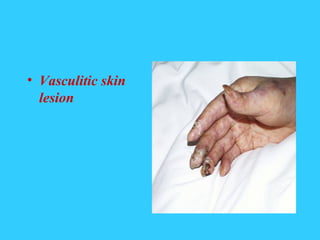
• Vasculitic skin
  lesion
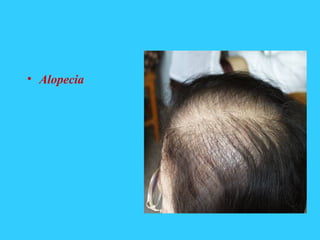
• Alopecia
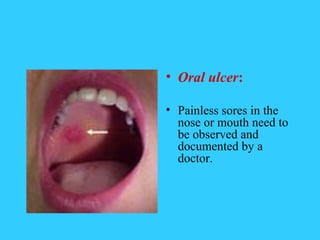
• Oral ulcer:

• Painless sores in the
  nose or mouth need to
  be observed and
  documented by a
  doctor.
Different symptoms in different
          body systems :

• Kidneys
Inflammation of the kidneys (nephritis)
Lungs

Central nervous system:
• Blood vessels:
• Blood vessels may become inflamed
  (vasculitis)
• Muscles and Bones:
• joint pain or inflammation.
• The pain can come and go, or it can be
  long lasting.
• Blood:
• anemia, leucopenia (a decreased number
  of white blood cells), or thrombocytopenia
  (a decrease in the number of platelets in the
  blood, which assist in clotting).
• Heart:
• (myocarditis and endocarditis) or the
  membrane that surrounds it (pericarditis).
• Digestive System:
• Symptoms include abdominal pain, loss of
  appetite, nausea, and sometimes vomiting.
• psychological and emotional effects
• such as grief, depression, and anger,
  depression
• Pregnancy.
• However, the chances of miscarriage,
  premature birth, and death of the baby in
  the uterus are high.
Diagnostic studies
  – Complete blood count (CBC)
   – Erythrocyte sedimentation rate (ESR)
   – Urinalysis
   – Blood chemistries
   – Antinuclear antibody test (ANA)
   – Other autoantibody tests (anti-DNA)
• Skin biopsy
• Kidney biopsy
Treatment
• A conservative regimen of physical and
  emotional rest is required
• protection from direct sunlight
• a healthful diet
• prompt treatment of infections
• pregnancy must be planned for times when
  the disease is under control, and the patient is
  on allowable medications.
Medications
1-NSAIDs:
• Nonsteroidal anti-inflammatory drugs (NSAIDs)
   such as ibuprofen and naproxen.
2- Antimalarials:
• (Plaquenil). It may be used alone or in
   combination with other drugs
3- Corticosteroids:
4- Immunosuppressives: For some patients
whose kidneys or central nervous system are
 affected by lupus, such as cyclophosphamide
                  (Cytoxan)
- restrain the overactive immune system by
  blocking the production of immune cells.
Other therapy
•   Plasma exchange
•   Intravenous Immunoglobulin
•   Stem cell transplantation
•   Immune therapy ( anti-IL10, anti-CD20,
    and immune tolerance therapy)
Nursing care
                 • Minimize appearance of lesions.
                          • Alleviate discomfort
                             • Minimize fatigue.
               • Maintain weight at optimal range
• Teach the patient to recognize fever and signs and
                             symptoms of infection.
     • Maintain joint function and increase muscle
                                            strength.
– Recognize anemia and develop a plan of
  care
– Minimize episodes of bleeding.
– Minimize incidence of infection.
– Educate the patient about immunizations
– Educate patient nutritional status.
Thanks

Systemic lupus erythematosus

  • 1.
    Systemic Lupus Erythematosus Safaa EID Medical surgical and critical care department
  • 2.
    Definition • is anautoimmune disease of the body's connective tissues. • Autoimmune means that the immune system attacks the tissues of the body. • attacks parts of the cell nucleus. • between the ages of 15 and 40, although it can show up at any age.
  • 3.
    Pathogenesis • A healthyimmune system produces proteins called antibodies and specific cells called lymphocytes. • that help fight and destroy viruses, bacteria, and other foreign substances that invade the body.
  • 4.
    • In lupus,the immune system produces antibodies against the body's healthy cells and tissues. • These antibodies, contribute to the inflammation of various parts of the body and can cause damage to organs and tissues. • Lupus can affect -joints, skin, kidneys, heart, lungs, blood vessels, and brain.
  • 5.
    Causes • The exact causes is not known. • Inherited genes, viruses, ultraviolet light, and drugs may all play some role. • Genetic factors increase the tendency of developing autoimmune diseases
  • 6.
    female hormones play an important role in the expression of SLE. • a key enzyme's failure to dispose of dying cells may contribute the development of SLE. • a genetic mutation • Drug-induced lupus. ( hydralazine, beta- blokers, isoniazid) .
  • 7.
    There are severalkinds of lupus: • Discoid lupus erythematosus is • a chronic skin disorder • red, raised rash appears on the face, scalp, or elsewhere • The rash may last for days or years .
  • 8.
    • Sub acutecutaneous lupus erythematosus refers to skin lesions that appear on parts of the body exposed to sun. The lesions do not cause scarring. • Drug-induced lupus is a form of lupus caused by medications. Many different drugs can cause drug- induced lupus • Neonatal lupus is a rare disease that can occur in newborn babies of women with SLE
  • 9.
    • Sjögren's syndromeis an autoimmune disorder in which immune cells attack and destroy the excroin glands that produce tears and saliva. • Sjögren's syndrome is also associated with rheumatic disorders such as rheumatoid arthritis
  • 10.
    Secondary sjogren’s syndrome •Dry eyes • Dry mouth
  • 11.
    Clinical manifestations • Thesymptoms of SLE come on in waves, called flares or flare-ups. In between flares, patients may have almost no symptoms. • general discomfort, extreme fatigue, fever, and weight loss at some point.
  • 12.
    “Common Symptoms ofLupus • Painful or swollen joints and muscle pain • Unexplained fever • Red rashes, most commonly on the face • Chest pain upon deep breathing • Unusual loss of hair • Pale or purple fingers or toes from cold or stress .
  • 13.
    Sensitivity to the sun • Swelling (edema) in legs or around eyes • Swollen glands • Extreme fatigue
  • 14.
    • Malar rash: •This is a "butterfly- shaped" red rash over the cheeks below the eyes and across the bridge of the nose. • It may be a flat or a raised rash. • The rashes are made worse by sun exposure.
  • 15.
    • Raynaud’s phenomenon • is commonly found in lupus. • reaction of distal digits to cold or emotion, in which the skin colour changes from white to blue to red)
  • 16.
  • 17.
  • 18.
  • 19.
    • Oral ulcer: •Painless sores in the nose or mouth need to be observed and documented by a doctor.
  • 20.
    Different symptoms indifferent body systems : • Kidneys Inflammation of the kidneys (nephritis) Lungs Central nervous system:
  • 21.
    • Blood vessels: •Blood vessels may become inflamed (vasculitis) • Muscles and Bones: • joint pain or inflammation. • The pain can come and go, or it can be long lasting.
  • 22.
    • Blood: • anemia,leucopenia (a decreased number of white blood cells), or thrombocytopenia (a decrease in the number of platelets in the blood, which assist in clotting). • Heart: • (myocarditis and endocarditis) or the membrane that surrounds it (pericarditis).
  • 23.
    • Digestive System: •Symptoms include abdominal pain, loss of appetite, nausea, and sometimes vomiting. • psychological and emotional effects • such as grief, depression, and anger, depression • Pregnancy. • However, the chances of miscarriage, premature birth, and death of the baby in the uterus are high.
  • 24.
    Diagnostic studies – Complete blood count (CBC) – Erythrocyte sedimentation rate (ESR) – Urinalysis – Blood chemistries – Antinuclear antibody test (ANA) – Other autoantibody tests (anti-DNA) • Skin biopsy • Kidney biopsy
  • 25.
    Treatment • A conservativeregimen of physical and emotional rest is required • protection from direct sunlight • a healthful diet • prompt treatment of infections • pregnancy must be planned for times when the disease is under control, and the patient is on allowable medications.
  • 26.
    Medications 1-NSAIDs: • Nonsteroidal anti-inflammatorydrugs (NSAIDs) such as ibuprofen and naproxen. 2- Antimalarials: • (Plaquenil). It may be used alone or in combination with other drugs 3- Corticosteroids:
  • 27.
    4- Immunosuppressives: Forsome patients whose kidneys or central nervous system are affected by lupus, such as cyclophosphamide (Cytoxan) - restrain the overactive immune system by blocking the production of immune cells.
  • 28.
    Other therapy • Plasma exchange • Intravenous Immunoglobulin • Stem cell transplantation • Immune therapy ( anti-IL10, anti-CD20, and immune tolerance therapy)
  • 29.
    Nursing care • Minimize appearance of lesions. • Alleviate discomfort • Minimize fatigue. • Maintain weight at optimal range • Teach the patient to recognize fever and signs and symptoms of infection. • Maintain joint function and increase muscle strength.
  • 30.
    – Recognize anemiaand develop a plan of care – Minimize episodes of bleeding. – Minimize incidence of infection. – Educate the patient about immunizations – Educate patient nutritional status.
  • 31.