Anatomy of Female Reproductive System:
Vagina - Fallopian Tube -Ovary
Dr Mathew Joseph
MBBS,MD(AIIMS),BCC(Palliative Medicine)
Assistant Professor
Department of Anatomy
Amala Institute of Medical Sciences
Thrissur
Functions of Female Reproductive System
• Produce sex hormones : Estrogen, Progesterone
• Produce Female Gamate : Ovum
• Support & Protect developing Embryo/Fetus
• Give birth to offspring
Female Reproductive System: Major Organs
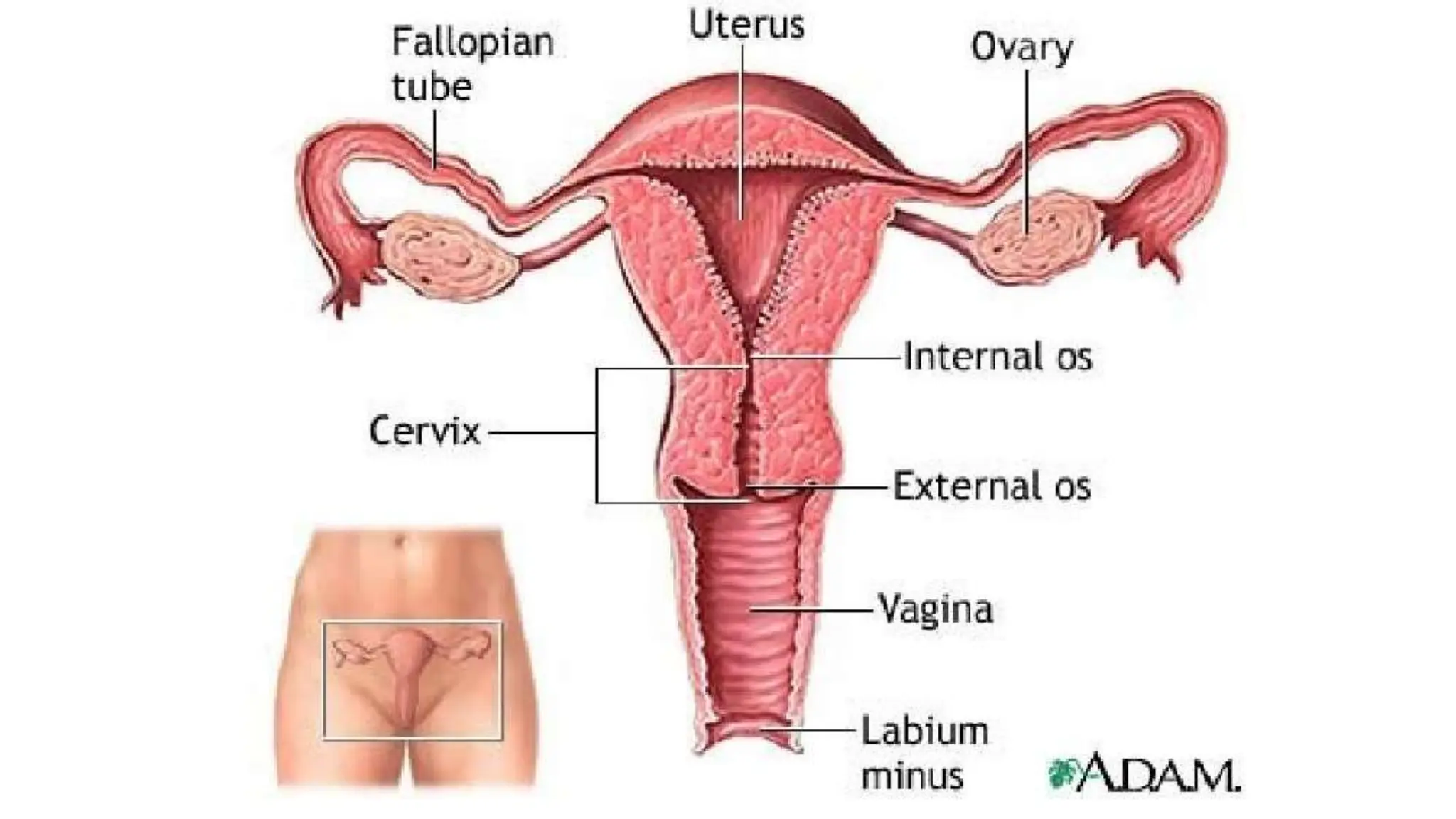
• Vagina
• Cervix
• Uterus
• Uterine tubes [fallopian tubes]
• Ovaries [gonads]
The Cervix
• The lower portion or neck of the
uterus.
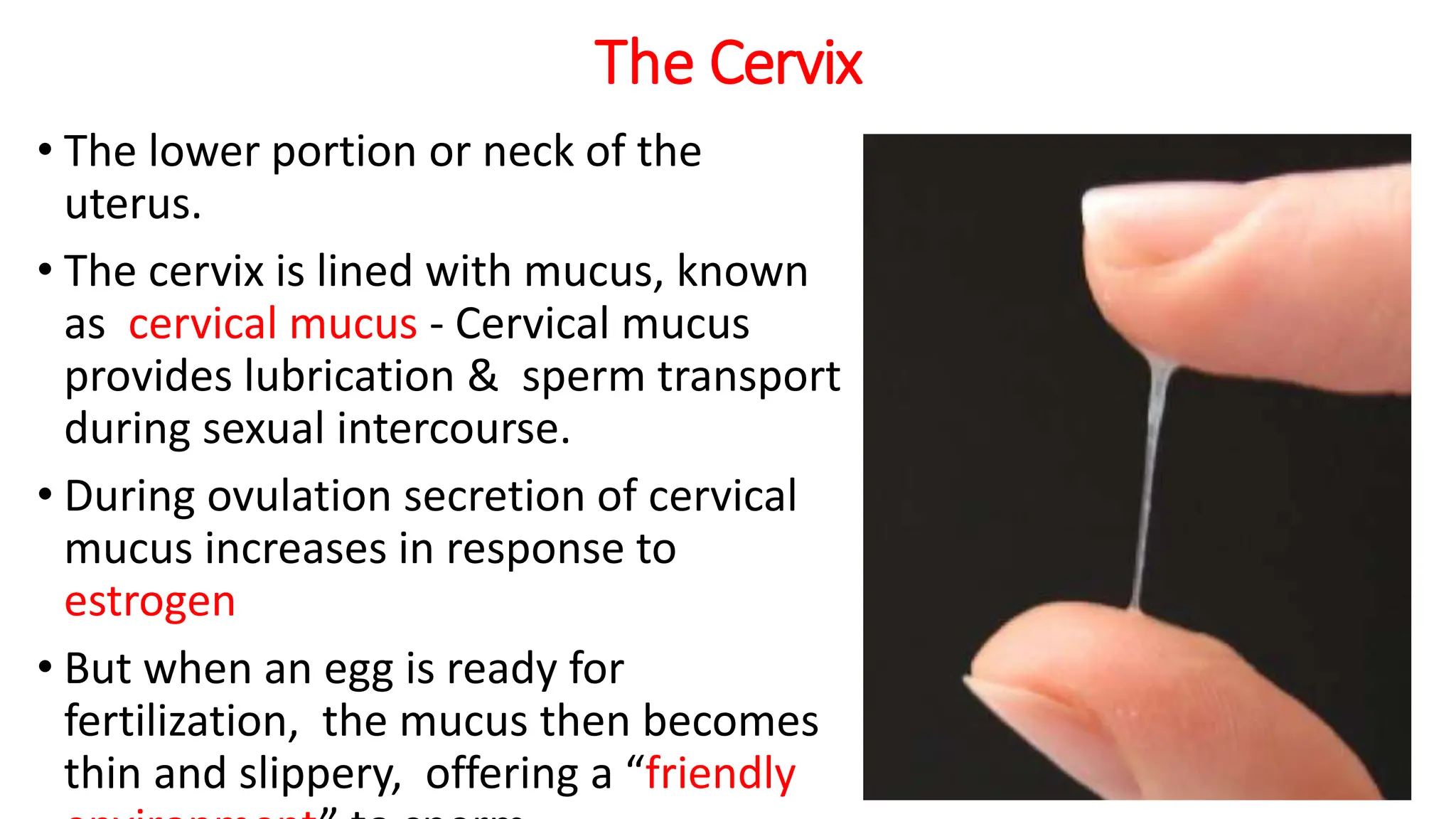
• The cervix is lined with mucus, known
as cervical mucus - Cervical mucus
provides lubrication & sperm transport
during sexual intercourse.
• During ovulation secretion of cervical
mucus increases in response to
estrogen
• But when an egg is ready for
fertilization, the mucus then becomes
thin and slippery, offering a “friendly
The Cervix: At the end of pregnancy
• The cervix acts as the passage
through which the baby exits the
uterus into the vagina.
• The cervical canal expands to
roughly 50 times its normal width for
the passage of the baby during birth
The Vagina
• A muscular, ridged sheath
connecting the external genitals
to the uterus.
• Functions as a two-way street,
accepting the penis and sperm
during intercourse
• Serving as the avenue of birth
through which the new baby
enters the world
External genetalia : The Vulva
• Labia majora: The part around the
vagina containing two glands
(Bartholin’s glands) which helps
lubrication during intercourse.
• Labia minora: The thin hairless
ridges at the entrance of the vagina,
which joins behind and in front.
• The clitoris is a small pea- shaped
structure. It plays an important part
in sexual excitement in females.
External genetalia : The Vulva
• The urethral orifice : External urinary
opening is below the clitoris on the
upper wall of the vagina and is the
passage for urine.
• Opening of the vagina: is separate
from the urinary opening and located
below it.
• The hymen: A thin cresentic fold of
tissue which partially covers the
opening of the vagina. Medically it is
no longer considered to be a 100%
proof of female virginity.
Types of hymen
Virgin
Bi-perforate
Imperforate
Deflorated
Cribriform
Blood Supply
Arterial Supply
• Internal pudendal artery: The
terminal branch of the anterior
division of the internal iliac artery
that ends as the dorsal artery of the
clitoris.
• Branches from the femoral artery,
supply the anterior part.
• Superficial and deep external
pudendal arteries.
Venous Drainage
• The veins draining the vulva form a
venous plexus from which veins
accompany their corresponding
arteries.
• The veins draining the clitoris join
vaginal and vesical venous plexuses.
Lymphatics & Nerve Supply
Lymphatic Drainage of the vulva
• From the skin and appendages, to the
superficial inguinal lymph nodes, to
the deep inguinal and femoral lymph
nodes of which the lymph node of
Cloquet drains the clitoris directly.
• From the former superficial group,
lymphatic channels pass to the deep
pelvic nodes including; the external
iliac, common iliac, then para-aortic
lymph nodes.
Nerve Supply of the vulva
• The vulva is supplied mainly from the
pudendal nerve (S 2, 3 & 4).
• Additional sensory nerves are supplied
from; the Ilio-inguinal nerve (L1), the
genital branch of genito-femoral nerve (L
1,2), and the posterior cutaneous nerve
of the thigh.
The Ovaries
• Female gonads
• They produce eggs (also called ova)
every female is born with a lifetime
supply of eggs
• They also produce hormones:
Estrogen & Progesterone
The Ovary
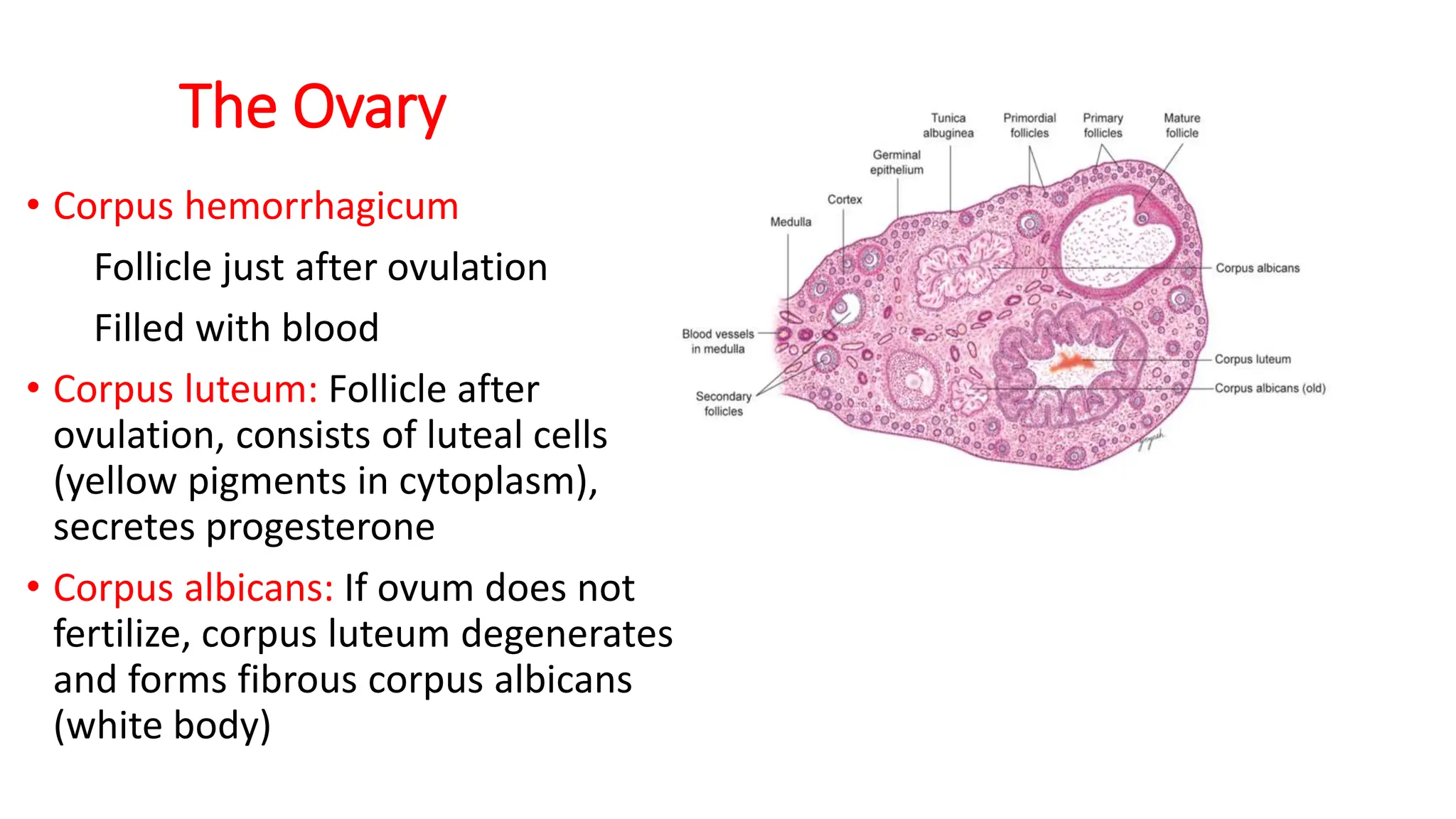
• Ovary has outer cortex shows
follicles of various sizes and inner
medulla consists of connective
tissue, blood vessels, and nerves
• Ovary – covered with cuboidal
germinal epithelium
• Layer of connective tissue lies deep
to germinal epithelium – called
tunica albuginea
• Primordial follicle: Primary oocyte covered
by flattened layer of follicular cells
• Primary follicle: Primary oocyte covered by
zona pellucida and single-cell thick
cuboidal follicular cells
• Secondary follicle: In secondary follicle,
primary oocyte – covered by zona
pellucida, granulosa cells with follicular
antrum, theca interna (vascular), and theca
externa (fibrous) layers
• Graafian follicle: About 10 mm or more in
size and shows secondary oocyte with first
polar body
The Ovary
• Corpus hemorrhagicum
Follicle just after ovulation
Filled with blood
• Corpus luteum: Follicle after
ovulation, consists of luteal cells
(yellow pigments in cytoplasm),
secretes progesterone
• Corpus albicans: If ovum does not
fertilize, corpus luteum degenerates
and forms fibrous corpus albicans
(white body)
The Ovary
Arterial supply
• Ovarian artery: Arises from the aorta at the level of L2 and passes through the
infundibulopelvic ligament.
• Ovarian branch from the uterine artery; which anastomose with the ovarian vesels at the
broad ligament.
Venous drainage
• The ovarian veins accompany the arterial supply, and join with the pampiniform plexus of
veins and the uterine vein.
Lymphatic drainage
• to the para-aortic LNs via the ovarian vessels.
• insensitive except to squeezing on P.V examination.
• sympathetic and parasympathetic nerves (T10 and T11) through the preaortic plexus that
accompany the ovarian vessel.
Fallopian tubes
• Stretch from the uterus to the ovaries and measure about 8 to 13 cm in
length.
• The ends of the fallopian tubes lying next to the ovaries feather into ends
called fimbria
• Millions of tiny hair-like cilia line the fimbria and interior of the fallopian
tubes.
• The cilia beat in waves hundreds of times a second catching the egg at
ovulation and moving it through the tube to the uterine cavity.
• Fertilization typically occurs in the fallopian tube
Fallopian tubes
1. Interstitial part (1 cm): pierces the uterine wall, very narrow, no peritoneal
covering, no outer longitudinal muscles.
2. Isthmus (2 cm): straight, narrow, thick walled portion lateral to uterus.
3. Ampulla (5 cm): the widest, tortuous, thin walled outer part.
4. Infundibulum (2 cm): trumpet shaped outer end opens into the peritoneal
cavity by the tubal ostium.
The ostuim is surrounded by fimbriae, one of which is long and directed
towards the ovary (fimbria ovarica).
Thank You

Anatomy of Female Reproductive System.pptx

  • 1.
    Anatomy of FemaleReproductive System: Vagina - Fallopian Tube -Ovary Dr Mathew Joseph MBBS,MD(AIIMS),BCC(Palliative Medicine) Assistant Professor Department of Anatomy Amala Institute of Medical Sciences Thrissur
  • 5.
    Functions of FemaleReproductive System • Produce sex hormones : Estrogen, Progesterone • Produce Female Gamate : Ovum • Support & Protect developing Embryo/Fetus • Give birth to offspring
  • 6.
    Female Reproductive System:Major Organs • Vagina • Cervix • Uterus • Uterine tubes [fallopian tubes] • Ovaries [gonads]
  • 9.
    The Cervix • Thelower portion or neck of the uterus. • The cervix is lined with mucus, known as cervical mucus - Cervical mucus provides lubrication & sperm transport during sexual intercourse. • During ovulation secretion of cervical mucus increases in response to estrogen • But when an egg is ready for fertilization, the mucus then becomes thin and slippery, offering a “friendly
  • 10.
    The Cervix: Atthe end of pregnancy • The cervix acts as the passage through which the baby exits the uterus into the vagina. • The cervical canal expands to roughly 50 times its normal width for the passage of the baby during birth
  • 11.
    The Vagina • Amuscular, ridged sheath connecting the external genitals to the uterus. • Functions as a two-way street, accepting the penis and sperm during intercourse • Serving as the avenue of birth through which the new baby enters the world
  • 12.
    External genetalia :The Vulva • Labia majora: The part around the vagina containing two glands (Bartholin’s glands) which helps lubrication during intercourse. • Labia minora: The thin hairless ridges at the entrance of the vagina, which joins behind and in front. • The clitoris is a small pea- shaped structure. It plays an important part in sexual excitement in females.
  • 13.
    External genetalia :The Vulva • The urethral orifice : External urinary opening is below the clitoris on the upper wall of the vagina and is the passage for urine. • Opening of the vagina: is separate from the urinary opening and located below it. • The hymen: A thin cresentic fold of tissue which partially covers the opening of the vagina. Medically it is no longer considered to be a 100% proof of female virginity.
  • 14.
  • 19.
    Blood Supply Arterial Supply •Internal pudendal artery: The terminal branch of the anterior division of the internal iliac artery that ends as the dorsal artery of the clitoris. • Branches from the femoral artery, supply the anterior part. • Superficial and deep external pudendal arteries. Venous Drainage • The veins draining the vulva form a venous plexus from which veins accompany their corresponding arteries. • The veins draining the clitoris join vaginal and vesical venous plexuses.
  • 20.
    Lymphatics & NerveSupply Lymphatic Drainage of the vulva • From the skin and appendages, to the superficial inguinal lymph nodes, to the deep inguinal and femoral lymph nodes of which the lymph node of Cloquet drains the clitoris directly. • From the former superficial group, lymphatic channels pass to the deep pelvic nodes including; the external iliac, common iliac, then para-aortic lymph nodes. Nerve Supply of the vulva • The vulva is supplied mainly from the pudendal nerve (S 2, 3 & 4). • Additional sensory nerves are supplied from; the Ilio-inguinal nerve (L1), the genital branch of genito-femoral nerve (L 1,2), and the posterior cutaneous nerve of the thigh.
  • 21.
    The Ovaries • Femalegonads • They produce eggs (also called ova) every female is born with a lifetime supply of eggs • They also produce hormones: Estrogen & Progesterone
  • 23.
    The Ovary • Ovaryhas outer cortex shows follicles of various sizes and inner medulla consists of connective tissue, blood vessels, and nerves • Ovary – covered with cuboidal germinal epithelium • Layer of connective tissue lies deep to germinal epithelium – called tunica albuginea • Primordial follicle: Primary oocyte covered by flattened layer of follicular cells • Primary follicle: Primary oocyte covered by zona pellucida and single-cell thick cuboidal follicular cells • Secondary follicle: In secondary follicle, primary oocyte – covered by zona pellucida, granulosa cells with follicular antrum, theca interna (vascular), and theca externa (fibrous) layers • Graafian follicle: About 10 mm or more in size and shows secondary oocyte with first polar body
  • 24.
    The Ovary • Corpushemorrhagicum Follicle just after ovulation Filled with blood • Corpus luteum: Follicle after ovulation, consists of luteal cells (yellow pigments in cytoplasm), secretes progesterone • Corpus albicans: If ovum does not fertilize, corpus luteum degenerates and forms fibrous corpus albicans (white body)
  • 25.
    The Ovary Arterial supply •Ovarian artery: Arises from the aorta at the level of L2 and passes through the infundibulopelvic ligament. • Ovarian branch from the uterine artery; which anastomose with the ovarian vesels at the broad ligament. Venous drainage • The ovarian veins accompany the arterial supply, and join with the pampiniform plexus of veins and the uterine vein. Lymphatic drainage • to the para-aortic LNs via the ovarian vessels. • insensitive except to squeezing on P.V examination. • sympathetic and parasympathetic nerves (T10 and T11) through the preaortic plexus that accompany the ovarian vessel.
  • 31.
    Fallopian tubes • Stretchfrom the uterus to the ovaries and measure about 8 to 13 cm in length. • The ends of the fallopian tubes lying next to the ovaries feather into ends called fimbria • Millions of tiny hair-like cilia line the fimbria and interior of the fallopian tubes. • The cilia beat in waves hundreds of times a second catching the egg at ovulation and moving it through the tube to the uterine cavity. • Fertilization typically occurs in the fallopian tube
  • 33.
    Fallopian tubes 1. Interstitialpart (1 cm): pierces the uterine wall, very narrow, no peritoneal covering, no outer longitudinal muscles. 2. Isthmus (2 cm): straight, narrow, thick walled portion lateral to uterus. 3. Ampulla (5 cm): the widest, tortuous, thin walled outer part. 4. Infundibulum (2 cm): trumpet shaped outer end opens into the peritoneal cavity by the tubal ostium. The ostuim is surrounded by fimbriae, one of which is long and directed towards the ovary (fimbria ovarica).
  • 38.