UMTS
Submitted by:Mustahid ali
MOBILE SYSTEM GENERATIONS
1 GENERATION(1 G) :Mobile system were designed to offer a
single service, i.e., speech.

2 GENERATION(2 G) :Mobile systems were also designed to offer
limited capability to download data along
with speech.
3 GENERATION(3 G) :Mobile systems are expected to
offer high quality multimedia
services and

4 GENERATION(4 G) :The demand of the speed increases. The
technologies included are Wi-Max and
LTE.
UMTS(Universal Mobile
Telecommunications system)
UMTS will be a mobile communication system that
can offer significant user benefits including high
quality wireless multimedia services.
It will deliver information directly to users and
provide them with access to new and innovative
services and application.
It’ll offer mobile personalized communication to the
mass market regardless of location , network and
terminal used.
UMTS Main
Requirements
 MULTI-MEDIA.
MULTI-ENVIRONMENT.
MULTI-OPERATOR(VIRTUAL
OPERATOR).
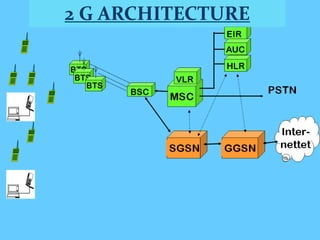
2 G ARCHITECTURE

2 G ARCHITECTURE
UMTS ARCHITECTURE
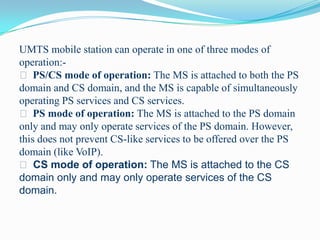
UMTS mobile station can operate in one of three modes of
operation: PS/CS mode of operation: The MS is attached to both the PS
domain and CS domain, and the MS is capable of simultaneously
operating PS services and CS services.
 PS mode of operation: The MS is attached to the PS domain
only and may only operate services of the PS domain. However,
this does not prevent CS-like services to be offered over the PS
domain (like VoIP).
 CS mode of operation: The MS is attached to the CS
domain only and may only operate services of the CS
domain.
UMTS RELEASES
 Realease 99
 3 GPP release 99 contains a couple of serious bugs.
 A debugged 3GPP R’99 is in operation in Japan.

 Release 4
 Approximately what you get today(2004).

 Release 5
 HSDPA(Commercially marketed in Austria, march 2005)

 Release 6
 All IP networking.

 Release 7
 MIMO Extention

 Release 8
 64-QAN
UMTS frequency Bands
Europe – 2100MHz
U.S.A. use 850 and 1900MHz
U.S. – 1700/2100MHz
THANK YOU.

Umts

  • 1.
  • 2.
    MOBILE SYSTEM GENERATIONS 1GENERATION(1 G) :Mobile system were designed to offer a single service, i.e., speech. 2 GENERATION(2 G) :Mobile systems were also designed to offer limited capability to download data along with speech.
  • 3.
    3 GENERATION(3 G):Mobile systems are expected to offer high quality multimedia services and 4 GENERATION(4 G) :The demand of the speed increases. The technologies included are Wi-Max and LTE.
  • 4.
    UMTS(Universal Mobile Telecommunications system) UMTSwill be a mobile communication system that can offer significant user benefits including high quality wireless multimedia services. It will deliver information directly to users and provide them with access to new and innovative services and application. It’ll offer mobile personalized communication to the mass market regardless of location , network and terminal used.
  • 5.
  • 6.
    2 G ARCHITECTURE 2G ARCHITECTURE
  • 7.
  • 9.
    UMTS mobile stationcan operate in one of three modes of operation: PS/CS mode of operation: The MS is attached to both the PS domain and CS domain, and the MS is capable of simultaneously operating PS services and CS services.  PS mode of operation: The MS is attached to the PS domain only and may only operate services of the PS domain. However, this does not prevent CS-like services to be offered over the PS domain (like VoIP).  CS mode of operation: The MS is attached to the CS domain only and may only operate services of the CS domain.
  • 10.
    UMTS RELEASES  Realease99  3 GPP release 99 contains a couple of serious bugs.  A debugged 3GPP R’99 is in operation in Japan.  Release 4  Approximately what you get today(2004).  Release 5  HSDPA(Commercially marketed in Austria, march 2005)  Release 6  All IP networking.  Release 7  MIMO Extention  Release 8  64-QAN
  • 11.
    UMTS frequency Bands Europe– 2100MHz U.S.A. use 850 and 1900MHz U.S. – 1700/2100MHz
  • 12.