Sachidananda Sahu
 Introduction
 Why SON
 SON In LTE
 Drivers for LTE SON
 LTE SON Features
 LTE SON Framework
 LTE SON Architecture
 Self Configuration Use Case
 PCI Planning Use Case
 ANR Use Case
 MRO Use Case
 Other LTE SON Features
 Conclusion
 References
Processes of self-organization literally create order out of disorder
~Francis Heylighen
 Self Organizational Network express itself that it organizes the network automatically and reduces
the manual intervention.
 SON is a collection of procedures or functions for automatic configuration, optimization,
diagnostication, and healing of networks.
 Things under consideration
 Material (Spectrum, Equipment, etc.) - With what things we will do the work.
 Human (Engineering time) - Who will do the work.
 The NGMN (Next Generation Mobile Networks Association) first published its SON requirements
in 2006.
 The concepts quickly picked up by 3GPP in 2008 and rolled into the LTE standardization activities.
 Starting with Release 8, 3GPP defines interfaces for SON built upon existing management
architecture.
 Successive 3GPP releases incorporates additional SON features tracking the expected network
evolution stages in time.
 Specification for SON and its use cases
 TS 36.300 : E-UTRAN Overall Description
 TR 32.821 : Study of SON related operation and OAM for home eNB.
 TR 32.500 : SON Concepts and Requirements
 TR 36.902 : Self Configuring and Self Optimizing Network use cases and solutions
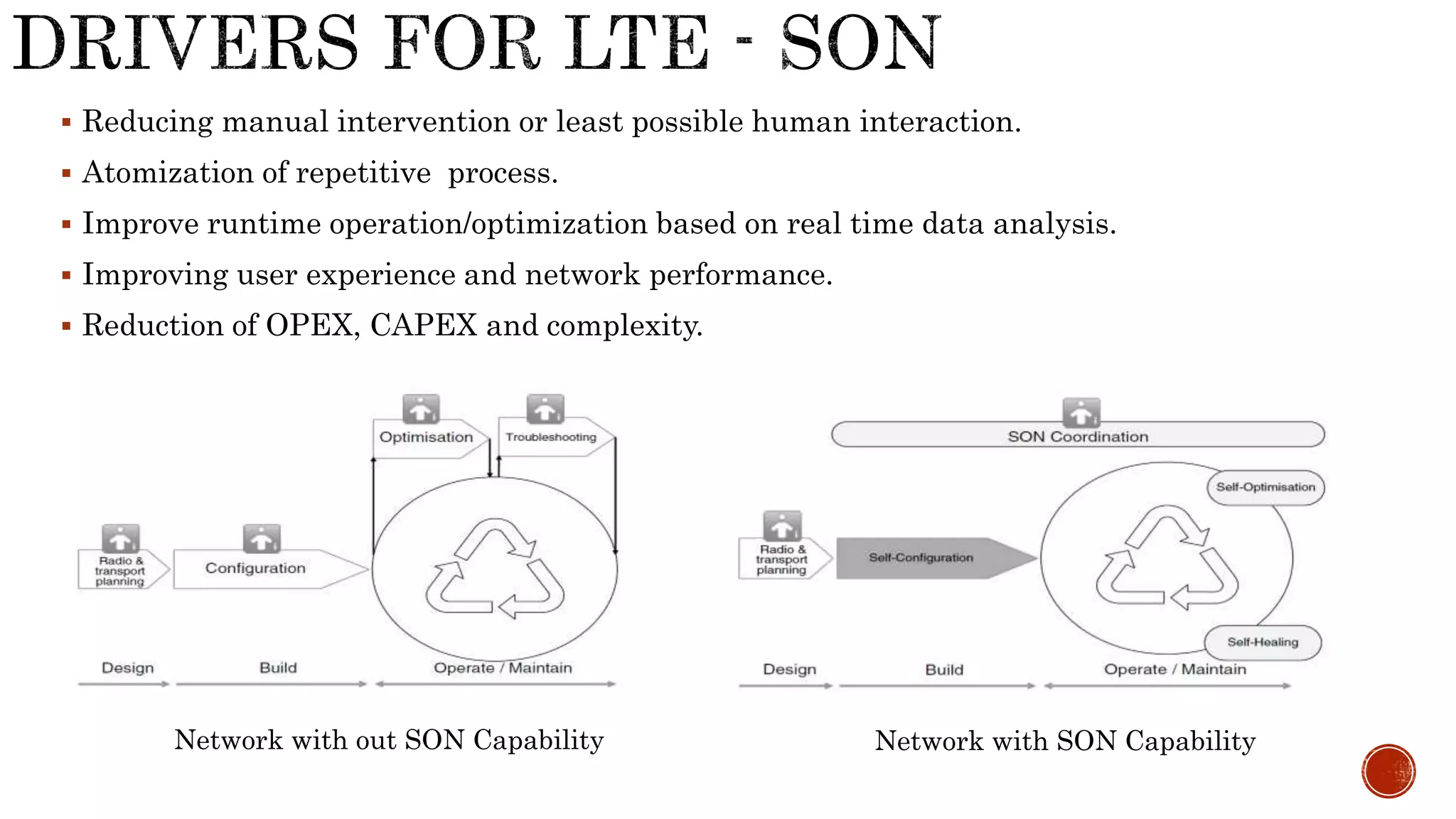
 Reducing manual intervention or least possible human interaction.
 Atomization of repetitive process.
 Improve runtime operation/optimization based on real time data analysis.
 Improving user experience and network performance.
 Reduction of OPEX, CAPEX and complexity.
Network with out SON Capability Network with SON Capability
 SON Solution can be divided in to three categories
1 Self Configuration
2 Self Optimization
3 Self Healing
SON Features Proposed by NGMN
LTE SON Features …
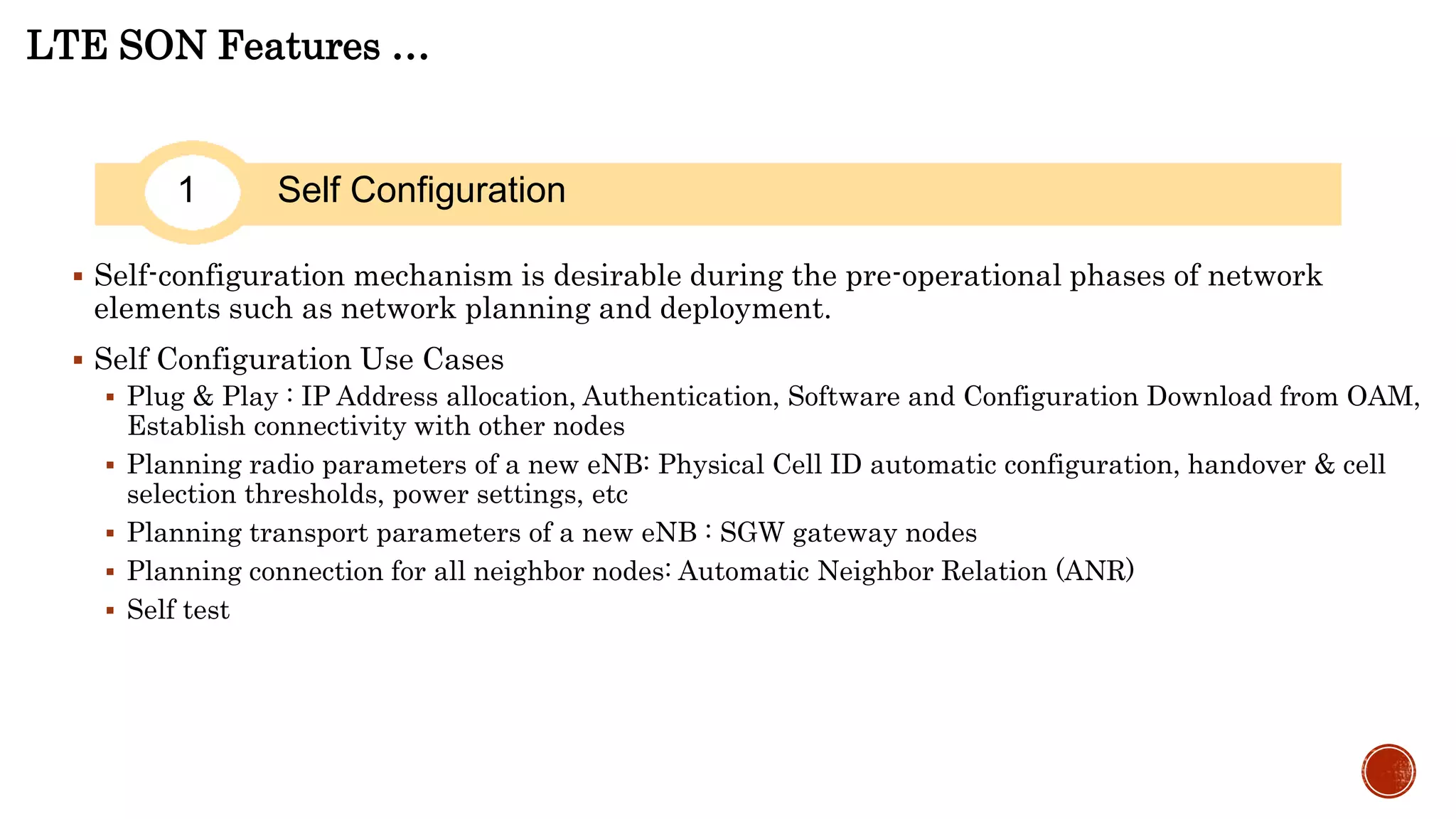
1 Self Configuration
 Self-configuration mechanism is desirable during the pre-operational phases of network
elements such as network planning and deployment.
 Self Configuration Use Cases
 Plug & Play : IP Address allocation, Authentication, Software and Configuration Download from OAM, Establish connectivity with other nodes
 Planning radio parameters of a new eNB: Physical Cell ID automatic configuration, handover & cell selection thresholds, power settings, etc
 Planning transport parameters of a new eNB : SGW gateway nodes
 Planning connection for all neighbor nodes: Automatic Neighbor Relation (ANR)
 Self test
LTE SON Features …
2 Self Optimization
 Self-optimization mechanism is desirable during the operational stage so that network operators
get benefits of the dynamic optimization.
 Self Optimization Use Cases
 Neighbor cell list optimization
 Evaluation/addition/deletion of existing neighbor cells
 Intra/inter frequency and inter system neighbor cell list optimization
 Interference control
 Handover parameter optimization (MRO)
 Load balancing
 Energy savings
 RACH load optimization
 QoS related parameter optimization
LTE SON Features …
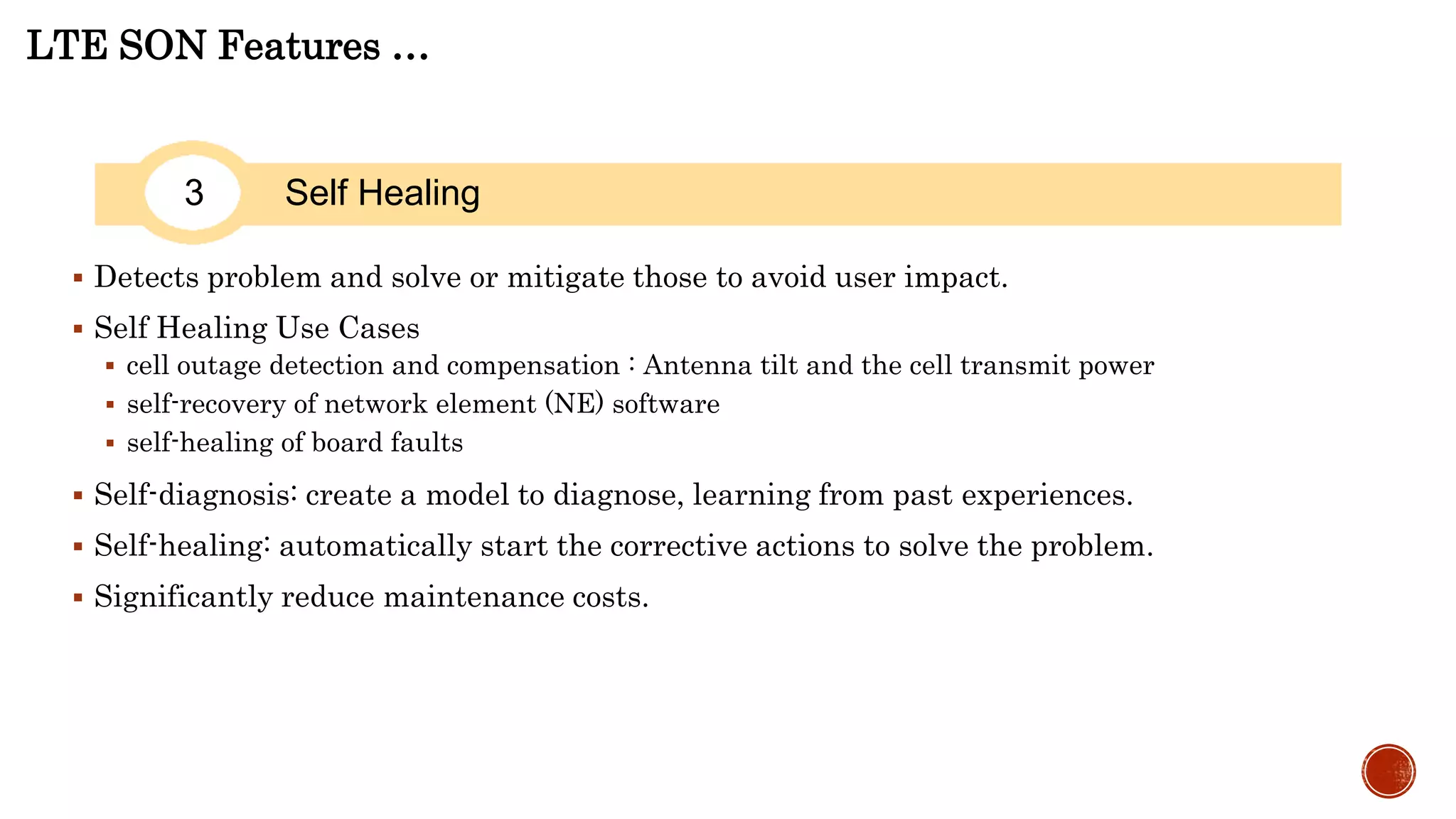
3 Self Healing
 Detects problem and solve or mitigate those to avoid user impact.
 Self Healing Use Cases
 cell outage detection and compensation : Antenna tilt and the cell transmit power
 self-recovery of network element (NE) software
 self-healing of board faults
 Self-diagnosis: create a model to diagnose, learning from past experiences.
 Self-healing: automatically start the corrective actions to solve the problem.
 Significantly reduce maintenance costs.
3GPP Proposed SON Framework
 SON can be located as whole functionality block or even split in sub-functionality located in
different nodes.
 Localization of algorithm and control.
Centralized SON Distributed SON Hybrid SON
 Process where newly deployed nodes (eNBs) are configured by automatic installation procedures to get the
necessary basic configuration for system operation.
Self Configuration Procedure Flow
 Automatically configure the Physical Cell ID of a newly introduced cell and also change the PCI to
after detection of problem in PCI planning.
 Things to consider :
 Collison Free : The PCI of one cell should not be the same as those of his neighbor cells.
 Confusion Free : The PCI of the neighbor cells should not be the same.
PCI A PCI BPCI A PCI A
Collision Based Collision Free
PCI A PCI C
PCI B
PCI A PCI A
PCI B
Confusion Based Confusion Free
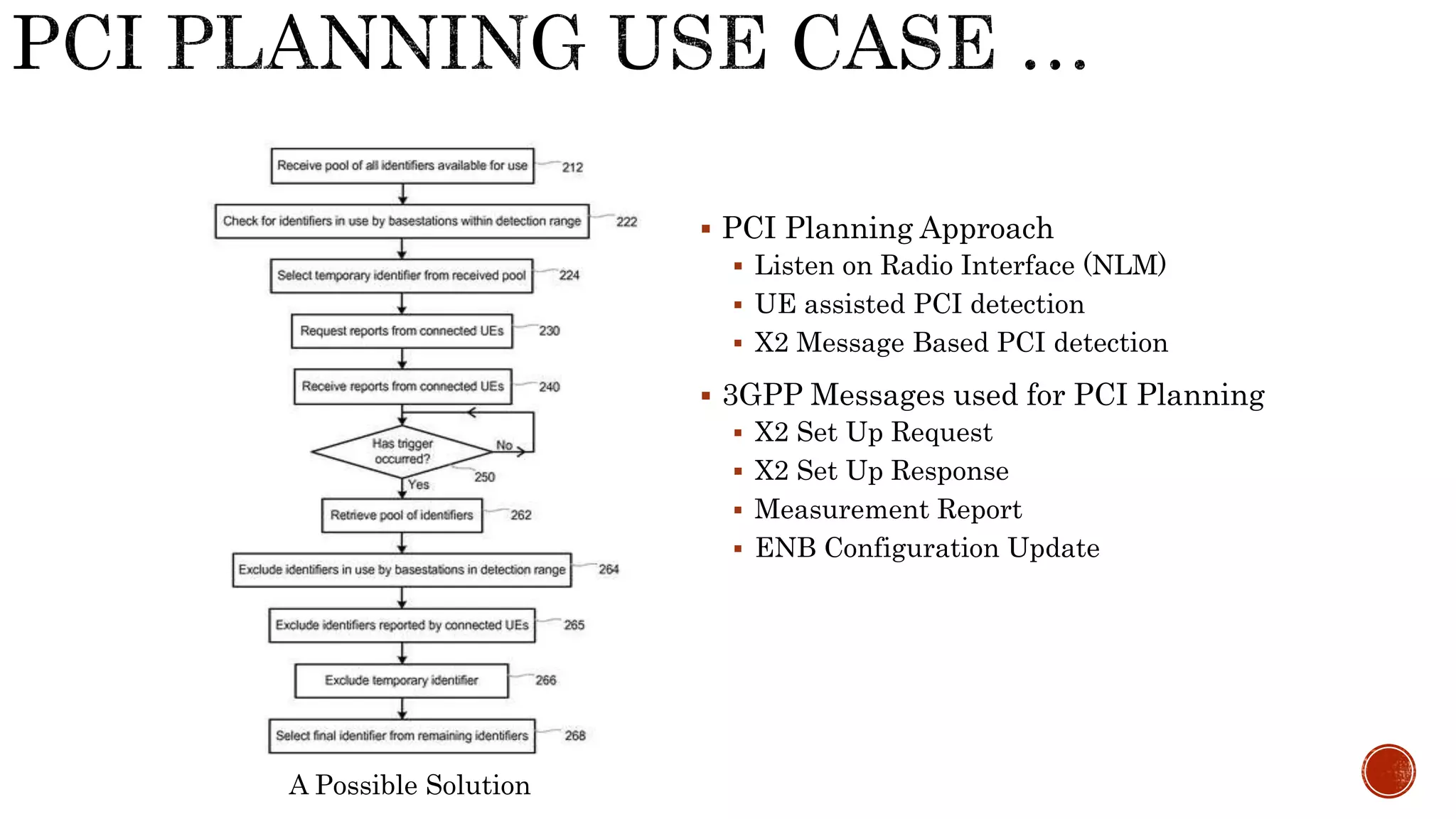
 PCI Planning Approach
 Listen on Radio Interface (NLM)
 UE assisted PCI detection
 X2 Message Based PCI detection
 3GPP Messages used for PCI Planning
 X2 Set Up Request
 X2 Set Up Response
 Measurement Report
 ENB Configuration Update
A Possible Solution
 It aims to set up the neighbor relation automatically as much as possible.
 ANR function relies on OAM and UE to report the neighbor cell information.
• OAM’s significance
• UE Measurement Report
ANR with help of UE Measurement
 A Neighbor cell Relation
• Source cell knows the ECGI/CGI and PCI of the target cell.
• Has an entry in the Neighbor Relation Table for the source cell identifying the target cell.
• Has the attributes in this Neighbor Relation Table entry defined, either by O&M or set to default values.
ANR Architecture Diagram
 Problem
 Manual setting of HO parameters in current 2G/3G systems is a time consuming task and it is also costly.
 Incorrect HO parameter setting negatively affect user experience.
 Solution
 Automatically adjusting the mobility parameters Trigger thresholds,Time to trigger, Hysteresis, NRT,
Antenna Remote Electrical Tilt etc
 Detecting the cause of Reduce Radio Link Failures and unnecessary handovers and decrease those counts.
 To enable adjustment of HO parameters , HO errors, reported by UE, can be notified to eNBs by backhaul
signaling.
 Too late handover
 Too early handover
 Handover to the wrong cell
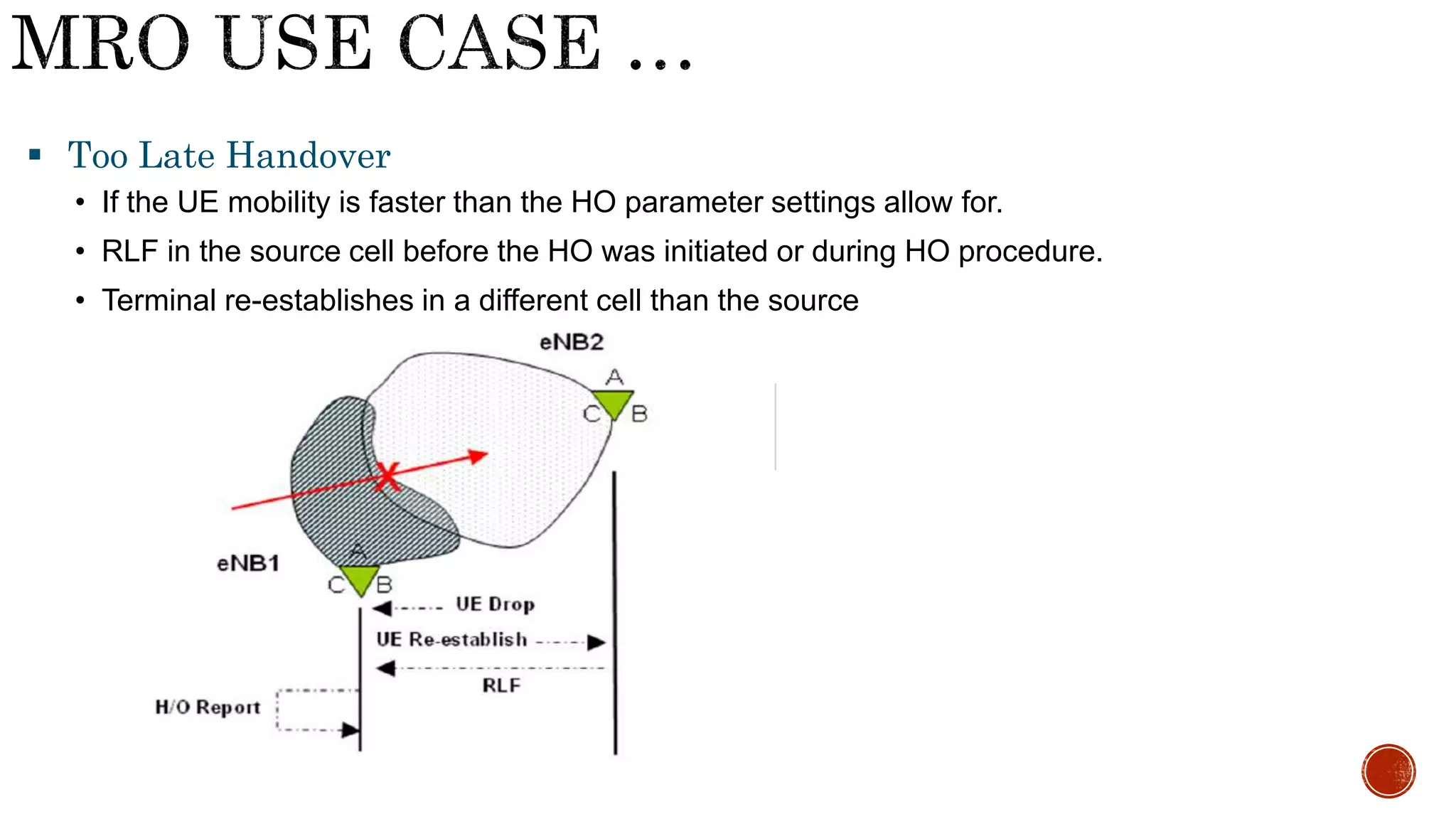
 Too Late Handover
• If the UE mobility is faster than the HO parameter settings allow for.
• RLF in the source cell before the HO was initiated or during HO procedure.
• Terminal re-establishes in a different cell than the source
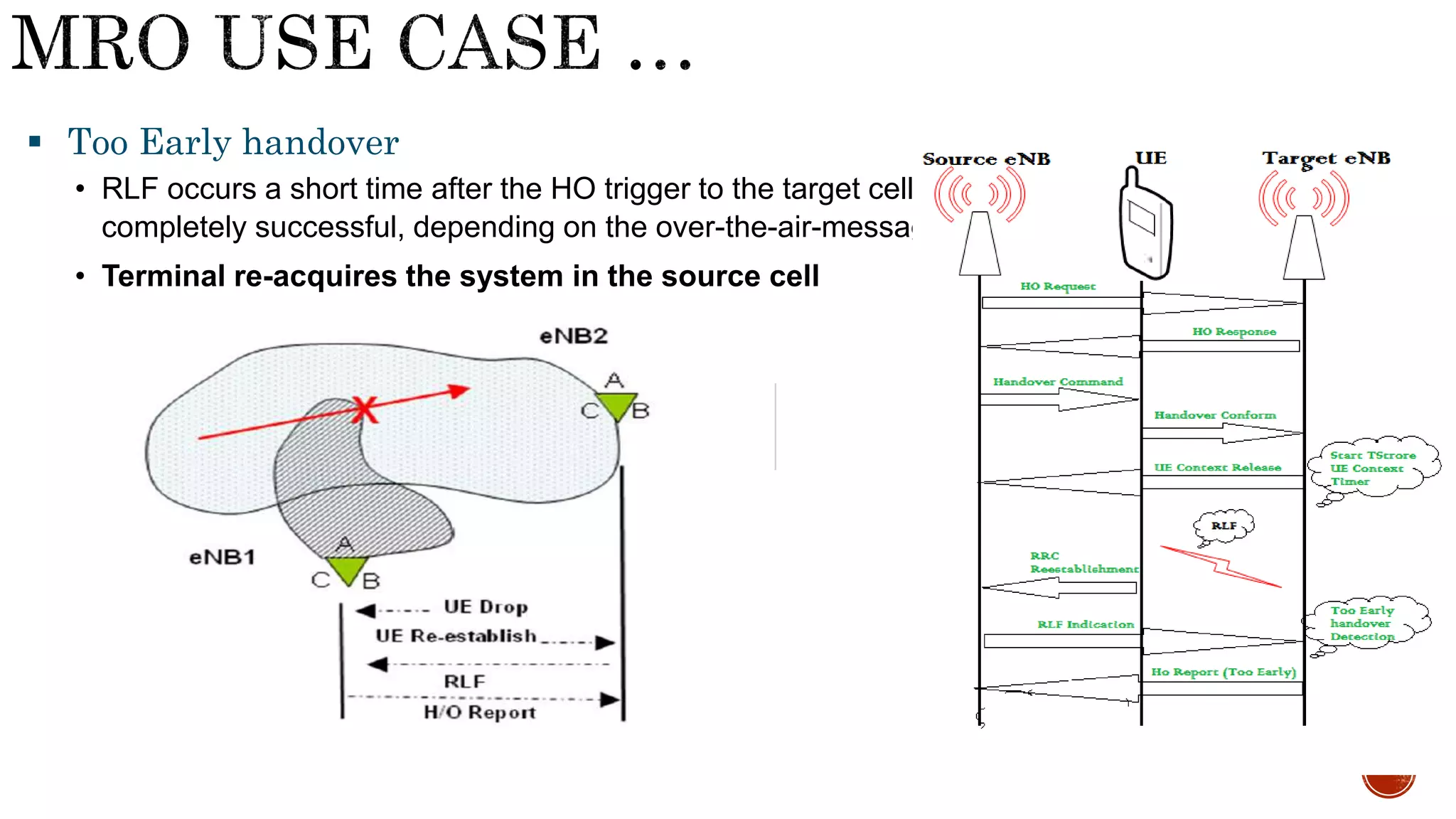
 Too Early handover
• RLF occurs a short time after the HO trigger to the target cell. The HO may or may not be
completely successful, depending on the over-the-air-messaging in the target cell.
• Terminal re-acquires the system in the source cell
 Wrong Cell handover
• RLF occurs a short time after the HO trigger to the target cell. The HO may or may not be
completely successful, depending on the over-the-air-messaging in the target cell.
• Terminal re-establishes in a different cell than the source or target.
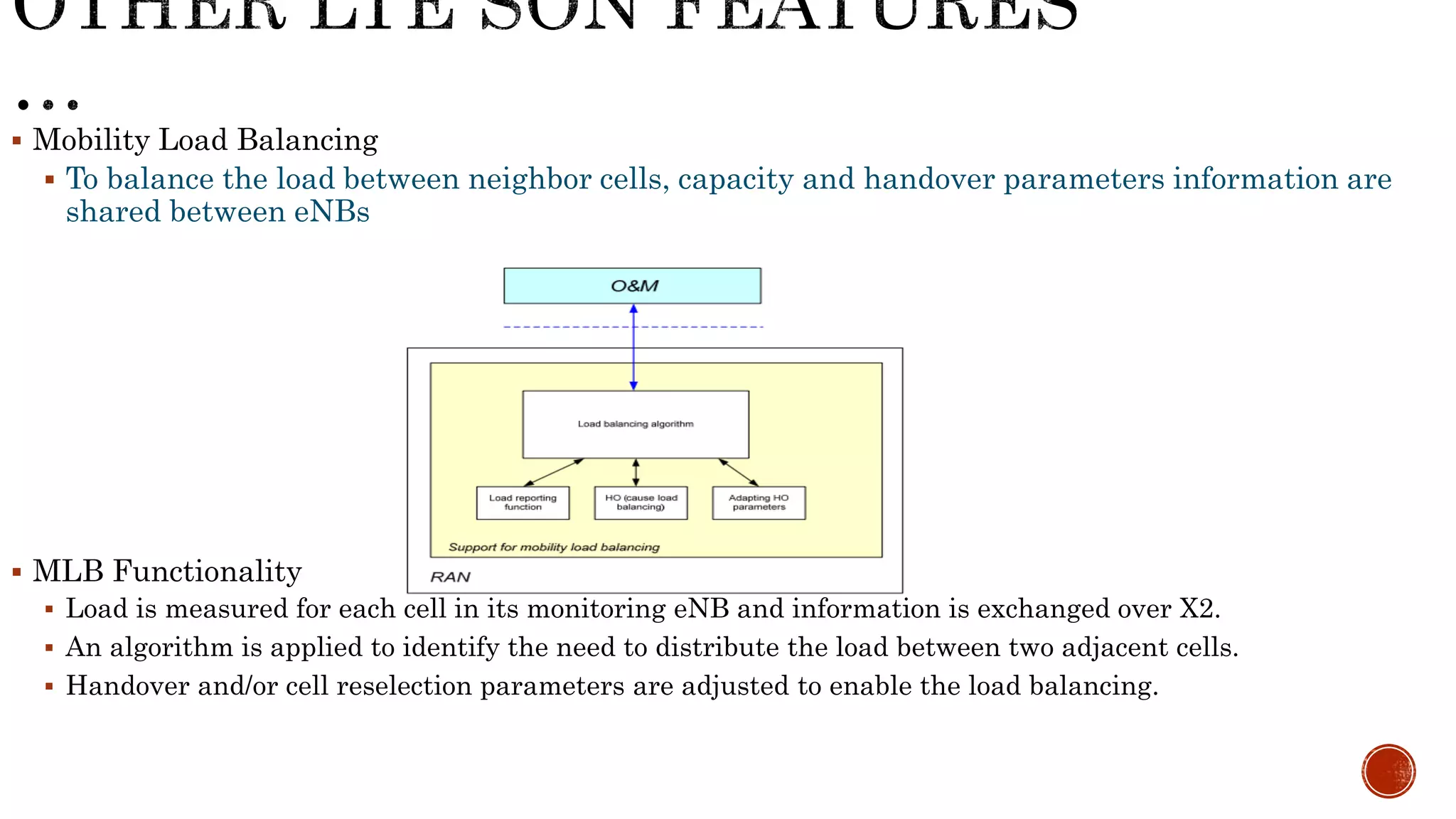
 Mobility Load Balancing
 To balance the load between neighbor cells, capacity and handover parameters information are shared between eNBs
 MLB Functionality
 Load is measured for each cell in its monitoring eNB and information is exchanged over X2.
 An algorithm is applied to identify the need to distribute the load between two adjacent cells.
 Handover and/or cell reselection parameters are adjusted to enable the load balancing.
 Energy Saving & Interference Reduction
 Decreasing power consumption of network elements and reduce greenhouse emission.
 The ability of ENB to perform cell deactivation and reactivation based on cell load information and maintaining coverage, capacity
and quality of service.
 Interference reduction based on cell switch on/off which also increases capacity and quality.
 Based on load server information SON server takes decision.
3GPP Supported Messages
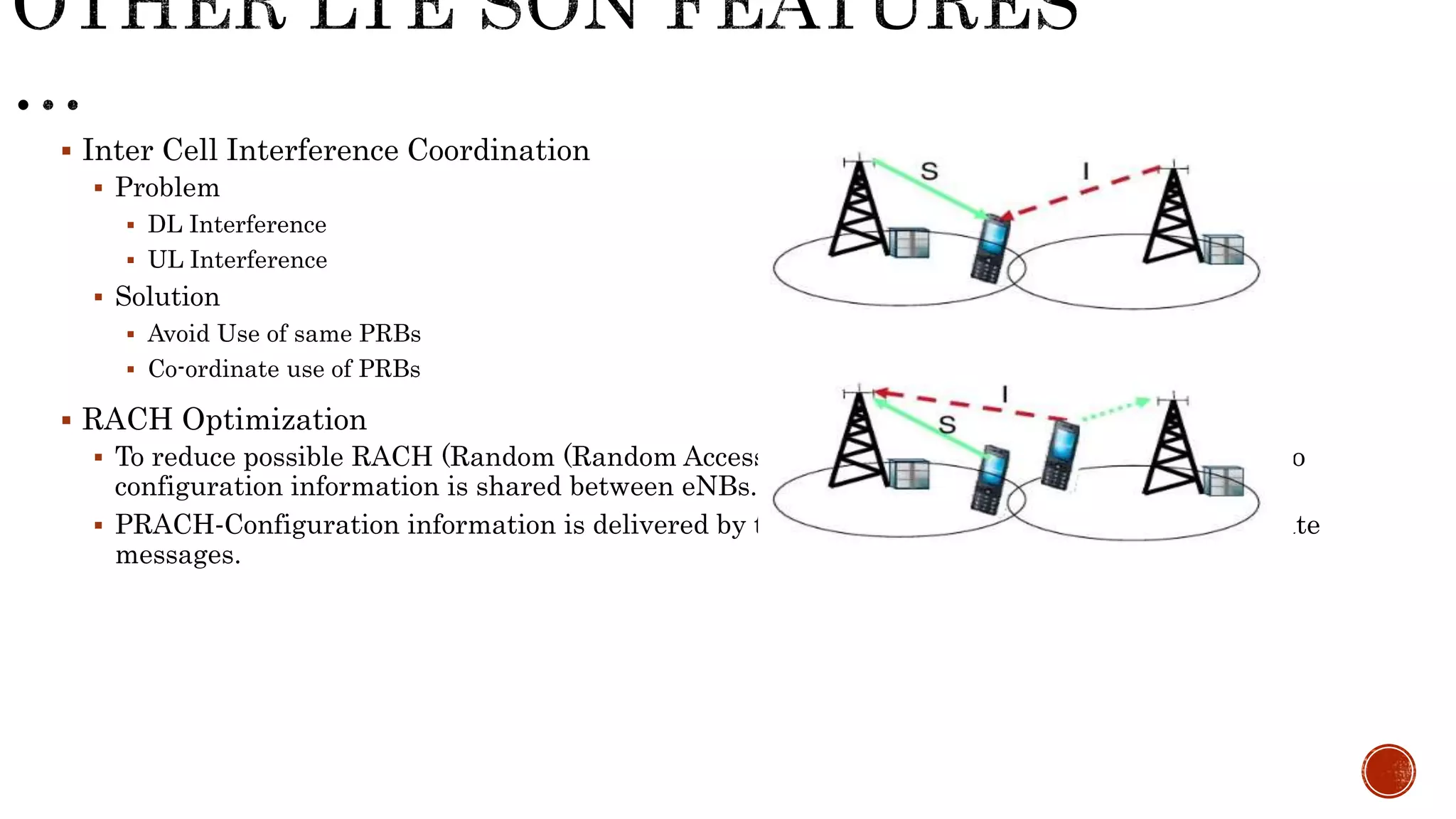
 Inter Cell Interference Coordination
 Problem
 DL Interference
 UL Interference
 Solution
 Avoid Use of same PRBs
 Co-ordinate use of PRBs
 RACH Optimization
 To reduce possible RACH (Random (Random Access Channel) Channel) resources collisions, so
configuration information is shared between eNBs.
 PRACH‐Configuration information is delivered by the X2 Setup and eNB Configuration Update messages.
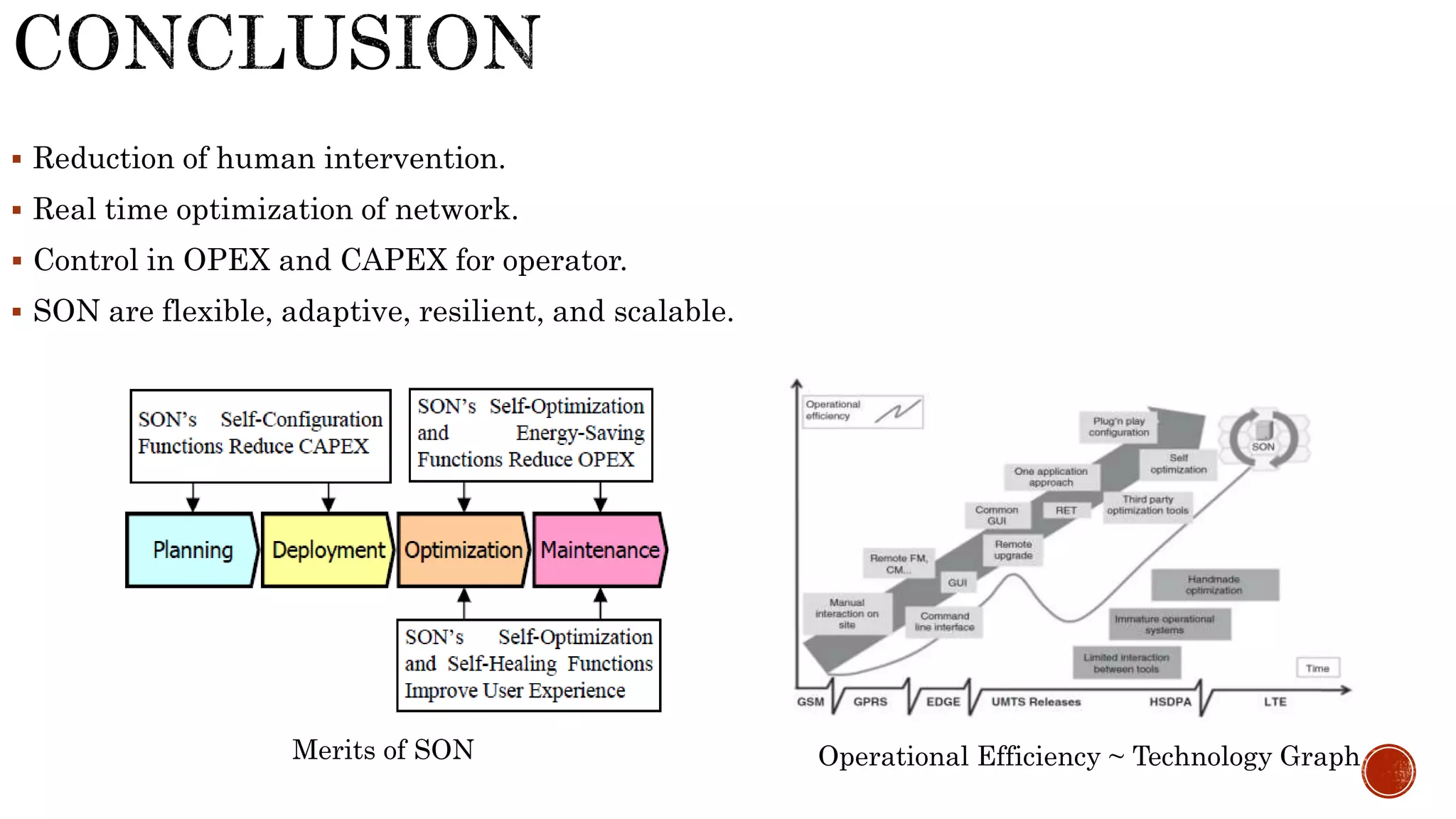
 Reduction of human intervention.
 Real time optimization of network.
 Control in OPEX and CAPEX for operator.
 SON are flexible, adaptive, resilient, and scalable.
Merits of SON Operational Efficiency ~ Technology Graph
 TS 36.300 - Evolved Universal Terrestrial Radio Access Network (E-UTRAN) Overall description
 TR 36.902 : Self Configuring and Self Optimizing Network use cases and solutions
 Self-Organizing Networks (SON) in 3GPP LTE Nomor Research
 The SOCRATES (Self-Optimisation and self-ConfiguRATion in wirelEss networkS) Project
 Benefits of Self-Organizing Networks (SON) for Mobile Operators Journal
 https://www.exploregate.com/
 https://www.sonlte.com/
 http://www.3gpp.org/
THANK YOU!

Self Organizing Network

  • 1.
  • 2.
     Introduction  WhySON  SON In LTE  Drivers for LTE SON  LTE SON Features  LTE SON Framework  LTE SON Architecture  Self Configuration Use Case  PCI Planning Use Case  ANR Use Case  MRO Use Case  Other LTE SON Features  Conclusion  References
  • 3.
    Processes of self-organizationliterally create order out of disorder ~Francis Heylighen
  • 4.
     Self OrganizationalNetwork express itself that it organizes the network automatically and reduces the manual intervention.  SON is a collection of procedures or functions for automatic configuration, optimization, diagnostication, and healing of networks.  Things under consideration  Material (Spectrum, Equipment, etc.) - With what things we will do the work.  Human (Engineering time) - Who will do the work.
  • 5.
     The NGMN(Next Generation Mobile Networks Association) first published its SON requirements in 2006.  The concepts quickly picked up by 3GPP in 2008 and rolled into the LTE standardization activities.  Starting with Release 8, 3GPP defines interfaces for SON built upon existing management architecture.  Successive 3GPP releases incorporates additional SON features tracking the expected network evolution stages in time.  Specification for SON and its use cases  TS 36.300 : E-UTRAN Overall Description  TR 32.821 : Study of SON related operation and OAM for home eNB.  TR 32.500 : SON Concepts and Requirements  TR 36.902 : Self Configuring and Self Optimizing Network use cases and solutions
  • 6.
     Reducing manualintervention or least possible human interaction.  Atomization of repetitive process.  Improve runtime operation/optimization based on real time data analysis.  Improving user experience and network performance.  Reduction of OPEX, CAPEX and complexity. Network with out SON Capability Network with SON Capability
  • 7.
     SON Solutioncan be divided in to three categories 1 Self Configuration 2 Self Optimization 3 Self Healing SON Features Proposed by NGMN
  • 8.
    LTE SON Features… 1 Self Configuration  Self-configuration mechanism is desirable during the pre-operational phases of network elements such as network planning and deployment.  Self Configuration Use Cases  Plug & Play : IP Address allocation, Authentication, Software and Configuration Download from OAM, Establish connectivity with other nodes  Planning radio parameters of a new eNB: Physical Cell ID automatic configuration, handover & cell selection thresholds, power settings, etc  Planning transport parameters of a new eNB : SGW gateway nodes  Planning connection for all neighbor nodes: Automatic Neighbor Relation (ANR)  Self test
  • 9.
    LTE SON Features… 2 Self Optimization  Self-optimization mechanism is desirable during the operational stage so that network operators get benefits of the dynamic optimization.  Self Optimization Use Cases  Neighbor cell list optimization  Evaluation/addition/deletion of existing neighbor cells  Intra/inter frequency and inter system neighbor cell list optimization  Interference control  Handover parameter optimization (MRO)  Load balancing  Energy savings  RACH load optimization  QoS related parameter optimization
  • 10.
    LTE SON Features… 3 Self Healing  Detects problem and solve or mitigate those to avoid user impact.  Self Healing Use Cases  cell outage detection and compensation : Antenna tilt and the cell transmit power  self-recovery of network element (NE) software  self-healing of board faults  Self-diagnosis: create a model to diagnose, learning from past experiences.  Self-healing: automatically start the corrective actions to solve the problem.  Significantly reduce maintenance costs.
  • 11.
  • 12.
     SON canbe located as whole functionality block or even split in sub-functionality located in different nodes.  Localization of algorithm and control. Centralized SON Distributed SON Hybrid SON
  • 13.
     Process wherenewly deployed nodes (eNBs) are configured by automatic installation procedures to get the necessary basic configuration for system operation. Self Configuration Procedure Flow
  • 14.
     Automatically configurethe Physical Cell ID of a newly introduced cell and also change the PCI to after detection of problem in PCI planning.  Things to consider :  Collison Free : The PCI of one cell should not be the same as those of his neighbor cells.  Confusion Free : The PCI of the neighbor cells should not be the same. PCI A PCI BPCI A PCI A Collision Based Collision Free PCI A PCI C PCI B PCI A PCI A PCI B Confusion Based Confusion Free
  • 15.
     PCI PlanningApproach  Listen on Radio Interface (NLM)  UE assisted PCI detection  X2 Message Based PCI detection  3GPP Messages used for PCI Planning  X2 Set Up Request  X2 Set Up Response  Measurement Report  ENB Configuration Update A Possible Solution
  • 16.
     It aimsto set up the neighbor relation automatically as much as possible.  ANR function relies on OAM and UE to report the neighbor cell information. • OAM’s significance • UE Measurement Report ANR with help of UE Measurement
  • 17.
     A Neighborcell Relation • Source cell knows the ECGI/CGI and PCI of the target cell. • Has an entry in the Neighbor Relation Table for the source cell identifying the target cell. • Has the attributes in this Neighbor Relation Table entry defined, either by O&M or set to default values. ANR Architecture Diagram
  • 18.
     Problem  Manualsetting of HO parameters in current 2G/3G systems is a time consuming task and it is also costly.  Incorrect HO parameter setting negatively affect user experience.  Solution  Automatically adjusting the mobility parameters Trigger thresholds,Time to trigger, Hysteresis, NRT, Antenna Remote Electrical Tilt etc  Detecting the cause of Reduce Radio Link Failures and unnecessary handovers and decrease those counts.  To enable adjustment of HO parameters , HO errors, reported by UE, can be notified to eNBs by backhaul signaling.  Too late handover  Too early handover  Handover to the wrong cell
  • 19.
     Too LateHandover • If the UE mobility is faster than the HO parameter settings allow for. • RLF in the source cell before the HO was initiated or during HO procedure. • Terminal re-establishes in a different cell than the source
  • 20.
     Too Earlyhandover • RLF occurs a short time after the HO trigger to the target cell. The HO may or may not be completely successful, depending on the over-the-air-messaging in the target cell. • Terminal re-acquires the system in the source cell
  • 21.
     Wrong Cellhandover • RLF occurs a short time after the HO trigger to the target cell. The HO may or may not be completely successful, depending on the over-the-air-messaging in the target cell. • Terminal re-establishes in a different cell than the source or target.
  • 22.
     Mobility LoadBalancing  To balance the load between neighbor cells, capacity and handover parameters information are shared between eNBs  MLB Functionality  Load is measured for each cell in its monitoring eNB and information is exchanged over X2.  An algorithm is applied to identify the need to distribute the load between two adjacent cells.  Handover and/or cell reselection parameters are adjusted to enable the load balancing.
  • 23.
     Energy Saving& Interference Reduction  Decreasing power consumption of network elements and reduce greenhouse emission.  The ability of ENB to perform cell deactivation and reactivation based on cell load information and maintaining coverage, capacity and quality of service.  Interference reduction based on cell switch on/off which also increases capacity and quality.  Based on load server information SON server takes decision. 3GPP Supported Messages
  • 24.
     Inter CellInterference Coordination  Problem  DL Interference  UL Interference  Solution  Avoid Use of same PRBs  Co-ordinate use of PRBs  RACH Optimization  To reduce possible RACH (Random (Random Access Channel) Channel) resources collisions, so configuration information is shared between eNBs.  PRACH‐Configuration information is delivered by the X2 Setup and eNB Configuration Update messages.
  • 25.
     Reduction ofhuman intervention.  Real time optimization of network.  Control in OPEX and CAPEX for operator.  SON are flexible, adaptive, resilient, and scalable. Merits of SON Operational Efficiency ~ Technology Graph
  • 26.
     TS 36.300- Evolved Universal Terrestrial Radio Access Network (E-UTRAN) Overall description  TR 36.902 : Self Configuring and Self Optimizing Network use cases and solutions  Self-Organizing Networks (SON) in 3GPP LTE Nomor Research  The SOCRATES (Self-Optimisation and self-ConfiguRATion in wirelEss networkS) Project  Benefits of Self-Organizing Networks (SON) for Mobile Operators Journal  https://www.exploregate.com/  https://www.sonlte.com/  http://www.3gpp.org/
  • 27.