Internal Carotid Artery
Begins: bifurcation
of the common
carotid artery at the
level of the upper
border of the thyroid
cartilage
Ascends in the neck
embedded in the
carotid sheath
Passes deep to the
parotid gland
Leaves the neck by
passing through the
carotid canal
Relations of the Internal Carotid Artery in the Neck
Anterolaterally: Below the
digastric. skin, the fascia, the
anterior border of the
sternocleidomastoid, and the
hypoglossal nerve. Above the
digastric lie the stylohyoid
muscle, the stylopharyngeus
muscle, the glossopharyngeal
nerve, the pharyngeal branch of
the vagus, the parotid gland,
and the external carotid artery
Posteriorly: The sympathetic
trunk, the longus capitis
muscle, and the transverse
processes of the upper three
cervical vertebrae
Medially: The pharyngeal wall
and the superior laryngeal
nerve
Laterally: The internal jugular
vein and the vagus nerve
The internal
jugular vein
Receives blood from
the brain, face, and
neck
Starts: continuation of
the sigmoid sinus and
leaves the skull through
the jugular foramen.
Descends through the
neck in the carotid
sheath lateral to the
vagus nerve and the
internal and common
carotid arteries.
Ends: by joining the
subclavian vein behind
the medial end of the
clavicle to form the
brachiocephalic vein
Closely related to the
deep cervical lymph
nodes.
Relations of the Internal Jugular Vein
Anterolaterally:
The skin, the
fascia, the
sternocleidomastoi
d, and the parotid
salivary gland.
Infrahyoid
muscles. crossed
by the stylohyoid,
the posterior belly
of the digastric,
and the spinal part
of the accessory
nerve.
Posteriorly: The
transverse
processes of the
cervical vertebrae,
muscles that attach
to the vertebrae , the
phrenic nerve, the
thyrocervical trunk,
the vertebral vein,
and the first part of
the subclavian artery
Medially: Above lie
the internal carotid
artery and the 9th,
10th, 11th, and 12th
cranial nerves.
Below lie the
common carotid
artery and the vagus
nerve.
Relations of the Internal Jugular Vein
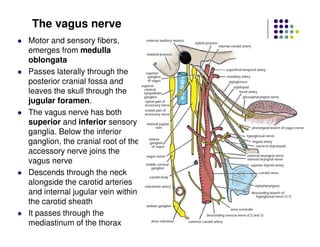
The vagus nerve
Motor and sensory fibers,
emerges from medulla
oblongata
Passes laterally through the
posterior cranial fossa and
leaves the skull through the
jugular foramen.
The vagus nerve has both
superior and inferior sensory
ganglia. Below the inferior
ganglion, the cranial root of the
accessory nerve joins the
vagus nerve
Descends through the neck
alongside the carotid arteries
and internal jugular vein within
the carotid sheath
It passes through the
mediastinum of the thorax
Vagus nerve branches
Pharyngeal branch: contains
nerve fibers from the cranial part of
the accessory nerve. joins the
pharyngeal plexus and supplies all
the muscles of the pharynx (except
the stylopharyngeus) and of the soft
palate (except the tensor veli
palatini).
Superior laryngeal nerve, divides
into:
Internal laryngeal nerve: sensory
to the mucous membrane of the
larynx down as far as the vocal
cords.
External laryngeal nerve: motor,
located close to the superior thyroid
artery; supplies the cricothyroid
muscle.
Recurrent laryngeal nerve:
Right: hooks around the first part
of the subclavian artery and then
ascends in the groove between the
trachea and the esophagus.
Left: hooks around the arch of the
aorta and then ascends into the
neck between the trachea and the
esophagus.
Related to the inferior thyroid
artery
Supplies: all the muscles of the
larynx, except the cricothyroid
muscle, the mucous membrane of
the larynx below the vocal cords,
and the mucous membrane of the
upper part of the trachea.
Cardiac branches: arise in the
neck, descend into the thorax, and
end in the cardiac plexus
Vagus nerve branches
The glossopharyngeal nerve
Motor and sensory
nerve, emerges from
the medulla
oblongata
passes laterally in
the posterior cranial
fossa and leaves the
skull by passing
through the jugular
foramen
The superior and
inferior sensory
ganglia are located
on the nerve as it
passes through the
foramen.
Descends through
the upper part of the
neck to the back of
the tongue
Nerve to the
stylopharyngeus
muscle
Pharyngeal
branches: run to
the pharyngeal
plexus and also
receive branches
from the vagus
nerve
Lingual branch:
passes to the
mucous
membrane of the
posterior third of
the tongue
(including the
vallate papillae).
The glossopharyngeal nerve branches
The hypoglossal nerve
Motor nerve.
emerges on the
medulla oblongata
Crosses the
posterior cranial
fossa, and leaves
the skull through the
hypoglossal canal.
Passes downward
and forward in the
neck and crosses
the internal and
external carotid
arteries to reach the
tongue
hooking around the
occipital artery
In the upper part of
its course, it is joined
by C1 fibers from the
cervical plexus.
Branches of the Hypoglossal Nerve
Descending
branch (C1 fibers)
passes downward
and joins the
descending
cervical nerve (C2
and 3) to form the
ansa cervicalis.
supply the
omohyoid, the
sternohyoid, and
the sternothyroid
muscles.
Nerve to the
thyrohyoid muscle
(C1)
Muscular
branches: to all the
muscles of the
tongue except the
palatoglossus
(pharyngeal plexus)
Nerve to the geniohyoid muscle (C1). The
hypoglossal nerve thus innervates the muscles
of the tongue
Does not give off any branches as it passes
through the anterior triangle of the neck
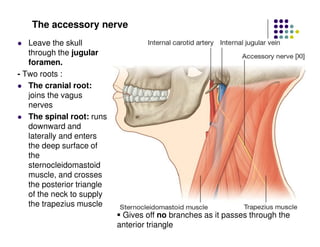
Leave the skull
through the jugular
foramen.
- Two roots :
The cranial root:
joins the vagus
nerves
The spinal root: runs
downward and
laterally and enters
the deep surface of
the
sternocleidomastoid
muscle, and crosses
the posterior triangle
of the neck to supply
the trapezius muscle
The accessory nerve
Gives off no branches as it passes through the
anterior triangle
The thyroid gland
Two lobes connected by
a narrow isthmus
Attached to the larynx
and the trachea by a
sheath derived from the
pretracheal layer of
deep fascia
Each lobe is pear
shaped
- Apex: directed upward
as far as the oblique line
on the lamina of the
thyroid cartilage
- Base: at the level of the
fourth or fifth tracheal
ring.
Clinical notes
Any pathologic neck
swelling that is part
of the thyroid gland
will move upward
when the patient is
asked to swallow.
Pathologic
enlargement of the
thyroid commonly
results in pressure
on the trachea
Relations of the Lobes
Anterolaterally: The
sternothyroid, the
superior belly of the
omohyoid, the
sternohyoid, and the
anterior border of the
sternocleidomastoid
Posterolaterally:
common carotid artery,
the internal jugular vein,
and the vagus nerve
Medially: The larynx,
the trachea, the
pharynx, and the
esophagus. the
cricothyroid muscle and
its nerve supply,
recurrent laryngeal
nerve
The isthmus
Extends across the
midline in front of the
second, third, and
fourth tracheal rings
pyramidal lobe: is
often present, and it
projects upward from
the isthmus, usually to
the left of the midline.
Usually connected to
the hyoid bone by a
fibrous or muscular
band
levator glandulae
thyroideae: (if it is
muscular)
- Relations:
Anteriorly: The sternothyroids, sternohyoids, anterior jugular veins, fascia,
and skin
Posteriorly: The second, third, and fourth rings of the trachea
Blood supply
The superior thyroid
artery: a branch of the
external carotid artery,
descends to the upper
pole of each lobe,
accompanied by the
external laryngeal
nerve
Thyroid ima artery?
arises from the
brachiocephalic trunk or
the arch of the aorta and
ascends on the anterior
surface of the trachea to
supply the thyroid gland
Blood supply
The inferior thyroid
artery: a branch of the
thyrocervical trunk
(branch of first part of
subclavian artery,
ascends behind the gland
to the level of the cricoid
cartilage. It then turns
medially and downward
to reach the posterior
border of the gland
Venous drainage
Superior thyroid vein:
drains into the internal
jugular vein
Middle thyroid: drains
into the internal jugular
vein
Inferior thyroid veins:
anastomose with one
another as they descend
in front of the trachea.
They drain into the left
brachiocephalic vein
Lymphatic drainage
Deep cervical
paratracheal nodes
Parathyroid Glands
Ovoid bodies measuring about
6 mm long in their greatest
diameter.
Four in number on the
posterior border of the thyroid
gland, within its fascial capsule
- Two superior parathyroid
glands: at the level of the
middle of the posterior border
of the thyroid gland.
- Two inferior parathyroid
glands: usually lie close to the
inferior poles of the thyroid
gland, but may be found:
* Embedded in the thyroid
substance
* Superior mediastinum

anterior_triangle_2.pdf

  • 1.
    Internal Carotid Artery Begins:bifurcation of the common carotid artery at the level of the upper border of the thyroid cartilage Ascends in the neck embedded in the carotid sheath Passes deep to the parotid gland Leaves the neck by passing through the carotid canal
  • 2.
    Relations of theInternal Carotid Artery in the Neck Anterolaterally: Below the digastric. skin, the fascia, the anterior border of the sternocleidomastoid, and the hypoglossal nerve. Above the digastric lie the stylohyoid muscle, the stylopharyngeus muscle, the glossopharyngeal nerve, the pharyngeal branch of the vagus, the parotid gland, and the external carotid artery Posteriorly: The sympathetic trunk, the longus capitis muscle, and the transverse processes of the upper three cervical vertebrae Medially: The pharyngeal wall and the superior laryngeal nerve Laterally: The internal jugular vein and the vagus nerve
  • 3.
    The internal jugular vein Receivesblood from the brain, face, and neck Starts: continuation of the sigmoid sinus and leaves the skull through the jugular foramen. Descends through the neck in the carotid sheath lateral to the vagus nerve and the internal and common carotid arteries. Ends: by joining the subclavian vein behind the medial end of the clavicle to form the brachiocephalic vein Closely related to the deep cervical lymph nodes.
  • 6.
    Relations of theInternal Jugular Vein Anterolaterally: The skin, the fascia, the sternocleidomastoi d, and the parotid salivary gland. Infrahyoid muscles. crossed by the stylohyoid, the posterior belly of the digastric, and the spinal part of the accessory nerve.
  • 7.
    Posteriorly: The transverse processes ofthe cervical vertebrae, muscles that attach to the vertebrae , the phrenic nerve, the thyrocervical trunk, the vertebral vein, and the first part of the subclavian artery Medially: Above lie the internal carotid artery and the 9th, 10th, 11th, and 12th cranial nerves. Below lie the common carotid artery and the vagus nerve. Relations of the Internal Jugular Vein
  • 8.
    The vagus nerve Motorand sensory fibers, emerges from medulla oblongata Passes laterally through the posterior cranial fossa and leaves the skull through the jugular foramen. The vagus nerve has both superior and inferior sensory ganglia. Below the inferior ganglion, the cranial root of the accessory nerve joins the vagus nerve Descends through the neck alongside the carotid arteries and internal jugular vein within the carotid sheath It passes through the mediastinum of the thorax
  • 9.
    Vagus nerve branches Pharyngealbranch: contains nerve fibers from the cranial part of the accessory nerve. joins the pharyngeal plexus and supplies all the muscles of the pharynx (except the stylopharyngeus) and of the soft palate (except the tensor veli palatini). Superior laryngeal nerve, divides into: Internal laryngeal nerve: sensory to the mucous membrane of the larynx down as far as the vocal cords. External laryngeal nerve: motor, located close to the superior thyroid artery; supplies the cricothyroid muscle.
  • 10.
    Recurrent laryngeal nerve: Right:hooks around the first part of the subclavian artery and then ascends in the groove between the trachea and the esophagus. Left: hooks around the arch of the aorta and then ascends into the neck between the trachea and the esophagus. Related to the inferior thyroid artery Supplies: all the muscles of the larynx, except the cricothyroid muscle, the mucous membrane of the larynx below the vocal cords, and the mucous membrane of the upper part of the trachea. Cardiac branches: arise in the neck, descend into the thorax, and end in the cardiac plexus Vagus nerve branches
  • 11.
    The glossopharyngeal nerve Motorand sensory nerve, emerges from the medulla oblongata passes laterally in the posterior cranial fossa and leaves the skull by passing through the jugular foramen The superior and inferior sensory ganglia are located on the nerve as it passes through the foramen. Descends through the upper part of the neck to the back of the tongue
  • 12.
    Nerve to the stylopharyngeus muscle Pharyngeal branches:run to the pharyngeal plexus and also receive branches from the vagus nerve Lingual branch: passes to the mucous membrane of the posterior third of the tongue (including the vallate papillae). The glossopharyngeal nerve branches
  • 13.
    The hypoglossal nerve Motornerve. emerges on the medulla oblongata Crosses the posterior cranial fossa, and leaves the skull through the hypoglossal canal. Passes downward and forward in the neck and crosses the internal and external carotid arteries to reach the tongue hooking around the occipital artery In the upper part of its course, it is joined by C1 fibers from the cervical plexus.
  • 14.
    Branches of theHypoglossal Nerve Descending branch (C1 fibers) passes downward and joins the descending cervical nerve (C2 and 3) to form the ansa cervicalis. supply the omohyoid, the sternohyoid, and the sternothyroid muscles. Nerve to the thyrohyoid muscle (C1) Muscular branches: to all the muscles of the tongue except the palatoglossus (pharyngeal plexus) Nerve to the geniohyoid muscle (C1). The hypoglossal nerve thus innervates the muscles of the tongue Does not give off any branches as it passes through the anterior triangle of the neck
  • 16.
    Leave the skull throughthe jugular foramen. - Two roots : The cranial root: joins the vagus nerves The spinal root: runs downward and laterally and enters the deep surface of the sternocleidomastoid muscle, and crosses the posterior triangle of the neck to supply the trapezius muscle The accessory nerve Gives off no branches as it passes through the anterior triangle
  • 17.
    The thyroid gland Twolobes connected by a narrow isthmus Attached to the larynx and the trachea by a sheath derived from the pretracheal layer of deep fascia Each lobe is pear shaped - Apex: directed upward as far as the oblique line on the lamina of the thyroid cartilage - Base: at the level of the fourth or fifth tracheal ring.
  • 18.
    Clinical notes Any pathologicneck swelling that is part of the thyroid gland will move upward when the patient is asked to swallow. Pathologic enlargement of the thyroid commonly results in pressure on the trachea
  • 19.
    Relations of theLobes Anterolaterally: The sternothyroid, the superior belly of the omohyoid, the sternohyoid, and the anterior border of the sternocleidomastoid Posterolaterally: common carotid artery, the internal jugular vein, and the vagus nerve Medially: The larynx, the trachea, the pharynx, and the esophagus. the cricothyroid muscle and its nerve supply, recurrent laryngeal nerve
  • 20.
    The isthmus Extends acrossthe midline in front of the second, third, and fourth tracheal rings pyramidal lobe: is often present, and it projects upward from the isthmus, usually to the left of the midline. Usually connected to the hyoid bone by a fibrous or muscular band levator glandulae thyroideae: (if it is muscular) - Relations: Anteriorly: The sternothyroids, sternohyoids, anterior jugular veins, fascia, and skin Posteriorly: The second, third, and fourth rings of the trachea
  • 21.
    Blood supply The superiorthyroid artery: a branch of the external carotid artery, descends to the upper pole of each lobe, accompanied by the external laryngeal nerve Thyroid ima artery? arises from the brachiocephalic trunk or the arch of the aorta and ascends on the anterior surface of the trachea to supply the thyroid gland
  • 22.
    Blood supply The inferiorthyroid artery: a branch of the thyrocervical trunk (branch of first part of subclavian artery, ascends behind the gland to the level of the cricoid cartilage. It then turns medially and downward to reach the posterior border of the gland
  • 23.
    Venous drainage Superior thyroidvein: drains into the internal jugular vein Middle thyroid: drains into the internal jugular vein Inferior thyroid veins: anastomose with one another as they descend in front of the trachea. They drain into the left brachiocephalic vein Lymphatic drainage Deep cervical paratracheal nodes
  • 24.
    Parathyroid Glands Ovoid bodiesmeasuring about 6 mm long in their greatest diameter. Four in number on the posterior border of the thyroid gland, within its fascial capsule - Two superior parathyroid glands: at the level of the middle of the posterior border of the thyroid gland. - Two inferior parathyroid glands: usually lie close to the inferior poles of the thyroid gland, but may be found: * Embedded in the thyroid substance * Superior mediastinum