Akshay Kumar Kansal Int. Journal of Engineering Research and Applications www.ijera.com
ISSN: 2248-9622, Vol. 5, Issue 12, (Part - 2) December 2015, pp.05-10
www.ijera.com 5|P a g e
Low Power and Fast Transient High Swing CMOS Telescopic
Operational Amplifier
Akshay Kumar Kansal1
, Asst Prof. Gayatri Sakya2
Electronics and Communication Department, 1,2
JSS Academy of Technical Education, Noida, U.P. – 201301
Abstract
CMOS telescopic operational amplifier with high-swing and high-performance is described in this paper. The
swing is attained by using the tail and current source-transistors in deep-linear region. The resultant deprivation
in parameters like differential gain, CMRR and added characteristics are recompensed by using regulated-
cascode differential gain enhancement and a replica-tail feedback technique. Operating at power supply of 3.3V,
the power consumption, slew rate and settling time are improved using transmission controlled pass circuitry
and level amplifier. It is shown through simulations that the Op-Amp preserves its high CMRR and unity gain
frequency.
Index Terms: CMOS feedback logic, transient response, op-amp, operational amplifier, telescopic, improved,
low power.
I. Introduction
Operational Amplifiers are the most important
and basic integrated parts of the Analog and mixed-
mode signal operations. The continuous work in the
op-amp design provides developments from simple
two stage op-amp to telescopic op-amp. Telescopic
op-amps have lot of advantages over the remaining
types, but the disadvantage is low output swing.
Initially when we are using high supply voltages this
was not a severe problem. As the developments in the
VLSI technology making the supply voltages scaling
down the output voltage swing drawing a more
concern towards it, and it becomes an important
parameter to be considered while designing the op-
amps. To get a high-swing in the telescopic op-amp
we need to compromise with the other parameters of
the op-amp, such as speed, gain and power.
There are two types of telescopic op-amps, 1)
Telescopic op-amp with tail and 2) Telescopic op-
amp without tail. They are briefed below
1) Telescopic amplifier:
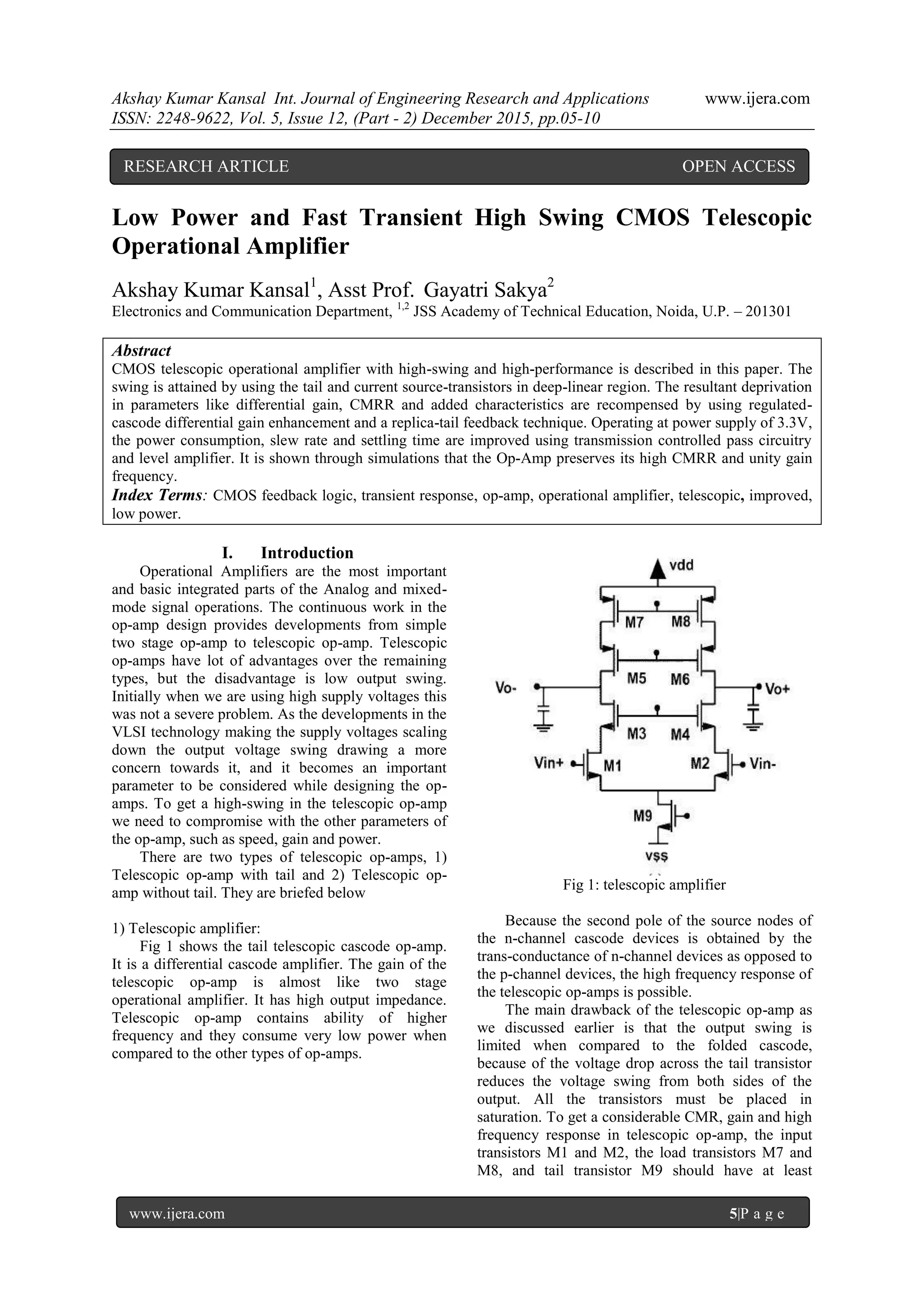
Fig 1 shows the tail telescopic cascode op-amp.
It is a differential cascode amplifier. The gain of the
telescopic op-amp is almost like two stage
operational amplifier. It has high output impedance.
Telescopic op-amp contains ability of higher
frequency and they consume very low power when
compared to the other types of op-amps.
Fig 1: telescopic amplifier
Because the second pole of the source nodes of
the n-channel cascode devices is obtained by the
trans-conductance of n-channel devices as opposed to
the p-channel devices, the high frequency response of
the telescopic op-amps is possible.
The main drawback of the telescopic op-amp as
we discussed earlier is that the output swing is
limited when compared to the folded cascode,
because of the voltage drop across the tail transistor
reduces the voltage swing from both sides of the
output. All the transistors must be placed in
saturation. To get a considerable CMR, gain and high
frequency response in telescopic op-amp, the input
transistors M1 and M2, the load transistors M7 and
M8, and tail transistor M9 should have at least
RESEARCH ARTICLE OPEN ACCESS
Akshay Kumar Kansal Int. Journal of Engineering Research and Applications www.ijera.com
ISSN: 2248-9622, Vol. 5, Issue 12, (Part - 2) December 2015, pp.05-10
www.ijera.com 6|P a g e
minimum drain to source saturation voltage Vds,sat
across them. So the maximum output differential
swing can be given by the equation 2Vsupply -
10Vds,saturation - 6Vmargin [1].
2) No-tail telescopic op-amp:
Fig 2: No-tail telescopic op-amp
No-tail telescopic op-amp is shown in above fig
2. Because there is no need of voltage drop across the
tail transistor, in the no-tail telescopic op-amp the
output voltage swing will be improved. The amount
of voltage swing improved in no-tail op-amp will be
equal to 2Vds,saturation + 2Vmargine. To get this improved
output swing in the telescopic op-amp we have to
compromise with the CMRR, PSRR of the telescopic
op-amp. In addition to that the parameters like
settling time and unity gain frequency of the
telescopic op-amp are sensitive to the input common-
mode and variations in the supply voltage.
II. High-swing Op-amp
A) why high-swing op-amps?
The relationship among the parameters of op-
amp is given by
𝑆𝑁𝑅 .(𝑠𝑝𝑒𝑒𝑑 )
𝑃
=
𝑠𝑤𝑖𝑛𝑔 2
𝛾(
𝑘𝑇
𝐶
)
.
𝛽(
𝑔𝑚
𝐶
)
𝑉 𝑠𝑢𝑝𝑝𝑙𝑦 .(𝜆𝐼)
.....(1)
Where SNR is signal to noise ratio, P is power, β is
the feedback factor of the closed loop op-amp, 𝜆 is
the ratio of total current consumption of the
operational amplifier to the current flowing through
one of the input devices, 𝛾 is the number of kT/C
noise contributions at the output of the amplifier.
kT/C is the thermal noise which is dominant in the
analog circuits.
The equation (1) can be represented in the simplified
form as
𝑆𝑁𝑅 .(𝑠𝑝𝑒𝑒𝑑 )
𝑃
𝛼
𝑠𝑤𝑖𝑛𝑔 2
𝑉 𝑠𝑢𝑝𝑝𝑙𝑦
....... (2)
From the above equation we can incur that if the
swing is high then either SNR is high or power
consumption P is low. Here the speed will be
determined by the location of the dominant pole of
the operational amplifier. So the overall performance
of the op-amp will be improved.
B. Procedure to improve the swing:
Fig 3: procedure for improving swing
If we want to improve the output swing we need
to reduce the voltage drop across the tail and the load
transistors. To reduce the voltage drop across these
transistors, we need to drive the tail transistor M9,
and load transistors M7 and M8 into deep linear
region[2]. As these transistors or operating in the
triode region the marginal voltage Vmargin need not to
be considered. The output swing equation is given by
2Vsupply - 2Vmargin - 6Vds, saturation - 2Vds,linear-tail -
2Vds,linear-load, where Vds,linear-tail is the voltage drop
across the drain and source of the tail transistor in the
linear region and Vds,linear-load is the voltage drop
across the drain to source of the load transistors in the
linear region. The swing obtained in this method is
not only superior to the telescopic op-amp but also
superior to the regular folded cascode amplifier. The
improvement in the swing is because of i. no longer
we need marginal voltage, ii. difference between
Vds,sat and the voltage across the devices in the linear
region. Any voltage reduction in across the tail
transistor M9 will improve the voltage swing by
twofold of the reduction, because the tail transistor is
connected to the both sides of the output of the op-
amp.
III. Implementation of op-amp :
Description of the circuit:
Akshay Kumar Kansal Int. Journal of Engineering Research and Applications www.ijera.com
ISSN: 2248-9622, Vol. 5, Issue 12, (Part - 2) December 2015, pp.05-10
www.ijera.com 7|P a g e
Fig 4: gain amplification across p-channel
The op-amp architecture will be determined by
the requirements in the application such as speed,
SNR, or power. The amplifier shown in fig 4 uses
standard folded-cascode amplifier architecture. The
input applied at the gate of the transistor named as
the M5E sets the drain voltage of the M7 and M8 in
the main amplifier.
The modified amplifier is shown in shown in fig
5 below
Fig 5: gain amp across n-channel
The transistors in shaded region M3X, M4X,
M7X and M8X act as active load. This amplifier
serves as replica amplifier without Vt.
This amplifier has many advantages, i) the
current through the single third input transistor will
be reused in the new differential pair and it will
reduce the additional power required to construct
amplifier, ii) the common voltage at the inputs of this
enhancement amplifier equals the common-mode
voltage of inputs of amplifier iii) ensures good
replica matching, which improves the performance of
the replica-tail feedback technique, iv) this
implementation allows simultaneous setting of the dc
levels of the common-mode voltage at the drains of
the input devices[3]
The overall implementation is shown in below
fig 6.
Fig 6: overall implementation
Capacitance Cc can be used to push the second
stage pole to a higher frequency. The ratio of the
transcondance of the duplication amplifier to the
capacitance Cc establishes the unity gain frequency of
the replica loop. The gain amps, on the other hand,
are stabilized by the arrangement of an explicit
capacitance and parasitic capacitance at the gate of
the cascoded devices. A cascode current-mirror is
used to supply the current to the replica circuitry. For
the common-mode feedback, the typical switched
capacitor circuit is used [5].
IV. Modified Circuit and Description
As we can see from the results of Base design,
the power dissipation is controlled differentially by
the input supplies only. Here in order to prevent
leakage from supply, transmission controlled
circuitry is added which helps to improvise the
previously obtained results. Also improvisation in
current flowing through tail transistor is also done by
increasing the gate voltage across the tail transistor
by employing level change amplifier, which in turn
increases the gate-to-source voltage for tail transistor.
Due to this added circuitry, settling time and slew
rate restored their base values, which were initially
degraded due to transmission controlled circuitry.
CMMR and internal gain of the amplifier remained
legitimately constant. A very small increase in output
offset voltage resulted due to very small leakages in
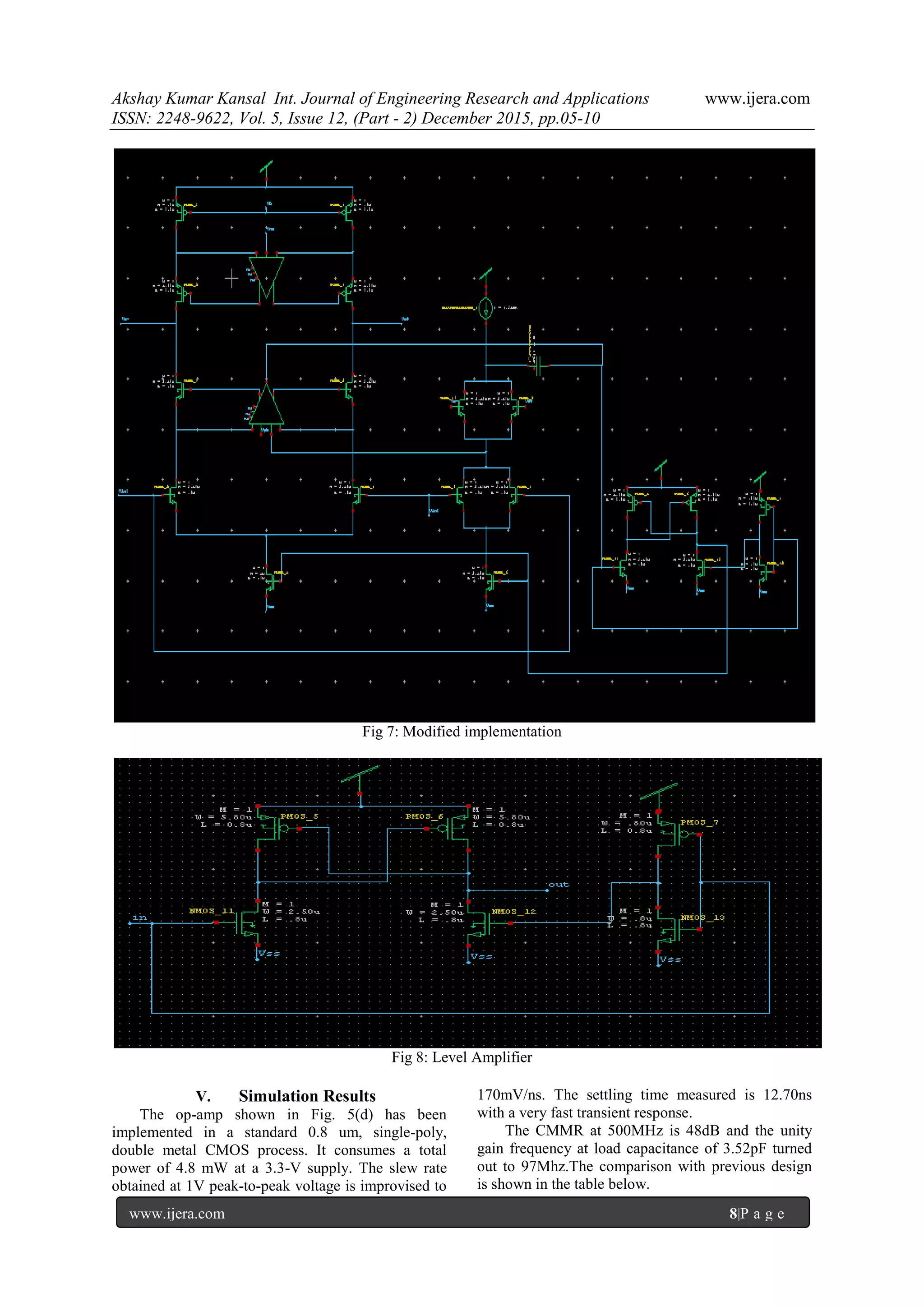
amplifier gain circuitry. The schematic diagram of
proposed design is shown in the fig given below. The
added circuit components transmission controller and
level change amplifier are also shown below:
Akshay Kumar Kansal Int. Journal of Engineering Research and Applications www.ijera.com
ISSN: 2248-9622, Vol. 5, Issue 12, (Part - 2) December 2015, pp.05-10
www.ijera.com 8|P a g e
Fig 7: Modified implementation
Fig 8: Level Amplifier
V. Simulation Results
The op-amp shown in Fig. 5(d) has been
implemented in a standard 0.8 um, single-poly,
double metal CMOS process. It consumes a total
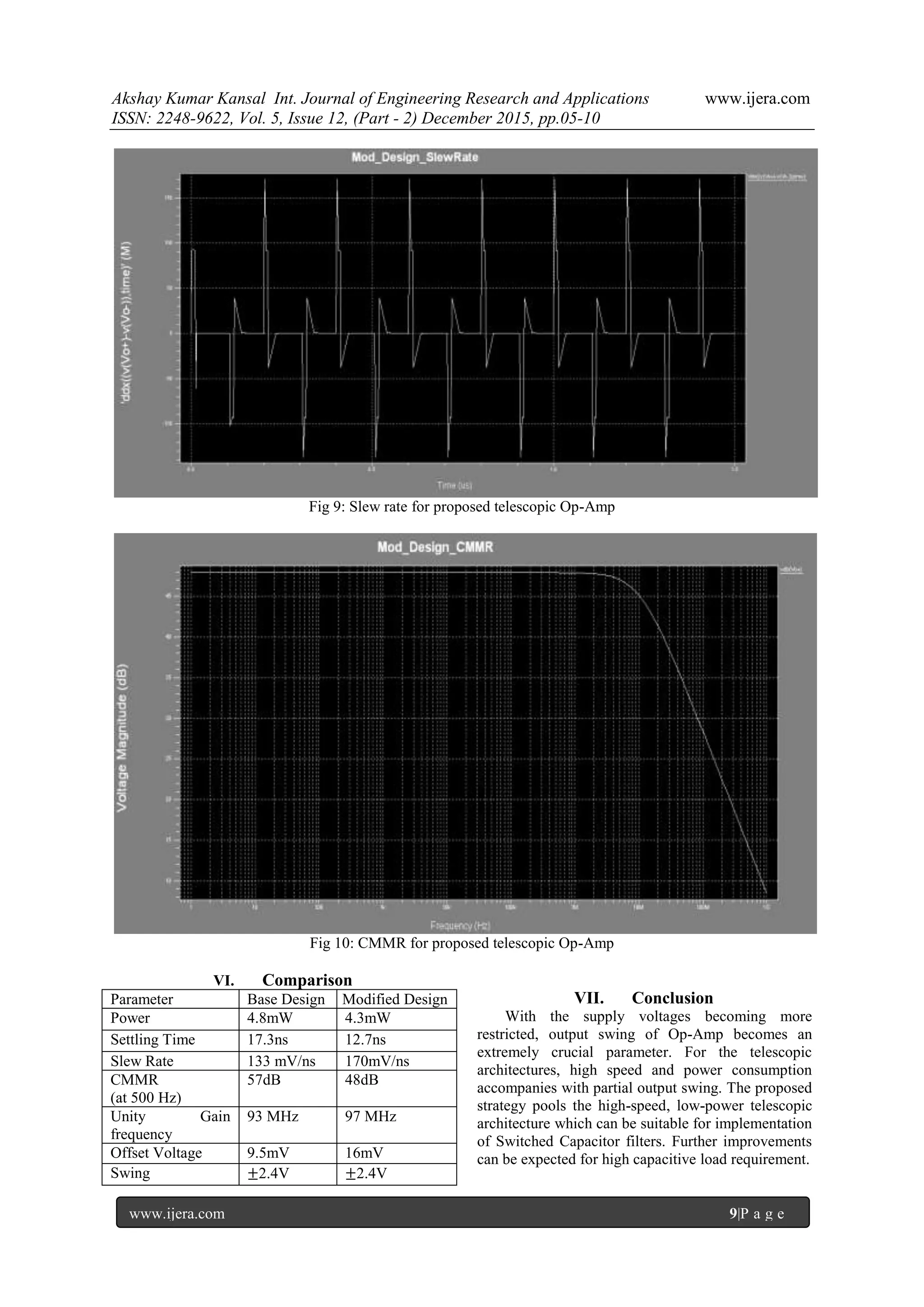
power of 4.8 mW at a 3.3-V supply. The slew rate
obtained at 1V peak-to-peak voltage is improvised to
170mV/ns. The settling time measured is 12.70ns
with a very fast transient response.
The CMMR at 500MHz is 48dB and the unity
gain frequency at load capacitance of 3.52pF turned
out to 97Mhz.The comparison with previous design
is shown in the table below.
Akshay Kumar Kansal Int. Journal of Engineering Research and Applications www.ijera.com
ISSN: 2248-9622, Vol. 5, Issue 12, (Part - 2) December 2015, pp.05-10
www.ijera.com 9|P a g e
Fig 9: Slew rate for proposed telescopic Op-Amp
Fig 10: CMMR for proposed telescopic Op-Amp
VI. Comparison
Parameter Base Design Modified Design
Power 4.8mW 4.3mW
Settling Time 17.3ns 12.7ns
Slew Rate 133 mV/ns 170mV/ns
CMMR
(at 500 Hz)
57dB 48dB
Unity Gain
frequency
93 MHz 97 MHz
Offset Voltage 9.5mV 16mV
Swing ±2.4V ±2.4V
VII. Conclusion
With the supply voltages becoming more
restricted, output swing of Op-Amp becomes an
extremely crucial parameter. For the telescopic
architectures, high speed and power consumption
accompanies with partial output swing. The proposed
strategy pools the high-speed, low-power telescopic
architecture which can be suitable for implementation
of Switched Capacitor filters. Further improvements
can be expected for high capacitive load requirement.
Akshay Kumar Kansal Int. Journal of Engineering Research and Applications www.ijera.com
ISSN: 2248-9622, Vol. 5, Issue 12, (Part - 2) December 2015, pp.05-10
www.ijera.com 10|P a g e
References
[1] G. Nicollini, F. Moretti, and M. Conti,
“High-frequency fully differential filter
using operational amplifiers without
common-mode feedback,” IEEE J. Solid-
State Circuits, vol. 24, pp. 803–813, June
1989.
[2] P. W. Li, M. J. Chin, P. R. Gray, and R.
Castello, “A ratio-independent algorithmic
analog-to-digital conversion technique,”
IEEE J. Solid-State Circuits, vol. SC-19, pp.
1138–1143, Dec. 1984.
[3] J. N. Babanezad, “A low-output-impedance
fully differential op amp with large output
swing and continuous-time common-mode
feedback,” IEEE J. Solid-State Circuits, vol.
26, pp. 1825–1833, Dec. 1991.
[4] K. Bult and G. J. G. M. Geelen, “A fast-
settling CMOS op amp for SC circuits with
90-dB DC gain,” IEEE J. Solid-State
Circuits, vol. 25, pp. 1379–1384, Dec. 1990.
[5] J. Yang and H.-S. Lee, “A CMOS 12-bit 4
MHz pipelined A/D converter with
commutative feedback capacitor,” in Proc.
IEEE Custom Integrated Circuits Conf.,
1996, pp. 427–430.
[6] W. Krenik, J. Hellums, W.-C. Hsu, R. Nail,
and L. Izzi, “High dynamic range CMOS
amplifier design in reduced supply voltage
environment,” Tech. Dig. Midwest Symp.
Circuits and Systems, 1988, pp. 368–370.

Low Power and Fast Transient High Swing CMOS Telescopic Operational Amplifier

  • 1.
    Akshay Kumar KansalInt. Journal of Engineering Research and Applications www.ijera.com ISSN: 2248-9622, Vol. 5, Issue 12, (Part - 2) December 2015, pp.05-10 www.ijera.com 5|P a g e Low Power and Fast Transient High Swing CMOS Telescopic Operational Amplifier Akshay Kumar Kansal1 , Asst Prof. Gayatri Sakya2 Electronics and Communication Department, 1,2 JSS Academy of Technical Education, Noida, U.P. – 201301 Abstract CMOS telescopic operational amplifier with high-swing and high-performance is described in this paper. The swing is attained by using the tail and current source-transistors in deep-linear region. The resultant deprivation in parameters like differential gain, CMRR and added characteristics are recompensed by using regulated- cascode differential gain enhancement and a replica-tail feedback technique. Operating at power supply of 3.3V, the power consumption, slew rate and settling time are improved using transmission controlled pass circuitry and level amplifier. It is shown through simulations that the Op-Amp preserves its high CMRR and unity gain frequency. Index Terms: CMOS feedback logic, transient response, op-amp, operational amplifier, telescopic, improved, low power. I. Introduction Operational Amplifiers are the most important and basic integrated parts of the Analog and mixed- mode signal operations. The continuous work in the op-amp design provides developments from simple two stage op-amp to telescopic op-amp. Telescopic op-amps have lot of advantages over the remaining types, but the disadvantage is low output swing. Initially when we are using high supply voltages this was not a severe problem. As the developments in the VLSI technology making the supply voltages scaling down the output voltage swing drawing a more concern towards it, and it becomes an important parameter to be considered while designing the op- amps. To get a high-swing in the telescopic op-amp we need to compromise with the other parameters of the op-amp, such as speed, gain and power. There are two types of telescopic op-amps, 1) Telescopic op-amp with tail and 2) Telescopic op- amp without tail. They are briefed below 1) Telescopic amplifier: Fig 1 shows the tail telescopic cascode op-amp. It is a differential cascode amplifier. The gain of the telescopic op-amp is almost like two stage operational amplifier. It has high output impedance. Telescopic op-amp contains ability of higher frequency and they consume very low power when compared to the other types of op-amps. Fig 1: telescopic amplifier Because the second pole of the source nodes of the n-channel cascode devices is obtained by the trans-conductance of n-channel devices as opposed to the p-channel devices, the high frequency response of the telescopic op-amps is possible. The main drawback of the telescopic op-amp as we discussed earlier is that the output swing is limited when compared to the folded cascode, because of the voltage drop across the tail transistor reduces the voltage swing from both sides of the output. All the transistors must be placed in saturation. To get a considerable CMR, gain and high frequency response in telescopic op-amp, the input transistors M1 and M2, the load transistors M7 and M8, and tail transistor M9 should have at least RESEARCH ARTICLE OPEN ACCESS
  • 2.
    Akshay Kumar KansalInt. Journal of Engineering Research and Applications www.ijera.com ISSN: 2248-9622, Vol. 5, Issue 12, (Part - 2) December 2015, pp.05-10 www.ijera.com 6|P a g e minimum drain to source saturation voltage Vds,sat across them. So the maximum output differential swing can be given by the equation 2Vsupply - 10Vds,saturation - 6Vmargin [1]. 2) No-tail telescopic op-amp: Fig 2: No-tail telescopic op-amp No-tail telescopic op-amp is shown in above fig 2. Because there is no need of voltage drop across the tail transistor, in the no-tail telescopic op-amp the output voltage swing will be improved. The amount of voltage swing improved in no-tail op-amp will be equal to 2Vds,saturation + 2Vmargine. To get this improved output swing in the telescopic op-amp we have to compromise with the CMRR, PSRR of the telescopic op-amp. In addition to that the parameters like settling time and unity gain frequency of the telescopic op-amp are sensitive to the input common- mode and variations in the supply voltage. II. High-swing Op-amp A) why high-swing op-amps? The relationship among the parameters of op- amp is given by 𝑆𝑁𝑅 .(𝑠𝑝𝑒𝑒𝑑 ) 𝑃 = 𝑠𝑤𝑖𝑛𝑔 2 𝛾( 𝑘𝑇 𝐶 ) . 𝛽( 𝑔𝑚 𝐶 ) 𝑉 𝑠𝑢𝑝𝑝𝑙𝑦 .(𝜆𝐼) .....(1) Where SNR is signal to noise ratio, P is power, β is the feedback factor of the closed loop op-amp, 𝜆 is the ratio of total current consumption of the operational amplifier to the current flowing through one of the input devices, 𝛾 is the number of kT/C noise contributions at the output of the amplifier. kT/C is the thermal noise which is dominant in the analog circuits. The equation (1) can be represented in the simplified form as 𝑆𝑁𝑅 .(𝑠𝑝𝑒𝑒𝑑 ) 𝑃 𝛼 𝑠𝑤𝑖𝑛𝑔 2 𝑉 𝑠𝑢𝑝𝑝𝑙𝑦 ....... (2) From the above equation we can incur that if the swing is high then either SNR is high or power consumption P is low. Here the speed will be determined by the location of the dominant pole of the operational amplifier. So the overall performance of the op-amp will be improved. B. Procedure to improve the swing: Fig 3: procedure for improving swing If we want to improve the output swing we need to reduce the voltage drop across the tail and the load transistors. To reduce the voltage drop across these transistors, we need to drive the tail transistor M9, and load transistors M7 and M8 into deep linear region[2]. As these transistors or operating in the triode region the marginal voltage Vmargin need not to be considered. The output swing equation is given by 2Vsupply - 2Vmargin - 6Vds, saturation - 2Vds,linear-tail - 2Vds,linear-load, where Vds,linear-tail is the voltage drop across the drain and source of the tail transistor in the linear region and Vds,linear-load is the voltage drop across the drain to source of the load transistors in the linear region. The swing obtained in this method is not only superior to the telescopic op-amp but also superior to the regular folded cascode amplifier. The improvement in the swing is because of i. no longer we need marginal voltage, ii. difference between Vds,sat and the voltage across the devices in the linear region. Any voltage reduction in across the tail transistor M9 will improve the voltage swing by twofold of the reduction, because the tail transistor is connected to the both sides of the output of the op- amp. III. Implementation of op-amp : Description of the circuit:
  • 3.
    Akshay Kumar KansalInt. Journal of Engineering Research and Applications www.ijera.com ISSN: 2248-9622, Vol. 5, Issue 12, (Part - 2) December 2015, pp.05-10 www.ijera.com 7|P a g e Fig 4: gain amplification across p-channel The op-amp architecture will be determined by the requirements in the application such as speed, SNR, or power. The amplifier shown in fig 4 uses standard folded-cascode amplifier architecture. The input applied at the gate of the transistor named as the M5E sets the drain voltage of the M7 and M8 in the main amplifier. The modified amplifier is shown in shown in fig 5 below Fig 5: gain amp across n-channel The transistors in shaded region M3X, M4X, M7X and M8X act as active load. This amplifier serves as replica amplifier without Vt. This amplifier has many advantages, i) the current through the single third input transistor will be reused in the new differential pair and it will reduce the additional power required to construct amplifier, ii) the common voltage at the inputs of this enhancement amplifier equals the common-mode voltage of inputs of amplifier iii) ensures good replica matching, which improves the performance of the replica-tail feedback technique, iv) this implementation allows simultaneous setting of the dc levels of the common-mode voltage at the drains of the input devices[3] The overall implementation is shown in below fig 6. Fig 6: overall implementation Capacitance Cc can be used to push the second stage pole to a higher frequency. The ratio of the transcondance of the duplication amplifier to the capacitance Cc establishes the unity gain frequency of the replica loop. The gain amps, on the other hand, are stabilized by the arrangement of an explicit capacitance and parasitic capacitance at the gate of the cascoded devices. A cascode current-mirror is used to supply the current to the replica circuitry. For the common-mode feedback, the typical switched capacitor circuit is used [5]. IV. Modified Circuit and Description As we can see from the results of Base design, the power dissipation is controlled differentially by the input supplies only. Here in order to prevent leakage from supply, transmission controlled circuitry is added which helps to improvise the previously obtained results. Also improvisation in current flowing through tail transistor is also done by increasing the gate voltage across the tail transistor by employing level change amplifier, which in turn increases the gate-to-source voltage for tail transistor. Due to this added circuitry, settling time and slew rate restored their base values, which were initially degraded due to transmission controlled circuitry. CMMR and internal gain of the amplifier remained legitimately constant. A very small increase in output offset voltage resulted due to very small leakages in amplifier gain circuitry. The schematic diagram of proposed design is shown in the fig given below. The added circuit components transmission controller and level change amplifier are also shown below:
  • 4.
    Akshay Kumar KansalInt. Journal of Engineering Research and Applications www.ijera.com ISSN: 2248-9622, Vol. 5, Issue 12, (Part - 2) December 2015, pp.05-10 www.ijera.com 8|P a g e Fig 7: Modified implementation Fig 8: Level Amplifier V. Simulation Results The op-amp shown in Fig. 5(d) has been implemented in a standard 0.8 um, single-poly, double metal CMOS process. It consumes a total power of 4.8 mW at a 3.3-V supply. The slew rate obtained at 1V peak-to-peak voltage is improvised to 170mV/ns. The settling time measured is 12.70ns with a very fast transient response. The CMMR at 500MHz is 48dB and the unity gain frequency at load capacitance of 3.52pF turned out to 97Mhz.The comparison with previous design is shown in the table below.
  • 5.
    Akshay Kumar KansalInt. Journal of Engineering Research and Applications www.ijera.com ISSN: 2248-9622, Vol. 5, Issue 12, (Part - 2) December 2015, pp.05-10 www.ijera.com 9|P a g e Fig 9: Slew rate for proposed telescopic Op-Amp Fig 10: CMMR for proposed telescopic Op-Amp VI. Comparison Parameter Base Design Modified Design Power 4.8mW 4.3mW Settling Time 17.3ns 12.7ns Slew Rate 133 mV/ns 170mV/ns CMMR (at 500 Hz) 57dB 48dB Unity Gain frequency 93 MHz 97 MHz Offset Voltage 9.5mV 16mV Swing ±2.4V ±2.4V VII. Conclusion With the supply voltages becoming more restricted, output swing of Op-Amp becomes an extremely crucial parameter. For the telescopic architectures, high speed and power consumption accompanies with partial output swing. The proposed strategy pools the high-speed, low-power telescopic architecture which can be suitable for implementation of Switched Capacitor filters. Further improvements can be expected for high capacitive load requirement.
  • 6.
    Akshay Kumar KansalInt. Journal of Engineering Research and Applications www.ijera.com ISSN: 2248-9622, Vol. 5, Issue 12, (Part - 2) December 2015, pp.05-10 www.ijera.com 10|P a g e References [1] G. Nicollini, F. Moretti, and M. Conti, “High-frequency fully differential filter using operational amplifiers without common-mode feedback,” IEEE J. Solid- State Circuits, vol. 24, pp. 803–813, June 1989. [2] P. W. Li, M. J. Chin, P. R. Gray, and R. Castello, “A ratio-independent algorithmic analog-to-digital conversion technique,” IEEE J. Solid-State Circuits, vol. SC-19, pp. 1138–1143, Dec. 1984. [3] J. N. Babanezad, “A low-output-impedance fully differential op amp with large output swing and continuous-time common-mode feedback,” IEEE J. Solid-State Circuits, vol. 26, pp. 1825–1833, Dec. 1991. [4] K. Bult and G. J. G. M. Geelen, “A fast- settling CMOS op amp for SC circuits with 90-dB DC gain,” IEEE J. Solid-State Circuits, vol. 25, pp. 1379–1384, Dec. 1990. [5] J. Yang and H.-S. Lee, “A CMOS 12-bit 4 MHz pipelined A/D converter with commutative feedback capacitor,” in Proc. IEEE Custom Integrated Circuits Conf., 1996, pp. 427–430. [6] W. Krenik, J. Hellums, W.-C. Hsu, R. Nail, and L. Izzi, “High dynamic range CMOS amplifier design in reduced supply voltage environment,” Tech. Dig. Midwest Symp. Circuits and Systems, 1988, pp. 368–370.