TRANSPORTATION
MANAGEMENT
Transportation Economics and Pricing
Transportation Economics
Cost structures
Carrier pricing strategy
Transportation rates and ratings
Transportation Economics…
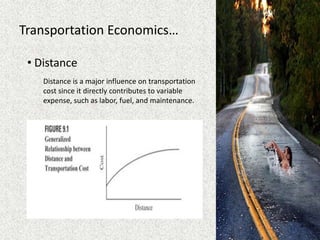
• Distance
Distance is a major influence on transportation
cost since it directly contributes to variable
expense, such as labor, fuel, and maintenance.
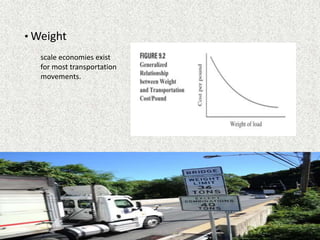
• Weight
scale economies exist
for most transportation
movements.
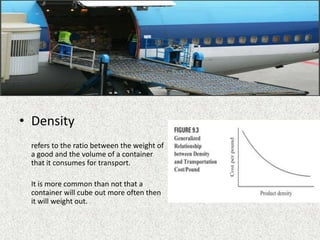
• Density
refers to the ratio between the weight of
a good and the volume of a container
that it consumes for transport.
It is more common than not that a
container will cube out more often then
it will weight out.
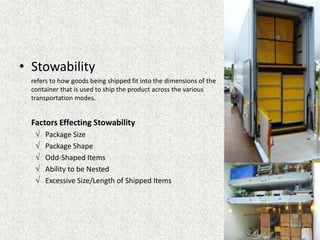
• Stowability
refers to how goods being shipped fit into the dimensions of the
container that is used to ship the product across the various
transportation modes.
Factors Effecting Stowability
√ Package Size
√ Package Shape
√ Odd-Shaped Items
√ Ability to be Nested
√ Excessive Size/Length of Shipped Items
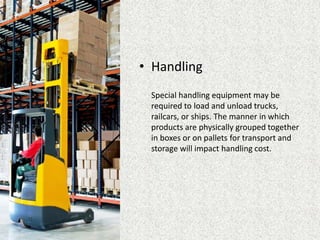
• Handling
Special handling equipment may be
required to load and unload trucks,
railcars, or ships. The manner in which
products are physically grouped together
in boxes or on pallets for transport and
storage will impact handling cost.
• Liability
Carriers must either have insurance to
protect against potential damage or
accept financial responsibility. Shippers
can reduce their risk, and ultimately
transportation cost, by improved
packaging or reducing susceptibility to
loss or damage.
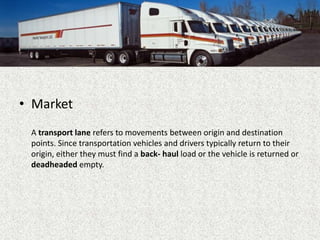
• Market
A transport lane refers to movements between origin and destination
points. Since transportation vehicles and drivers typically return to their
origin, either they must find a back- haul load or the vehicle is returned or
deadheaded empty.
Transportation Costing...
• Variable Cost
… the variable category includes direct carrier cost associated with movement of each
load.
• Fixed Cost
… the fixed category includes costs not directly influenced by shipment volume.
• Joint
… expenses created by the decision to provide a particular service
• Common
… this category includes carrier costs that are incurred on behalf of all or selected
shippers.
Carrier Pricing Strategy...
• Cost-of-Service
The cost-of-service strategy is a buildup approach where the
carrier establishes a rate based on the cost of providing the
service plus a profit margin.
• Value-of-Service
An alternative strategy that charges a price based on value as
perceived by the shipper rather than the carrier cost of actually
providing the service.
• Combination
pricing strategy establishes the transport price at an
intermediate level between the cost-of-service minimum and the
value-of-service maximum
• Net-Rate
the net rate is an all-inclusive price. The goal is to drastically
reduce a carrier’s administrative cost and directly respond to
customer demand to simplify the pricing process. Shippers are
attracted to such simplification because it promotes billing
accuracy and provides a clear understanding of how to generate
savings in transportation.
Transportation Rates…
• Class Rates
evolved from the fact that all products transported by common carriers
are classified for pricing purposes.
• Classification
products transported are typically grouped together into uniform
classifications. The classification takes into consideration the
characteristics of a product or commodity that will influence the cost of
handling or transport.
• Rate Determination
The rate per hundredweight is usually based on the shipment
origin and destination, although the actual price charged for a
particular shipment is normally subject to a minimum charge
and may also be subject to surcharges.
• Cube Rates
are determined for the weight contained in each category of
freight.
• Commodity Rates
are special or specific rates published without regard to classification.
The terms and conditions of a commodity rate are usually indicated in
a contract between the carrier and shipper.
• Exception Rates
Special rates published to provide prices lower than the prevailing class
rates
• Special Rate and Services
A number of special rates and services provided by carriers are
available for use in logistical operations.

Transportation Management

  • 1.
  • 2.
    Transportation Economics andPricing Transportation Economics Cost structures Carrier pricing strategy Transportation rates and ratings
  • 3.
    Transportation Economics… • Distance Distanceis a major influence on transportation cost since it directly contributes to variable expense, such as labor, fuel, and maintenance.
  • 4.
    • Weight scale economiesexist for most transportation movements.
  • 5.
    • Density refers tothe ratio between the weight of a good and the volume of a container that it consumes for transport. It is more common than not that a container will cube out more often then it will weight out.
  • 6.
    • Stowability refers tohow goods being shipped fit into the dimensions of the container that is used to ship the product across the various transportation modes. Factors Effecting Stowability √ Package Size √ Package Shape √ Odd-Shaped Items √ Ability to be Nested √ Excessive Size/Length of Shipped Items
  • 7.
    • Handling Special handlingequipment may be required to load and unload trucks, railcars, or ships. The manner in which products are physically grouped together in boxes or on pallets for transport and storage will impact handling cost.
  • 8.
    • Liability Carriers musteither have insurance to protect against potential damage or accept financial responsibility. Shippers can reduce their risk, and ultimately transportation cost, by improved packaging or reducing susceptibility to loss or damage.
  • 9.
    • Market A transportlane refers to movements between origin and destination points. Since transportation vehicles and drivers typically return to their origin, either they must find a back- haul load or the vehicle is returned or deadheaded empty.
  • 10.
    Transportation Costing... • VariableCost … the variable category includes direct carrier cost associated with movement of each load. • Fixed Cost … the fixed category includes costs not directly influenced by shipment volume. • Joint … expenses created by the decision to provide a particular service • Common … this category includes carrier costs that are incurred on behalf of all or selected shippers.
  • 11.
    Carrier Pricing Strategy... •Cost-of-Service The cost-of-service strategy is a buildup approach where the carrier establishes a rate based on the cost of providing the service plus a profit margin. • Value-of-Service An alternative strategy that charges a price based on value as perceived by the shipper rather than the carrier cost of actually providing the service. • Combination pricing strategy establishes the transport price at an intermediate level between the cost-of-service minimum and the value-of-service maximum • Net-Rate the net rate is an all-inclusive price. The goal is to drastically reduce a carrier’s administrative cost and directly respond to customer demand to simplify the pricing process. Shippers are attracted to such simplification because it promotes billing accuracy and provides a clear understanding of how to generate savings in transportation.
  • 12.
    Transportation Rates… • ClassRates evolved from the fact that all products transported by common carriers are classified for pricing purposes. • Classification products transported are typically grouped together into uniform classifications. The classification takes into consideration the characteristics of a product or commodity that will influence the cost of handling or transport.
  • 13.
    • Rate Determination Therate per hundredweight is usually based on the shipment origin and destination, although the actual price charged for a particular shipment is normally subject to a minimum charge and may also be subject to surcharges. • Cube Rates are determined for the weight contained in each category of freight.
  • 14.
    • Commodity Rates arespecial or specific rates published without regard to classification. The terms and conditions of a commodity rate are usually indicated in a contract between the carrier and shipper. • Exception Rates Special rates published to provide prices lower than the prevailing class rates • Special Rate and Services A number of special rates and services provided by carriers are available for use in logistical operations.