Amazon.com
Supply chain management
Binsu Benny
Greeshma P
Saddam S
S3 MBA
College of Engineering Trivandrum
Introduction
 American international electronic
commerce company with
headquarters in Seattle, Washington.
 Amazon.com started as an online
bookstore, but soon diversified,
selling DVDs, VHSs, CDs, video and
MP3
downloads/streaming, software, video
games, electronics, apparel, furniture,
food, toys, and jewelry.
Levels
 Pre-structural level
◦ Amazon is one of the pioneers of online consumer
sales. They sells books, music and many other items
over the internet
 Uni-structural level
◦ Amazon's supply chain management has an edge
over other companies because of the shopping
experience the company offers. It has supply chain
and fulfillment capabilities and popular pricing
strategies.
 Multi-structural level
◦ Amazon was one of the first companies who
introduced the rating system. The rating system is a
way for customers to rate the service that they
received from the vendor. Amazon manages and
ships it's own inventory and the inventory of other
companies like Eddie Bauer and Target.
 Relational level
◦ Amazon's supply chain is so great that major
brick-and-mortar retailers like Target Corp,
Borders and Toys “R” uses Amazon's website
for their e-commerce efforts. They are
effectively managing their inventory and
became competitive by satisfying all type of
customers.
 Critical level
◦ Amazon conducts its business on an
international scale. The company ships to
almost 200 countries. Right now, Amazon
firmly has the e-commerce market at the
palm of its hand. They have to expand their
DCs to other countries to reduce
transportation cost.
Why is Amazon building more warehouses as it
grows? How many warehouses should it have and
where should they be located?
 As it grew the company added
warehouses allowing it to react more
quickly to customer orders. Increasing
the number of warehouses near
customers will reduce the response time.
 Amazon aims to be able to deliver most
items the day they’re ordered, so it can
keep rivals such as EBay and Wal-Mart
Stores from peeling off customers.
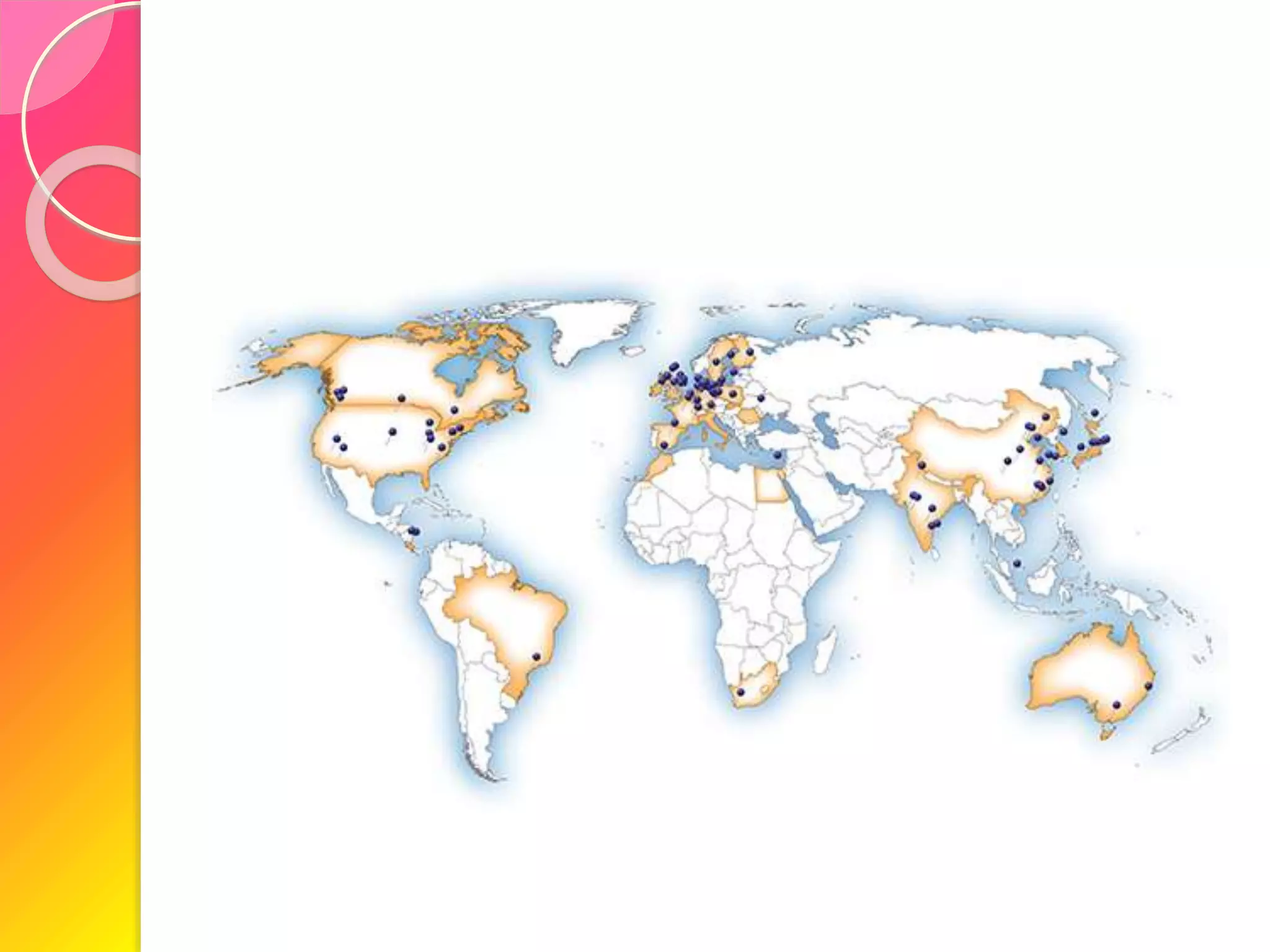
 Amazon has around 50 warehouses, 20
in US and rest in Canada, France,
Germany, Italy, UK, China, Japan
What advantages does selling books via
internet provides over traditional book store?
Are there any disadvantages to selling via
internet
 It is proved to be a more convenient option for the
customer. The customer did not have to drive or walk to
the store to buy a book.
 The reader received a catalog containing reviews about
books and information about popular books in the
market.
 Don't have to advertise and find the buyers, post the
message at any book purchasing website, and
concerned buyers would automatically get in touch with.
 Can get the best money, as one can select from the
buyers that hit on the book.
 the elimination of costs related to maintenance of retail
stores and the direct contact with the customer online.
 Online trade removes geographical barriers and allows
the customers to shop 24/7.
 Customers can view all the information about
the book, book reviews and books on similar
topics. This gives them far more information
than looking at the single book at the
bookshelf of a retail store.
 The security of online payments is a problem
preventing many people from shopping
online. The totally secure system has not
been introduced yet, and customers might
find it confusing revealing their payment data
online.
 Delivery of books also might not happen
timely, due to many factors.
 The customer never has the chance to see
and “feel” the book; many people dislike
buying books online because they cannot
sense the book, turn over the pages and read
a few lines.
Should amazon stock every book it sells?
 No
 If Amazon stocked every book it sells, it would need a warehouse the
size of Nevada. It would also have gigantic inventory costs.
 Amazon uses three basic methods for selling books
◦ standard inventory
◦ "just in time" inventory
◦ third party sellers
 Physical inventory of the most popular books it sells.
 Less popular books are subject to "just in time" inventory
management.
 Amazon doesn't have the books, but has arrangements with the
publishers to ship the books as soon as it receives orders.
 Results in a slight delay in shipping to the customer, but Amazon
saves a lot of money in inventory costs.
 Has network of third party merchants who sell through Amazon. These
third party merchants generally specialize in out-of-print books or
books that deal with relatively arcane subjects. Those books are
shipped to the customer directly from the third party and are billed by
the third party to the customer's credit card or paypal account. Amazon
takes a small commission for acting as a middleman.
 Stock only those product with high demand
What advantage can brick-and-mortar players drive from
setting up an online channel? How should they use the two
channels to gain maximum advantage?
 Stand out from the competition: A professional webstore will
be the ultimate competitor. Advancement in Internet and
software technology, making it cheaply available to even the
smallest business so they can compete more effectively with
larger competitors.
 Saving customers a trip to the store: By setting up own-
branded online store, customers can shop and pay for the goods
at their convenience and comfort and get it delivered to their
offices or door steps anytime.
 Low-cost way to expand your business: Compared to a new
brick-and-mortar store investment, online storefront cost a lot
less. This investment goes a long way and it only cost less than
a month worth of offine store rental.
 Inexpensive yet Highly Targeted Marketing Channel: it helps
to tap into email newsletter marketing, feed marketing via
Google Base & SMS Coupon Marketing. All which are very
affordable ways of extending the brand and services online. It's
proven that email and SMS marketing work best on an opt-in list
(or existing database). More repeated purchases.
 Complete Range of Products Selection & In-Depth
Information: In-depth product information educates well and
sells even better! Nobody does it better than an tireless
24x7x365 online web store. When sell online, can offer other
products and services online that would be difficult to carry in
a store due to size and space constraints.
 Easily Automate Cross-Sell and Make more Money:
encourages the customers to buy a complementary or related
product or service which can have a significant impact on
profitability.
 Pre-order done easily: An online store lets you take and
process pre-order easily via credit card payment. For some
hot selling products, getting large quantity not just ensure that
don't have Inventory Turnover problem, it also means(with
larger quantity) can negotiate more competitive pricing with
the suppliers.
 Increase Customer Value over Lifetime: Setting up online
store allows customers to interact consistently and
conveniently via both online and offline channel. This
consistent experience will extend the brand that will increase
their loyalty.
Should traditional bookseller like Barner & Noble integrate e-
commerce into their current supply chain or manage it as
separate supply chain?
 It is better to integrate e-commerce
supply chain to their current supply
chain.
 Advantages:
◦ Common warehouse.
◦ Global market
◦ More competitive
For what product does e-commerce channel
offer greatest advantage? What characterizes
these products?
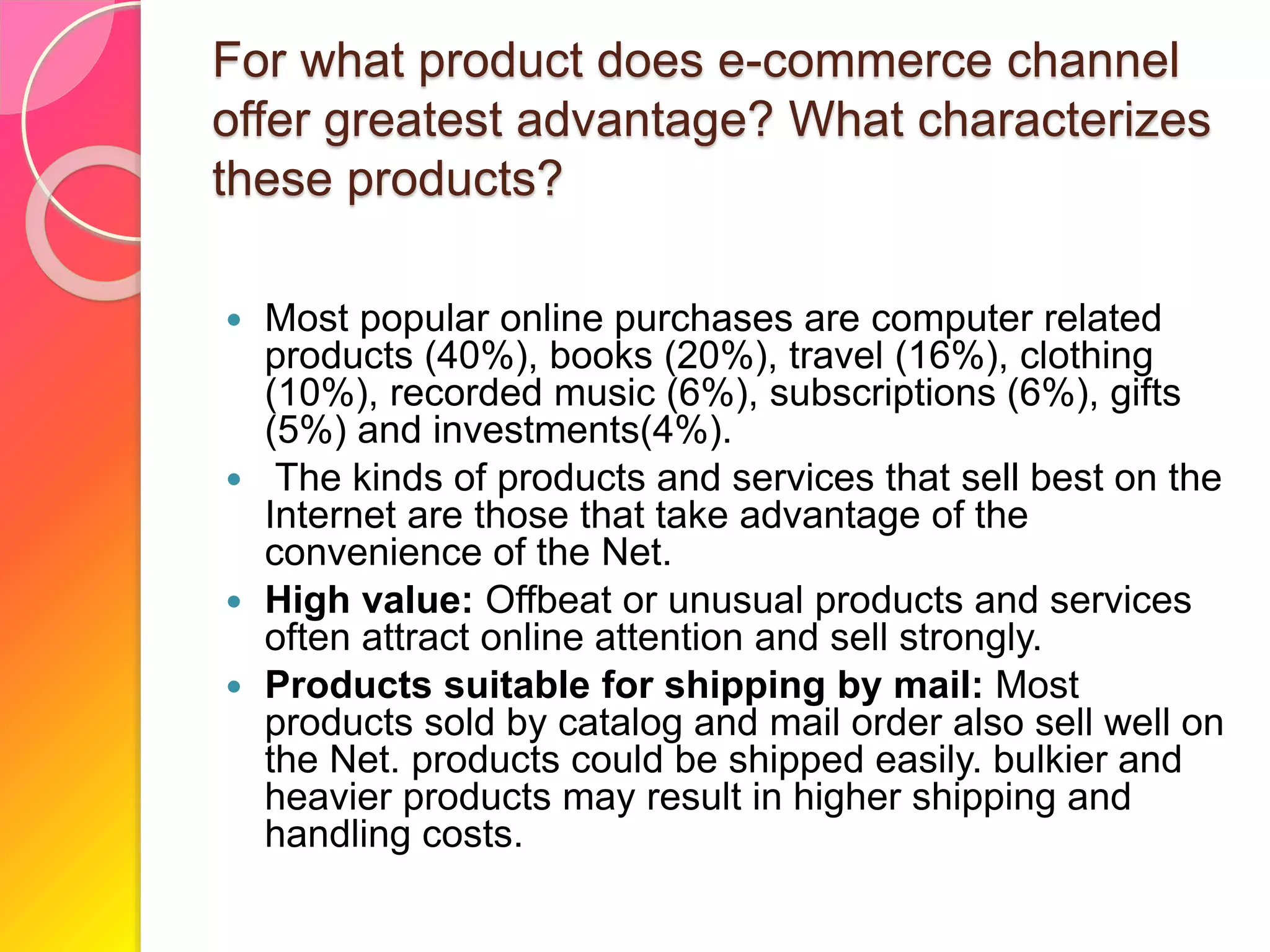
 Most popular online purchases are computer related
products (40%), books (20%), travel (16%), clothing
(10%), recorded music (6%), subscriptions (6%), gifts
(5%) and investments(4%).
 The kinds of products and services that sell best on the
Internet are those that take advantage of the
convenience of the Net.
 High value: Offbeat or unusual products and services
often attract online attention and sell strongly.
 Products suitable for shipping by mail: Most
products sold by catalog and mail order also sell well on
the Net. products could be shipped easily. bulkier and
heavier products may result in higher shipping and
handling costs.
 Information-based products: Nonperishable,
information-intensive products are the most
popular online products at present. Content-rich
sites, subscription-based sites to advertiser-
supported sites focusing on a wide range of topics,
have been sprouting all over the Internet.
 Downloadable products: Downloadable products
such as software, apps, music files, eBooks,
photos and clip art, web design themes are ideal
for the Web.
 Services: Services such as hotel reservation, air
travel and investments have successfully
translated themselves to the Internet
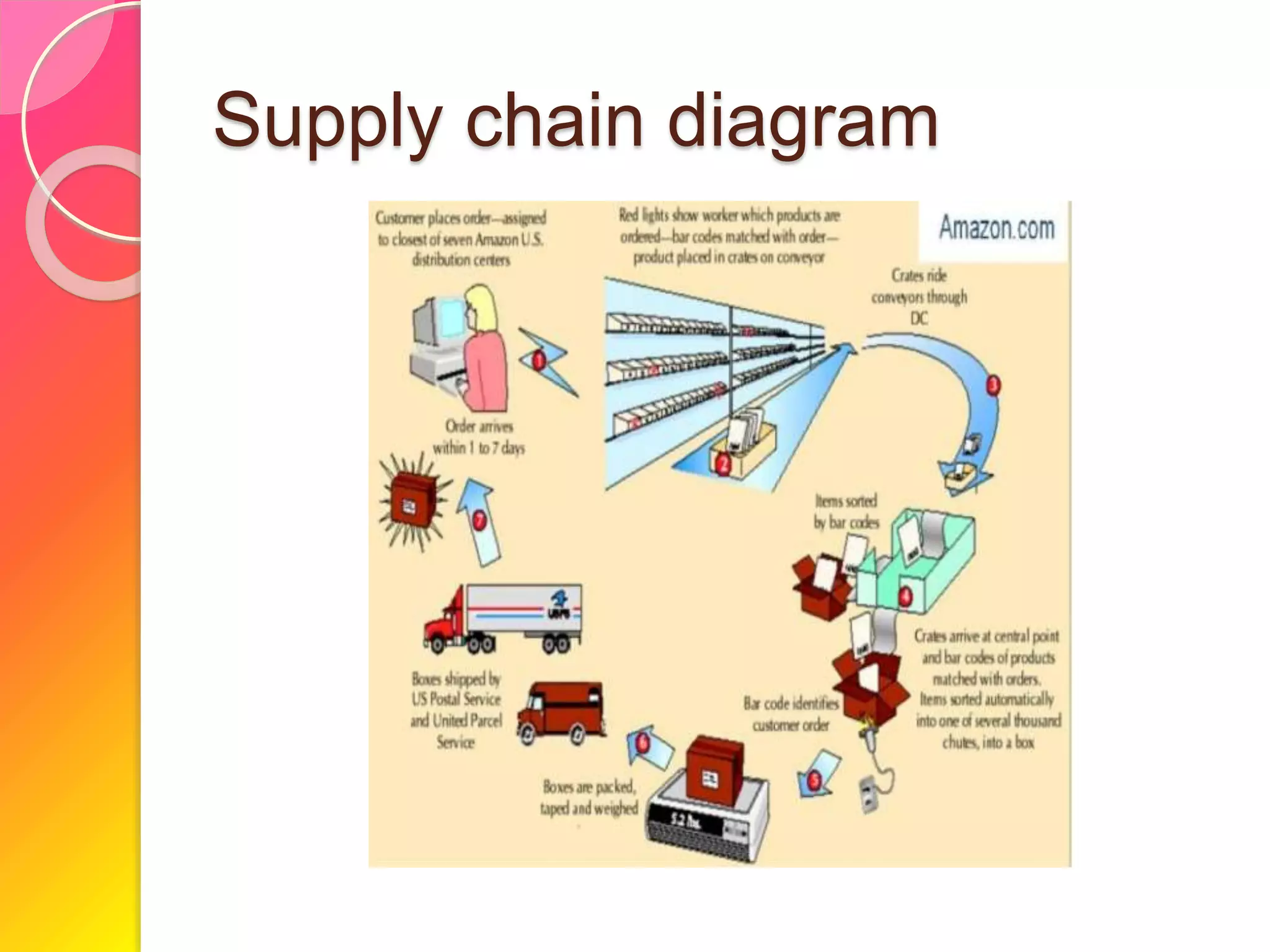
Supply chain diagram
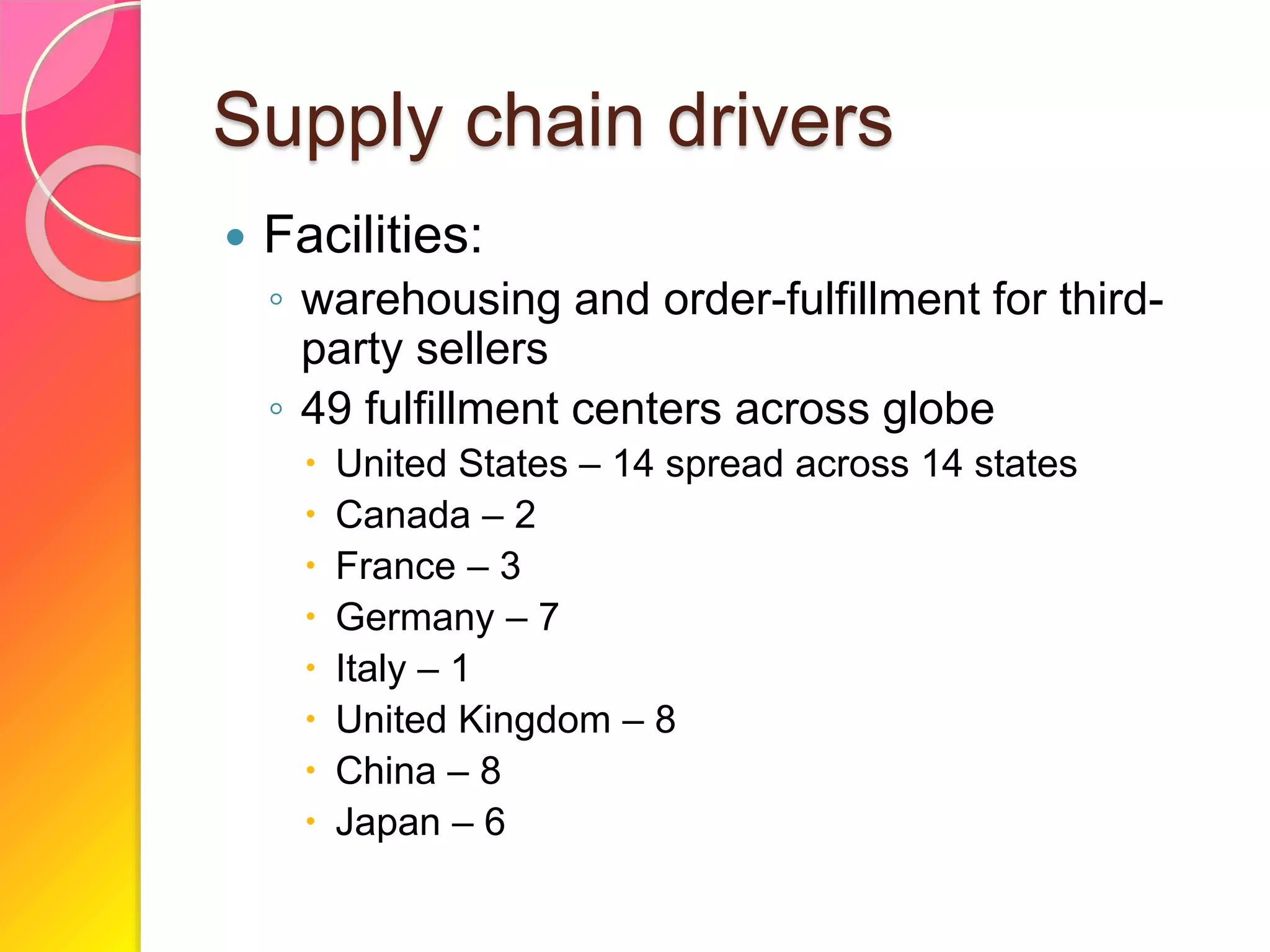
Supply chain drivers
 Facilities:
◦ warehousing and order-fulfillment for third-
party sellers
◦ 49 fulfillment centers across globe
 United States – 14 spread across 14 states
 Canada – 2
 France – 3
 Germany – 7
 Italy – 1
 United Kingdom – 8
 China – 8
 Japan – 6
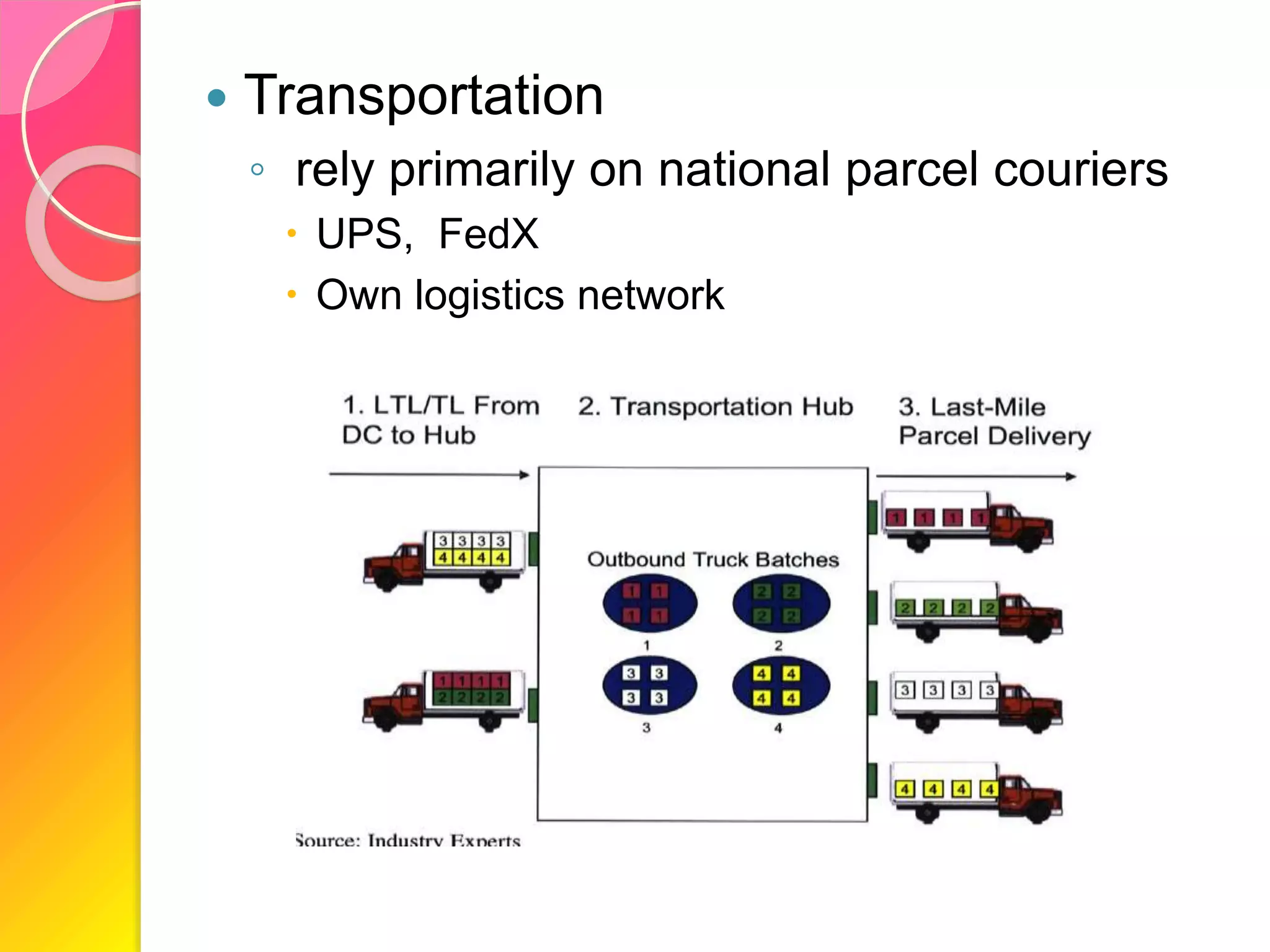
 Transportation
◦ rely primarily on national parcel couriers
 UPS, FedX
 Own logistics network
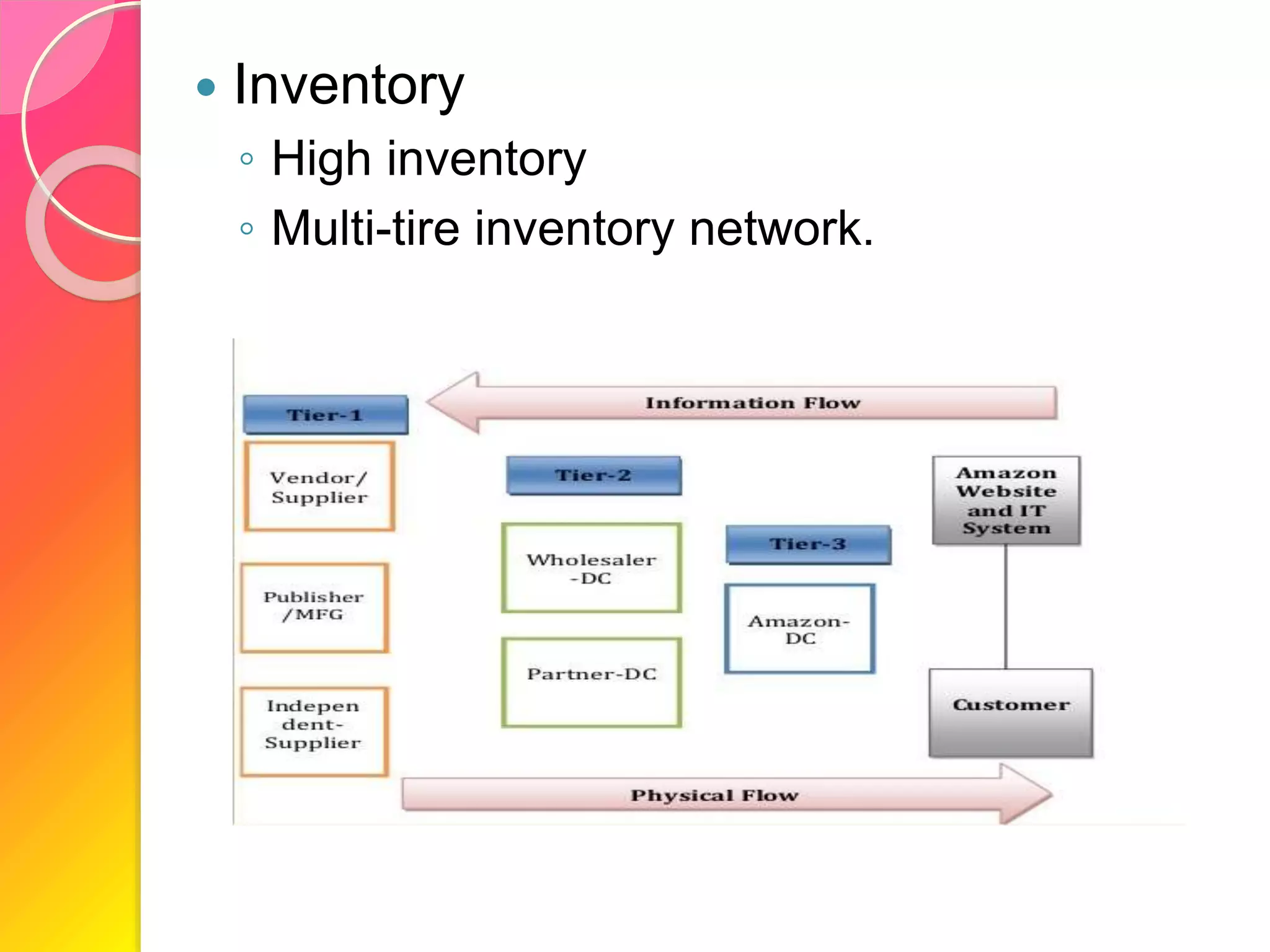
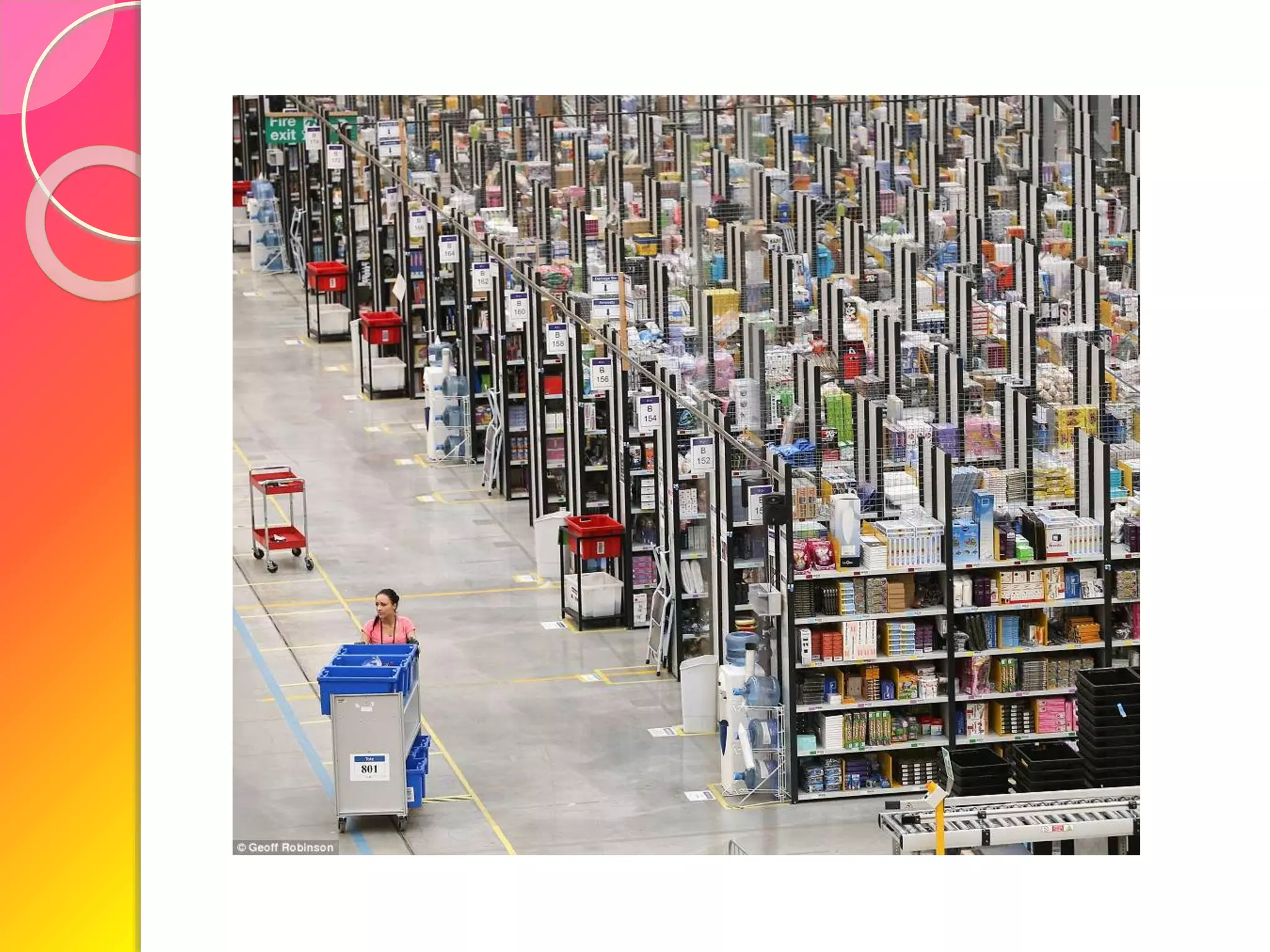
 Inventory
◦ High inventory
◦ Multi-tire inventory network.
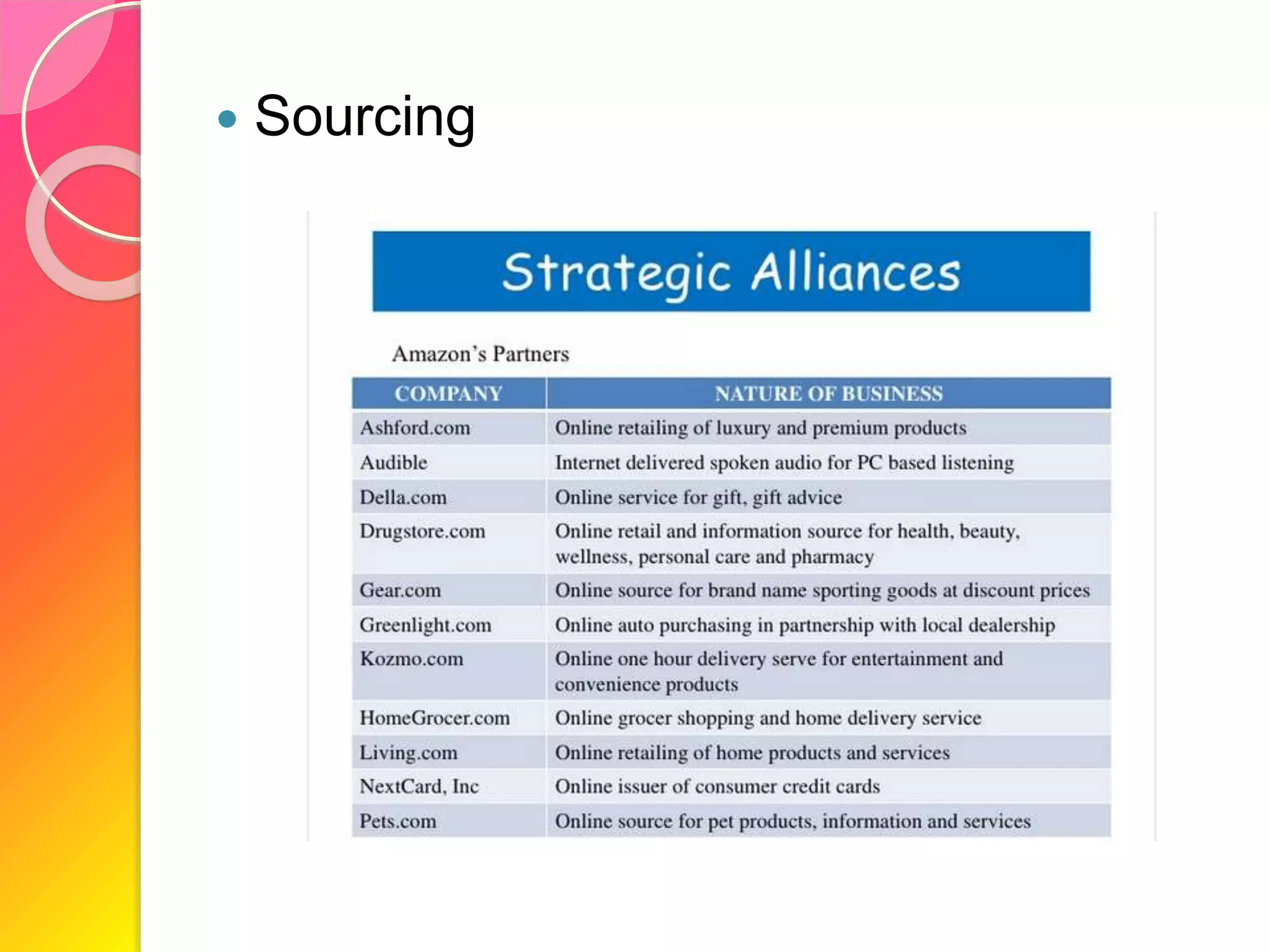
 Sourcing
Pricing
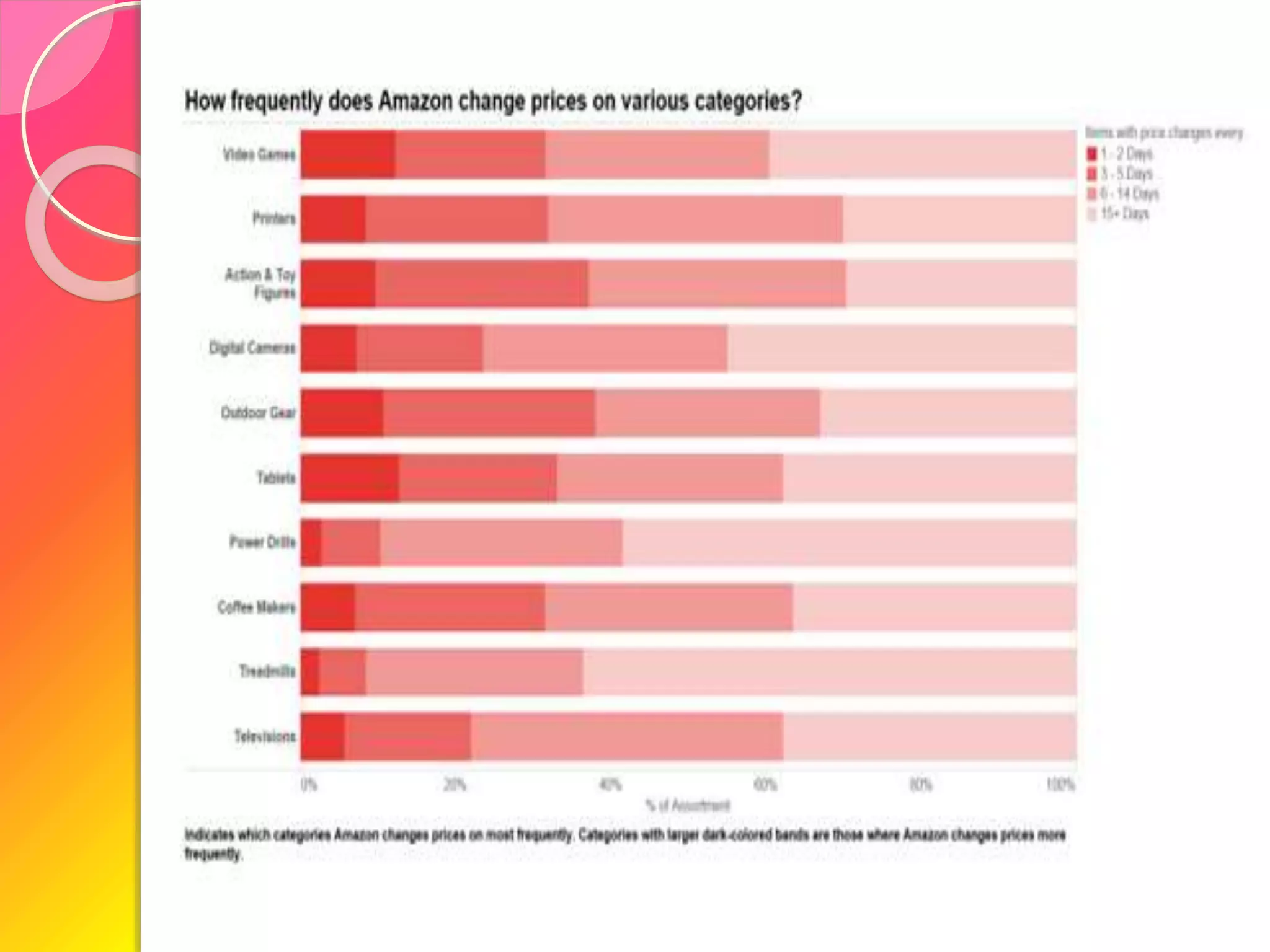
 Amazon does make millions of price
changes daily
◦ In March 2014, Amazon changed prices on
an average of 15-18 percent of its
assortment every day and this number is
growing. Many retailers today are struggling
to emulate, or even react to, this level of price
dynamism.
 Price dynamism varies by season
 Some categories are more price-
dynamic than others.
◦ Amazon's price dynamism varies between
categories,
Information
 Amazon web service: allow partner retailers,
the individual sellers and developers to advertise
their products through Amazon.com by building
their web based applications in a reliable,
scalable, and low cost way.
 Simple storage service: designed to make web-
scale computing easier for the business partners
and developers by web service interface to keep
and receive any data, any time, from anywhere.
 Smart analytic search: allow detecting and
decreasing the examples of fraud in Amazon web
site by analyzing the behavioral patterns of
fraudsters and designing the predictive scores.
 The mainframe of the company’s
information system is focused on Service
Oriented Architecture.
 Transaction processing system: based
on creating convenience for users.
 Online payment system: allows customers
to pay via their Amazon account by
controlled access
 Recommender system: to give the
relevant and useful information to the
customers.
Strategic fit
 Competitive strategy
◦ Respond to wide range of demand
◦ Fulfill orders in short lead time
◦ Meet high service level
 Supply chain strategy
◦ Both cost effective and responsive
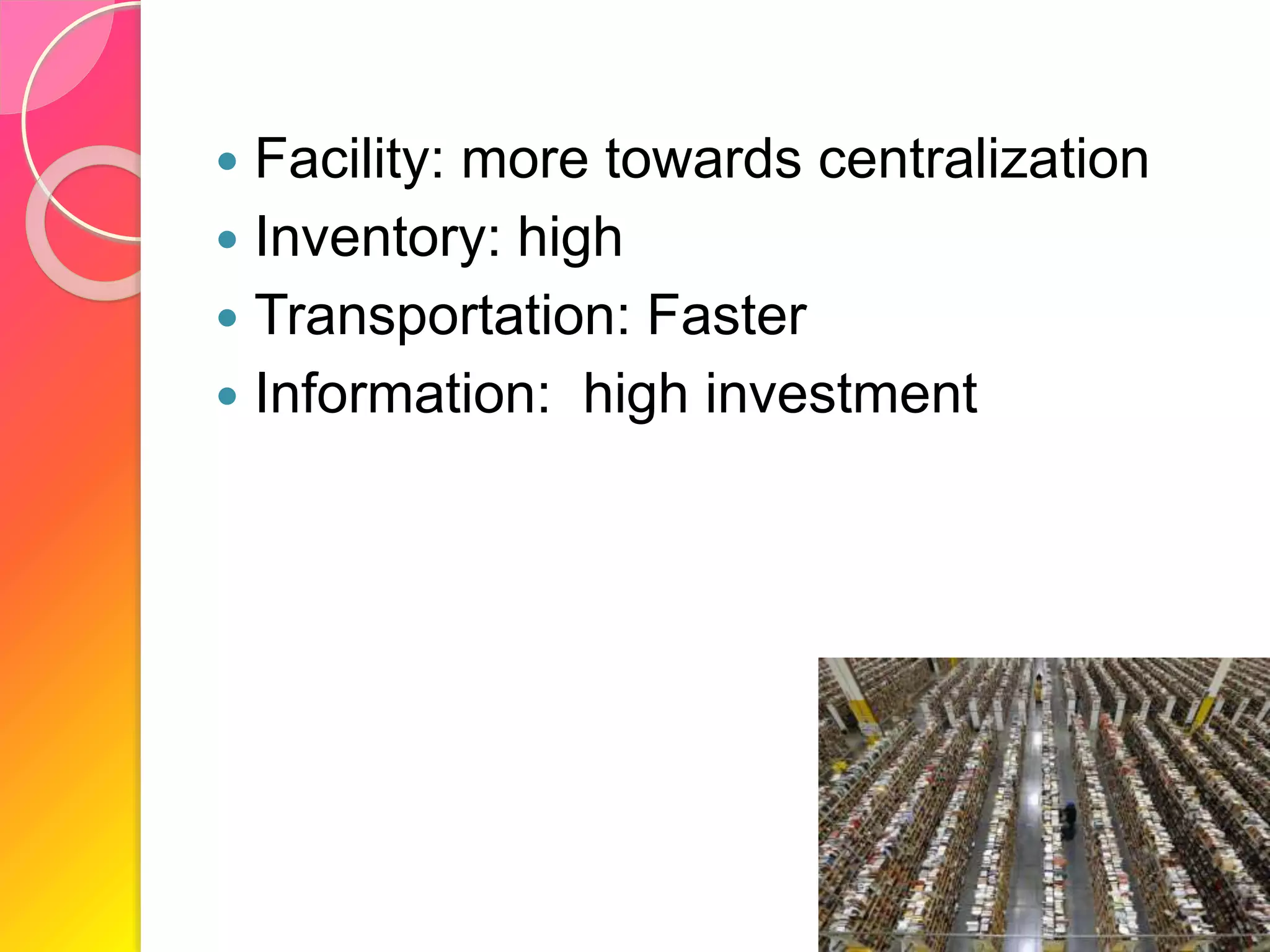
 Facility: more towards centralization
 Inventory: high
 Transportation: Faster
 Information: high investment
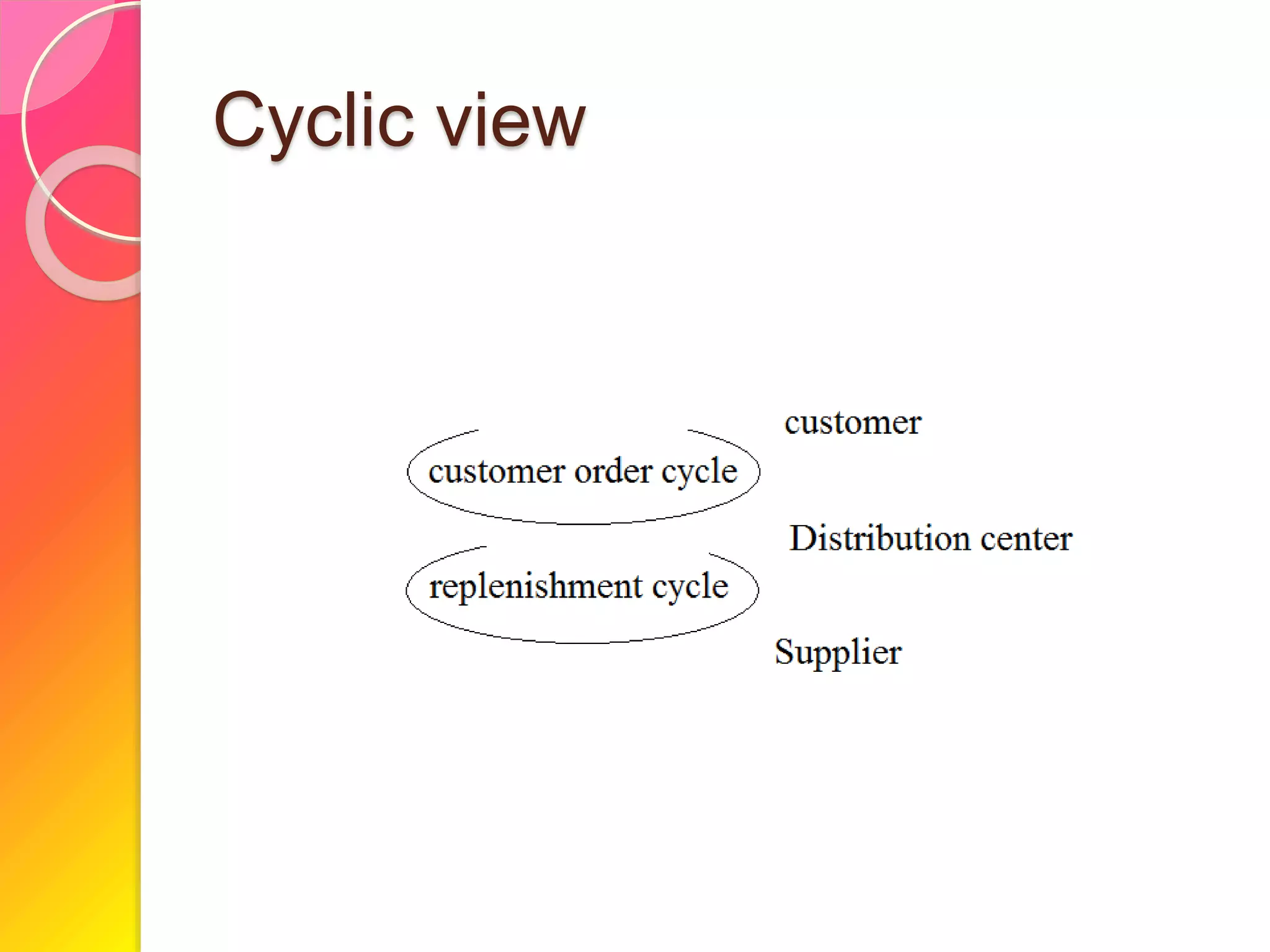
Cyclic view
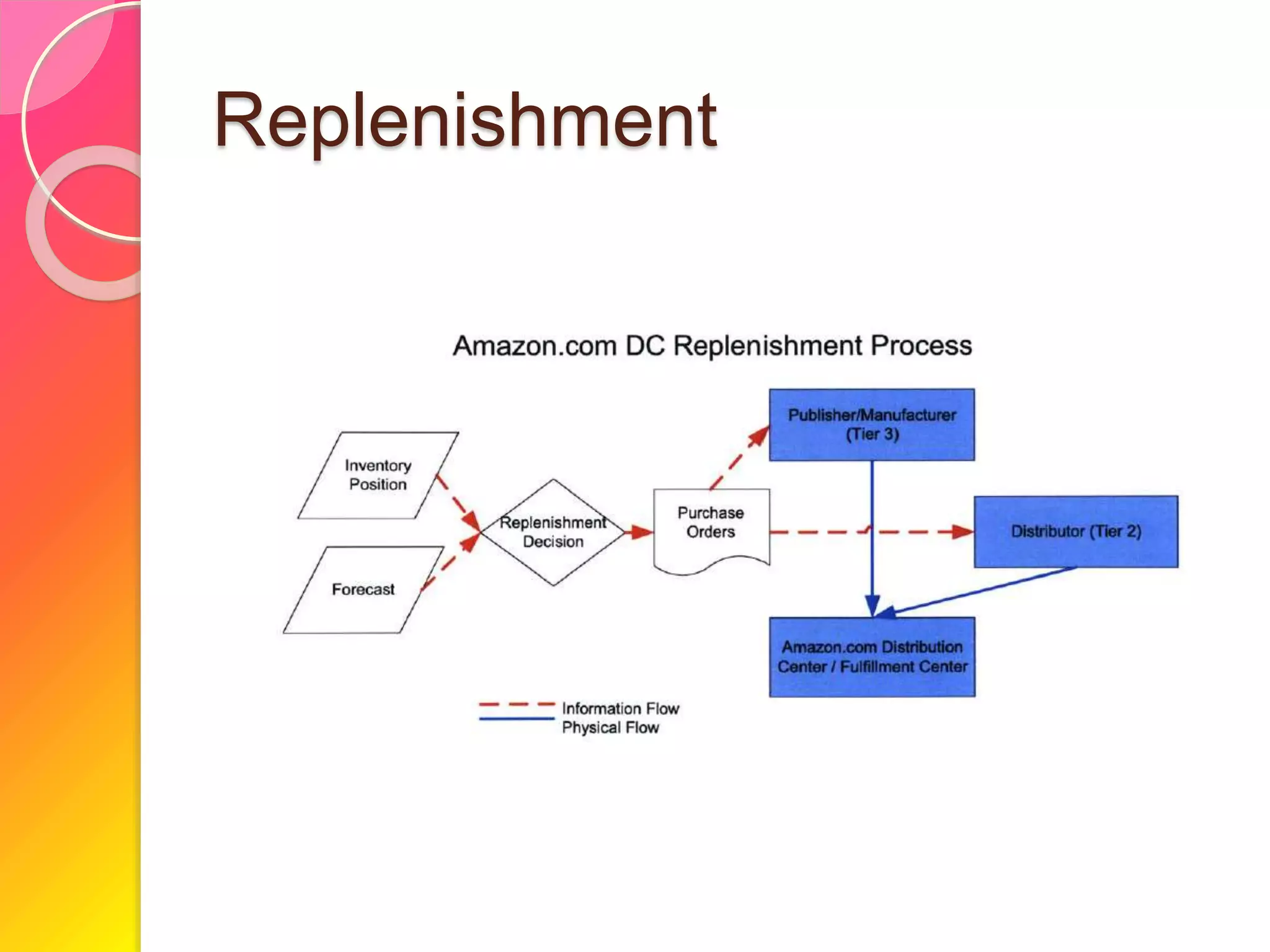
Replenishment
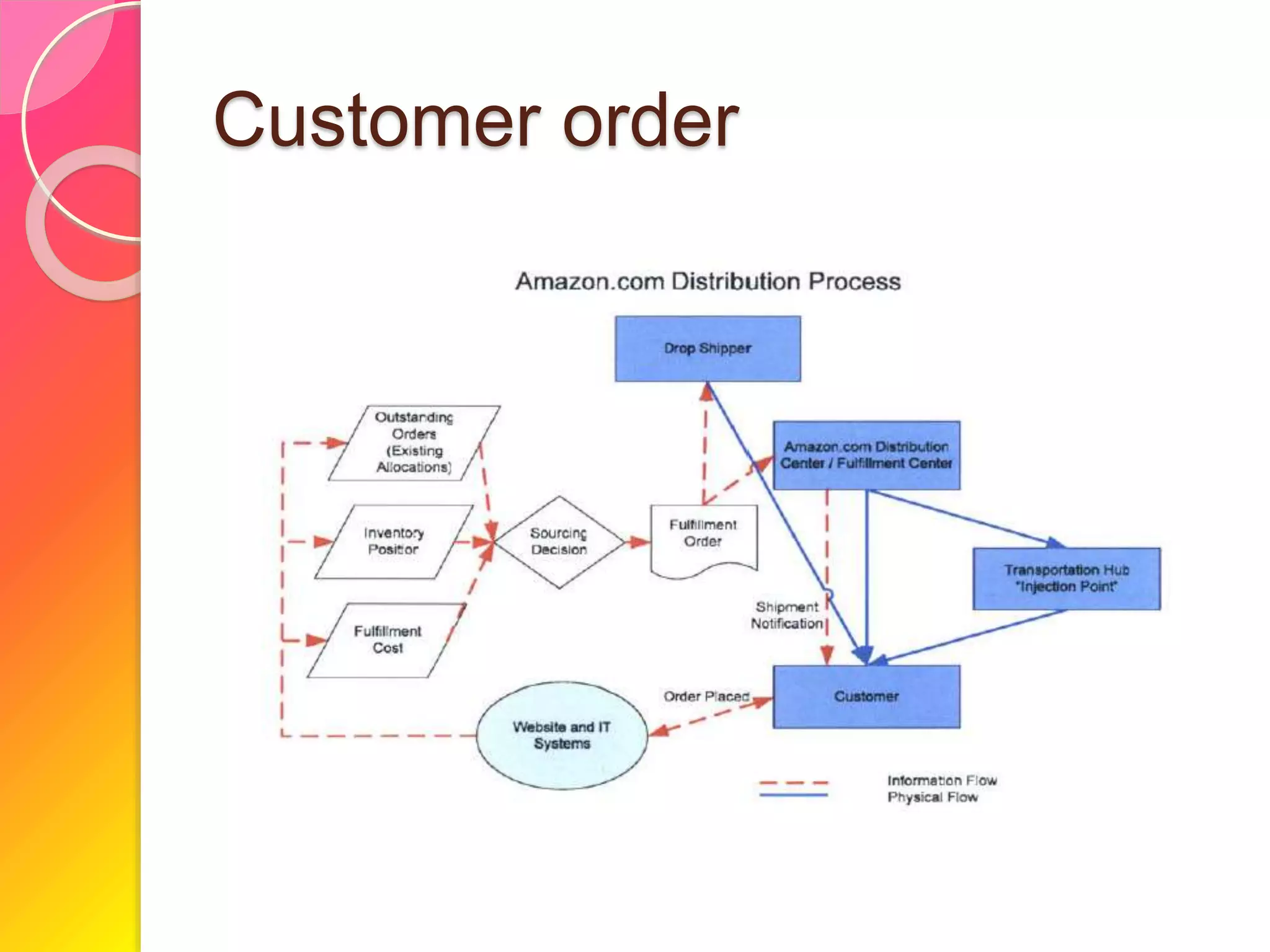
Customer order

Amazon.com Supply chain management- case study

  • 1.
    Amazon.com Supply chain management BinsuBenny Greeshma P Saddam S S3 MBA College of Engineering Trivandrum
  • 2.
    Introduction  American internationalelectronic commerce company with headquarters in Seattle, Washington.  Amazon.com started as an online bookstore, but soon diversified, selling DVDs, VHSs, CDs, video and MP3 downloads/streaming, software, video games, electronics, apparel, furniture, food, toys, and jewelry.
  • 3.
    Levels  Pre-structural level ◦Amazon is one of the pioneers of online consumer sales. They sells books, music and many other items over the internet  Uni-structural level ◦ Amazon's supply chain management has an edge over other companies because of the shopping experience the company offers. It has supply chain and fulfillment capabilities and popular pricing strategies.  Multi-structural level ◦ Amazon was one of the first companies who introduced the rating system. The rating system is a way for customers to rate the service that they received from the vendor. Amazon manages and ships it's own inventory and the inventory of other companies like Eddie Bauer and Target.
  • 4.
     Relational level ◦Amazon's supply chain is so great that major brick-and-mortar retailers like Target Corp, Borders and Toys “R” uses Amazon's website for their e-commerce efforts. They are effectively managing their inventory and became competitive by satisfying all type of customers.  Critical level ◦ Amazon conducts its business on an international scale. The company ships to almost 200 countries. Right now, Amazon firmly has the e-commerce market at the palm of its hand. They have to expand their DCs to other countries to reduce transportation cost.
  • 5.
    Why is Amazonbuilding more warehouses as it grows? How many warehouses should it have and where should they be located?  As it grew the company added warehouses allowing it to react more quickly to customer orders. Increasing the number of warehouses near customers will reduce the response time.  Amazon aims to be able to deliver most items the day they’re ordered, so it can keep rivals such as EBay and Wal-Mart Stores from peeling off customers.  Amazon has around 50 warehouses, 20 in US and rest in Canada, France, Germany, Italy, UK, China, Japan
  • 6.
    What advantages doesselling books via internet provides over traditional book store? Are there any disadvantages to selling via internet  It is proved to be a more convenient option for the customer. The customer did not have to drive or walk to the store to buy a book.  The reader received a catalog containing reviews about books and information about popular books in the market.  Don't have to advertise and find the buyers, post the message at any book purchasing website, and concerned buyers would automatically get in touch with.  Can get the best money, as one can select from the buyers that hit on the book.  the elimination of costs related to maintenance of retail stores and the direct contact with the customer online.  Online trade removes geographical barriers and allows the customers to shop 24/7.
  • 7.
     Customers canview all the information about the book, book reviews and books on similar topics. This gives them far more information than looking at the single book at the bookshelf of a retail store.  The security of online payments is a problem preventing many people from shopping online. The totally secure system has not been introduced yet, and customers might find it confusing revealing their payment data online.  Delivery of books also might not happen timely, due to many factors.  The customer never has the chance to see and “feel” the book; many people dislike buying books online because they cannot sense the book, turn over the pages and read a few lines.
  • 8.
    Should amazon stockevery book it sells?  No  If Amazon stocked every book it sells, it would need a warehouse the size of Nevada. It would also have gigantic inventory costs.  Amazon uses three basic methods for selling books ◦ standard inventory ◦ "just in time" inventory ◦ third party sellers  Physical inventory of the most popular books it sells.  Less popular books are subject to "just in time" inventory management.  Amazon doesn't have the books, but has arrangements with the publishers to ship the books as soon as it receives orders.  Results in a slight delay in shipping to the customer, but Amazon saves a lot of money in inventory costs.  Has network of third party merchants who sell through Amazon. These third party merchants generally specialize in out-of-print books or books that deal with relatively arcane subjects. Those books are shipped to the customer directly from the third party and are billed by the third party to the customer's credit card or paypal account. Amazon takes a small commission for acting as a middleman.  Stock only those product with high demand
  • 9.
    What advantage canbrick-and-mortar players drive from setting up an online channel? How should they use the two channels to gain maximum advantage?  Stand out from the competition: A professional webstore will be the ultimate competitor. Advancement in Internet and software technology, making it cheaply available to even the smallest business so they can compete more effectively with larger competitors.  Saving customers a trip to the store: By setting up own- branded online store, customers can shop and pay for the goods at their convenience and comfort and get it delivered to their offices or door steps anytime.  Low-cost way to expand your business: Compared to a new brick-and-mortar store investment, online storefront cost a lot less. This investment goes a long way and it only cost less than a month worth of offine store rental.  Inexpensive yet Highly Targeted Marketing Channel: it helps to tap into email newsletter marketing, feed marketing via Google Base & SMS Coupon Marketing. All which are very affordable ways of extending the brand and services online. It's proven that email and SMS marketing work best on an opt-in list (or existing database). More repeated purchases.
  • 10.
     Complete Rangeof Products Selection & In-Depth Information: In-depth product information educates well and sells even better! Nobody does it better than an tireless 24x7x365 online web store. When sell online, can offer other products and services online that would be difficult to carry in a store due to size and space constraints.  Easily Automate Cross-Sell and Make more Money: encourages the customers to buy a complementary or related product or service which can have a significant impact on profitability.  Pre-order done easily: An online store lets you take and process pre-order easily via credit card payment. For some hot selling products, getting large quantity not just ensure that don't have Inventory Turnover problem, it also means(with larger quantity) can negotiate more competitive pricing with the suppliers.  Increase Customer Value over Lifetime: Setting up online store allows customers to interact consistently and conveniently via both online and offline channel. This consistent experience will extend the brand that will increase their loyalty.
  • 11.
    Should traditional booksellerlike Barner & Noble integrate e- commerce into their current supply chain or manage it as separate supply chain?  It is better to integrate e-commerce supply chain to their current supply chain.  Advantages: ◦ Common warehouse. ◦ Global market ◦ More competitive
  • 12.
    For what productdoes e-commerce channel offer greatest advantage? What characterizes these products?  Most popular online purchases are computer related products (40%), books (20%), travel (16%), clothing (10%), recorded music (6%), subscriptions (6%), gifts (5%) and investments(4%).  The kinds of products and services that sell best on the Internet are those that take advantage of the convenience of the Net.  High value: Offbeat or unusual products and services often attract online attention and sell strongly.  Products suitable for shipping by mail: Most products sold by catalog and mail order also sell well on the Net. products could be shipped easily. bulkier and heavier products may result in higher shipping and handling costs.
  • 13.
     Information-based products:Nonperishable, information-intensive products are the most popular online products at present. Content-rich sites, subscription-based sites to advertiser- supported sites focusing on a wide range of topics, have been sprouting all over the Internet.  Downloadable products: Downloadable products such as software, apps, music files, eBooks, photos and clip art, web design themes are ideal for the Web.  Services: Services such as hotel reservation, air travel and investments have successfully translated themselves to the Internet
  • 14.
  • 15.
    Supply chain drivers Facilities: ◦ warehousing and order-fulfillment for third- party sellers ◦ 49 fulfillment centers across globe  United States – 14 spread across 14 states  Canada – 2  France – 3  Germany – 7  Italy – 1  United Kingdom – 8  China – 8  Japan – 6
  • 17.
     Transportation ◦ relyprimarily on national parcel couriers  UPS, FedX  Own logistics network
  • 18.
     Inventory ◦ Highinventory ◦ Multi-tire inventory network.
  • 20.
  • 21.
    Pricing  Amazon doesmake millions of price changes daily ◦ In March 2014, Amazon changed prices on an average of 15-18 percent of its assortment every day and this number is growing. Many retailers today are struggling to emulate, or even react to, this level of price dynamism.  Price dynamism varies by season  Some categories are more price- dynamic than others. ◦ Amazon's price dynamism varies between categories,
  • 23.
    Information  Amazon webservice: allow partner retailers, the individual sellers and developers to advertise their products through Amazon.com by building their web based applications in a reliable, scalable, and low cost way.  Simple storage service: designed to make web- scale computing easier for the business partners and developers by web service interface to keep and receive any data, any time, from anywhere.  Smart analytic search: allow detecting and decreasing the examples of fraud in Amazon web site by analyzing the behavioral patterns of fraudsters and designing the predictive scores.
  • 24.
     The mainframeof the company’s information system is focused on Service Oriented Architecture.  Transaction processing system: based on creating convenience for users.  Online payment system: allows customers to pay via their Amazon account by controlled access  Recommender system: to give the relevant and useful information to the customers.
  • 25.
    Strategic fit  Competitivestrategy ◦ Respond to wide range of demand ◦ Fulfill orders in short lead time ◦ Meet high service level  Supply chain strategy ◦ Both cost effective and responsive
  • 26.
     Facility: moretowards centralization  Inventory: high  Transportation: Faster  Information: high investment
  • 27.
  • 28.
  • 29.