Insects Attacking Stored Grains, Seeds, and Grain Products Dr. Ayanava Majumdar Extension Entomologist Alabama Cooperative Extension System Gulf Coast Research & Extension Center 8300 State Hwy 104, Fairhope, Alabama 36532 Cell phone: 251-331-8416
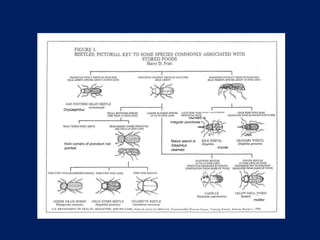
front corners of pronotum not pointed rounded or  irregular punctures Maize weevil or Sitophilus zeamais oryzae molitor Oryzaephilus
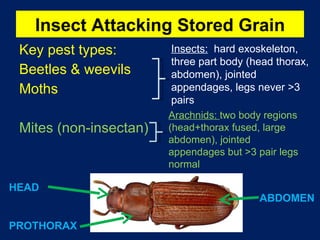
Key pest types: Beetles & weevils Moths Mites (non-insectan) Insect Attacking Stored Grain Insects:   hard exoskeleton, three part body (head thorax, abdomen), jointed appendages, legs never >3 pairs Arachnids:  two body regions (head+thorax fused, large abdomen), jointed appendages but >3 pair legs normal HEAD PROTHORAX ABDOMEN
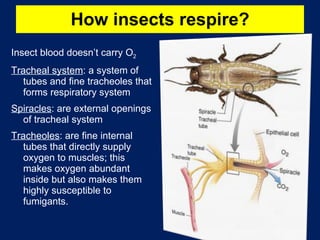
How insects respire? Insect blood doesn’t carry O 2   Tracheal system : a system of tubes and fine tracheoles that forms respiratory system Spiracles : are external openings of tracheal system Tracheoles : are fine internal tubes that directly supply oxygen to muscles; this makes oxygen abundant inside but also makes them highly susceptible to fumigants.
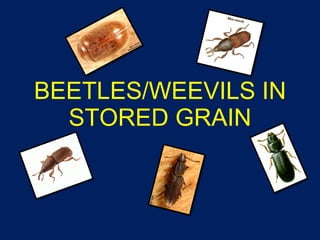
BEETLES/WEEVILS IN STORED GRAIN
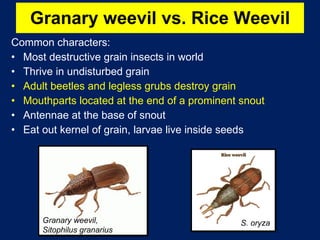
Granary weevil vs. Rice Weevil Common characters: Most destructive grain insects in world Thrive in undisturbed grain Adult beetles and legless grubs destroy grain Mouthparts located at the end of a prominent snout Antennae at the base of snout Eat out kernel of grain, larvae live inside seeds Granary weevil,  Sitophilus granarius S. oryza
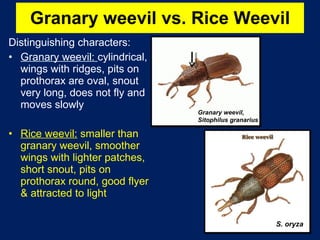
Granary weevil vs. Rice Weevil Distinguishing characters: Granary weevil:  cylindrical, wings with ridges, pits on prothorax are oval, snout very long, does not fly and moves slowly Rice weevil:  smaller than granary weevil, smoother wings with lighter patches, short snout, pits on prothorax round, good flyer & attracted to light Granary weevil,  Sitophilus granarius S. oryza
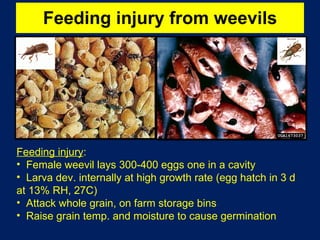
Feeding injury from weevils Feeding injury :  Female weevil lays 300-400 eggs one in a cavity Larva dev. internally at high growth rate (egg hatch in 3 d at 13% RH, 27C) Attack whole grain, on farm storage bins Raise grain temp. and moisture to cause germination
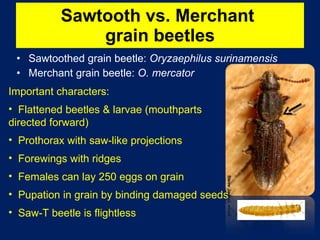
Sawtooth vs. Merchant  grain beetles Sawtoothed grain beetle:  Oryzaephilus surinamensis Merchant grain beetle:  O. mercator Important characters: Flattened beetles & larvae (mouthparts directed forward)  Prothorax with saw-like projections Forewings with ridges Females can lay 250 eggs on grain Pupation in grain by binding damaged seeds Saw-T beetle is flightless
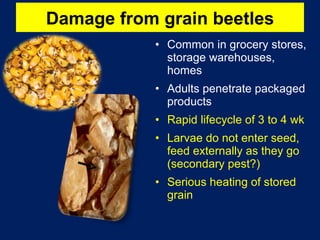
Common in grocery stores, storage warehouses, homes  Adults penetrate packaged products Rapid lifecycle of 3 to 4 wk Larvae do not enter seed, feed externally as they go (secondary pest?) Serious heating of stored grain Damage from grain beetles
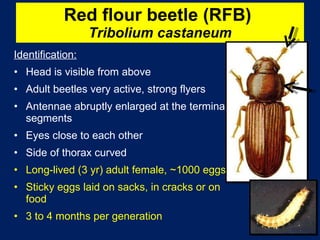
Red flour beetle (RFB)  Tribolium castaneum Identification: Head is visible from above Adult beetles very active, strong flyers Antennae abruptly enlarged at the terminal segments Eyes close to each other Side of thorax curved Long-lived (3 yr) adult female, ~1000 eggs Sticky eggs laid on sacks, in cracks or on food 3 to 4 months per generation
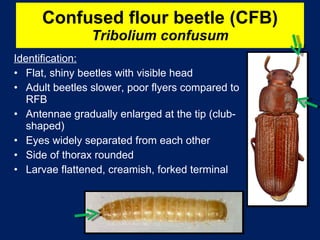
Confused flour beetle (CFB) Tribolium confusum Identification: Flat, shiny beetles with visible head Adult beetles slower, poor flyers compared to RFB Antennae gradually enlarged at the tip (club-shaped) Eyes widely separated from each other Side of thorax rounded Larvae flattened, creamish, forked terminal
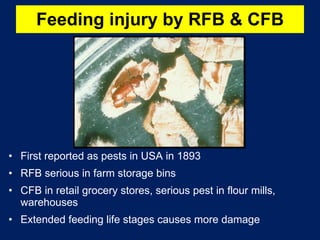
Feeding injury by RFB & CFB First reported as pests in USA in 1893 RFB serious in farm storage bins CFB in retail grocery stores, serious pest in flour mills, warehouses Extended feeding life stages causes more damage
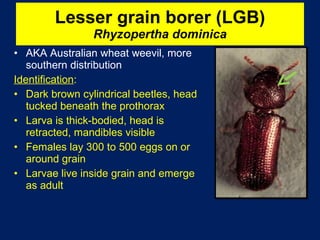
Lesser grain borer (LGB) Rhyzopertha dominica AKA Australian wheat weevil, more southern distribution Identification : Dark brown cylindrical beetles, head tucked beneath the prothorax Larva is thick-bodied, head is retracted, mandibles visible Females lay 300 to 500 eggs on or around grain Larvae live inside grain and emerge as adult
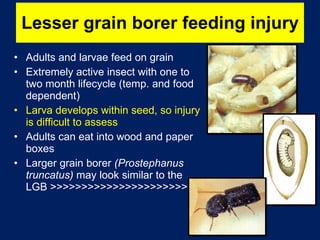
Lesser grain borer feeding injury  Adults and larvae feed on grain Extremely active insect with one to two month lifecycle (temp. and food dependent) Larva develops within seed, so injury is difficult to assess Adults can eat into wood and paper boxes Larger grain borer  (Prostephanus truncatus)  may look similar to the LGB >>>>>>>>>>>>>>>>>>>>>>
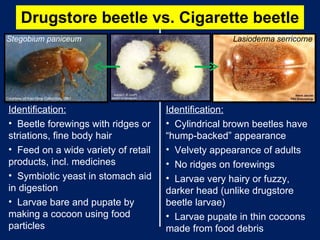
Drugstore beetle vs. Cigarette beetle  Identification: Beetle forewings with ridges or striations, fine body hair Feed on a wide variety of retail products, incl. medicines Symbiotic yeast in stomach aid in digestion Larvae bare and pupate by making a cocoon using food particles Identification: Cylindrical brown beetles have “hump-backed” appearance Velvety appearance of adults No ridges on forewings Larvae very hairy or fuzzy, darker head (unlike drugstore beetle larvae) Larvae pupate in thin cocoons made from food debris Stegobium paniceum Lasioderma serricorne
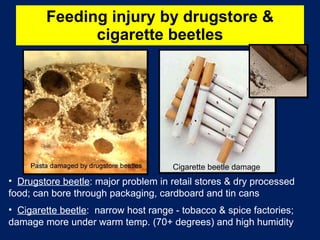
Feeding injury by drugstore & cigarette beetles Drugstore beetle : major problem in retail stores & dry processed food; can bore through packaging, cardboard and tin cans Cigarette beetle :  narrow host range - tobacco & spice factories; damage more under warm temp. (70+ degrees) and high humidity Cigarette beetle damage
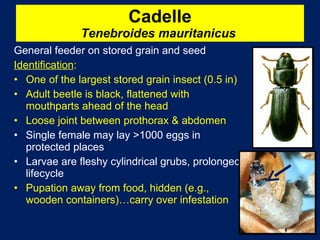
Cadelle Tenebroides mauritanicus  General feeder on stored grain and seed Identification : One of the largest stored grain insect (0.5 in) Adult beetle is black, flattened with mouthparts ahead of the head Loose joint between prothorax & abdomen Single female may lay >1000 eggs in protected places Larvae are fleshy cylindrical grubs, prolonged lifecycle Pupation away from food, hidden (e.g., wooden containers)…carry over infestation
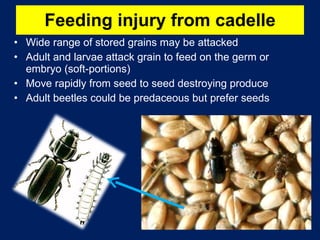
Feeding injury from cadelle Wide range of stored grains may be attacked Adult and larvae attack grain to feed on the germ or embryo (soft-portions) Move rapidly from seed to seed destroying produce Adult beetles could be predaceous but prefer seeds
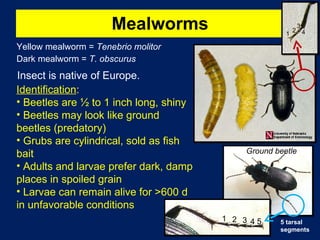
Mealworms Yellow mealworm =  Tenebrio molitor Dark mealworm =  T. obscurus Identification : Beetles are ½ to 1 inch long, shiny Beetles may look like ground beetles (predatory) Grubs are cylindrical, sold as fish bait Adults and larvae prefer dark, damp places in spoiled grain Larvae can remain alive for >600 d in unfavorable conditions Insect is native of Europe. 1 2 3 4 Ground beetle 1 2 3 4 5 5 tarsal segments
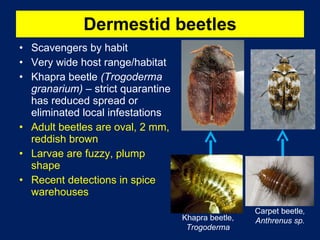
Dermestid beetles Scavengers by habit Very wide host range/habitat Khapra beetle  (Trogoderma granarium) –  strict quarantine has reduced spread or eliminated local infestations Adult beetles are oval, 2 mm, reddish brown Larvae are fuzzy, plump shape Recent detections in spice warehouses Carpet beetle , Anthrenus sp. Khapra beetle,  Trogoderma
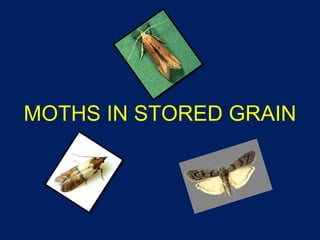
MOTHS IN STORED GRAIN
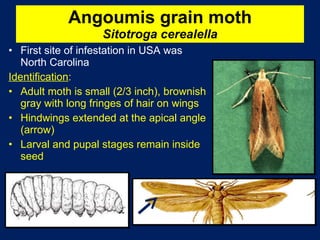
Angoumis grain moth Sitotroga cerealella First site of infestation in USA was North Carolina Identification : Adult moth is small (2/3 inch), brownish gray with long fringes of hair on wings Hindwings extended at the apical angle (arrow) Larval and pupal stages remain inside seed
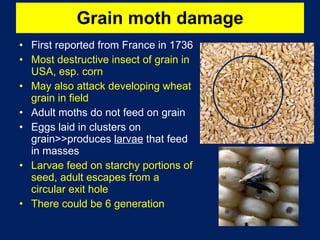
Grain moth damage First reported from France in 1736 Most destructive insect of grain in USA, esp. corn May also attack developing wheat grain in field Adult moths do not feed on grain Eggs laid in clusters on grain>>produces  larvae  that feed in masses Larvae feed on starchy portions of seed, adult escapes from a circular exit hole There could be 6 generation
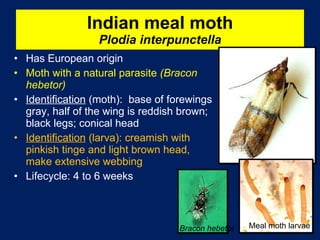
Indian meal moth Plodia interpunctella Has European origin Moth with a natural parasite  (Bracon hebetor) Identification  (moth):  base of forewings gray, half of the wing is reddish brown; black legs; conical head Identification  (larva): creamish with pinkish tinge and light brown head, make extensive webbing Lifecycle: 4 to 6 weeks Meal moth larvae Bracon hebetor
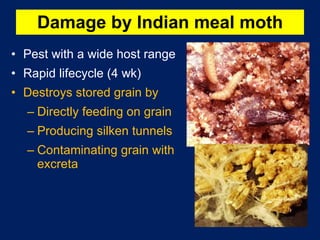
Damage by Indian meal moth Pest with a wide host range Rapid lifecycle (4 wk) Destroys stored grain by  Directly feeding on grain Producing silken tunnels Contaminating grain with excreta
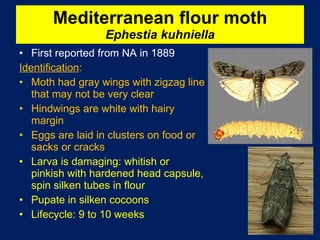
Mediterranean flour moth Ephestia kuhniella First reported from NA in 1889 Identification : Moth had gray wings with zigzag line that may not be very clear Hindwings are white with hairy margin Eggs are laid in clusters on food or sacks or cracks Larva is damaging: whitish or pinkish with hardened head capsule, spin silken tubes in flour Pupate in silken cocoons  Lifecycle: 9 to 10 weeks
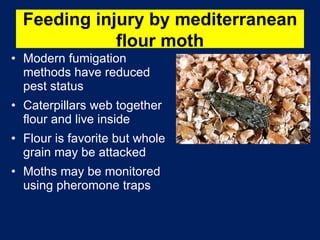
Modern fumigation methods have reduced pest status Caterpillars web together flour and live inside Flour is favorite but whole grain may be attacked Moths may be monitored using pheromone traps Feeding injury by mediterranean flour moth
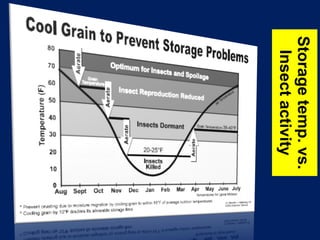
Storage temp. vs. Insect activity
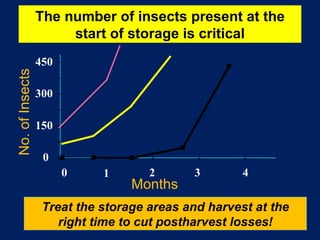
0 150 300 450 0 1 2 3 4 No. of Insects Months The number of insects present at the start of storage is critical Treat the storage areas and harvest at the right time to cut postharvest losses!
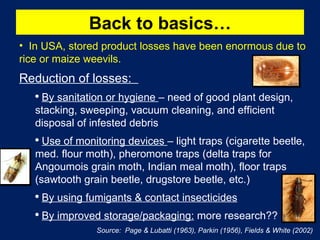
Back to basics… In USA, stored product losses have been enormous due to rice or maize weevils. Reduction of losses:  By sanitation or hygiene  – need of good plant design, stacking, sweeping, vacuum cleaning, and efficient disposal of infested debris Use of monitoring devices  – light traps (cigarette beetle, med. flour moth), pheromone traps (delta traps for Angoumois grain moth, Indian meal moth), floor traps (sawtooth grain beetle, drugstore beetle, etc.) By using fumigants & contact insecticides By improved storage/packaging:  more research?? Source:  Page & Lubatti (1963), Parkin (1956), Fields & White (2002)
Back to basics… Mode of action: fumigants intervene ATP formation, upset enzyme systems, action is rapid The rate of uptake of fumigant by insects depends on the rate of fixation in tissues  Insects that may seem to recover can have sublethal effects Success of fumigation depends largely on even distribution of fumigant and on penetration. Source:  Page & Lubatti (1963), Parkin (1956), Fields & White (2002)
QUESTIONS?

Stored Grain Insect Pests

  • 1.
    Insects Attacking StoredGrains, Seeds, and Grain Products Dr. Ayanava Majumdar Extension Entomologist Alabama Cooperative Extension System Gulf Coast Research & Extension Center 8300 State Hwy 104, Fairhope, Alabama 36532 Cell phone: 251-331-8416
  • 2.
    front corners ofpronotum not pointed rounded or irregular punctures Maize weevil or Sitophilus zeamais oryzae molitor Oryzaephilus
  • 3.
    Key pest types:Beetles & weevils Moths Mites (non-insectan) Insect Attacking Stored Grain Insects: hard exoskeleton, three part body (head thorax, abdomen), jointed appendages, legs never >3 pairs Arachnids: two body regions (head+thorax fused, large abdomen), jointed appendages but >3 pair legs normal HEAD PROTHORAX ABDOMEN
  • 4.
    How insects respire?Insect blood doesn’t carry O 2 Tracheal system : a system of tubes and fine tracheoles that forms respiratory system Spiracles : are external openings of tracheal system Tracheoles : are fine internal tubes that directly supply oxygen to muscles; this makes oxygen abundant inside but also makes them highly susceptible to fumigants.
  • 5.
  • 6.
    Granary weevil vs.Rice Weevil Common characters: Most destructive grain insects in world Thrive in undisturbed grain Adult beetles and legless grubs destroy grain Mouthparts located at the end of a prominent snout Antennae at the base of snout Eat out kernel of grain, larvae live inside seeds Granary weevil, Sitophilus granarius S. oryza
  • 7.
    Granary weevil vs.Rice Weevil Distinguishing characters: Granary weevil: cylindrical, wings with ridges, pits on prothorax are oval, snout very long, does not fly and moves slowly Rice weevil: smaller than granary weevil, smoother wings with lighter patches, short snout, pits on prothorax round, good flyer & attracted to light Granary weevil, Sitophilus granarius S. oryza
  • 8.
    Feeding injury fromweevils Feeding injury : Female weevil lays 300-400 eggs one in a cavity Larva dev. internally at high growth rate (egg hatch in 3 d at 13% RH, 27C) Attack whole grain, on farm storage bins Raise grain temp. and moisture to cause germination
  • 9.
    Sawtooth vs. Merchant grain beetles Sawtoothed grain beetle: Oryzaephilus surinamensis Merchant grain beetle: O. mercator Important characters: Flattened beetles & larvae (mouthparts directed forward) Prothorax with saw-like projections Forewings with ridges Females can lay 250 eggs on grain Pupation in grain by binding damaged seeds Saw-T beetle is flightless
  • 10.
    Common in grocerystores, storage warehouses, homes Adults penetrate packaged products Rapid lifecycle of 3 to 4 wk Larvae do not enter seed, feed externally as they go (secondary pest?) Serious heating of stored grain Damage from grain beetles
  • 11.
    Red flour beetle(RFB) Tribolium castaneum Identification: Head is visible from above Adult beetles very active, strong flyers Antennae abruptly enlarged at the terminal segments Eyes close to each other Side of thorax curved Long-lived (3 yr) adult female, ~1000 eggs Sticky eggs laid on sacks, in cracks or on food 3 to 4 months per generation
  • 12.
    Confused flour beetle(CFB) Tribolium confusum Identification: Flat, shiny beetles with visible head Adult beetles slower, poor flyers compared to RFB Antennae gradually enlarged at the tip (club-shaped) Eyes widely separated from each other Side of thorax rounded Larvae flattened, creamish, forked terminal
  • 13.
    Feeding injury byRFB & CFB First reported as pests in USA in 1893 RFB serious in farm storage bins CFB in retail grocery stores, serious pest in flour mills, warehouses Extended feeding life stages causes more damage
  • 14.
    Lesser grain borer(LGB) Rhyzopertha dominica AKA Australian wheat weevil, more southern distribution Identification : Dark brown cylindrical beetles, head tucked beneath the prothorax Larva is thick-bodied, head is retracted, mandibles visible Females lay 300 to 500 eggs on or around grain Larvae live inside grain and emerge as adult
  • 15.
    Lesser grain borerfeeding injury Adults and larvae feed on grain Extremely active insect with one to two month lifecycle (temp. and food dependent) Larva develops within seed, so injury is difficult to assess Adults can eat into wood and paper boxes Larger grain borer (Prostephanus truncatus) may look similar to the LGB >>>>>>>>>>>>>>>>>>>>>>
  • 16.
    Drugstore beetle vs.Cigarette beetle Identification: Beetle forewings with ridges or striations, fine body hair Feed on a wide variety of retail products, incl. medicines Symbiotic yeast in stomach aid in digestion Larvae bare and pupate by making a cocoon using food particles Identification: Cylindrical brown beetles have “hump-backed” appearance Velvety appearance of adults No ridges on forewings Larvae very hairy or fuzzy, darker head (unlike drugstore beetle larvae) Larvae pupate in thin cocoons made from food debris Stegobium paniceum Lasioderma serricorne
  • 17.
    Feeding injury bydrugstore & cigarette beetles Drugstore beetle : major problem in retail stores & dry processed food; can bore through packaging, cardboard and tin cans Cigarette beetle : narrow host range - tobacco & spice factories; damage more under warm temp. (70+ degrees) and high humidity Cigarette beetle damage
  • 18.
    Cadelle Tenebroides mauritanicus General feeder on stored grain and seed Identification : One of the largest stored grain insect (0.5 in) Adult beetle is black, flattened with mouthparts ahead of the head Loose joint between prothorax & abdomen Single female may lay >1000 eggs in protected places Larvae are fleshy cylindrical grubs, prolonged lifecycle Pupation away from food, hidden (e.g., wooden containers)…carry over infestation
  • 19.
    Feeding injury fromcadelle Wide range of stored grains may be attacked Adult and larvae attack grain to feed on the germ or embryo (soft-portions) Move rapidly from seed to seed destroying produce Adult beetles could be predaceous but prefer seeds
  • 20.
    Mealworms Yellow mealworm= Tenebrio molitor Dark mealworm = T. obscurus Identification : Beetles are ½ to 1 inch long, shiny Beetles may look like ground beetles (predatory) Grubs are cylindrical, sold as fish bait Adults and larvae prefer dark, damp places in spoiled grain Larvae can remain alive for >600 d in unfavorable conditions Insect is native of Europe. 1 2 3 4 Ground beetle 1 2 3 4 5 5 tarsal segments
  • 21.
    Dermestid beetles Scavengersby habit Very wide host range/habitat Khapra beetle (Trogoderma granarium) – strict quarantine has reduced spread or eliminated local infestations Adult beetles are oval, 2 mm, reddish brown Larvae are fuzzy, plump shape Recent detections in spice warehouses Carpet beetle , Anthrenus sp. Khapra beetle, Trogoderma
  • 22.
  • 23.
    Angoumis grain mothSitotroga cerealella First site of infestation in USA was North Carolina Identification : Adult moth is small (2/3 inch), brownish gray with long fringes of hair on wings Hindwings extended at the apical angle (arrow) Larval and pupal stages remain inside seed
  • 24.
    Grain moth damageFirst reported from France in 1736 Most destructive insect of grain in USA, esp. corn May also attack developing wheat grain in field Adult moths do not feed on grain Eggs laid in clusters on grain>>produces larvae that feed in masses Larvae feed on starchy portions of seed, adult escapes from a circular exit hole There could be 6 generation
  • 25.
    Indian meal mothPlodia interpunctella Has European origin Moth with a natural parasite (Bracon hebetor) Identification (moth): base of forewings gray, half of the wing is reddish brown; black legs; conical head Identification (larva): creamish with pinkish tinge and light brown head, make extensive webbing Lifecycle: 4 to 6 weeks Meal moth larvae Bracon hebetor
  • 26.
    Damage by Indianmeal moth Pest with a wide host range Rapid lifecycle (4 wk) Destroys stored grain by Directly feeding on grain Producing silken tunnels Contaminating grain with excreta
  • 27.
    Mediterranean flour mothEphestia kuhniella First reported from NA in 1889 Identification : Moth had gray wings with zigzag line that may not be very clear Hindwings are white with hairy margin Eggs are laid in clusters on food or sacks or cracks Larva is damaging: whitish or pinkish with hardened head capsule, spin silken tubes in flour Pupate in silken cocoons Lifecycle: 9 to 10 weeks
  • 28.
    Modern fumigation methodshave reduced pest status Caterpillars web together flour and live inside Flour is favorite but whole grain may be attacked Moths may be monitored using pheromone traps Feeding injury by mediterranean flour moth
  • 29.
    Storage temp. vs.Insect activity
  • 30.
    0 150 300450 0 1 2 3 4 No. of Insects Months The number of insects present at the start of storage is critical Treat the storage areas and harvest at the right time to cut postharvest losses!
  • 31.
    Back to basics…In USA, stored product losses have been enormous due to rice or maize weevils. Reduction of losses: By sanitation or hygiene – need of good plant design, stacking, sweeping, vacuum cleaning, and efficient disposal of infested debris Use of monitoring devices – light traps (cigarette beetle, med. flour moth), pheromone traps (delta traps for Angoumois grain moth, Indian meal moth), floor traps (sawtooth grain beetle, drugstore beetle, etc.) By using fumigants & contact insecticides By improved storage/packaging: more research?? Source: Page & Lubatti (1963), Parkin (1956), Fields & White (2002)
  • 32.
    Back to basics…Mode of action: fumigants intervene ATP formation, upset enzyme systems, action is rapid The rate of uptake of fumigant by insects depends on the rate of fixation in tissues Insects that may seem to recover can have sublethal effects Success of fumigation depends largely on even distribution of fumigant and on penetration. Source: Page & Lubatti (1963), Parkin (1956), Fields & White (2002)
  • 33.