Primary Pests of Stored Grain
Muhammad Shoaib
Primary Pest
Insects That feed on whole grains.
1- Trogoderma granarium
2- Sitophilus oryzae
3- Rhyzopertha dominica
4- Sitotroga cerealella
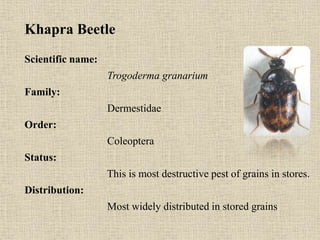
Khapra Beetle
Scientific name:
Trogoderma granarium
Family:
Dermestidae
Order:
Coleoptera
Status:
This is most destructive pest of grains in stores.
Distribution:
Most widely distributed in stored grains
Description of stages
Adult:
Small dark brown, antennae 11 jointed and clubbed.
Egg:
White when freshly laid, becoming reddish later on.
Grub:
Dark reddish brown.
Pupa:
Dirty white ,later dark brown.
Life History
Over wintering:
As larva
Inactive period:
November - February
Active period:
March to October - November.
Period of optimum activity:
July - September
No. of generations:
4
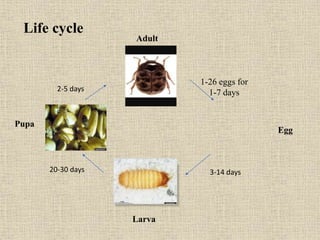
Life cycle
Egg
Adult
Larva
Pupa
3-14 days20-30 days
2-5 days
1-26 eggs for
1-7 days
Damages
Damage of this pest is limited to upper 50cm layer of grains
in the heap.
Larva feeds on grain and in case of severe attack it
converts grain into frass.
 Larva is most destructive pest.
 The beetle does not bore into host material but young larvae
feed on damaged seed older on feeds on whole grains
Control
Chemical control
Grain stocks may be fumigated with phosphine
to eliminate existing infestations, but these
treatments provide no protection against re-
infestation.
If T. granarium is present, then fumigations should
be undertaken for a longer than normal period,
preferably for 7 days.
Good store hygiene plays an important role in
limiting infestation by T. granarium. The
removal of infested residues from the previous
season's harvest is essential, as is general
hygiene in stores; all spillage should be
removed and all cracks and crevices filled.
Cultural Control by sanitary methods
Fumigation is the most effective form of
treatment of khapra beetle infestations.
Methyl bromide is usually the treatment
of choice.
Because of khapra beetle's habit of hiding
in cracks and crevice and in entire storage
facility all its contents must be fumigated.
Typically, the building/commodity or
container is fully covered by tarpaulin
and fumigated with methyl-bromide .
Control by fumigation
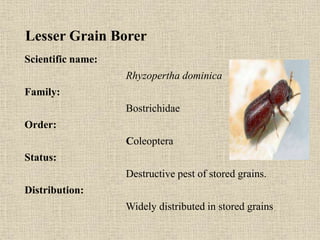
Lesser Grain Borer
Scientific name:
Rhyzopertha dominica
Family:
Bostrichidae
Order:
Coleoptera
Status:
Destructive pest of stored grains.
Distribution:
Widely distributed in stored grains
Description of stages
Adult:
Small dark brown, antenna tripartite club
Eggs:
Whitish becoming pinkish before hatching
Grub:
Dark white cylindrical head brown-lives inside grain.
Pupa:
Yellowish white inside grain.
Life history
Overwintering:
As larva and adult.
Inactive period:
November to february
Active period:
Feb-March to Oct-November
Period of optimum activity:
July to September-Oct
No of generations:
5-6
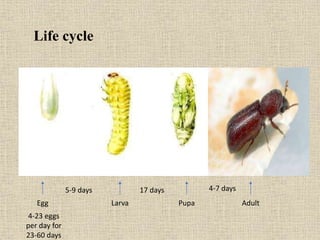
Life cycle
Egg Larva Pupa Adult
5-9 days 17 days 4-7 days
4-23 eggs
per day for
23-60 days
DAMAGES
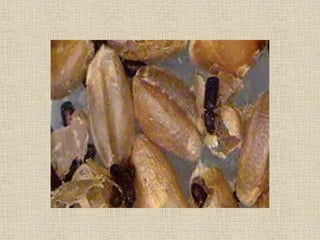
 Both larva and adult attack on the grains and
cause damage by feeding and making many
irregular hole on them .
 In severe infestation a considerable amount of frass
is produce by adult and they spoil more then what
they eat .
 On the flour young grabs are nourished.
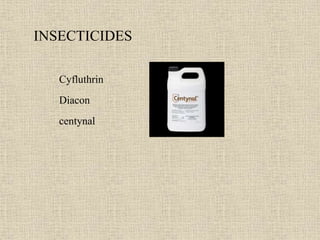
INSECTICIDES
Cyfluthrin
Diacon
centynal
Control
 Properly dry the stored products before storage.
 Store grains in the clean cantainers .
 Plug all the crevices and cracks in the store .
 Fumigation of food grains and store with carbon
tetra chloride should be done .
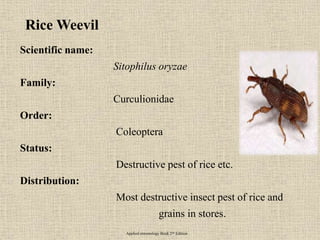
Rice Weevil
Scientific name:
Sitophilus oryzae
Family:
Curculionidae
Order:
Coleoptera
Status:
Destructive pest of rice etc.
Distribution:
Most destructive insect pest of rice and
grains in stores.
Applied entomology Book 2nd Edition
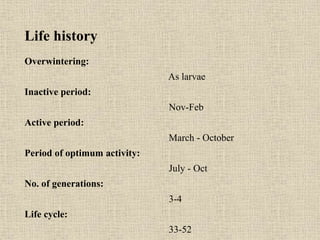
Life history
Overwintering:
As larvae
Inactive period:
Nov-Feb
Active period:
March - October
Period of optimum activity:
July - Oct
No. of generations:
3-4
Life cycle:
33-52
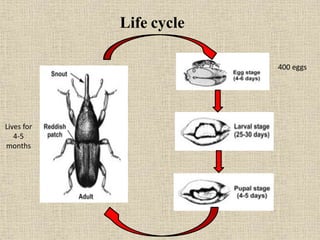
Life cycle
400 eggs
Lives for
4-5
months
Damage
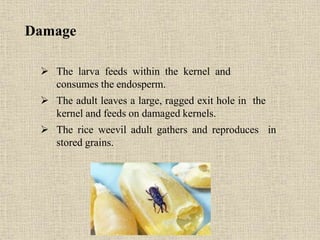
 The larva feeds within the kernel and
consumes the endosperm.
 The adult leaves a large, ragged exit hole in the
kernel and feeds on damaged kernels.
 The rice weevil adult gathers and reproduces in
stored grains.
Control
 Removal of infested food products.
 Discarding the heavily infested material.
 Repackaging material in new containers.
 Vacuuming kitchen cabinets.
 Products are placed in the freezer for several
weeks.
 Clean bins regularly.
 Treat bins with a registered insecticide.
 Properly dispose of any grain debris found
outside of the storage area.
 Fumigation.
 Apply insecticide.
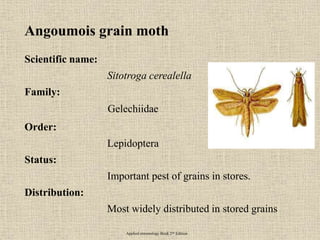
Angoumois grain moth
Scientific name:
Sitotroga cerealella
Family:
Gelechiidae
Order:
Lepidoptera
Status:
Important pest of grains in stores.
Distribution:
Most widely distributed in stored grains
Applied entomology Book 2nd Edition
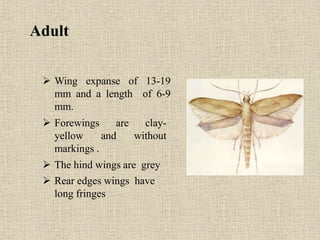
Adult
 Wing expanse of 13-19
mm and a length of 6-9
mm.
 Forewings are clay-
yellow and without
markings .
 The hind wings are grey
 Rear edges wings have
long fringes
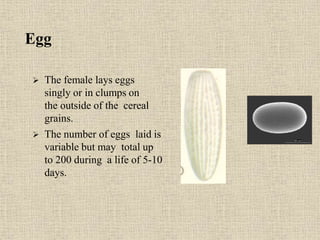
Egg
 The female lays eggs
singly or in clumps on
the outside of the cereal
grains.
 The number of eggs laid is
variable but may total up
to 200 during a life of 5-10
days.
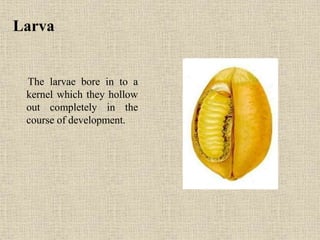
Larva
The larvae bore in to a
kernel which they hollow
out completely in the
course of development.
Pupa
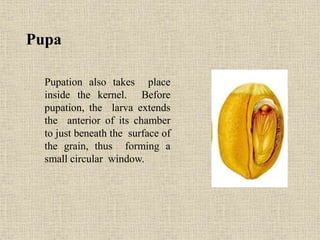
Pupation also takes place
inside the kernel. Before
pupation, the larva extends
the anterior of its chamber
to just beneath the surface of
the grain, thus forming a
small circular window.
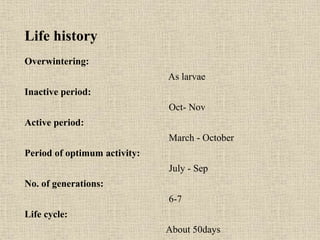
Life history
Overwintering:
As larvae
Inactive period:
Oct- Nov
Active period:
March - October
Period of optimum activity:
July - Sep
No. of generations:
6-7
Life cycle:
About 50days
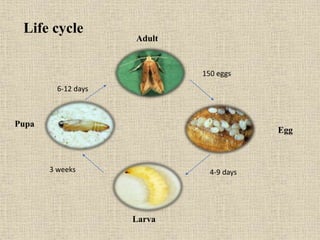
Life cycle
Egg
Adult
Larva
Pupa
4-9 days3 weeks
6-12 days
150 eggs
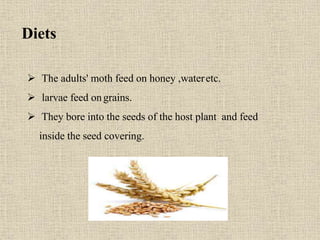
Diets
 The adults' moth feed on honey ,wateretc.
 larvae feed ongrains.
 They bore into the seeds of the host plant and feed
inside the seed covering.
Damage
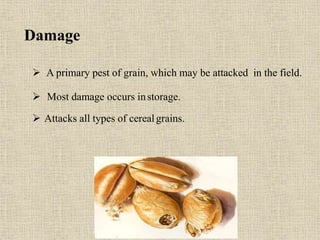
 A primary pest of grain, which may be attacked in the field.
 Most damage occurs instorage.
 Attacks all types of cerealgrains.
Cleaning And Disinfesting The
Storage System
 By sanitation orhygiene
 Use of monitoringdevices
 May needto treat with insecticide
 Malathion (50EC) at 5ml/20l of water
@20ml/m2,
 Fenitrothion (50EC) at 5ml/l water
@20ml/m2,
 Deltamethrin (2.5% WP) at 1.5g/l water
@20ml/m2
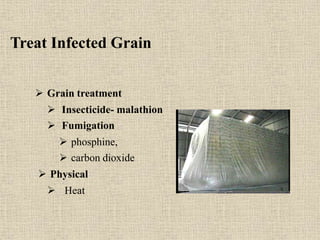
Treat Infected Grain
 Grain treatment
 Insecticide- malathion
 Fumigation
 phosphine,
 carbon dioxide
 Physical
 Heat

Stored grain pests

  • 1.
    Primary Pests ofStored Grain Muhammad Shoaib
  • 2.
    Primary Pest Insects Thatfeed on whole grains. 1- Trogoderma granarium 2- Sitophilus oryzae 3- Rhyzopertha dominica 4- Sitotroga cerealella
  • 3.
    Khapra Beetle Scientific name: Trogodermagranarium Family: Dermestidae Order: Coleoptera Status: This is most destructive pest of grains in stores. Distribution: Most widely distributed in stored grains
  • 4.
    Description of stages Adult: Smalldark brown, antennae 11 jointed and clubbed. Egg: White when freshly laid, becoming reddish later on. Grub: Dark reddish brown. Pupa: Dirty white ,later dark brown.
  • 5.
    Life History Over wintering: Aslarva Inactive period: November - February Active period: March to October - November. Period of optimum activity: July - September No. of generations: 4
  • 6.
    Life cycle Egg Adult Larva Pupa 3-14 days20-30days 2-5 days 1-26 eggs for 1-7 days
  • 7.
    Damages Damage of thispest is limited to upper 50cm layer of grains in the heap. Larva feeds on grain and in case of severe attack it converts grain into frass.  Larva is most destructive pest.  The beetle does not bore into host material but young larvae feed on damaged seed older on feeds on whole grains
  • 8.
    Control Chemical control Grain stocksmay be fumigated with phosphine to eliminate existing infestations, but these treatments provide no protection against re- infestation. If T. granarium is present, then fumigations should be undertaken for a longer than normal period, preferably for 7 days.
  • 9.
    Good store hygieneplays an important role in limiting infestation by T. granarium. The removal of infested residues from the previous season's harvest is essential, as is general hygiene in stores; all spillage should be removed and all cracks and crevices filled. Cultural Control by sanitary methods
  • 10.
    Fumigation is themost effective form of treatment of khapra beetle infestations. Methyl bromide is usually the treatment of choice. Because of khapra beetle's habit of hiding in cracks and crevice and in entire storage facility all its contents must be fumigated. Typically, the building/commodity or container is fully covered by tarpaulin and fumigated with methyl-bromide . Control by fumigation
  • 11.
    Lesser Grain Borer Scientificname: Rhyzopertha dominica Family: Bostrichidae Order: Coleoptera Status: Destructive pest of stored grains. Distribution: Widely distributed in stored grains
  • 12.
    Description of stages Adult: Smalldark brown, antenna tripartite club Eggs: Whitish becoming pinkish before hatching Grub: Dark white cylindrical head brown-lives inside grain. Pupa: Yellowish white inside grain.
  • 13.
    Life history Overwintering: As larvaand adult. Inactive period: November to february Active period: Feb-March to Oct-November Period of optimum activity: July to September-Oct No of generations: 5-6
  • 14.
    Life cycle Egg LarvaPupa Adult 5-9 days 17 days 4-7 days 4-23 eggs per day for 23-60 days
  • 15.
    DAMAGES  Both larvaand adult attack on the grains and cause damage by feeding and making many irregular hole on them .  In severe infestation a considerable amount of frass is produce by adult and they spoil more then what they eat .  On the flour young grabs are nourished.
  • 17.
  • 18.
    Control  Properly drythe stored products before storage.  Store grains in the clean cantainers .  Plug all the crevices and cracks in the store .  Fumigation of food grains and store with carbon tetra chloride should be done .
  • 19.
    Rice Weevil Scientific name: Sitophilusoryzae Family: Curculionidae Order: Coleoptera Status: Destructive pest of rice etc. Distribution: Most destructive insect pest of rice and grains in stores. Applied entomology Book 2nd Edition
  • 20.
    Life history Overwintering: As larvae Inactiveperiod: Nov-Feb Active period: March - October Period of optimum activity: July - Oct No. of generations: 3-4 Life cycle: 33-52
  • 21.
  • 22.
    Damage  The larvafeeds within the kernel and consumes the endosperm.  The adult leaves a large, ragged exit hole in the kernel and feeds on damaged kernels.  The rice weevil adult gathers and reproduces in stored grains.
  • 23.
    Control  Removal ofinfested food products.  Discarding the heavily infested material.  Repackaging material in new containers.  Vacuuming kitchen cabinets.  Products are placed in the freezer for several weeks.  Clean bins regularly.  Treat bins with a registered insecticide.  Properly dispose of any grain debris found outside of the storage area.  Fumigation.  Apply insecticide.
  • 24.
    Angoumois grain moth Scientificname: Sitotroga cerealella Family: Gelechiidae Order: Lepidoptera Status: Important pest of grains in stores. Distribution: Most widely distributed in stored grains Applied entomology Book 2nd Edition
  • 25.
    Adult  Wing expanseof 13-19 mm and a length of 6-9 mm.  Forewings are clay- yellow and without markings .  The hind wings are grey  Rear edges wings have long fringes
  • 26.
    Egg  The femalelays eggs singly or in clumps on the outside of the cereal grains.  The number of eggs laid is variable but may total up to 200 during a life of 5-10 days.
  • 27.
    Larva The larvae borein to a kernel which they hollow out completely in the course of development.
  • 28.
    Pupa Pupation also takesplace inside the kernel. Before pupation, the larva extends the anterior of its chamber to just beneath the surface of the grain, thus forming a small circular window.
  • 29.
    Life history Overwintering: As larvae Inactiveperiod: Oct- Nov Active period: March - October Period of optimum activity: July - Sep No. of generations: 6-7 Life cycle: About 50days
  • 30.
  • 31.
    Diets  The adults'moth feed on honey ,wateretc.  larvae feed ongrains.  They bore into the seeds of the host plant and feed inside the seed covering.
  • 32.
    Damage  A primarypest of grain, which may be attacked in the field.  Most damage occurs instorage.  Attacks all types of cerealgrains.
  • 33.
    Cleaning And DisinfestingThe Storage System  By sanitation orhygiene  Use of monitoringdevices  May needto treat with insecticide  Malathion (50EC) at 5ml/20l of water @20ml/m2,  Fenitrothion (50EC) at 5ml/l water @20ml/m2,  Deltamethrin (2.5% WP) at 1.5g/l water @20ml/m2
  • 34.
    Treat Infected Grain Grain treatment  Insecticide- malathion  Fumigation  phosphine,  carbon dioxide  Physical  Heat