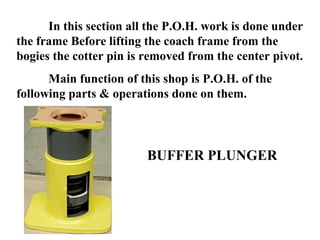
In this section all the P.O.H. work is done under
the frame Before lifting the coach frame from the
bogies the cotter pin is removed from the center pivot.
Main function of this shop is P.O.H. of the
following parts & operations done on them.

BUFFER PLUNGER
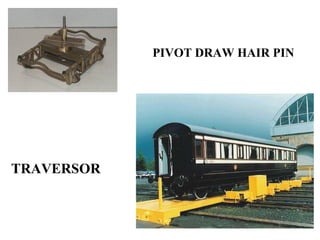
PIVOT DRAW HAIR PIN

TRAVERSOR
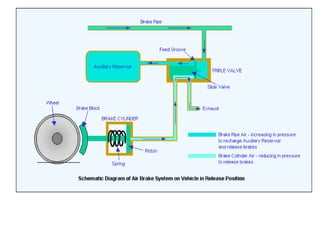
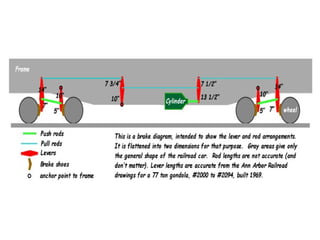
AIR BRAKES
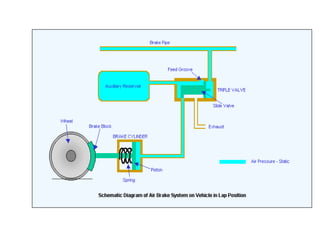
AIR BRAKES USE COMPRESSED AIR TO MAKE
THEM WORK. YOU CAN APPLY ALL THE
BRAKING FORCE YOU NEED TO EACH WHEEL
OF A VEHICLE, EVEN TRACTORS PULLING
TRAILERS. IF MAINTAINED AND USED PROPERLY
THEY WILL SAFELY STOP LARGE VEHICLES.
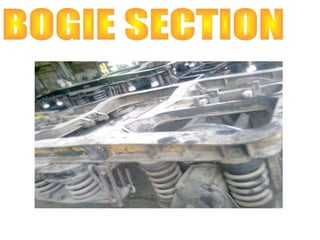
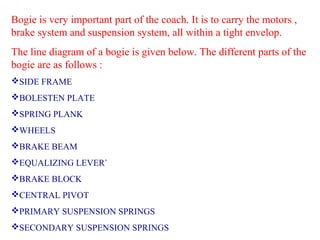
Bogie is very important part of the coach. It is to carry the motors ,
brake system and suspension system, all within a tight envelop.
The line diagram of a bogie is given below. The different parts of the
bogie are as follows :
SIDE FRAME
BOLESTEN PLATE
SPRING PLANK
WHEELS
BRAKE BEAM
EQUALIZING LEVER`
BRAKE BLOCK
CENTRAL PIVOT
PRIMARY SUSPENSION SPRINGS
SECONDARY SUSPENSION SPRINGS
ASSEMBLY OF ROLLER BEARING
REAR COVER
DISTANCE RING
O RING

Axle Box
In assembly section roller bearing is assembled on the
journal by using various processes. Introduction heating is done
for expanding inner race of the bearing of so that it can be
mounted on the journal of the wheel without any problem.
Induction heating includes following features :
1. Temperature is maintained at 120°C.
2. Minimum time for heating between induction coils is 5 to 7 min.
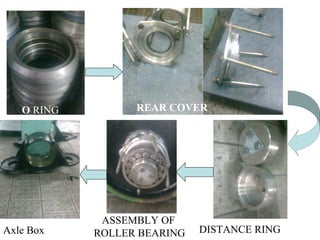
O RING

Axle Box

REAR COVER

ASSEMBLY OF
ROLLER BEARING

DISTANCE RING
Smithing involves heating the metal or waste
material in an open hearth furnace and give it the
desired shape by forging. Optimal utilization of
waste metal can be made through this shop
Various sections of Smithy Shop are :
1. HAMMER SECTION
2. SPRING SECTION
3. HEAT TREATMENT & TENSILE TESTING
SECTION
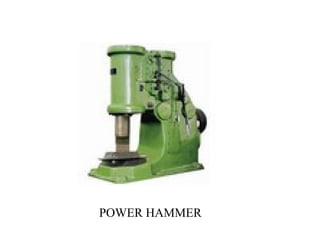
POWER HAMMER
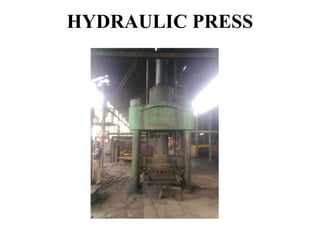
HYDRAULIC PRESS
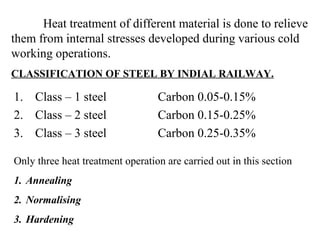
Heat treatment of different material is done to relieve
them from internal stresses developed during various cold
working operations.
CLASSIFICATION OF STEEL BY INDIAL RAILWAY.

1. Class – 1 steel
2. Class – 2 steel
3. Class – 3 steel

Carbon 0.05-0.15%
Carbon 0.15-0.25%
Carbon 0.25-0.35%

Only three heat treatment operation are carried out in this section
1. Annealing
2. Normalising
3. Hardening
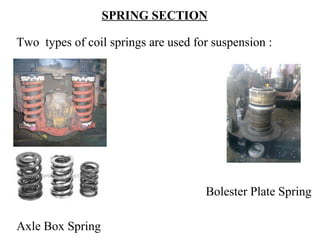
SPRING SECTION
Two types of coil springs are used for suspension :

Bolester Plate Spring
Axle Box Spring
MACHINE SHOP
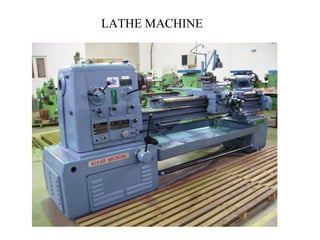
LATHE MACHINE
SLOTTER MACHINE
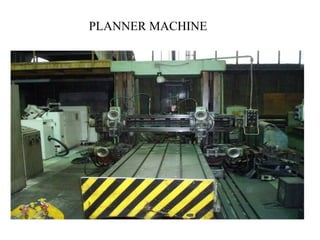
PLANNER MACHINE
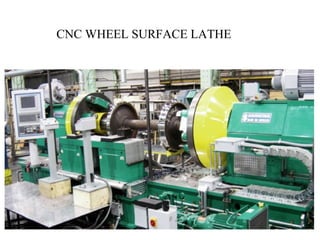
CNC WHEEL SURFACE LATHE
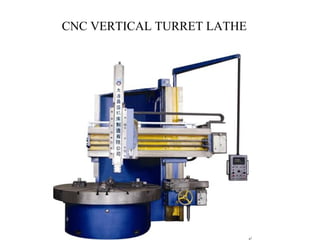
CNC VERTICAL TURRET LATHE
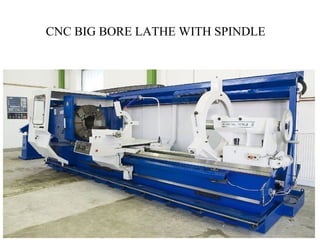
CNC BIG BORE LATHE WITH SPINDLE
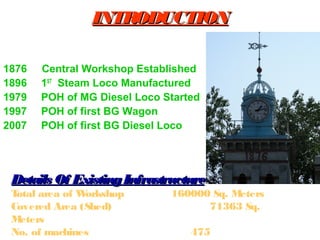
INTRODUCTION
1876
1896
1979
1997
2007

Central Workshop Established
1ST Steam Loco Manufactured
POH of MG Diesel Loco Started
POH of first BG Wagon
POH of first BG Diesel Loco

Details Of Existing Infrastructure
T
otal area of W
orkshop
Covered Area (Shed)
M
eters
No. of machines

160000 Sq. Meters
71363 Sq.
475
INTRODUCTION
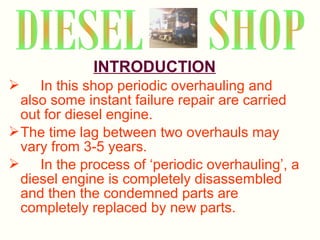
In this shop periodic overhauling and
also some instant failure repair are carried
out for diesel engine.
 The time lag between two overhauls may
vary from 3-5 years.
 In the process of ‘periodic overhauling’, a
diesel engine is completely disassembled
and then the condemned parts are
completely replaced by new parts.

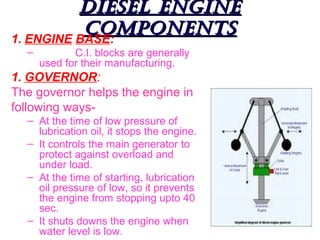
DIESEL ENGINE
COMPONENTS
1. ENGINE BASE:
–

C.I. blocks are generally
used for their manufacturing.

1. GOVERNOR:
The governor helps the engine in
following ways– At the time of low pressure of
lubrication oil, it stops the engine.
– It controls the main generator to
protect against overload and
under load.
– At the time of starting, lubrication
oil pressure of low, so it prevents
the engine from stopping upto 40
sec.
– It shuts downs the engine when
water level is low.
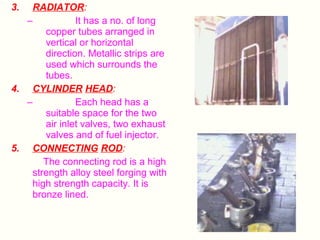
3.

RADIATOR:
–
It has a no. of long
copper tubes arranged in
vertical or horizontal
direction. Metallic strips are
used which surrounds the
tubes.
4. CYLINDER HEAD:
–
Each head has a
suitable space for the two
air inlet valves, two exhaust
valves and of fuel injector.
5. CONNECTING ROD:
The connecting rod is a high
strength alloy steel forging with
high strength capacity. It is
bronze lined.
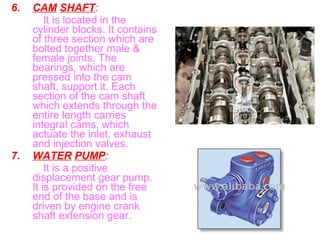
6.

7.

CAM SHAFT:
It is located in the
cylinder blocks. It contains
of three section which are
bolted together male &
female joints. The
bearings, which are
pressed into the cam
shaft, support it. Each
section of the cam shaft
which extends through the
entire length carries
integral cams, which
actuate the inlet, exhaust
and injection valves.
WATER PUMP:
It is a positive
displacement gear pump.
It is provided on the free
end of the base and is
driven by engine crank
shaft extension gear.
8.

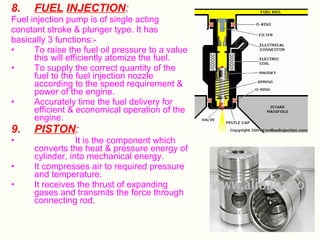
FUEL INJECTION:

Fuel injection pump is of single acting
constant stroke & plunger type. It has
basically 3 functions:•
To raise the fuel oil pressure to a value
this will efficiently atomize the fuel.
•
To supply the correct quantity of the
fuel to the fuel injection nozzle
according to the speed requirement &
power of the engine.
•
Accurately time the fuel delivery for
efficient & economical operation of the
engine.

9.

PISTON:

•

It is the component which
converts the heat & pressure energy of
cylinder, into mechanical energy.
It compresses air to required pressure
and temperature.
It receives the thrust of expanding
gases and transmits the force through
connecting rod.

•
•
Loco workshop

Loco workshop

  • 5.
    In this sectionall the P.O.H. work is done under the frame Before lifting the coach frame from the bogies the cotter pin is removed from the center pivot. Main function of this shop is P.O.H. of the following parts & operations done on them. BUFFER PLUNGER
  • 6.
    PIVOT DRAW HAIRPIN TRAVERSOR
  • 8.
    AIR BRAKES AIR BRAKESUSE COMPRESSED AIR TO MAKE THEM WORK. YOU CAN APPLY ALL THE BRAKING FORCE YOU NEED TO EACH WHEEL OF A VEHICLE, EVEN TRACTORS PULLING TRAILERS. IF MAINTAINED AND USED PROPERLY THEY WILL SAFELY STOP LARGE VEHICLES.
  • 13.
    Bogie is veryimportant part of the coach. It is to carry the motors , brake system and suspension system, all within a tight envelop. The line diagram of a bogie is given below. The different parts of the bogie are as follows : SIDE FRAME BOLESTEN PLATE SPRING PLANK WHEELS BRAKE BEAM EQUALIZING LEVER` BRAKE BLOCK CENTRAL PIVOT PRIMARY SUSPENSION SPRINGS SECONDARY SUSPENSION SPRINGS
  • 15.
    ASSEMBLY OF ROLLERBEARING REAR COVER DISTANCE RING O RING Axle Box In assembly section roller bearing is assembled on the journal by using various processes. Introduction heating is done for expanding inner race of the bearing of so that it can be mounted on the journal of the wheel without any problem. Induction heating includes following features : 1. Temperature is maintained at 120°C. 2. Minimum time for heating between induction coils is 5 to 7 min.
  • 16.
    O RING Axle Box REARCOVER ASSEMBLY OF ROLLER BEARING DISTANCE RING
  • 18.
    Smithing involves heatingthe metal or waste material in an open hearth furnace and give it the desired shape by forging. Optimal utilization of waste metal can be made through this shop Various sections of Smithy Shop are : 1. HAMMER SECTION 2. SPRING SECTION 3. HEAT TREATMENT & TENSILE TESTING SECTION
  • 19.
  • 20.
  • 21.
    Heat treatment ofdifferent material is done to relieve them from internal stresses developed during various cold working operations. CLASSIFICATION OF STEEL BY INDIAL RAILWAY. 1. Class – 1 steel 2. Class – 2 steel 3. Class – 3 steel Carbon 0.05-0.15% Carbon 0.15-0.25% Carbon 0.25-0.35% Only three heat treatment operation are carried out in this section 1. Annealing 2. Normalising 3. Hardening
  • 22.
    SPRING SECTION Two typesof coil springs are used for suspension : Bolester Plate Spring Axle Box Spring
  • 23.
  • 24.
  • 25.
  • 26.
  • 28.
  • 29.
  • 30.
    CNC BIG BORELATHE WITH SPINDLE
  • 32.
    INTRODUCTION 1876 1896 1979 1997 2007 Central Workshop Established 1STSteam Loco Manufactured POH of MG Diesel Loco Started POH of first BG Wagon POH of first BG Diesel Loco Details Of Existing Infrastructure T otal area of W orkshop Covered Area (Shed) M eters No. of machines 160000 Sq. Meters 71363 Sq. 475
  • 34.
    INTRODUCTION In this shopperiodic overhauling and also some instant failure repair are carried out for diesel engine.  The time lag between two overhauls may vary from 3-5 years.  In the process of ‘periodic overhauling’, a diesel engine is completely disassembled and then the condemned parts are completely replaced by new parts. 
  • 35.
    DIESEL ENGINE COMPONENTS 1. ENGINEBASE: – C.I. blocks are generally used for their manufacturing. 1. GOVERNOR: The governor helps the engine in following ways– At the time of low pressure of lubrication oil, it stops the engine. – It controls the main generator to protect against overload and under load. – At the time of starting, lubrication oil pressure of low, so it prevents the engine from stopping upto 40 sec. – It shuts downs the engine when water level is low.
  • 36.
    3. RADIATOR: – It has ano. of long copper tubes arranged in vertical or horizontal direction. Metallic strips are used which surrounds the tubes. 4. CYLINDER HEAD: – Each head has a suitable space for the two air inlet valves, two exhaust valves and of fuel injector. 5. CONNECTING ROD: The connecting rod is a high strength alloy steel forging with high strength capacity. It is bronze lined.
  • 37.
    6. 7. CAM SHAFT: It islocated in the cylinder blocks. It contains of three section which are bolted together male & female joints. The bearings, which are pressed into the cam shaft, support it. Each section of the cam shaft which extends through the entire length carries integral cams, which actuate the inlet, exhaust and injection valves. WATER PUMP: It is a positive displacement gear pump. It is provided on the free end of the base and is driven by engine crank shaft extension gear.
  • 38.
    8. FUEL INJECTION: Fuel injectionpump is of single acting constant stroke & plunger type. It has basically 3 functions:• To raise the fuel oil pressure to a value this will efficiently atomize the fuel. • To supply the correct quantity of the fuel to the fuel injection nozzle according to the speed requirement & power of the engine. • Accurately time the fuel delivery for efficient & economical operation of the engine. 9. PISTON: • It is the component which converts the heat & pressure energy of cylinder, into mechanical energy. It compresses air to required pressure and temperature. It receives the thrust of expanding gases and transmits the force through connecting rod. • •