
Policy Considerations

In large scale utilisation of
biodiesel as a traction fuel for
Indian Railways
Government of India – Ministry of Railways

Ministry of Railways
Introduction
Approx two billion litres of diesel fuel
are consumed annually by nearly 4,000
freight and passenger locomotives in the
Indian Railway fleet
The annual expenditure of Indian Railways
on diesel fuel is approx Rs.4400 Crore
Biodiesel blended with petrodiesel can
serve as an alternate fuel

Ministry of Railways
Diesel Loco fleet of Indian
Railways
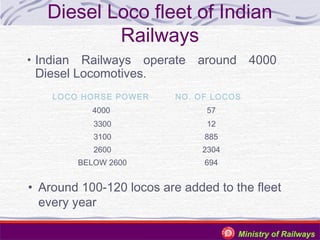
• Indian

Railways operate around 4000
Diesel Locomotives.
LOCO HORSE POWER

NO. OF LOCOS

4000

57

3300

12

3100

885

2600

2304

BELOW 2600

694

• Around 100-120 locos are added to the fleet
every year
Ministry of Railways
Biodiesel : Key Advantages
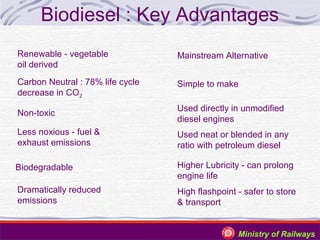
Renewable - vegetable
oil derived

Mainstream Alternative

Carbon Neutral : 78% life cycle
decrease in CO2

Simple to make

Non-toxic

Used directly in unmodified
diesel engines

Less noxious - fuel &
exhaust emissions

Used neat or blended in any
ratio with petroleum diesel

Biodegradable

Higher Lubricity - can prolong
engine life

Dramatically reduced
emissions

High flashpoint - safer to store
& transport

Ministry of Railways
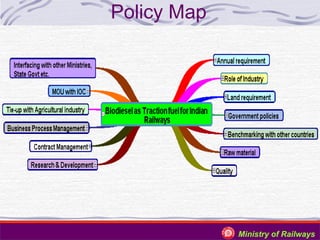
Policy Map

Ministry of Railways
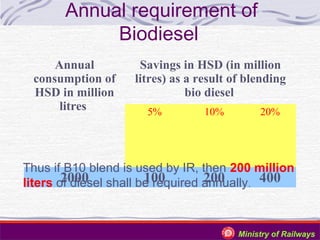
Annual requirement of
Biodiesel
Annual
consumption of
HSD in million
litres

Savings in HSD (in million
litres) as a result of blending
bio diesel
5%

10%

20%

Thus if B10 blend is used by IR, then 200 million
2000
100
200
liters of diesel shall be required annually. 400

Ministry of Railways
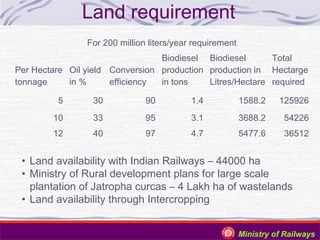
Land requirement
For 200 million liters/year requirement
Biodiesel Biodiesel
Total
Per Hectare Oil yield Conversion production production in Hectarge
tonnage
in %
efficiency
in tons
Litres/Hectare required
5

30

90

1.4

1588.2

125926

10

33

95

3.1

3688.2

54226

12

40

97

4.7

5477.6

36512

• Land availability with Indian Railways – 44000 ha
• Ministry of Rural development plans for large scale
plantation of Jatropha curcas – 4 Lakh ha of wastelands
• Land availability through Intercropping
Ministry of Railways
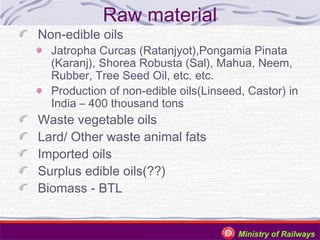
Raw material

Non-edible oils

Jatropha Curcas (Ratanjyot),Pongamia Pinata
(Karanj), Shorea Robusta (Sal), Mahua, Neem,
Rubber, Tree Seed Oil, etc. etc.
Production of non-edible oils(Linseed, Castor) in
India – 400 thousand tons

Waste vegetable oils
Lard/ Other waste animal fats
Imported oils
Surplus edible oils(??)
Biomass - BTL

Ministry of Railways
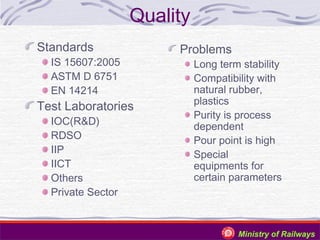
Quality
Standards

IS 15607:2005
ASTM D 6751
EN 14214

Test Laboratories
IOC(R&D)
RDSO
IIP
IICT
Others
Private Sector

Problems

Long term stability
Compatibility with
natural rubber,
plastics
Purity is process
dependent
Pour point is high
Special
equipments for
certain parameters

Ministry of Railways
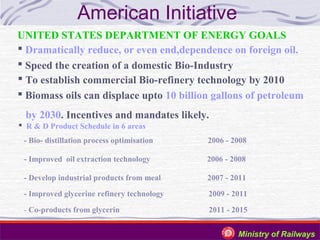
American Initiative
UNITED STATES DEPARTMENT OF ENERGY GOALS
 Dramatically reduce, or even end,dependence on foreign oil.
 Speed the creation of a domestic Bio-Industry
 To establish commercial Bio-refinery technology by 2010
 Biomass oils can displace upto 10 billion gallons of petroleum
by 2030. Incentives and mandates likely.
 R & D Product Schedule in 6 areas
- Bio- distillation process optimisation

2006 - 2008

- Improved oil extraction technology

2006 - 2008

- Develop industrial products from meal

2007 - 2011

- Improved glycerine refinery technology

2009 - 2011

- Co-products from glycerin

2011 - 2015
Ministry of Railways
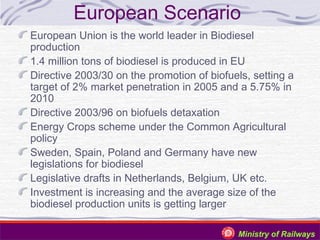
European Scenario
European Union is the world leader in Biodiesel
production
1.4 million tons of biodiesel is produced in EU
Directive 2003/30 on the promotion of biofuels, setting a
target of 2% market penetration in 2005 and a 5.75% in
2010
Directive 2003/96 on biofuels detaxation
Energy Crops scheme under the Common Agricultural
policy
Sweden, Spain, Poland and Germany have new
legislations for biodiesel
Legislative drafts in Netherlands, Belgium, UK etc.
Investment is increasing and the average size of the
biodiesel production units is getting larger
Ministry of Railways
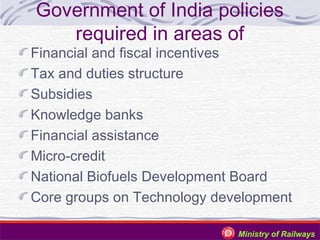
Government of India policies
required in areas of

Financial and fiscal incentives
Tax and duties structure
Subsidies
Knowledge banks
Financial assistance
Micro-credit
National Biofuels Development Board
Core groups on Technology development
Ministry of Railways
Research & Development
Plantation methods

Generative Propagation
Vegetative Propagation
Drip Irrigation

High yield plants – 160 types of Genus Jatropha
Heterogeneous transesterification, 2nd generation
conversion methods
Quality Control
Engine Studies/ Optimisation
Field trial
Engine Development Experiments

New Raw Materials
Algae, Fungi etc.
Biomass

Ministry of Railways
Contract Management
Public Private Partnership
Vendor selection procedures
ISO TS 16949
Juran’s 16-step vendor development
procedure, etc.
Market friendly contract conditions
Reduction of delay points
In synchronisation with International practices

Ministry of Railways
Business Process Management
Steering Committee
Project monitoring committee
Identification of processes
Reengineering of processes
Process Owners
Adequate Financial powers

Obsolescence of departmental working
Project Management

Ministry of Railways
MoU with IOC - salient features
Signed in February 2003 for a period of 15
years
Railways has offered about 500 hectare
land to IOC for plantation of jatropha
curcas
81 hectares are under plantation and
normal yield expected from 2008
IOC will take up plantation, extraction,
transesterification
IR will use bio diesel supplied by IOC
Starting with 1-5 % bio diesel Indian
Railways will go upto 20 % depending on
field experience
Ministry of Railways
Current Status


MOU with IOC signed



Engine experimentation with imported Soya based
biodiesel completed



Limited Field trials with imported soya based biodiesel
undertaken



Two Diesel Multiple units being run on B5 blend in
Southern Railway



Large scale Field trials under progress in Northern
Railway



Two biodiesel production plants set-up in Southern
Railway and South-Eastern Railway



Plantation of Jatropha taken up in Kharagpur division of
South-Eastern Railway
Ministry of Railways
Testing in RDSO
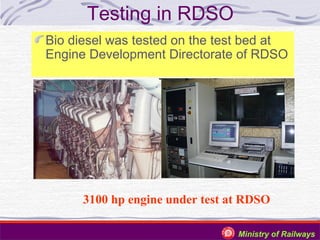
Bio diesel was tested on the test bed at
Engine Development Directorate of RDSO

3100 hp engine under test at RDSO
Ministry of Railways
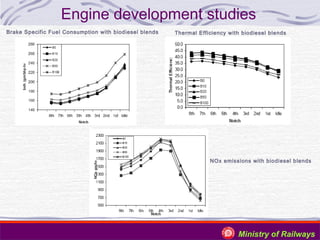
Engine development studies
Brake Specific Fuel Consumption with biodiesel blends

Thermal Efficiency with biodiesel blends

NOx emissions with biodiesel blends

Ministry of Railways
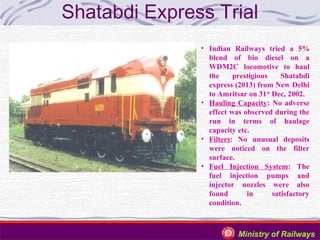
Shatabdi Express Trial
• Indian Railways tried a 5%
blend of bio diesel on a
WDM2C locomotive to haul
the
prestigious
Shatabdi
express (2013) from New Delhi
to Amritsar on 31st Dec, 2002.
• Hauling Capacity: No adverse
effect was observed during the
run in terms of haulage
capacity etc.
• Filters: No unusual deposits
were noticed on the filter
surface.
• Fuel Injection System: The
fuel injection pumps and
injector nozzles were also
found
in
satisfactory
condition.

Ministry of Railways
Future
Setting up of pilot biodiesel plant at RDSO with
heterogeneous catalyst technology
Biodiesel plants in Zonal Railways
Well to wheel project for biodiesel at RDSO
Transesterification with multiple stocks
Engine studies and optimisation with multi-stock
biodiesel, Jatropha, Karanja, etc.
Development of Industry for production of
biodiesel
Implementation of B10/B20 blended biodiesel on
whole fleet of diesel locomotives
Ministry of Railways
Expectations from the Industry


Participate in biofuel plantation, Indian Railways have already called
for Expression of Interest for 44000 ha land with IR



Extraction, storage and logistics facilities development



Import of cheaper non-edible oils without adversely impacting the
local agricultural interests



Quality control facilities development under a central monitoring
body



Develop heterogeneous & other 2nd generation biodiesel production
facilities



Annual requirement of IR is 400 m liters of biodiesel per year with
B20 blend and expected to go up if higher blends are used



Supply of biodiesel at a reasonable cost



Supply the IS 15607 quality biodiesel to IOC who shall supply
blended biodiesel to IR, a tripartite contract between IR, IOC and
Industry



Ensure sustained supply of biodiesel
Ministry of Railways
Conclusion
Bio diesel can be used in medium-speed diesel
engines – Optimisation might be required
Use of bio diesel can reduce the amount of
harmful emissions
A blend of 10 percent bio diesel and 90 percent
petrodiesel (B10) to be implemented to start
with
Biodiesel Industry required to develop in India
For price competitiveness Fiscal and Financial
incentives by the Government required
Raw material planning critical to success
Development of second generation conversion
process essential
The associated agencies should actively
monitor the initiatives underway in India to
promote and financially facilitate commercial
supply of bio diesel
Ministry of Railways
Thank You

Ministry of Railways

bio diesel

  • 1.
    Policy Considerations In largescale utilisation of biodiesel as a traction fuel for Indian Railways Government of India – Ministry of Railways Ministry of Railways
  • 2.
    Introduction Approx two billionlitres of diesel fuel are consumed annually by nearly 4,000 freight and passenger locomotives in the Indian Railway fleet The annual expenditure of Indian Railways on diesel fuel is approx Rs.4400 Crore Biodiesel blended with petrodiesel can serve as an alternate fuel Ministry of Railways
  • 3.
    Diesel Loco fleetof Indian Railways • Indian Railways operate around 4000 Diesel Locomotives. LOCO HORSE POWER NO. OF LOCOS 4000 57 3300 12 3100 885 2600 2304 BELOW 2600 694 • Around 100-120 locos are added to the fleet every year Ministry of Railways
  • 4.
    Biodiesel : KeyAdvantages Renewable - vegetable oil derived Mainstream Alternative Carbon Neutral : 78% life cycle decrease in CO2 Simple to make Non-toxic Used directly in unmodified diesel engines Less noxious - fuel & exhaust emissions Used neat or blended in any ratio with petroleum diesel Biodegradable Higher Lubricity - can prolong engine life Dramatically reduced emissions High flashpoint - safer to store & transport Ministry of Railways
  • 5.
  • 6.
    Annual requirement of Biodiesel Annual consumptionof HSD in million litres Savings in HSD (in million litres) as a result of blending bio diesel 5% 10% 20% Thus if B10 blend is used by IR, then 200 million 2000 100 200 liters of diesel shall be required annually. 400 Ministry of Railways
  • 7.
    Land requirement For 200million liters/year requirement Biodiesel Biodiesel Total Per Hectare Oil yield Conversion production production in Hectarge tonnage in % efficiency in tons Litres/Hectare required 5 30 90 1.4 1588.2 125926 10 33 95 3.1 3688.2 54226 12 40 97 4.7 5477.6 36512 • Land availability with Indian Railways – 44000 ha • Ministry of Rural development plans for large scale plantation of Jatropha curcas – 4 Lakh ha of wastelands • Land availability through Intercropping Ministry of Railways
  • 8.
    Raw material Non-edible oils JatrophaCurcas (Ratanjyot),Pongamia Pinata (Karanj), Shorea Robusta (Sal), Mahua, Neem, Rubber, Tree Seed Oil, etc. etc. Production of non-edible oils(Linseed, Castor) in India – 400 thousand tons Waste vegetable oils Lard/ Other waste animal fats Imported oils Surplus edible oils(??) Biomass - BTL Ministry of Railways
  • 9.
    Quality Standards IS 15607:2005 ASTM D6751 EN 14214 Test Laboratories IOC(R&D) RDSO IIP IICT Others Private Sector Problems Long term stability Compatibility with natural rubber, plastics Purity is process dependent Pour point is high Special equipments for certain parameters Ministry of Railways
  • 10.
    American Initiative UNITED STATESDEPARTMENT OF ENERGY GOALS  Dramatically reduce, or even end,dependence on foreign oil.  Speed the creation of a domestic Bio-Industry  To establish commercial Bio-refinery technology by 2010  Biomass oils can displace upto 10 billion gallons of petroleum by 2030. Incentives and mandates likely.  R & D Product Schedule in 6 areas - Bio- distillation process optimisation 2006 - 2008 - Improved oil extraction technology 2006 - 2008 - Develop industrial products from meal 2007 - 2011 - Improved glycerine refinery technology 2009 - 2011 - Co-products from glycerin 2011 - 2015 Ministry of Railways
  • 11.
    European Scenario European Unionis the world leader in Biodiesel production 1.4 million tons of biodiesel is produced in EU Directive 2003/30 on the promotion of biofuels, setting a target of 2% market penetration in 2005 and a 5.75% in 2010 Directive 2003/96 on biofuels detaxation Energy Crops scheme under the Common Agricultural policy Sweden, Spain, Poland and Germany have new legislations for biodiesel Legislative drafts in Netherlands, Belgium, UK etc. Investment is increasing and the average size of the biodiesel production units is getting larger Ministry of Railways
  • 12.
    Government of Indiapolicies required in areas of Financial and fiscal incentives Tax and duties structure Subsidies Knowledge banks Financial assistance Micro-credit National Biofuels Development Board Core groups on Technology development Ministry of Railways
  • 13.
    Research & Development Plantationmethods Generative Propagation Vegetative Propagation Drip Irrigation High yield plants – 160 types of Genus Jatropha Heterogeneous transesterification, 2nd generation conversion methods Quality Control Engine Studies/ Optimisation Field trial Engine Development Experiments New Raw Materials Algae, Fungi etc. Biomass Ministry of Railways
  • 14.
    Contract Management Public PrivatePartnership Vendor selection procedures ISO TS 16949 Juran’s 16-step vendor development procedure, etc. Market friendly contract conditions Reduction of delay points In synchronisation with International practices Ministry of Railways
  • 15.
    Business Process Management SteeringCommittee Project monitoring committee Identification of processes Reengineering of processes Process Owners Adequate Financial powers Obsolescence of departmental working Project Management Ministry of Railways
  • 16.
    MoU with IOC- salient features Signed in February 2003 for a period of 15 years Railways has offered about 500 hectare land to IOC for plantation of jatropha curcas 81 hectares are under plantation and normal yield expected from 2008 IOC will take up plantation, extraction, transesterification IR will use bio diesel supplied by IOC Starting with 1-5 % bio diesel Indian Railways will go upto 20 % depending on field experience Ministry of Railways
  • 17.
    Current Status  MOU withIOC signed  Engine experimentation with imported Soya based biodiesel completed  Limited Field trials with imported soya based biodiesel undertaken  Two Diesel Multiple units being run on B5 blend in Southern Railway  Large scale Field trials under progress in Northern Railway  Two biodiesel production plants set-up in Southern Railway and South-Eastern Railway  Plantation of Jatropha taken up in Kharagpur division of South-Eastern Railway Ministry of Railways
  • 18.
    Testing in RDSO Biodiesel was tested on the test bed at Engine Development Directorate of RDSO 3100 hp engine under test at RDSO Ministry of Railways
  • 19.
    Engine development studies BrakeSpecific Fuel Consumption with biodiesel blends Thermal Efficiency with biodiesel blends NOx emissions with biodiesel blends Ministry of Railways
  • 20.
    Shatabdi Express Trial •Indian Railways tried a 5% blend of bio diesel on a WDM2C locomotive to haul the prestigious Shatabdi express (2013) from New Delhi to Amritsar on 31st Dec, 2002. • Hauling Capacity: No adverse effect was observed during the run in terms of haulage capacity etc. • Filters: No unusual deposits were noticed on the filter surface. • Fuel Injection System: The fuel injection pumps and injector nozzles were also found in satisfactory condition. Ministry of Railways
  • 21.
    Future Setting up ofpilot biodiesel plant at RDSO with heterogeneous catalyst technology Biodiesel plants in Zonal Railways Well to wheel project for biodiesel at RDSO Transesterification with multiple stocks Engine studies and optimisation with multi-stock biodiesel, Jatropha, Karanja, etc. Development of Industry for production of biodiesel Implementation of B10/B20 blended biodiesel on whole fleet of diesel locomotives Ministry of Railways
  • 22.
    Expectations from theIndustry  Participate in biofuel plantation, Indian Railways have already called for Expression of Interest for 44000 ha land with IR  Extraction, storage and logistics facilities development  Import of cheaper non-edible oils without adversely impacting the local agricultural interests  Quality control facilities development under a central monitoring body  Develop heterogeneous & other 2nd generation biodiesel production facilities  Annual requirement of IR is 400 m liters of biodiesel per year with B20 blend and expected to go up if higher blends are used  Supply of biodiesel at a reasonable cost  Supply the IS 15607 quality biodiesel to IOC who shall supply blended biodiesel to IR, a tripartite contract between IR, IOC and Industry  Ensure sustained supply of biodiesel Ministry of Railways
  • 23.
    Conclusion Bio diesel canbe used in medium-speed diesel engines – Optimisation might be required Use of bio diesel can reduce the amount of harmful emissions A blend of 10 percent bio diesel and 90 percent petrodiesel (B10) to be implemented to start with Biodiesel Industry required to develop in India For price competitiveness Fiscal and Financial incentives by the Government required Raw material planning critical to success Development of second generation conversion process essential The associated agencies should actively monitor the initiatives underway in India to promote and financially facilitate commercial supply of bio diesel Ministry of Railways
  • 24.