RAILWAY MAINTENANCE 
AT 
SUBMITTED BY : 
SATYAM SINGH 
B.Tech [ME-D] 4th Year 
110106247 
11SETME252
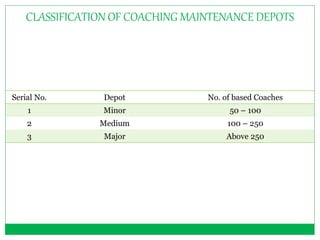
CLASSIFICATION OF COACHING MAINTENANCE DEPOTS 
Serial No. Depot No. of based Coaches 
1 Minor 50 – 100 
2 Medium 100 – 250 
3 Major Above 250
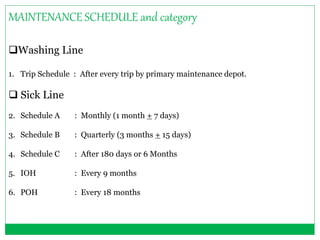
MAINTENANCE SCHEDULE and category 
Washing Line 
1. Trip Schedule : After every trip by primary maintenance depot. 
 Sick Line 
2. Schedule A : Monthly (1 month + 7 days) 
3. Schedule B : Quarterly (3 months + 15 days) 
4. Schedule C : After 180 days or 6 Months 
5. IOH : Every 9 months 
6. POH : Every 18 months
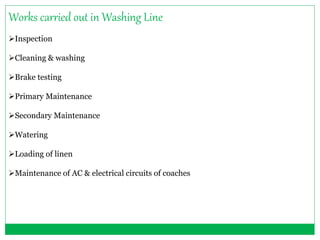
Works carried out in Washing Line 
Inspection 
Cleaning & washing 
Brake testing 
Primary Maintenance 
Secondary Maintenance 
Watering 
Loading of linen 
Maintenance of AC & electrical circuits of coaches
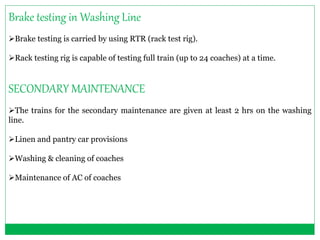
Brake testing in Washing Line 
Brake testing is carried by using RTR (rack test rig). 
Rack testing rig is capable of testing full train (up to 24 coaches) at a time. 
SECONDARY MAINTENANCE 
The trains for the secondary maintenance are given at least 2 hrs on the washing 
line. 
Linen and pantry car provisions 
Washing & cleaning of coaches 
Maintenance of AC of coaches
PRIMARY MAINTENANCE 
The trains for the primary maintenance are given at least 6 hrs at the washing line 
in addition to secondary maintenance 
Oil in hydraulic dash pots 
Wheel profiles are visually examined and gauged 
Pest control treatment 
Axle box is examined for grease oozing 
Brake blocks & piston stroke checked & changed
Sick line 
Sick line is the workshop for the major and periodical maintenance of the coaches. 
Works carried out in sick line 
1. Wheel and Axle Assembly 
2. Bogie Maintenance 
3. Buffer Maintenance 
4. Air Brake System Maintenance 
5. Trolley Maintenance 
6. Lifting of Coaches
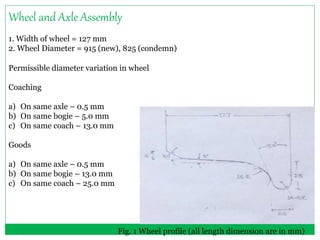
Wheel and Axle Assembly 
1. Width of wheel = 127 mm 
2. Wheel Diameter = 915 (new), 825 (condemn) 
Permissible diameter variation in wheel 
Coaching 
a) On same axle – 0.5 mm 
b) On same bogie – 5.0 mm 
c) On same coach – 13.0 mm 
Goods 
a) On same axle – 0.5 mm 
b) On same bogie – 13.0 mm 
c) On same coach – 25.0 mm 
Fig. 1 Wheel profile (all length dimension are in mm)
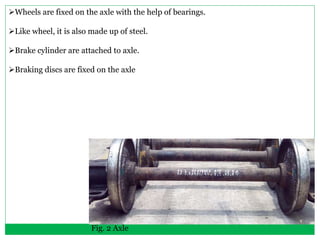
Wheels are fixed on the axle with the help of bearings. 
Like wheel, it is also made up of steel. 
Brake cylinder are attached to axle. 
Braking discs are fixed on the axle 
Fig. 2 Axle
Buffer height adjustment 
Causes of low buffer height in ICF coaching stock : 
a) excessive wear of wheel 
b) Due to loss of proper stiffness of coil spring 
c) Due to excessive wear on side bearer’s metal & bronze piece. 
Maximum buffer height = 1105 mm [In empty condition] 
Minimum buffer height = 1030 mm [In loaded condition] 
To achieve buffer height a standard size of wooden packing pieces are used which are 
kept below the Dash Pot Flange on axle Box wings of primary suspension. 
Serial N0. Wheel Diameter (mm) Thickness of Wooden Packing (mm) 
1. Below 889 up to 863 13 
2. Below 863 up to 839 26 
3. Below 839 up to 819 38 
4. 819 & below 48
Air brake system maintenance 
Components of Air Brake System 
1. Brake Container 
2. Distributor Valve 
3. Pressure Tanks (125 liters, 6 liters) 
4. B.P. / F.P. coupling and hosts 
5. Emergency Brake Pull Box 
6. Emergency Brake Valve
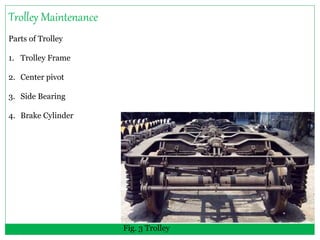
Trolley Maintenance 
Parts of Trolley 
1. Trolley Frame 
2. Center pivot 
3. Side Bearing 
4. Brake Cylinder 
Fig. 3 Trolley
Lifting of coaches 
Require tools and equipments 
1. With the use of Mechanical Jacks 
2. With the use of Hydraulic Jacks 
3. With the use of Electrical operated Travelling Crane 
4. With the use of Whiting Jacks
PLATFORM TRAIN DUTY 
 Rolling In 
Rolling out 
Axle box feeling 
Brake Power Certificate 
Safe to Run
ROLLING IN/ROLLING OUT 
When train enters in station Examiner staff take up positions on both sides inspect the train 
enters at the speed of 8 Km/hr 
Whistling sound of hot axle boxes. 
 Any hanging part or loose fitting of vehicle. 
Any component or spring suspension bracket loose/broken. 
 Abnormal behaviour of vehicle.
Axle box feeling 
After the train come to halt, all axle boxes are felt within 20 minutes. The temp. of axle is 
checked by touching with hand 
Temp. is found high then it is checked by the temp. gun which gives exact temp. 
If this temp. is found more than 30 degree than atm. temp. then the cause is inspected and 
coach is sent to workshop
BRAKE POWER Certificate 
 This certificate is jointly signed by Guard , Driver, and C&W supervisor. 
 The incoming driver shall handover the brake power certificate to Reliving driver or 
Deposit it the nominated authority, who will give it to the outgoing Driver. 
 The outgoing driver and guard will satisfy themselves from the listed coach numbers that 
the Brake Power Certificate pertains to their train.
Safe to run 
If all of above factors like no hanging parts brakes are working correctly the temp of 
axle box is with in range and the train is in good and safe condition of running then 
the train is announced as safe to run.
THANK YOU ALL FOR YOUR KIND ATTENTION

Coach care centre new delhi

  • 1.
    RAILWAY MAINTENANCE AT SUBMITTED BY : SATYAM SINGH B.Tech [ME-D] 4th Year 110106247 11SETME252
  • 2.
    CLASSIFICATION OF COACHINGMAINTENANCE DEPOTS Serial No. Depot No. of based Coaches 1 Minor 50 – 100 2 Medium 100 – 250 3 Major Above 250
  • 3.
    MAINTENANCE SCHEDULE andcategory Washing Line 1. Trip Schedule : After every trip by primary maintenance depot.  Sick Line 2. Schedule A : Monthly (1 month + 7 days) 3. Schedule B : Quarterly (3 months + 15 days) 4. Schedule C : After 180 days or 6 Months 5. IOH : Every 9 months 6. POH : Every 18 months
  • 4.
    Works carried outin Washing Line Inspection Cleaning & washing Brake testing Primary Maintenance Secondary Maintenance Watering Loading of linen Maintenance of AC & electrical circuits of coaches
  • 5.
    Brake testing inWashing Line Brake testing is carried by using RTR (rack test rig). Rack testing rig is capable of testing full train (up to 24 coaches) at a time. SECONDARY MAINTENANCE The trains for the secondary maintenance are given at least 2 hrs on the washing line. Linen and pantry car provisions Washing & cleaning of coaches Maintenance of AC of coaches
  • 6.
    PRIMARY MAINTENANCE Thetrains for the primary maintenance are given at least 6 hrs at the washing line in addition to secondary maintenance Oil in hydraulic dash pots Wheel profiles are visually examined and gauged Pest control treatment Axle box is examined for grease oozing Brake blocks & piston stroke checked & changed
  • 7.
    Sick line Sickline is the workshop for the major and periodical maintenance of the coaches. Works carried out in sick line 1. Wheel and Axle Assembly 2. Bogie Maintenance 3. Buffer Maintenance 4. Air Brake System Maintenance 5. Trolley Maintenance 6. Lifting of Coaches
  • 8.
    Wheel and AxleAssembly 1. Width of wheel = 127 mm 2. Wheel Diameter = 915 (new), 825 (condemn) Permissible diameter variation in wheel Coaching a) On same axle – 0.5 mm b) On same bogie – 5.0 mm c) On same coach – 13.0 mm Goods a) On same axle – 0.5 mm b) On same bogie – 13.0 mm c) On same coach – 25.0 mm Fig. 1 Wheel profile (all length dimension are in mm)
  • 9.
    Wheels are fixedon the axle with the help of bearings. Like wheel, it is also made up of steel. Brake cylinder are attached to axle. Braking discs are fixed on the axle Fig. 2 Axle
  • 10.
    Buffer height adjustment Causes of low buffer height in ICF coaching stock : a) excessive wear of wheel b) Due to loss of proper stiffness of coil spring c) Due to excessive wear on side bearer’s metal & bronze piece. Maximum buffer height = 1105 mm [In empty condition] Minimum buffer height = 1030 mm [In loaded condition] To achieve buffer height a standard size of wooden packing pieces are used which are kept below the Dash Pot Flange on axle Box wings of primary suspension. Serial N0. Wheel Diameter (mm) Thickness of Wooden Packing (mm) 1. Below 889 up to 863 13 2. Below 863 up to 839 26 3. Below 839 up to 819 38 4. 819 & below 48
  • 11.
    Air brake systemmaintenance Components of Air Brake System 1. Brake Container 2. Distributor Valve 3. Pressure Tanks (125 liters, 6 liters) 4. B.P. / F.P. coupling and hosts 5. Emergency Brake Pull Box 6. Emergency Brake Valve
  • 12.
    Trolley Maintenance Partsof Trolley 1. Trolley Frame 2. Center pivot 3. Side Bearing 4. Brake Cylinder Fig. 3 Trolley
  • 13.
    Lifting of coaches Require tools and equipments 1. With the use of Mechanical Jacks 2. With the use of Hydraulic Jacks 3. With the use of Electrical operated Travelling Crane 4. With the use of Whiting Jacks
  • 14.
    PLATFORM TRAIN DUTY  Rolling In Rolling out Axle box feeling Brake Power Certificate Safe to Run
  • 15.
    ROLLING IN/ROLLING OUT When train enters in station Examiner staff take up positions on both sides inspect the train enters at the speed of 8 Km/hr Whistling sound of hot axle boxes.  Any hanging part or loose fitting of vehicle. Any component or spring suspension bracket loose/broken.  Abnormal behaviour of vehicle.
  • 16.
    Axle box feeling After the train come to halt, all axle boxes are felt within 20 minutes. The temp. of axle is checked by touching with hand Temp. is found high then it is checked by the temp. gun which gives exact temp. If this temp. is found more than 30 degree than atm. temp. then the cause is inspected and coach is sent to workshop
  • 17.
    BRAKE POWER Certificate  This certificate is jointly signed by Guard , Driver, and C&W supervisor.  The incoming driver shall handover the brake power certificate to Reliving driver or Deposit it the nominated authority, who will give it to the outgoing Driver.  The outgoing driver and guard will satisfy themselves from the listed coach numbers that the Brake Power Certificate pertains to their train.
  • 18.
    Safe to run If all of above factors like no hanging parts brakes are working correctly the temp of axle box is with in range and the train is in good and safe condition of running then the train is announced as safe to run.
  • 19.
    THANK YOU ALLFOR YOUR KIND ATTENTION