The Enlightenment
and Democratic Ideas
By: A. Aie
For Mr. Haskvitz
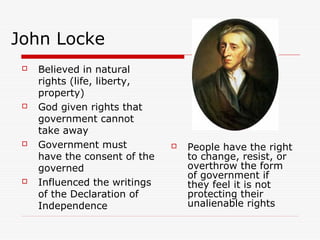
John Locke
 Believed in natural
rights (life, liberty,
property)
 God given rights that
government cannot
take away
 Government must
have the consent of the
governed
 Influenced the writings
of the Declaration of
Independence
 People have the right
to change, resist, or
overthrow the form
of government if
they feel it is not
protecting their
unalienable rights
Baron de
Montesquieu
 Formed separation of
powers in a
government
 Created the concept
of checks and
balances (power is
balanced throughout)
 Influenced the basis of
the constitution
 Opposed a monarchy
where power is in one
person’s control
(promoted
democracy)
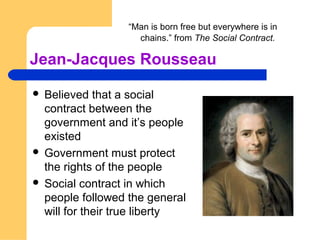
Jean-Jacques Rousseau
 Believed that a social
contract between the
government and it’s people
existed
 Government must protect
the rights of the people
 Social contract in which
people followed the general
will for their true liberty
“Man is born free but everywhere is in
chains.” from The Social Contract.
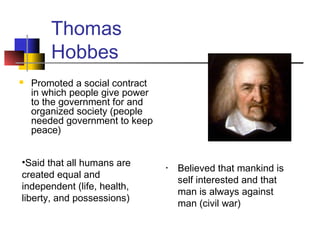
Thomas
Hobbes
• Believed that mankind is
self interested and that
man is always against
man (civil war)
 Promoted a social contract
in which people give power
to the government for and
organized society (people
needed government to keep
peace)
•Said that all humans are
created equal and
independent (life, health,
liberty, and possessions)
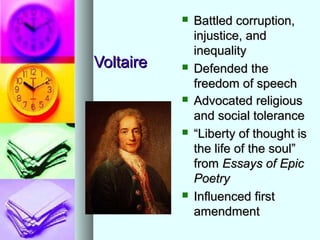
VoltaireVoltaire
 Battled corruption,Battled corruption,
injustice, andinjustice, and
inequalityinequality
 Defended theDefended the
freedom of speechfreedom of speech
 Advocated religiousAdvocated religious
and social toleranceand social tolerance
 ““Liberty of thought isLiberty of thought is
the life of the soul”the life of the soul”
fromfrom Essays of EpicEssays of Epic
PoetryPoetry
 Influenced firstInfluenced first
amendmentamendment
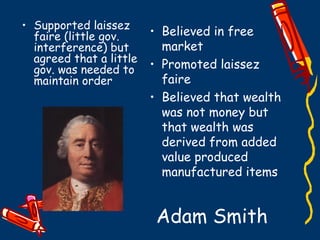
Adam Smith
• Believed in free
market
• Promoted laissez
faire
• Believed that wealth
was not money but
that wealth was
derived from added
value produced
manufactured items
• Supported laissez
faire (little gov.
interference) but
agreed that a little
gov. was needed to
maintain order
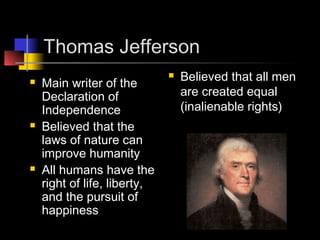
Thomas Jefferson
 Main writer of the
Declaration of
Independence
 Believed that the
laws of nature can
improve humanity
 All humans have the
right of life, liberty,
and the pursuit of
happiness
 Believed that all men
are created equal
(inalienable rights)
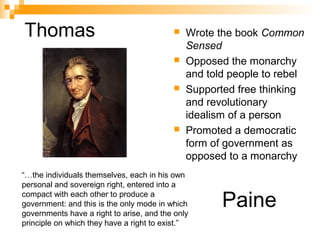
Thomas  Wrote the book Common
Sensed
 Opposed the monarchy
and told people to rebel
 Supported free thinking
and revolutionary
idealism of a person
 Promoted a democratic
form of government as
opposed to a monarchy
Paine
“…the individuals themselves, each in his own
personal and sovereign right, entered into a
compact with each other to produce a
government: and this is the only mode in which
governments have a right to arise, and the only
principle on which they have a right to exist.”
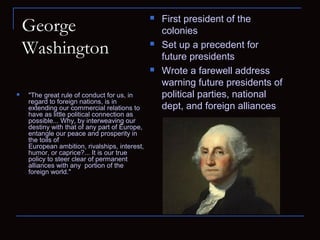
George
Washington
 First president of the
colonies
 Set up a precedent for
future presidents
 Wrote a farewell address
warning future presidents of
political parties, national
dept, and foreign alliances
 "The great rule of conduct for us, in
regard to foreign nations, is in
extending our commercial relations to
have as little political connection as
possible... Why, by interweaving our
destiny with that of any part of Europe,
entangle our peace and prosperity in
the toils of
European ambition, rivalships, interest,
humor, or caprice?... It is our true
policy to steer clear of permanent
alliances with any portion of the
foreign world."
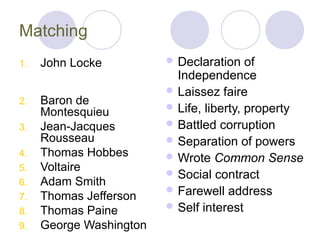
Matching
1. John Locke
2. Baron de
Montesquieu
3. Jean-Jacques
Rousseau
4. Thomas Hobbes
5. Voltaire
6. Adam Smith
7. Thomas Jefferson
8. Thomas Paine
9. George Washington
 Declaration of
Independence
 Laissez faire
 Life, liberty, property
 Battled corruption
 Separation of powers
 Wrote Common Sense
 Social contract
 Farewell address
 Self interest
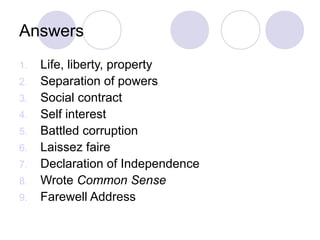
Answers
1. Life, liberty, property
2. Separation of powers
3. Social contract
4. Self interest
5. Battled corruption
6. Laissez faire
7. Declaration of Independence
8. Wrote Common Sense
9. Farewell Address

Enlightenment and Democratic Ideas

  • 1.
    The Enlightenment and DemocraticIdeas By: A. Aie For Mr. Haskvitz
  • 2.
    John Locke  Believedin natural rights (life, liberty, property)  God given rights that government cannot take away  Government must have the consent of the governed  Influenced the writings of the Declaration of Independence  People have the right to change, resist, or overthrow the form of government if they feel it is not protecting their unalienable rights
  • 3.
    Baron de Montesquieu  Formedseparation of powers in a government  Created the concept of checks and balances (power is balanced throughout)  Influenced the basis of the constitution  Opposed a monarchy where power is in one person’s control (promoted democracy)
  • 4.
    Jean-Jacques Rousseau  Believedthat a social contract between the government and it’s people existed  Government must protect the rights of the people  Social contract in which people followed the general will for their true liberty “Man is born free but everywhere is in chains.” from The Social Contract.
  • 5.
    Thomas Hobbes • Believed thatmankind is self interested and that man is always against man (civil war)  Promoted a social contract in which people give power to the government for and organized society (people needed government to keep peace) •Said that all humans are created equal and independent (life, health, liberty, and possessions)
  • 6.
    VoltaireVoltaire  Battled corruption,Battledcorruption, injustice, andinjustice, and inequalityinequality  Defended theDefended the freedom of speechfreedom of speech  Advocated religiousAdvocated religious and social toleranceand social tolerance  ““Liberty of thought isLiberty of thought is the life of the soul”the life of the soul” fromfrom Essays of EpicEssays of Epic PoetryPoetry  Influenced firstInfluenced first amendmentamendment
  • 7.
    Adam Smith • Believedin free market • Promoted laissez faire • Believed that wealth was not money but that wealth was derived from added value produced manufactured items • Supported laissez faire (little gov. interference) but agreed that a little gov. was needed to maintain order
  • 8.
    Thomas Jefferson  Mainwriter of the Declaration of Independence  Believed that the laws of nature can improve humanity  All humans have the right of life, liberty, and the pursuit of happiness  Believed that all men are created equal (inalienable rights)
  • 9.
    Thomas  Wrotethe book Common Sensed  Opposed the monarchy and told people to rebel  Supported free thinking and revolutionary idealism of a person  Promoted a democratic form of government as opposed to a monarchy Paine “…the individuals themselves, each in his own personal and sovereign right, entered into a compact with each other to produce a government: and this is the only mode in which governments have a right to arise, and the only principle on which they have a right to exist.”
  • 10.
    George Washington  First presidentof the colonies  Set up a precedent for future presidents  Wrote a farewell address warning future presidents of political parties, national dept, and foreign alliances  "The great rule of conduct for us, in regard to foreign nations, is in extending our commercial relations to have as little political connection as possible... Why, by interweaving our destiny with that of any part of Europe, entangle our peace and prosperity in the toils of European ambition, rivalships, interest, humor, or caprice?... It is our true policy to steer clear of permanent alliances with any portion of the foreign world."
  • 11.
    Matching 1. John Locke 2.Baron de Montesquieu 3. Jean-Jacques Rousseau 4. Thomas Hobbes 5. Voltaire 6. Adam Smith 7. Thomas Jefferson 8. Thomas Paine 9. George Washington  Declaration of Independence  Laissez faire  Life, liberty, property  Battled corruption  Separation of powers  Wrote Common Sense  Social contract  Farewell address  Self interest
  • 12.
    Answers 1. Life, liberty,property 2. Separation of powers 3. Social contract 4. Self interest 5. Battled corruption 6. Laissez faire 7. Declaration of Independence 8. Wrote Common Sense 9. Farewell Address