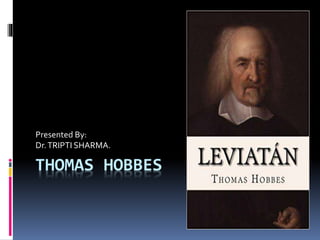
THOMAS HOBBES
Presented By:
Dr.TRIPTI SHARMA.
INTRODUCTION
 The English philosopher Thomas Hobbes (1588-1679) is best known
for his political thought, and deservedly so. His vision of the world is
strikingly original and still relevant to contemporary politics.
 Born in London in 1588.
 He received his college education at Oxford University in England,
where he studied classics.
 One of the founders of modern political philosophy.
 Traveled to other European countries several times to meet with
scientists and to study different forms of government.
 During his time outside of England, Hobbes became interested in why
people allowed themselves to be ruled and what would be the best
form of government for England.
WORKS
 De Corpore
 De Cive
Leviathan:
 Of man,
 Of commonwealth,
 Of a Christian commonwealth, and
 Of the Kingdom of Darkness.
INTELLECTUAL INFLENCES
 Reaction against religious authority
 Deep admiration for (and involvement in)
the emerging scientific method
METHODOLOGY
 PHILOSOPHICAL METHOD: RESOLUTION AND
COMPOSITION: Stresses the importance of having a
proper philosophical method for attaining knowledge; For
Hobbes, such a method was not only important for
attaining knowledge, but also served the practical end of
avoiding disputes which arose from speculation and
subjective interpretation.
 SCIENTIFIC MATERIALISM: existence of matter &
motion.
HUMAN NATURE
 Selfish creature
 Violent nature
 Fear
 Evil aspect
 Unsocial animal
 Feeling of self protection
 Egoism
 Quarrelsome
 Reason is artificial
CRITICISM
 Negative view
LIFE IN STATE OF NATURE IS ‘SOLITARY, POOR, NASTY,
BRUTISH & SHORT
 No distinction between right & wrong
 Existence of violence
 Irrational life
 Absence of private property
 Individual has all the rights over all the things
 Natural rights & laws
 Absolute liberty
 Insecurity of life
CRITICISM
 No historical proof
 Wrong notion isolated individual
 One side view about human
 State of nature is not a state of absolute
liberty & equality
LAWS OF NATURE
 Men should seek & observe peace
 Men should surrender their equal right to
possess all things
 Men should abide by the terms & conditions of
the contract
 Sense of gratitude
 Complasance
 Pardon the offences
 To carry out covenants & promises
 Surrender of natural rights
 Joint property
CRITICISM
 Changed the meaning of Law of nature
 Too radical
 Paradoxical
 illogical
Iauthorize&giveupmyrightofgoverningmyselftothisman,ortothisassemblyofmenon
thisconditionthatthougiveupthyrighttohim,&authorizeallhisactionsinlikemanner.
 Social contract theory, nearly as old as philosophy itself, is the
view that persons' moral and/or political obligations are
dependent upon a contract or agreement among them to form
the society in which they live.
 The enlightenment saw the development of social contract
theory of which Hobbes and Locke were the principal
exponents. The theory of social contract is essentially a morally
justified agreement made amongst individuals through which
an organized society is brought into existence .
 Ideas on Social Contract Theory can be found in his text
entitled Leviathan published in 1651
 One way to arrive at a moral social-contract, a solution to the
problem of self-interest.
MEANING
 The voluntary agreement among individuals by
which, according to any of various theories, as of
Hobbes, Locke, or Rousseau, organized society is
brought into being and invested with the right to
secure mutual protection and welfare or to
regulate the relations among its members.
 Social contract theory, nearly as old
as philosophy itself, is the view that persons'
moral and/or political obligations are dependent
upon a contract or agreement among them to form
the society in which they live.
FEATURES
 It is a contract between individuals
 Creation of a sovereign authority
 The sovereign is not a party to the contract
 Contract is perpetual & irrevocable
 Minority is subjected to the dictates of
majority
 The objective of the contract is protection of
human life
 Monarchy is the best government.
CRITICISM
 It is a bond of slavery.
 Individuals lose rights against the ruler.
 Contradiction in Hobbes theory.
 It puts cart before the horse.
 Not a convincing theory.
 It is a theory of fear.
 Personal motive.
THEORY OF ORIGIN OF STATE
 Leviathan delineates very precisely and
straightforwardly the creation of the state by
an agreement.
 To begin with, before the state was created,
there was a state of nature in which a war was
raging.
BEFORE DISCUSSING THE ORIGIN
HOBBES DESCRIBED:-
 Views on Human Nature
 State of Nature
 Social Contract
FEATURES
 State originates because of contract
 Contract- Result of Prudence
 Unilingual Contract
 Powers of sovereign are unlimited
 Minority has no right to revolt against
Majority
 Contract is Perpetual
 Law is the command of sovereign
 Advocacy of monarchy
CRITICISM
 Human nature described wrong
 Man is not unsocial
 Illogical
 Rights can be enjoyed only in a state
 Advocacy of absolute monarchy is wrong
 Contract can be unilateral
 Views regarding the surrender of rights are
without basis
VIEWS ON INDIVIDUALISM
 State is the means & Individuals are the end
 Right to resist
 Protection of life of individual is the obligation of
sovereign
 Contract do not destroy individual existence
 Supremacy of individual over individual not
acceptable
 Liberties of individual
 Non-interference in economic spheres
 Supporter of individual rights
CRITICISM
 Rights & liberties fades in front of the
sovereign
 Presented the negative human nature
 No limits for the sovereign
THEORY OF SOVEREIGNTY
 sovereignty is a general natural law that
human beings get to know of through the
exercise of reason.
HOBBES FORMS OF GOVERNMENT:
 Hobbes in actual talked about three forms of government
totally different from each other. Monarchy, Aristocracy
and democracy are his main concern in specifically talking
about the forms of government. He classified and explained
the concept of three forms of government in a way that
when all the powers are vested in a man by the state he is
said to be monarchic but at the same time when the powers
are vested in assembly it is said to be democratic form of
government at that point of time.And if specifically talks
about power given to few persons it would be called as
Aristocratic form of government. He specifically talked
about three forms of government and added no space for
any further form of government; that he doesn’t believe in
mixed form of government.
MONARCHY:
 The preference he gave more was on the Monarchic government calling
it as a best form of government. Apart from Monarchy, He rather
believed in that particular form of government which could bring up the
peace and security in the country. In his explanation of the forms of
government he rather was much against the division of the powers. He
believed the only division of the power between the Kings, Lords, and
commons was responsible who could bring civil war and yet a source of
destruction it was.
 According to him, Monarchy guarantees stability and uniformity which
actually helps in preventing from falling into any chaotic situation in any
type of country having this particular form of government. Whereas, he
supported Monarchy with a fact that in a monarchic form of government
the competition for the seat, offices and posts is less as compared to
aristocracy and that of democracy.The major advantage he came up
with was that the monarchs of any country have the same interests as
that of the people.
CONCLUSION
 Gauthier, Kleinerman, andVan Mill have
given the most famous critiques about
Hobbes’ political philosophy. • Logic versus
Irrationality • Curbing civil liberties •
Pessimistic ideas • Anti Democratic •
Conception of limited resources • Rejecting
basic individual right • Universalization of the
appetites and aversions • Contradiction •
Reality of a Leviathan

Thomas hobbes

  • 1.
  • 2.
    INTRODUCTION  The Englishphilosopher Thomas Hobbes (1588-1679) is best known for his political thought, and deservedly so. His vision of the world is strikingly original and still relevant to contemporary politics.  Born in London in 1588.  He received his college education at Oxford University in England, where he studied classics.  One of the founders of modern political philosophy.  Traveled to other European countries several times to meet with scientists and to study different forms of government.  During his time outside of England, Hobbes became interested in why people allowed themselves to be ruled and what would be the best form of government for England.
  • 3.
    WORKS  De Corpore De Cive Leviathan:  Of man,  Of commonwealth,  Of a Christian commonwealth, and  Of the Kingdom of Darkness.
  • 4.
    INTELLECTUAL INFLENCES  Reactionagainst religious authority  Deep admiration for (and involvement in) the emerging scientific method
  • 5.
    METHODOLOGY  PHILOSOPHICAL METHOD:RESOLUTION AND COMPOSITION: Stresses the importance of having a proper philosophical method for attaining knowledge; For Hobbes, such a method was not only important for attaining knowledge, but also served the practical end of avoiding disputes which arose from speculation and subjective interpretation.  SCIENTIFIC MATERIALISM: existence of matter & motion.
  • 6.
    HUMAN NATURE  Selfishcreature  Violent nature  Fear  Evil aspect  Unsocial animal  Feeling of self protection  Egoism  Quarrelsome  Reason is artificial
  • 7.
  • 8.
    LIFE IN STATEOF NATURE IS ‘SOLITARY, POOR, NASTY, BRUTISH & SHORT  No distinction between right & wrong  Existence of violence  Irrational life  Absence of private property  Individual has all the rights over all the things  Natural rights & laws  Absolute liberty  Insecurity of life
  • 9.
    CRITICISM  No historicalproof  Wrong notion isolated individual  One side view about human  State of nature is not a state of absolute liberty & equality
  • 10.
    LAWS OF NATURE Men should seek & observe peace  Men should surrender their equal right to possess all things  Men should abide by the terms & conditions of the contract  Sense of gratitude  Complasance  Pardon the offences  To carry out covenants & promises  Surrender of natural rights  Joint property
  • 11.
    CRITICISM  Changed themeaning of Law of nature  Too radical  Paradoxical  illogical
  • 12.
    Iauthorize&giveupmyrightofgoverningmyselftothisman,ortothisassemblyofmenon thisconditionthatthougiveupthyrighttohim,&authorizeallhisactionsinlikemanner.  Social contracttheory, nearly as old as philosophy itself, is the view that persons' moral and/or political obligations are dependent upon a contract or agreement among them to form the society in which they live.  The enlightenment saw the development of social contract theory of which Hobbes and Locke were the principal exponents. The theory of social contract is essentially a morally justified agreement made amongst individuals through which an organized society is brought into existence .  Ideas on Social Contract Theory can be found in his text entitled Leviathan published in 1651  One way to arrive at a moral social-contract, a solution to the problem of self-interest.
  • 13.
    MEANING  The voluntaryagreement among individuals by which, according to any of various theories, as of Hobbes, Locke, or Rousseau, organized society is brought into being and invested with the right to secure mutual protection and welfare or to regulate the relations among its members.  Social contract theory, nearly as old as philosophy itself, is the view that persons' moral and/or political obligations are dependent upon a contract or agreement among them to form the society in which they live.
  • 14.
    FEATURES  It isa contract between individuals  Creation of a sovereign authority  The sovereign is not a party to the contract  Contract is perpetual & irrevocable  Minority is subjected to the dictates of majority  The objective of the contract is protection of human life  Monarchy is the best government.
  • 15.
    CRITICISM  It isa bond of slavery.  Individuals lose rights against the ruler.  Contradiction in Hobbes theory.  It puts cart before the horse.  Not a convincing theory.  It is a theory of fear.  Personal motive.
  • 16.
    THEORY OF ORIGINOF STATE  Leviathan delineates very precisely and straightforwardly the creation of the state by an agreement.  To begin with, before the state was created, there was a state of nature in which a war was raging.
  • 17.
    BEFORE DISCUSSING THEORIGIN HOBBES DESCRIBED:-  Views on Human Nature  State of Nature  Social Contract
  • 18.
    FEATURES  State originatesbecause of contract  Contract- Result of Prudence  Unilingual Contract  Powers of sovereign are unlimited  Minority has no right to revolt against Majority  Contract is Perpetual  Law is the command of sovereign  Advocacy of monarchy
  • 19.
    CRITICISM  Human naturedescribed wrong  Man is not unsocial  Illogical  Rights can be enjoyed only in a state  Advocacy of absolute monarchy is wrong  Contract can be unilateral  Views regarding the surrender of rights are without basis
  • 20.
    VIEWS ON INDIVIDUALISM State is the means & Individuals are the end  Right to resist  Protection of life of individual is the obligation of sovereign  Contract do not destroy individual existence  Supremacy of individual over individual not acceptable  Liberties of individual  Non-interference in economic spheres  Supporter of individual rights
  • 21.
    CRITICISM  Rights &liberties fades in front of the sovereign  Presented the negative human nature  No limits for the sovereign
  • 22.
    THEORY OF SOVEREIGNTY sovereignty is a general natural law that human beings get to know of through the exercise of reason.
  • 23.
    HOBBES FORMS OFGOVERNMENT:  Hobbes in actual talked about three forms of government totally different from each other. Monarchy, Aristocracy and democracy are his main concern in specifically talking about the forms of government. He classified and explained the concept of three forms of government in a way that when all the powers are vested in a man by the state he is said to be monarchic but at the same time when the powers are vested in assembly it is said to be democratic form of government at that point of time.And if specifically talks about power given to few persons it would be called as Aristocratic form of government. He specifically talked about three forms of government and added no space for any further form of government; that he doesn’t believe in mixed form of government.
  • 24.
    MONARCHY:  The preferencehe gave more was on the Monarchic government calling it as a best form of government. Apart from Monarchy, He rather believed in that particular form of government which could bring up the peace and security in the country. In his explanation of the forms of government he rather was much against the division of the powers. He believed the only division of the power between the Kings, Lords, and commons was responsible who could bring civil war and yet a source of destruction it was.  According to him, Monarchy guarantees stability and uniformity which actually helps in preventing from falling into any chaotic situation in any type of country having this particular form of government. Whereas, he supported Monarchy with a fact that in a monarchic form of government the competition for the seat, offices and posts is less as compared to aristocracy and that of democracy.The major advantage he came up with was that the monarchs of any country have the same interests as that of the people.
  • 25.
    CONCLUSION  Gauthier, Kleinerman,andVan Mill have given the most famous critiques about Hobbes’ political philosophy. • Logic versus Irrationality • Curbing civil liberties • Pessimistic ideas • Anti Democratic • Conception of limited resources • Rejecting basic individual right • Universalization of the appetites and aversions • Contradiction • Reality of a Leviathan