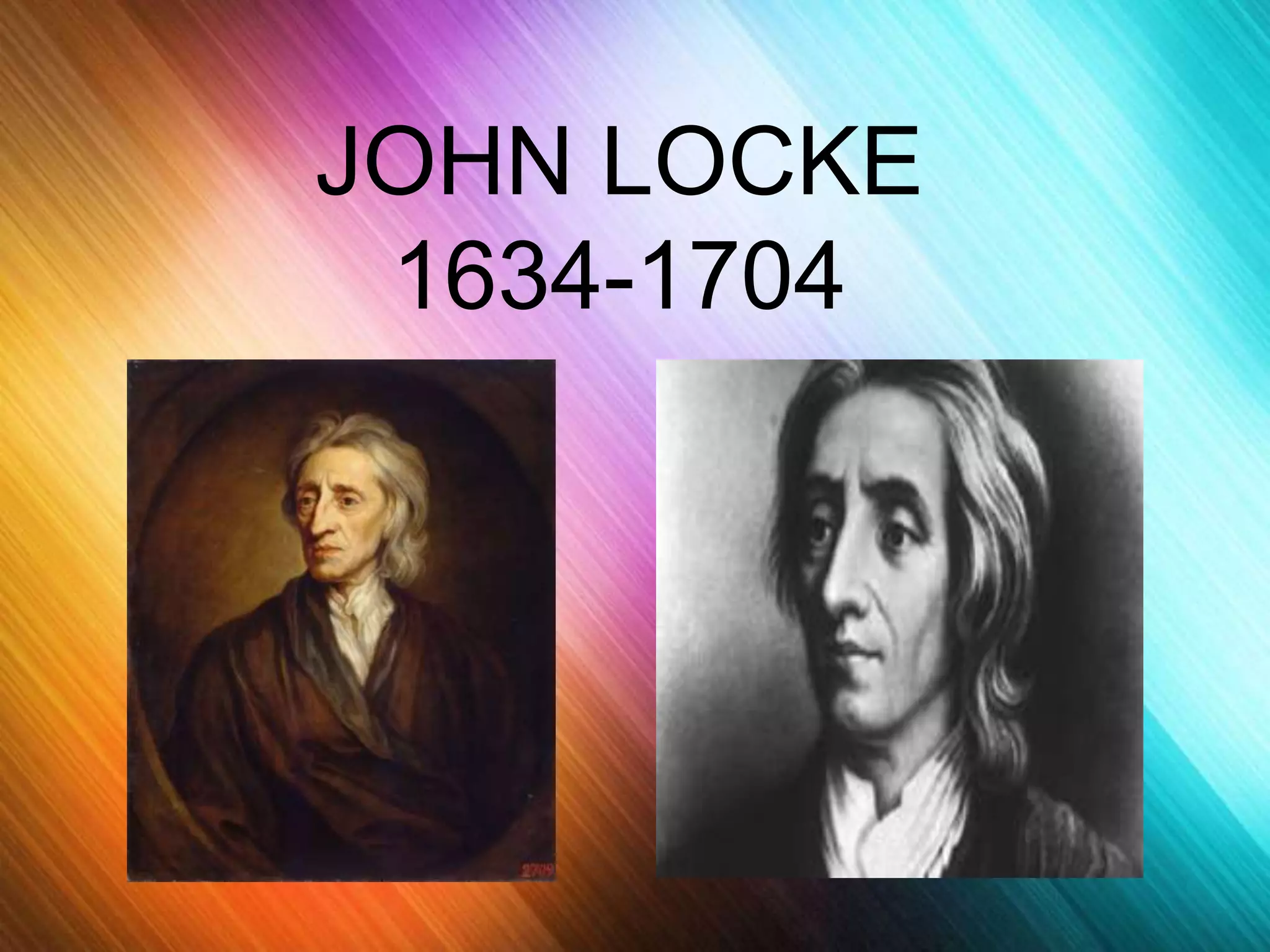
JOHN LOCKE 
1634-1704
John Locke's Early Life 
and Education 
John Locke was born in Wrington, 
Somerset, on Aug. 29, 1632. 
The father, also named John Locke, was 
a devout, even-tempered man. 
Locke was educated at Westminster 
School and Oxford.
He was interested in meteorology and the 
experimental sciences, especially chemistry. 
He turned to medicine and became known 
as one of the most skilled practitioners of his 
day. 
He graduated with a bachelor’s of medicine 
in 1674. 
He was an associate of Robert Hooke, 
Robert Boyle and other leading Oxford 
scientists.
John Locke and the Earl of 
Shaftesbury 
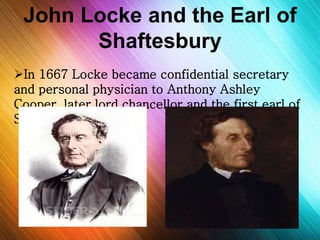
In 1667 Locke became confidential secretary 
and personal physician to Anthony Ashley 
Cooper, later lord chancellor and the first earl of 
Shaftesbury.
 He supervised a dangerous liver 
operation on Shaftesbury that likely 
saved his patron’s life. 
Shaftesbury was indicted for high 
treason. He was acquitted, but Locke 
was suspected of disloyalty. 
In 1683, he left England for Holland 
and returned only after the revolution of 
1688.
John Locke's Publications and Final Years 
Locke's "Essay Concerning Human Understanding" 
(1689) outlined a theory of human knowledge, identity 
and selfhood.
An Empirical Theory of 
Knowledge 
For Locke, all knowledge comes exclusively 
through experience. 
He argues that at birth the mind is a tabula 
rasa, or blank slate, that humans fill with ideas 
as they experience the world through the five 
senses. 
Locke defines knowledge as the connection 
and agreement, or disagreement and 
repugnancy, of the ideas humans form.
The "Two Treatises of Government" (1690) 
offered political theories developed and refined 
by Locke during his years at Shaftesbury's side. 
In his "Thoughts Concerning Education" (1693), 
Locke argued for a broadened syllabus and 
better treatment of students—ideas that were an 
enormous influence on Jean-Jacques Rousseau's 
novel "Emile" (1762). 
In three "Letters Concerning Toleration" 
(1689-92), Locke suggested that governments 
should respect freedom of religion except when 
the dissenting belief was a threat to public 
order.
Locke spent his final 14 years in Essex 
at the home of Sir Francis Masham and 
his wife, the philosopher Lady Damaris 
Cudworth Masham. He died there on 
October 24, 1704, as Lady Damaris read 
to him from the Psalms. 
Locke never married nor had a children.
Locke’s other 
themes, 
arguments and 
ideas
The moral role of government 
Locke was very critical of the British 
Monarchy 
Locke believed that Government was 
needed to protect everyone's natural rights. 
The reason why men enter into society is 
the preservation of their property.
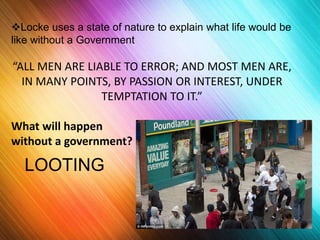
Locke uses a state of nature to explain what life would be 
like without a Government 
“ALL MEN ARE LIABLE TO ERROR; AND MOST MEN ARE, 
IN MANY POINTS, BY PASSION OR INTEREST, UNDER 
TEMPTATION TO IT.” 
What will happen 
without a government? 
LOOTING
A Natural Foundation of Reason 
Locke argues that God gave us our 
capacity for reason to aid us in the search 
for truth. 
God created in us a natural aversion to 
misery and a desire for happiness. 
Locke’s belief in separation of church and 
state.
Political leaders do not have the right 
to impose beliefs on people. 
Locke insists that if men were to follow 
the government blindly, they would be 
surrendering their own reason and thus 
violating God’s law, or natural law.
The Right to Private 
Property 
The right to private property is the cornerstone 
of Locke’s political theory, encapsulating how 
each man relates to God and to other men. 
Locke explains that man originally exists in a 
state of nature in which he need answer only to 
the laws of nature.
The beginnings of a 
modern outlook 
Locke has been described as having 
the first modern mind. 
Locke believed that languages should 
be learned not via grammar but through 
practice and example.

John Locke

  • 1.
  • 2.
    John Locke's EarlyLife and Education John Locke was born in Wrington, Somerset, on Aug. 29, 1632. The father, also named John Locke, was a devout, even-tempered man. Locke was educated at Westminster School and Oxford.
  • 3.
    He was interestedin meteorology and the experimental sciences, especially chemistry. He turned to medicine and became known as one of the most skilled practitioners of his day. He graduated with a bachelor’s of medicine in 1674. He was an associate of Robert Hooke, Robert Boyle and other leading Oxford scientists.
  • 4.
    John Locke andthe Earl of Shaftesbury In 1667 Locke became confidential secretary and personal physician to Anthony Ashley Cooper, later lord chancellor and the first earl of Shaftesbury.
  • 5.
     He superviseda dangerous liver operation on Shaftesbury that likely saved his patron’s life. Shaftesbury was indicted for high treason. He was acquitted, but Locke was suspected of disloyalty. In 1683, he left England for Holland and returned only after the revolution of 1688.
  • 6.
    John Locke's Publicationsand Final Years Locke's "Essay Concerning Human Understanding" (1689) outlined a theory of human knowledge, identity and selfhood.
  • 7.
    An Empirical Theoryof Knowledge For Locke, all knowledge comes exclusively through experience. He argues that at birth the mind is a tabula rasa, or blank slate, that humans fill with ideas as they experience the world through the five senses. Locke defines knowledge as the connection and agreement, or disagreement and repugnancy, of the ideas humans form.
  • 8.
    The "Two Treatisesof Government" (1690) offered political theories developed and refined by Locke during his years at Shaftesbury's side. In his "Thoughts Concerning Education" (1693), Locke argued for a broadened syllabus and better treatment of students—ideas that were an enormous influence on Jean-Jacques Rousseau's novel "Emile" (1762). In three "Letters Concerning Toleration" (1689-92), Locke suggested that governments should respect freedom of religion except when the dissenting belief was a threat to public order.
  • 9.
    Locke spent hisfinal 14 years in Essex at the home of Sir Francis Masham and his wife, the philosopher Lady Damaris Cudworth Masham. He died there on October 24, 1704, as Lady Damaris read to him from the Psalms. Locke never married nor had a children.
  • 10.
    Locke’s other themes, arguments and ideas
  • 11.
    The moral roleof government Locke was very critical of the British Monarchy Locke believed that Government was needed to protect everyone's natural rights. The reason why men enter into society is the preservation of their property.
  • 12.
    Locke uses astate of nature to explain what life would be like without a Government “ALL MEN ARE LIABLE TO ERROR; AND MOST MEN ARE, IN MANY POINTS, BY PASSION OR INTEREST, UNDER TEMPTATION TO IT.” What will happen without a government? LOOTING
  • 13.
    A Natural Foundationof Reason Locke argues that God gave us our capacity for reason to aid us in the search for truth. God created in us a natural aversion to misery and a desire for happiness. Locke’s belief in separation of church and state.
  • 14.
    Political leaders donot have the right to impose beliefs on people. Locke insists that if men were to follow the government blindly, they would be surrendering their own reason and thus violating God’s law, or natural law.
  • 15.
    The Right toPrivate Property The right to private property is the cornerstone of Locke’s political theory, encapsulating how each man relates to God and to other men. Locke explains that man originally exists in a state of nature in which he need answer only to the laws of nature.
  • 16.
    The beginnings ofa modern outlook Locke has been described as having the first modern mind. Locke believed that languages should be learned not via grammar but through practice and example.