II
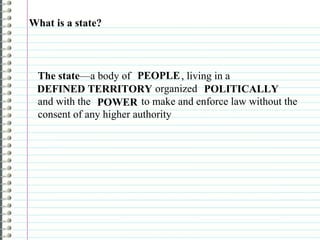
What is a state? The state —a body of  , living in a  organized  and with the  to make and enforce law without the consent of any higher authority PEOPLE POWER POLITICALLY DEFINED TERRITORY
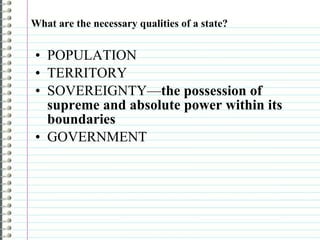
What are the necessary qualities of a state? POPULATION TERRITORY SOVEREIGNTY— the possession of supreme and absolute power within its boundaries GOVERNMENT
What is government? the institution through which a society  makes and enforces its public policies
Why did governments come about? We the People of the United States, in Order to form a more perfect Union, establish Justice, insure domestic tranquility, provide for the common defence, promote the general Welfare, and secure the Blessings of Liberty to ourselves and our Posterity, do ordain and establish this Constitution for the United States of America.
So… Form a more perfect union Establish justice Insure domestic tranquility Provide for the common defense Promote the general welfare Secure the blessings of liberty
How did governments come about? FORCE THEORY—the strongest rule THEORY 1
How did governments come about? EVOLUTIONARY THEORY—governments build from simpler  groups (family…clan…tribe, etc) THEORY 2
How did governments come about? DIVINE RIGHT THEORY—God created the state; God ordained those with royal standing the “divine right” to rule THEORY 3
How did governments come about? SOCIAL CONTRACT THEORY—in the state of nature, life was “nasty, brutish, and short.”  Humans agreed to a mutual agreement between the rulers and the ruled for the benefit of all. THEORY 4
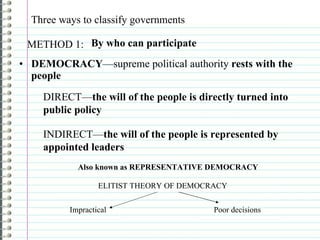
Three ways to classify governments DEMOCRACY —supreme political authority  rests with the people METHOD 1:  By who can participate  DIRECT— the will of the people is directly turned into public policy INDIRECT— the will of the people is represented by appointed leaders Also known as REPRESENTATIVE DEMOCRACY Impractical Poor decisions ELITIST THEORY OF DEMOCRACY
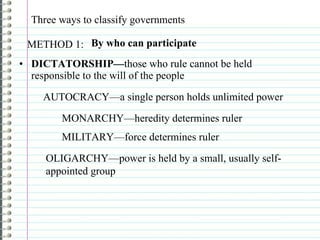
Three ways to classify governments DICTATORSHIP— those who rule cannot be held responsible to the will of the people METHOD 1:  By who can participate  AUTOCRACY—a single person holds unlimited power MONARCHY—heredity determines ruler MILITARY—force determines ruler OLIGARCHY—power is held by a small, usually self-appointed group
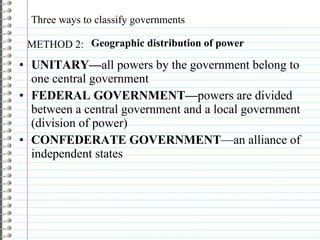
Three ways to classify governments UNITARY— all powers by the government belong to one central government FEDERAL GOVERNMENT— powers   are divided between a central government and a local government (division of power) CONFEDERATE GOVERNMENT —an alliance of independent states METHOD 2:  Geographic distribution of power
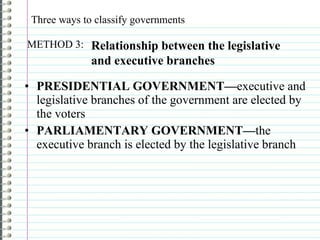
Three ways to classify governments PRESIDENTIAL GOVERNMENT— executive and legislative branches of the government are elected by the voters PARLIAMENTARY GOVERNMENT— the executive branch is elected by the legislative branch METHOD 3:  Relationship between the legislative and executive branches
Declaration of Independence
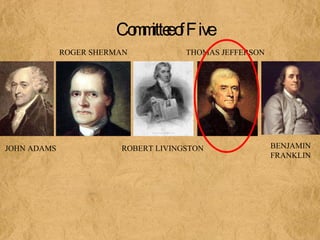
JOHN ADAMS ROGER SHERMAN ROBERT LIVINGSTON THOMAS JEFFERSON BENJAMIN FRANKLIN Committee of Five
When in the Course of human events it becomes necessary for one people to  dissolve the political bands  which have connected them with another and to assume among the powers of the earth…
When in the Course of human events it becomes necessary for one people to dissolve the political bands which have connected them with another and to assume among the powers of the earth, the separate and equal station to which the Laws of Nature and of Nature's God entitle them, a decent respect to the opinions of mankind requires that  they should declare the causes which impel them to the separation .
We hold these truths to be self-evident, that  all men are created equal , that  they are endowed by their Creator with certain unalienable Rights , that among these are Life, Liberty and the pursuit of Happiness.   UNALIENABLE—CANNOT BE TAKEN AWAY
We hold these truths to be self-evident, that  all men are created equal , that  they are endowed by their Creator with certain unalienable Rights , that among these are  Life, Liberty and the pursuit of Happiness .
That to secure these rights ,  Governments are instituted  among Men, deriving their just powers from the consent of the governed,
That  whenever any Form of Government becomes destructive of these ends , it is the  Right of the People to alter or to abolish it , and to institute new Government, laying its foundation on such principles and organizing its powers in such form, as to them shall seem most likely to effect their Safety and Happiness .
Articles of Confederation  Features/Powers  “ a league of friendship” Each  state  maintained its sovereignty Legislative: Unicameral 9/13 to pass any measure Each state had one vote Executive: In name only—powerless  Judicial: Did not exist Unanimous consent of all 13 to amend
Constitutional Convention
When? May 25—September 17, 1787
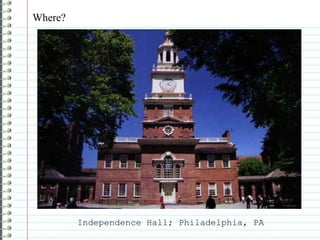
Where? Independence Hall; Philadelphia, PA
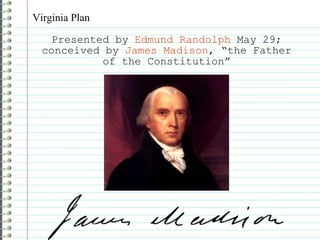
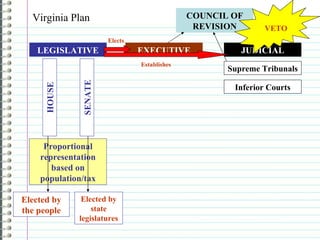
Virginia Plan Presented by  Edmund Randolph  May 29; conceived by  James Madison , “the Father of the Constitution”
Virginia Plan LEGISLATIVE EXECUTIVE JUDICIAL COUNCIL OF REVISION Supreme Tribunals Elected by the people Proportional representation based on population/tax Elected by state legislatures Elects Establishes Inferior Courts HOUSE SENATE VETO
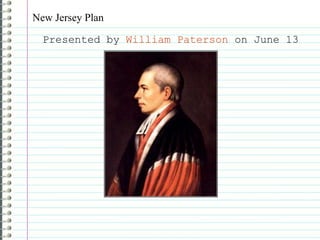
New Jersey Plan Presented by  William Paterson  on June 13
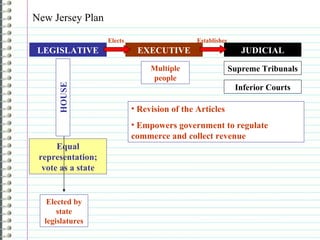
New Jersey Plan LEGISLATIVE EXECUTIVE JUDICIAL Supreme Tribunals Equal representation; vote as a state Elected by state legislatures Elects Establishes Inferior Courts HOUSE Revision of the Articles Empowers government to regulate commerce and collect revenue Multiple people
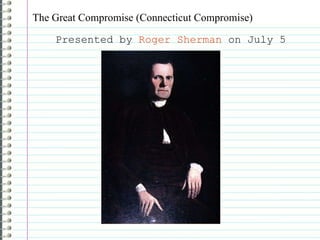
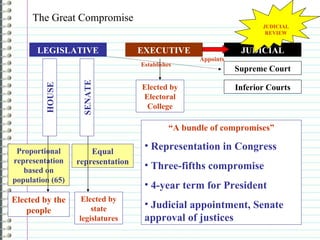
The Great Compromise (Connecticut Compromise) Presented by  Roger Sherman  on July 5
The Great Compromise Equal representation LEGISLATIVE EXECUTIVE JUDICIAL Supreme Court Elected by the people Proportional representation based on population (65) Elected by state legislatures Establishes Inferior Courts HOUSE SENATE Appoints Elected by Electoral College “ A bundle of compromises” Representation in Congress Three-fifths compromise 4-year term for President Judicial appointment, Senate approval of justices JUDICIAL REVIEW
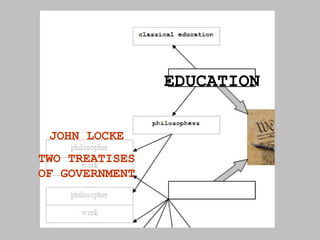
EDUCATION JOHN LOCKE TWO TREATISES OF GOVERNMENT
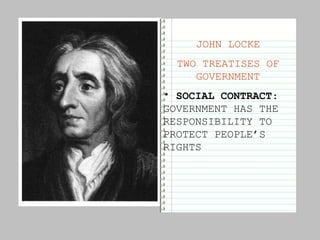
JOHN LOCKE TWO TREATISES OF GOVERNMENT SOCIAL CONTRACT : GOVERNMENT HAS THE RESPONSIBILITY TO PROTECT PEOPLE’S RIGHTS
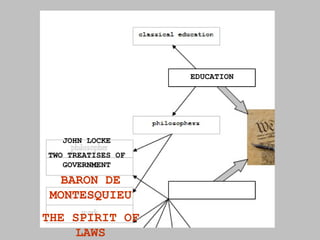
EDUCATION JOHN LOCKE TWO TREATISES OF GOVERNMENT BARON DE MONTESQUIEU THE SPIRIT OF LAWS
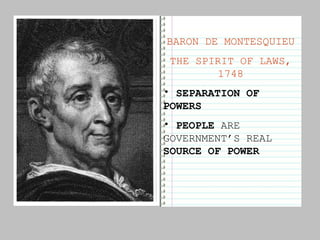
BARON DE MONTESQUIEU THE SPIRIT OF LAWS, 1748 SEPARATION OF POWERS PEOPLE  ARE GOVERNMENT’S REAL  SOURCE OF POWER
 
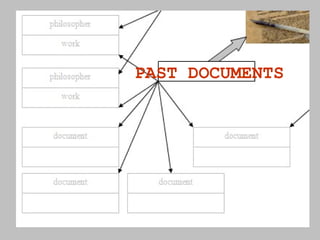
PAST DOCUMENTS
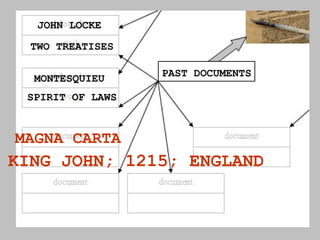
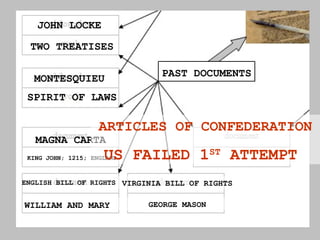
PAST DOCUMENTS JOHN LOCKE TWO TREATISES MONTESQUIEU SPIRIT OF LAWS MAGNA CARTA KING JOHN; 1215; ENGLAND
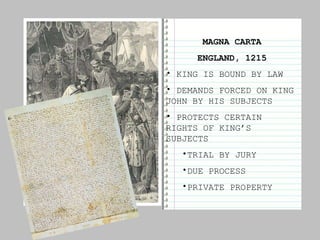
MAGNA CARTA ENGLAND, 1215 KING IS BOUND BY LAW DEMANDS FORCED ON KING JOHN BY HIS SUBJECTS PROTECTS CERTAIN RIGHTS OF KING’S SUBJECTS TRIAL BY JURY DUE PROCESS PRIVATE PROPERTY
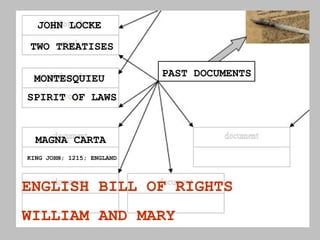
PAST DOCUMENTS JOHN LOCKE TWO TREATISES MONTESQUIEU SPIRIT OF LAWS MAGNA CARTA KING JOHN; 1215; ENGLAND ENGLISH BILL OF RIGHTS WILLIAM AND MARY
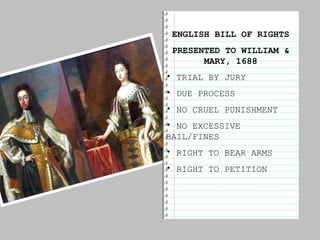
ENGLISH BILL OF RIGHTS PRESENTED TO WILLIAM & MARY, 1688 TRIAL BY JURY DUE PROCESS NO CRUEL PUNISHMENT NO EXCESSIVE BAIL/FINES RIGHT TO BEAR ARMS RIGHT TO PETITION
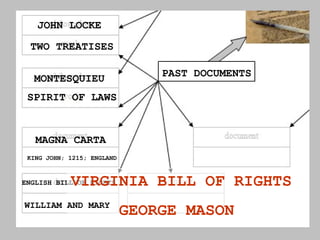
PAST DOCUMENTS JOHN LOCKE TWO TREATISES MONTESQUIEU SPIRIT OF LAWS MAGNA CARTA KING JOHN; 1215; ENGLAND ENGLISH BILL OF RIGHTS VIRGINIA BILL OF RIGHTS GEORGE MASON  WILLIAM AND MARY
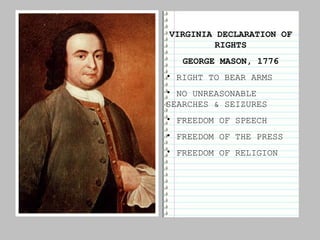
VIRGINIA DECLARATION OF RIGHTS GEORGE MASON, 1776 RIGHT TO BEAR ARMS NO UNREASONABLE SEARCHES & SEIZURES FREEDOM OF SPEECH FREEDOM OF THE PRESS FREEDOM OF RELIGION
PAST DOCUMENTS JOHN LOCKE TWO TREATISES MONTESQUIEU SPIRIT OF LAWS MAGNA CARTA KING JOHN; 1215; ENGLAND ENGLISH BILL OF RIGHTS VIRGINIA BILL OF RIGHTS WILLIAM AND MARY GEORGE MASON ARTICLES OF CONFEDERATION US FAILED 1 ST  ATTEMPT
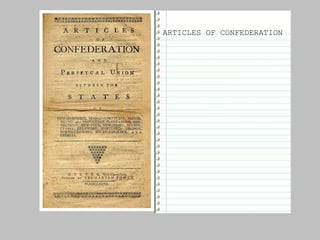
ARTICLES OF CONFEDERATION
 
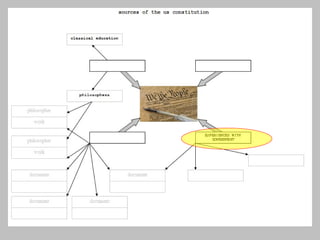
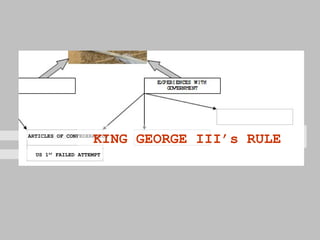
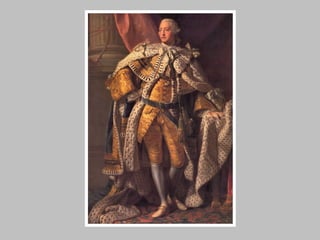
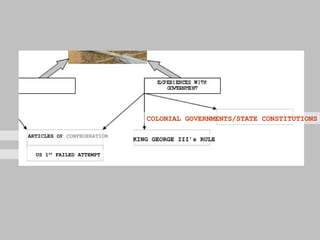
ARTICLES OF CONFEDERATION US 1 ST  FAILED ATTEMPT KING GEORGE III’s RULE
 
ARTICLES OF CONFEDERATION US 1 ST  FAILED ATTEMPT KING GEORGE III’s RULE  COLONIAL GOVERNMENTS/STATE CONSTITUTIONS
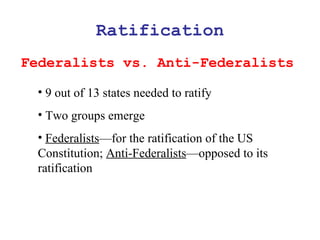
Ratification Federalists vs. Anti-Federalists 9 out of 13 states needed to ratify Two groups emerge Federalists —for the ratification of the US Constitution;  Anti-Federalists —opposed to its ratification
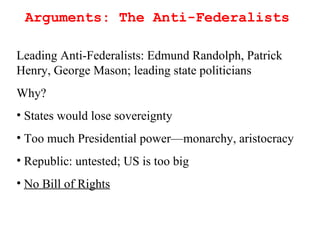
Arguments: The Anti-Federalists Leading Anti-Federalists: Edmund Randolph, Patrick Henry, George Mason; leading state politicians  Why? States would lose sovereignty  Too much Presidential power—monarchy, aristocracy Republic: untested; US is too big No Bill of Rights

Final prep II

  • 1.
  • 2.
    What is astate? The state —a body of , living in a organized and with the to make and enforce law without the consent of any higher authority PEOPLE POWER POLITICALLY DEFINED TERRITORY
  • 3.
    What are thenecessary qualities of a state? POPULATION TERRITORY SOVEREIGNTY— the possession of supreme and absolute power within its boundaries GOVERNMENT
  • 4.
    What is government?the institution through which a society makes and enforces its public policies
  • 5.
    Why did governmentscome about? We the People of the United States, in Order to form a more perfect Union, establish Justice, insure domestic tranquility, provide for the common defence, promote the general Welfare, and secure the Blessings of Liberty to ourselves and our Posterity, do ordain and establish this Constitution for the United States of America.
  • 6.
    So… Form amore perfect union Establish justice Insure domestic tranquility Provide for the common defense Promote the general welfare Secure the blessings of liberty
  • 7.
    How did governmentscome about? FORCE THEORY—the strongest rule THEORY 1
  • 8.
    How did governmentscome about? EVOLUTIONARY THEORY—governments build from simpler groups (family…clan…tribe, etc) THEORY 2
  • 9.
    How did governmentscome about? DIVINE RIGHT THEORY—God created the state; God ordained those with royal standing the “divine right” to rule THEORY 3
  • 10.
    How did governmentscome about? SOCIAL CONTRACT THEORY—in the state of nature, life was “nasty, brutish, and short.” Humans agreed to a mutual agreement between the rulers and the ruled for the benefit of all. THEORY 4
  • 11.
    Three ways toclassify governments DEMOCRACY —supreme political authority rests with the people METHOD 1: By who can participate DIRECT— the will of the people is directly turned into public policy INDIRECT— the will of the people is represented by appointed leaders Also known as REPRESENTATIVE DEMOCRACY Impractical Poor decisions ELITIST THEORY OF DEMOCRACY
  • 12.
    Three ways toclassify governments DICTATORSHIP— those who rule cannot be held responsible to the will of the people METHOD 1: By who can participate AUTOCRACY—a single person holds unlimited power MONARCHY—heredity determines ruler MILITARY—force determines ruler OLIGARCHY—power is held by a small, usually self-appointed group
  • 13.
    Three ways toclassify governments UNITARY— all powers by the government belong to one central government FEDERAL GOVERNMENT— powers are divided between a central government and a local government (division of power) CONFEDERATE GOVERNMENT —an alliance of independent states METHOD 2: Geographic distribution of power
  • 14.
    Three ways toclassify governments PRESIDENTIAL GOVERNMENT— executive and legislative branches of the government are elected by the voters PARLIAMENTARY GOVERNMENT— the executive branch is elected by the legislative branch METHOD 3: Relationship between the legislative and executive branches
  • 15.
  • 16.
    JOHN ADAMS ROGERSHERMAN ROBERT LIVINGSTON THOMAS JEFFERSON BENJAMIN FRANKLIN Committee of Five
  • 17.
    When in theCourse of human events it becomes necessary for one people to dissolve the political bands which have connected them with another and to assume among the powers of the earth…
  • 18.
    When in theCourse of human events it becomes necessary for one people to dissolve the political bands which have connected them with another and to assume among the powers of the earth, the separate and equal station to which the Laws of Nature and of Nature's God entitle them, a decent respect to the opinions of mankind requires that they should declare the causes which impel them to the separation .
  • 19.
    We hold thesetruths to be self-evident, that all men are created equal , that they are endowed by their Creator with certain unalienable Rights , that among these are Life, Liberty and the pursuit of Happiness. UNALIENABLE—CANNOT BE TAKEN AWAY
  • 20.
    We hold thesetruths to be self-evident, that all men are created equal , that they are endowed by their Creator with certain unalienable Rights , that among these are Life, Liberty and the pursuit of Happiness .
  • 21.
    That to securethese rights , Governments are instituted among Men, deriving their just powers from the consent of the governed,
  • 22.
    That wheneverany Form of Government becomes destructive of these ends , it is the Right of the People to alter or to abolish it , and to institute new Government, laying its foundation on such principles and organizing its powers in such form, as to them shall seem most likely to effect their Safety and Happiness .
  • 23.
    Articles of Confederation Features/Powers “ a league of friendship” Each state maintained its sovereignty Legislative: Unicameral 9/13 to pass any measure Each state had one vote Executive: In name only—powerless Judicial: Did not exist Unanimous consent of all 13 to amend
  • 24.
  • 25.
  • 26.
    Where? Independence Hall;Philadelphia, PA
  • 27.
    Virginia Plan Presentedby Edmund Randolph May 29; conceived by James Madison , “the Father of the Constitution”
  • 28.
    Virginia Plan LEGISLATIVEEXECUTIVE JUDICIAL COUNCIL OF REVISION Supreme Tribunals Elected by the people Proportional representation based on population/tax Elected by state legislatures Elects Establishes Inferior Courts HOUSE SENATE VETO
  • 29.
    New Jersey PlanPresented by William Paterson on June 13
  • 30.
    New Jersey PlanLEGISLATIVE EXECUTIVE JUDICIAL Supreme Tribunals Equal representation; vote as a state Elected by state legislatures Elects Establishes Inferior Courts HOUSE Revision of the Articles Empowers government to regulate commerce and collect revenue Multiple people
  • 31.
    The Great Compromise(Connecticut Compromise) Presented by Roger Sherman on July 5
  • 32.
    The Great CompromiseEqual representation LEGISLATIVE EXECUTIVE JUDICIAL Supreme Court Elected by the people Proportional representation based on population (65) Elected by state legislatures Establishes Inferior Courts HOUSE SENATE Appoints Elected by Electoral College “ A bundle of compromises” Representation in Congress Three-fifths compromise 4-year term for President Judicial appointment, Senate approval of justices JUDICIAL REVIEW
  • 33.
    EDUCATION JOHN LOCKETWO TREATISES OF GOVERNMENT
  • 34.
    JOHN LOCKE TWOTREATISES OF GOVERNMENT SOCIAL CONTRACT : GOVERNMENT HAS THE RESPONSIBILITY TO PROTECT PEOPLE’S RIGHTS
  • 35.
    EDUCATION JOHN LOCKETWO TREATISES OF GOVERNMENT BARON DE MONTESQUIEU THE SPIRIT OF LAWS
  • 36.
    BARON DE MONTESQUIEUTHE SPIRIT OF LAWS, 1748 SEPARATION OF POWERS PEOPLE ARE GOVERNMENT’S REAL SOURCE OF POWER
  • 37.
  • 38.
  • 39.
    PAST DOCUMENTS JOHNLOCKE TWO TREATISES MONTESQUIEU SPIRIT OF LAWS MAGNA CARTA KING JOHN; 1215; ENGLAND
  • 40.
    MAGNA CARTA ENGLAND,1215 KING IS BOUND BY LAW DEMANDS FORCED ON KING JOHN BY HIS SUBJECTS PROTECTS CERTAIN RIGHTS OF KING’S SUBJECTS TRIAL BY JURY DUE PROCESS PRIVATE PROPERTY
  • 41.
    PAST DOCUMENTS JOHNLOCKE TWO TREATISES MONTESQUIEU SPIRIT OF LAWS MAGNA CARTA KING JOHN; 1215; ENGLAND ENGLISH BILL OF RIGHTS WILLIAM AND MARY
  • 42.
    ENGLISH BILL OFRIGHTS PRESENTED TO WILLIAM & MARY, 1688 TRIAL BY JURY DUE PROCESS NO CRUEL PUNISHMENT NO EXCESSIVE BAIL/FINES RIGHT TO BEAR ARMS RIGHT TO PETITION
  • 43.
    PAST DOCUMENTS JOHNLOCKE TWO TREATISES MONTESQUIEU SPIRIT OF LAWS MAGNA CARTA KING JOHN; 1215; ENGLAND ENGLISH BILL OF RIGHTS VIRGINIA BILL OF RIGHTS GEORGE MASON WILLIAM AND MARY
  • 44.
    VIRGINIA DECLARATION OFRIGHTS GEORGE MASON, 1776 RIGHT TO BEAR ARMS NO UNREASONABLE SEARCHES & SEIZURES FREEDOM OF SPEECH FREEDOM OF THE PRESS FREEDOM OF RELIGION
  • 45.
    PAST DOCUMENTS JOHNLOCKE TWO TREATISES MONTESQUIEU SPIRIT OF LAWS MAGNA CARTA KING JOHN; 1215; ENGLAND ENGLISH BILL OF RIGHTS VIRGINIA BILL OF RIGHTS WILLIAM AND MARY GEORGE MASON ARTICLES OF CONFEDERATION US FAILED 1 ST ATTEMPT
  • 46.
  • 47.
  • 48.
    ARTICLES OF CONFEDERATIONUS 1 ST FAILED ATTEMPT KING GEORGE III’s RULE
  • 49.
  • 50.
    ARTICLES OF CONFEDERATIONUS 1 ST FAILED ATTEMPT KING GEORGE III’s RULE COLONIAL GOVERNMENTS/STATE CONSTITUTIONS
  • 51.
    Ratification Federalists vs.Anti-Federalists 9 out of 13 states needed to ratify Two groups emerge Federalists —for the ratification of the US Constitution; Anti-Federalists —opposed to its ratification
  • 52.
    Arguments: The Anti-FederalistsLeading Anti-Federalists: Edmund Randolph, Patrick Henry, George Mason; leading state politicians Why? States would lose sovereignty Too much Presidential power—monarchy, aristocracy Republic: untested; US is too big No Bill of Rights

Editor's Notes

  • #8 Force theory—the strongest ruled: O’Doyle Rules Evolutionary theory—Family—clan—tribe—agriculture/nomadic— state Divine right theory—God created the state; God gave those of royal standing the “Divine Right” to rule Social Contract theory—four primary philosophers: John Locke, James Harrington, Thomas Hobbes, and Jean Jacques Rousseau: because life in the state of nature was “nasty, brutish, and short,” humans agreed to a social contract  
  • #9 Force theory—the strongest ruled: O’Doyle Rules Evolutionary theory—Family—clan—tribe—agriculture/nomadic— state Divine right theory—God created the state; God gave those of royal standing the “Divine Right” to rule Social Contract theory—four primary philosophers: John Locke, James Harrington, Thomas Hobbes, and Jean Jacques Rousseau: because life in the state of nature was “nasty, brutish, and short,” humans agreed to a social contract  
  • #10 Force theory—the strongest ruled: O’Doyle Rules Evolutionary theory—Family—clan—tribe—agriculture/nomadic— state Divine right theory—God created the state; God gave those of royal standing the “Divine Right” to rule Social Contract theory—four primary philosophers: John Locke, James Harrington, Thomas Hobbes, and Jean Jacques Rousseau: because life in the state of nature was “nasty, brutish, and short,” humans agreed to a social contract  
  • #11 Force theory—the strongest ruled: O’Doyle Rules Evolutionary theory—Family—clan—tribe—agriculture/nomadic— state Divine right theory—God created the state; God gave those of royal standing the “Divine Right” to rule Social Contract theory—four primary philosophers: John Locke, James Harrington, Thomas Hobbes, and Jean Jacques Rousseau: because life in the state of nature was “nasty, brutish, and short,” humans agreed to a social contract  
  • #12 Democracy —supreme political authority rests with the people Direct —will of the people is directly turned into public policy Indirect —representative democracy Dictatorship —those who rule cannot be held responsible to the will of the people Autocracy —single person holds unlimited power Monarchy —hereditarily entitled Dictatorship —entitled by force Oligarchy —power is held by a small, usually self-appointed group
  • #13 Democracy —supreme political authority rests with the people Direct —will of the people is directly turned into public policy Indirect —representative democracy Dictatorship —those who rule cannot be held responsible to the will of the people Autocracy —single person holds unlimited power Monarchy —hereditarily entitled Dictatorship —entitled by force Oligarchy —power is held by a small, usually self-appointed group
  • #14 METHOD 2: Geographic distribution of power Unitary government —all powers by the government belong to a single, central agency Federal government —powers are divided between a central government and a local government (division of powers) Confederate government —an alliance of independent states
  • #15 METHOD 3: Relationship between Legislative and Executive Branches Presidential government —executive and legislative branches of the government are   Parliamentary government —the executive branch comes from the legislative branch
  • #28 Powers; representation; slavery Preserve order but protect liberty
  • #29 Presented by Edmond Randolph
  • #30 Powers; representation; slavery Preserve order but protect liberty
  • #31 Presented by Edmond Randolph
  • #32 Powers; representation; slavery Preserve order but protect liberty
  • #33 Presented by Edmond Randolph