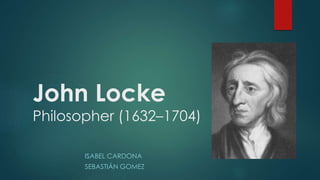
John Locke 
Philosopher (1632–1704) 
ISABEL CARDONA 
SEBASTIÁN GOMEZ
John Locke, born on August 29, 1632, in 
Wrington, Somerset, England, went to 
Westminster school and then Christ Church, 
University of Oxford. At Oxford he studied 
medicine, which would play a central role in 
his life. He became a highly influential 
philosopher, writing about such topics as 
political philosophy, epistemology, and 
education. Locke's writings helped found 
modern Western philosophy.
His theories concerning the 
separation of Church and State, 
religious freedom, and liberty, not 
only influenced European thinkers 
such as the French Enlightenment 
writer, Voltaire, but shaped the 
thinking of America's founders, 
from Alexander Hamilton to 
Thomas Jefferson.
Pedagogical theory 
EDUCATION MAKES THE MAN 
Locke posits an "empty" mind—a tabula 
rasa—that is "filled" by experience. 
THEORY OF THE SELF. 
That is, the "associations of ideas" made 
when young are more significant than those 
made when mature because they are the 
foundation of the self
Locke's emphasis on the role of 
experience in the formation of the 
mind and his concern with false 
associations of ideas has led many to 
characterise his theory of mind as 
passive rather than active
Body and mind 
Locke advises parents to carefully nurture their 
children's physical "habits" before pursuing their 
academic education. 
this seemingly simple generic innovation has 
proven to be one of Locke's most enduring 
legacies—Western child-rearing manuals are still 
dominated by the topics of food and sleep.
Virtue and reason 
He defines virtue as a combination of self-denial 
and rationality: "that a man is able to deny 
himself his own desires, cross his own inclinations, 
and purely follow what reason directs as best, 
though the appetite lean the other way“ 
Locke was convinced that children could reason 
early in life and that parents should address them 
as reasoning beings.
Academic curriculum 
Education is about instilling virtue and what 
Western educators would now call critical-thinking 
skills. 
Locke maintains that parents or teachers must first 
teach children how to learn and to enjoy learning 
Locke's curricular recommendations reflect the 
break from scholastic humanism and the 
emergence of a new kind of education—one 
emphasising not only science but also practical 
professional training.
Philosophy 
Locke examines the nature of the 
human mind and the process by 
which it knows the world. Repudiating 
the traditional doctrine of innate 
ideas, Locke believed that the mind is 
born blank, a tabula rasa upon which 
the world describes itself through the 
experience of the five senses.
Political Theory 
Contradicting Thomas Hobbes, Locke 
believed that the original state of 
nature was happy and characterized 
by reason and tolerance. In that state 
all people were equal and 
independent, and none had a right 
to harm another's "life, health, liberty, 
or possessions."
Ethical Theory 
Locke based his ethical theories upon 
belief in the natural goodness of 
humanity. The inevitable pursuit of 
happiness and pleasure, when 
conducted rationally, leads to 
cooperation, and in the long run 
private happiness and the general 
welfare coincide.
“Los hombres olvidan siempre 
que la felicidad humana es 
una disposición de la mente y 
no una condición de las 
circunstancias.” 
John Locke 1632-1704.

John locke (2)

  • 1.
    John Locke Philosopher(1632–1704) ISABEL CARDONA SEBASTIÁN GOMEZ
  • 2.
    John Locke, bornon August 29, 1632, in Wrington, Somerset, England, went to Westminster school and then Christ Church, University of Oxford. At Oxford he studied medicine, which would play a central role in his life. He became a highly influential philosopher, writing about such topics as political philosophy, epistemology, and education. Locke's writings helped found modern Western philosophy.
  • 3.
    His theories concerningthe separation of Church and State, religious freedom, and liberty, not only influenced European thinkers such as the French Enlightenment writer, Voltaire, but shaped the thinking of America's founders, from Alexander Hamilton to Thomas Jefferson.
  • 4.
    Pedagogical theory EDUCATIONMAKES THE MAN Locke posits an "empty" mind—a tabula rasa—that is "filled" by experience. THEORY OF THE SELF. That is, the "associations of ideas" made when young are more significant than those made when mature because they are the foundation of the self
  • 5.
    Locke's emphasis onthe role of experience in the formation of the mind and his concern with false associations of ideas has led many to characterise his theory of mind as passive rather than active
  • 6.
    Body and mind Locke advises parents to carefully nurture their children's physical "habits" before pursuing their academic education. this seemingly simple generic innovation has proven to be one of Locke's most enduring legacies—Western child-rearing manuals are still dominated by the topics of food and sleep.
  • 7.
    Virtue and reason He defines virtue as a combination of self-denial and rationality: "that a man is able to deny himself his own desires, cross his own inclinations, and purely follow what reason directs as best, though the appetite lean the other way“ Locke was convinced that children could reason early in life and that parents should address them as reasoning beings.
  • 8.
    Academic curriculum Educationis about instilling virtue and what Western educators would now call critical-thinking skills. Locke maintains that parents or teachers must first teach children how to learn and to enjoy learning Locke's curricular recommendations reflect the break from scholastic humanism and the emergence of a new kind of education—one emphasising not only science but also practical professional training.
  • 9.
    Philosophy Locke examinesthe nature of the human mind and the process by which it knows the world. Repudiating the traditional doctrine of innate ideas, Locke believed that the mind is born blank, a tabula rasa upon which the world describes itself through the experience of the five senses.
  • 10.
    Political Theory ContradictingThomas Hobbes, Locke believed that the original state of nature was happy and characterized by reason and tolerance. In that state all people were equal and independent, and none had a right to harm another's "life, health, liberty, or possessions."
  • 11.
    Ethical Theory Lockebased his ethical theories upon belief in the natural goodness of humanity. The inevitable pursuit of happiness and pleasure, when conducted rationally, leads to cooperation, and in the long run private happiness and the general welfare coincide.
  • 12.
    “Los hombres olvidansiempre que la felicidad humana es una disposición de la mente y no una condición de las circunstancias.” John Locke 1632-1704.