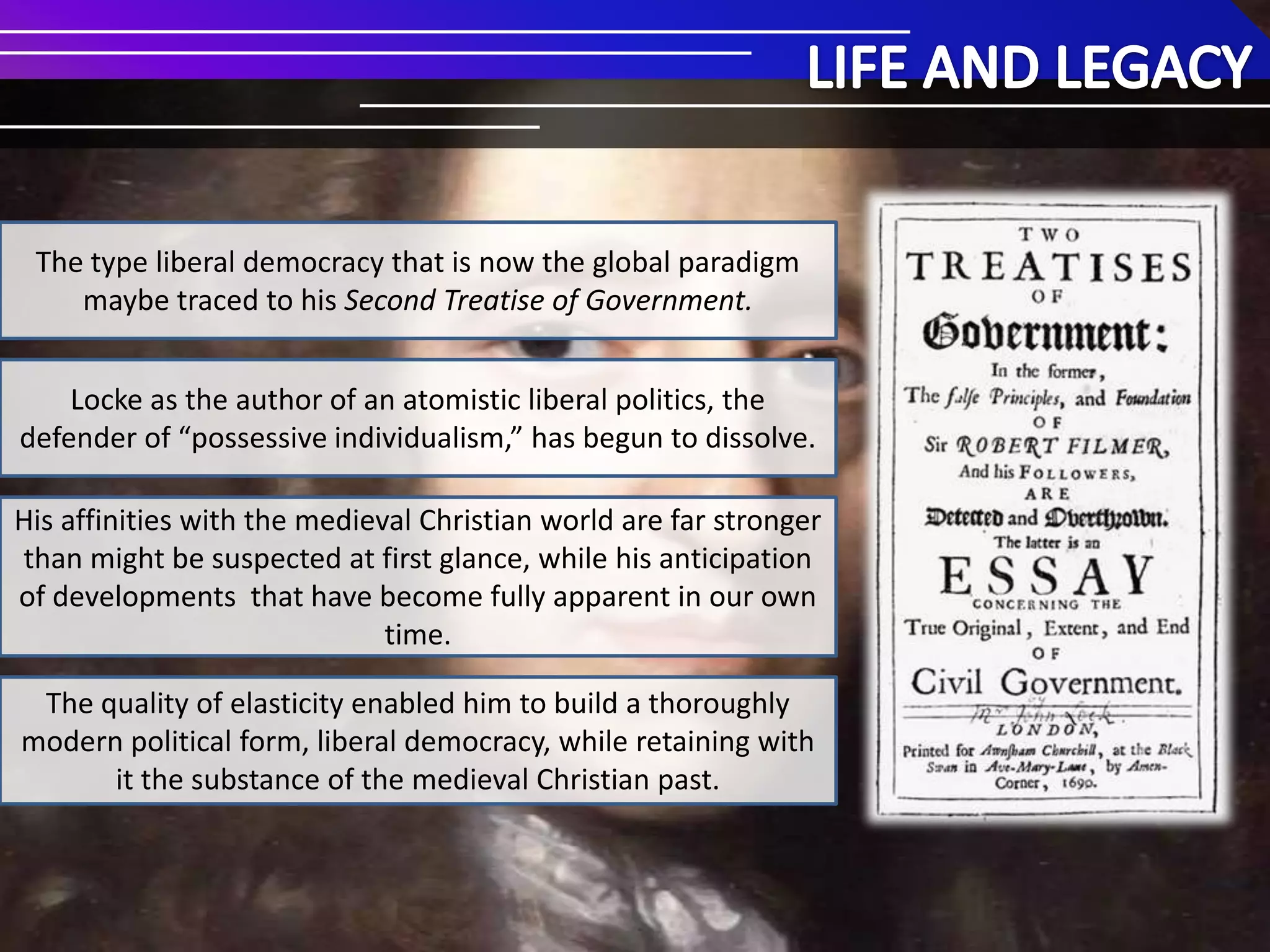
The type liberal democracy that is now the global paradigm
maybe traced to his Second Treatise of Government.
Locke as the author of an atomistic liberal politics, the
defender of “possessive individualism,” has begun to dissolve.
His affinities with the medieval Christian world are far stronger
than might be suspected at first glance, while his anticipation
of developments that have become fully apparent in our own
time.
The quality of elasticity enabled him to build a thoroughly
modern political form, liberal democracy, while retaining with
it the substance of the medieval Christian past.
We can think of no other way of
founding political society than on the
recognition of the inalienable rights of
human beings that Locke has taught us.

He wrote to
persuade the
people of the
direction in which it
should go.

An extended philosophical defense of
the self-evident truths may remain
desirable, but the convictions
themselves are indispensable.

B
R
I
D
G
E

Both in politics and theology, he rigorously
stripped away what he regarded as
inessential to arrive at the bedrock on which
a new conception of community could be
built.
His work is driven by a
moral purpose and
draws much authority
from that inspiration.
This helps to explain
the power it still
exercises today.

Defying the odds of reaching an
agreement between opposing factions, he
showed that they were nevertheless
capable of being reconciled by what they
still held in common.
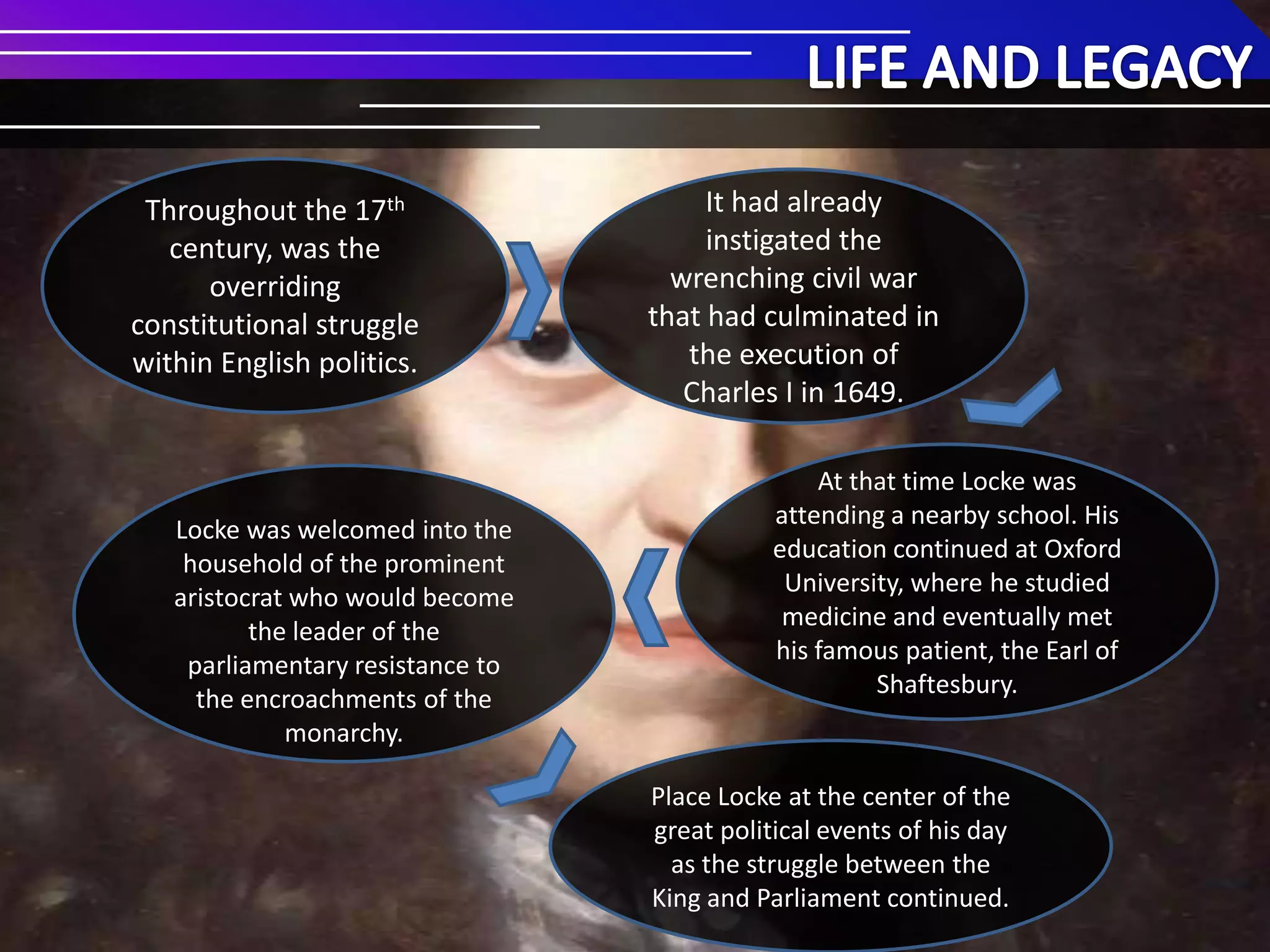
Throughout the 17th
century, was the
overriding
constitutional struggle
within English politics.

Locke was welcomed into the
household of the prominent
aristocrat who would become
the leader of the
parliamentary resistance to
the encroachments of the
monarchy.

It had already
instigated the
wrenching civil war
that had culminated in
the execution of
Charles I in 1649.
At that time Locke was
attending a nearby school. His
education continued at Oxford
University, where he studied
medicine and eventually met
his famous patient, the Earl of
Shaftesbury.

Place Locke at the center of the
great political events of his day
as the struggle between the
King and Parliament continued.
Individual emerges
precisely at the point at
which he begins to act
socially.
It is not the individual who
sustains the political
community, but rather the
political community that
sustains the individual.

He becomes an individual
through his assumption
of civic responsibilities.
Moral law operates blindly
and automatically; it is
precisely to persuade
people to recognize their
obligations to support civil
society that he wrote Two
Treaties.

The guiding intuition that prompted Locke’s
search for consensus was that the community of
human beings came before and remained despite
their disagreements.
“There could be no enjoyment of rights without law, and there could be no law
without respect for rights.”
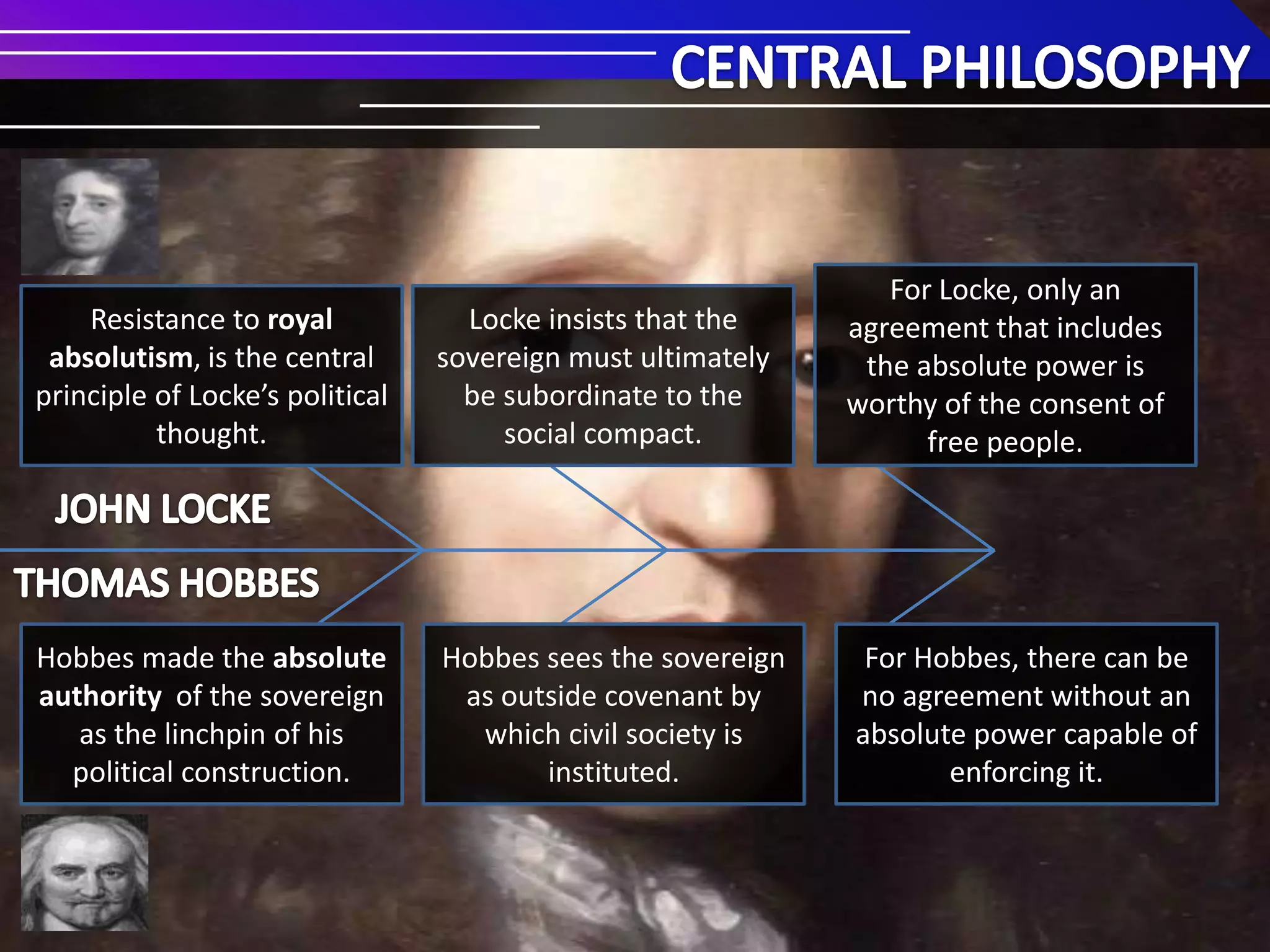
Resistance to royal
absolutism, is the central
principle of Locke’s political
thought.

Locke insists that the
sovereign must ultimately
be subordinate to the
social compact.

For Locke, only an
agreement that includes
the absolute power is
worthy of the consent of
free people.

Hobbes made the absolute
authority of the sovereign
as the linchpin of his
political construction.

Hobbes sees the sovereign
as outside covenant by
which civil society is
instituted.

For Hobbes, there can be
no agreement without an
absolute power capable of
enforcing it.
There is no reliable
way of deciding
between the many
potential claimants of
the Adamic authority.
Locked emphasizes
that each human
being is born into the
world with the same
authority that Adam
had—namely
authority over his
own person and over
his children until they
are old enough to
become responsible
for themselves.

Lockes critiques its exposition
in Robert Filmer’s Patriarcha.

Authority of kings and
princes must be
derived from the
consent of
individuals, all of
whom are free and
equal.
Government is based
on the consent of the
governed.

Against Filmer’s contention
that political authority
derives from God through
the descent of authority
given to Adam, being passed
along the royal line in each
generation up to the present.

No group of human
beings is entitled by
God or nature to rule
others because we all
have the same Godgiven authority over
ourselves.
Emphasizes the
degree to
which trust can
be reliably
placed in
others.

Lockes’ thought
provides a far
more
communitarian
bent.

Both recognize the
impossibility of basing
government on simple
self-interest. Hobbes used
the term covenant while
Locke used the term
compact.

Human beings are
more broadly
oriented toward
the good.

Both thinkers [Hobbes and
Locke] recognize that the
consent given is only as
good as the moral reliability
of the giver.
State of nature

TRANSITION

Do not have to agree to form a community
because they already find themselves bounded
up with one another.

Civil Society

CIVIL
COMMONWEALTH

They have only to form a government, to agree on
the mode by which they are to govern themselves
collectively.
Through his account of genesis of civil society, representation of Hobbes’ Leviathan—
an absolute ruler who stands above the contracting parties as the only means of
compelling their fidelity to the agreement.

Transfer of liberty that each enjoyed in the state of nature and to the state of civil
society whereby the same legislative function that each performed individually is now
enacted collectively.

John Locke's Political Philosophy

  • 2.
    The type liberaldemocracy that is now the global paradigm maybe traced to his Second Treatise of Government. Locke as the author of an atomistic liberal politics, the defender of “possessive individualism,” has begun to dissolve. His affinities with the medieval Christian world are far stronger than might be suspected at first glance, while his anticipation of developments that have become fully apparent in our own time. The quality of elasticity enabled him to build a thoroughly modern political form, liberal democracy, while retaining with it the substance of the medieval Christian past.
  • 3.
    We can thinkof no other way of founding political society than on the recognition of the inalienable rights of human beings that Locke has taught us. He wrote to persuade the people of the direction in which it should go. An extended philosophical defense of the self-evident truths may remain desirable, but the convictions themselves are indispensable. B R I D G E Both in politics and theology, he rigorously stripped away what he regarded as inessential to arrive at the bedrock on which a new conception of community could be built. His work is driven by a moral purpose and draws much authority from that inspiration. This helps to explain the power it still exercises today. Defying the odds of reaching an agreement between opposing factions, he showed that they were nevertheless capable of being reconciled by what they still held in common.
  • 4.
    Throughout the 17th century,was the overriding constitutional struggle within English politics. Locke was welcomed into the household of the prominent aristocrat who would become the leader of the parliamentary resistance to the encroachments of the monarchy. It had already instigated the wrenching civil war that had culminated in the execution of Charles I in 1649. At that time Locke was attending a nearby school. His education continued at Oxford University, where he studied medicine and eventually met his famous patient, the Earl of Shaftesbury. Place Locke at the center of the great political events of his day as the struggle between the King and Parliament continued.
  • 5.
    Individual emerges precisely atthe point at which he begins to act socially. It is not the individual who sustains the political community, but rather the political community that sustains the individual. He becomes an individual through his assumption of civic responsibilities. Moral law operates blindly and automatically; it is precisely to persuade people to recognize their obligations to support civil society that he wrote Two Treaties. The guiding intuition that prompted Locke’s search for consensus was that the community of human beings came before and remained despite their disagreements. “There could be no enjoyment of rights without law, and there could be no law without respect for rights.”
  • 6.
    Resistance to royal absolutism,is the central principle of Locke’s political thought. Locke insists that the sovereign must ultimately be subordinate to the social compact. For Locke, only an agreement that includes the absolute power is worthy of the consent of free people. Hobbes made the absolute authority of the sovereign as the linchpin of his political construction. Hobbes sees the sovereign as outside covenant by which civil society is instituted. For Hobbes, there can be no agreement without an absolute power capable of enforcing it.
  • 7.
    There is noreliable way of deciding between the many potential claimants of the Adamic authority. Locked emphasizes that each human being is born into the world with the same authority that Adam had—namely authority over his own person and over his children until they are old enough to become responsible for themselves. Lockes critiques its exposition in Robert Filmer’s Patriarcha. Authority of kings and princes must be derived from the consent of individuals, all of whom are free and equal. Government is based on the consent of the governed. Against Filmer’s contention that political authority derives from God through the descent of authority given to Adam, being passed along the royal line in each generation up to the present. No group of human beings is entitled by God or nature to rule others because we all have the same Godgiven authority over ourselves.
  • 8.
    Emphasizes the degree to whichtrust can be reliably placed in others. Lockes’ thought provides a far more communitarian bent. Both recognize the impossibility of basing government on simple self-interest. Hobbes used the term covenant while Locke used the term compact. Human beings are more broadly oriented toward the good. Both thinkers [Hobbes and Locke] recognize that the consent given is only as good as the moral reliability of the giver.
  • 9.
    State of nature TRANSITION Donot have to agree to form a community because they already find themselves bounded up with one another. Civil Society CIVIL COMMONWEALTH They have only to form a government, to agree on the mode by which they are to govern themselves collectively. Through his account of genesis of civil society, representation of Hobbes’ Leviathan— an absolute ruler who stands above the contracting parties as the only means of compelling their fidelity to the agreement. Transfer of liberty that each enjoyed in the state of nature and to the state of civil society whereby the same legislative function that each performed individually is now enacted collectively.