Dr. BRAOU Online Classes:
Unit -1
Need and Purpose of Library Classification
By
Dr.M.ANJAIAH, Associate Professor. (Retd.)
Dept. of Library and Information Science
Dravidian University-Kuppam, A.P.
&
Library Science Counselor, Dr,BRAOU,
Study Center:
University Arts & Science College, Warangal.
Email: anjaiahlib@gmail.com
Mobile No.: 9908694950
Date: 23rd May,2024
5/30/2024 1
INTRODUCTION TO
UNIVERSAL GROWTH OF KNOWLEDGE
• As we all known well, every 10 years, the knowledge is
growing double in all subjects and all languages, like
Population Explosion and Information Explosion.
• Knowledge is dynamic and continuous. Our curiosity
makes us to think more and more about certain
problems and improve our knowledge in that area.
• The totality of subjects is called “Universe Of Subjects”.
Sometimes, we also use the word universe of
knowledge, by which we mean that total knowledge
available to humanity at any particular point of time.
5/30/2024 2
MODE OF FORMATION OF SUBJECTS
• We hear about new subjects coming up for study
every now and then.
• New knowledge and new subjects are generated
from time to time.
• Ranganathan methodically studied the Modes of
Formation of Subjects around 1950.
• He identified that subjects are formed through 4
modes Namely- 1.Denudation, 2. Dissection 3.
Lamination and 4. Loose Assemblage. Subsequently,
two more modes of formation viz., ‘Distillation’ and
‘Fusion’ were added.
5/30/2024 3
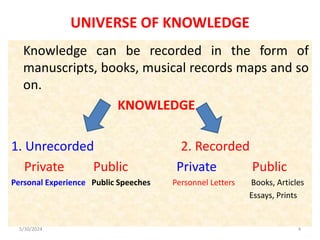
UNIVERSE OF KNOWLEDGE
Knowledge can be recorded in the form of
manuscripts, books, musical records maps and so
on.
KNOWLEDGE
1. Unrecorded 2. Recorded
Private Public Private Public
Personal Experience Public Speeches Personnel Letters Books, Articles
Essays, Prints
5/30/2024 4
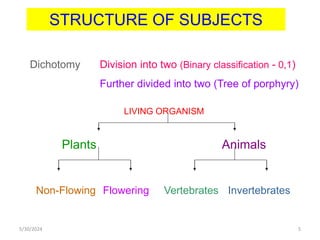
Dichotomy Division into two (Binary classification - 0,1)
Further divided into two (Tree of porphyry)
STRUCTURE OF SUBJECTS
LIVING ORGANISM
Plants Animals
Non-Flowing Flowering Vertebrates Invertebrates
5/30/2024 5
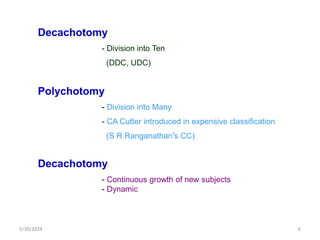
Decachotomy
- Division into Ten
(DDC, UDC)
Polychotomy
- Division into Many
- CA Cutter introduced in expensive classification
(S R Ranganathan’s CC)
Decachotomy
- Continuous growth of new subjects
- Dynamic
5/30/2024 6
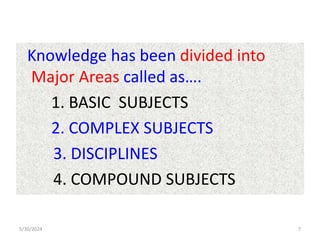
Knowledge has been divided into
Major Areas called as….
1. BASIC SUBJECTS
2. COMPLEX SUBJECTS
3. DISCIPLINES
4. COMPOUND SUBJECTS
5/30/2024 7
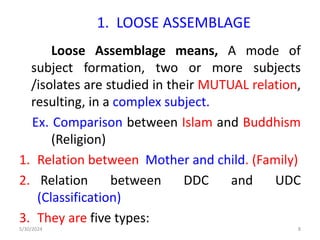
1. LOOSE ASSEMBLAGE
Loose Assemblage means, A mode of
subject formation, two or more subjects
/isolates are studied in their MUTUAL relation,
resulting, in a complex subject.
Ex. Comparison between Islam and Buddhism
(Religion)
1. Relation between Mother and child. (Family)
2. Relation between DDC and UDC
(Classification)
3. They are five types:
5/30/2024 8
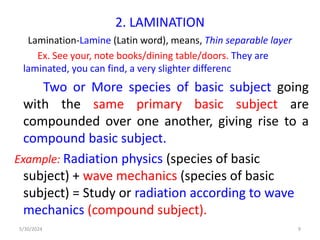
2. LAMINATION
Lamination-Lamine (Latin word), means, Thin separable layer
Ex. See your, note books/dining table/doors. They are
laminated, you can find, a very slighter differenc
Two or More species of basic subject going
with the same primary basic subject are
compounded over one another, giving rise to a
compound basic subject.
Example: Radiation physics (species of basic
subject) + wave mechanics (species of basic
subject) = Study or radiation according to wave
mechanics (compound subject).
5/30/2024 9
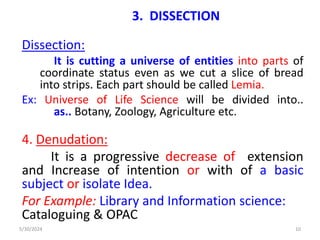
3. DISSECTION
Dissection:
It is cutting a universe of entities into parts of
coordinate status even as we cut a slice of bread
into strips. Each part should be called Lemia.
Ex: Universe of Life Science will be divided into..
as.. Botany, Zoology, Agriculture etc.
4. Denudation:
It is a progressive decrease of extension
and Increase of intention or with of a basic
subject or isolate Idea.
For Example: Library and Information science:
Cataloguing & OPAC
5/30/2024 10
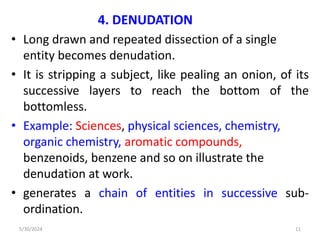
4. DENUDATION
• Long drawn and repeated dissection of a single
entity becomes denudation.
• It is stripping a subject, like pealing an onion, of its
successive layers to reach the bottom of the
bottomless.
• Example: Sciences, physical sciences, chemistry,
organic chemistry, aromatic compounds,
benzenoids, benzene and so on illustrate the
denudation at work.
• generates a chain of entities in successive sub-
ordination.
5/30/2024 11
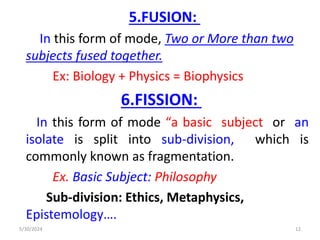
5.FUSION:
In this form of mode, Two or More than two
subjects fused together.
Ex: Biology + Physics = Biophysics
6.FISSION:
In this form of mode “a basic subject or an
isolate is split into sub-division, which is
commonly known as fragmentation.
Ex. Basic Subject: Philosophy
Sub-division: Ethics, Metaphysics,
Epistemology….
5/30/2024 12
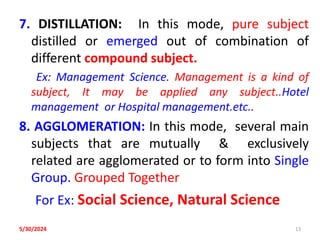
7. DISTILLATION: In this mode, pure subject
distilled or emerged out of combination of
different compound subject.
Ex: Management Science. Management is a kind of
subject, It may be applied any subject..Hotel
management or Hospital management.etc..
8. AGGLOMERATION: In this mode, several main
subjects that are mutually & exclusively
related are agglomerated or to form into Single
Group. Grouped Together
For Ex: Social Science, Natural Science
5/30/2024 13
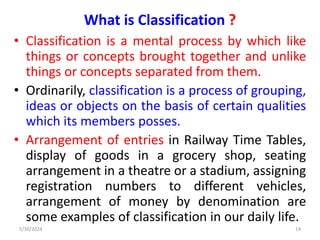
What is Classification ?
• Classification is a mental process by which like
things or concepts brought together and unlike
things or concepts separated from them.
• Ordinarily, classification is a process of grouping,
ideas or objects on the basis of certain qualities
which its members posses.
• Arrangement of entries in Railway Time Tables,
display of goods in a grocery shop, seating
arrangement in a theatre or a stadium, assigning
registration numbers to different vehicles,
arrangement of money by denomination are
some examples of classification in our daily life.
5/30/2024 14
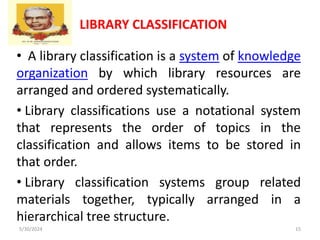
LIBRARY CLASSIFICATION
• A library classification is a system of knowledge
organization by which library resources are
arranged and ordered systematically.
• Library classifications use a notational system
that represents the order of topics in the
classification and allows items to be stored in
that order.
• Library classification systems group related
materials together, typically arranged in a
hierarchical tree structure.
5/30/2024 15
• A library classification is a system of coding and
organizing library materials (books, serials,
audiovisual materials, computer files, maps,
manuscripts, regalia) according to their subject and
allocating a call number to that information
resource.
• Similar to classification systems used in biology,
bibliographic classification systems group entities
together that are similar, typically arranged in a
hierarchical tree structure.
• A different kind of classification system, called a
faceted classification system, is also widely used
which allows the assignment of multiple
classifications to an object, enabling the
classifications to be ordered in multiple ways.
5/30/2024 16
Library Classification..conti..
• Library classification is a work consists of two steps.
Firstly, the “aboutness” of the material is
ascertained.
• Next, a call number (essentially a book’s address)
based on the classification system in use at the
particular library will be assigned to the work using
the notation of the system.
• It is important to note that unlike subject heading or
thesauri, where multiple terms can be assigned to
the same work, in library classification systems, each
work can only be placed in one class.
• This is due to shelving purposes: A book can have
only one physical place.
5/30/2024 17
Meaning of Classification
• The word ‘Classification’ comes from the Latin
word, ‘Classes’, or : Classis: which means grouping.
• In the ancient Rome, the term classis was used to
refer to a group of persons possessing certain
qualities in common as well as belonging to the
same class.
• Systematic grouping or classification lies at the
base of well managed human activity. For
Example:
• Our daily life depends very much on the process of
classification.
5/30/2024 18
DEFINITIONS
• Margaret Mann, Classification is the act of
arranging things according to their likeness and
unlikeness. She further says, It is a sorting or
grouping of things.
• According to Richardson, Classification is putting
together like things.
• Berwick.C.Sayers defines, library Classification as
the arrangement of books on shelves or
description of them, in a manner which is the
most useful to those who read.
• New Encyclopedias Britannica defines, library
classification as a system of arrangement
adopted by a library to enable patrons to find its
material quickly and easily.
5/30/2024 19
History Library Classification
• Library classifications were preceded by
classifications used by bibliographers such
as Conrad Gessner.
• The earliest library classification schemes
organized books in broad subject categories.
• The earliest known library classification scheme is
the Pinakes by Callimachus,a scholar at the Library
of Alexandria during the Third Century BC. During
the Renaissance and Reformation era, "Libraries
were organized according to the whims or
knowledge of individuals in charge.
5/30/2024 20
Importance of Classification
• Classification is needed for the convenient
study of living organisms.
• It is necessary for knowing the different
varieties of organisms.
• It helps in the correct identification of various
organisms. (Like– Books, Journals, etc.)
• It helps to know the origin and evolution of
organisms.
5/30/2024 21
The Features of Library Classification
• The Major Components Library
Classification are:
1. Schedules
2. Notations
3.Index.
4. Distinguished Features, such as: generalia
class, form divisions, book numbers, and
devices for number synthesis which are not
required in a knowledge classification.
5/30/2024 22
NEED AND PURPOSE LIBRARY CLASSIFICATION
• A library has to serve as an information centre/ referral
centre for specialized sources of information.
• The employment opportunities, public utility services,
social awareness programmes are considered to be
essential areas of information, which are collected and
stored for dissemination to the general public. Library is
a social institution and is a service organization. In order
that the service may be useful and purposeful and
documents are to be arranged systematically.
• The arrangement by subject is found to be more
suitable than anyother.Hence there is a need for library
classification. Library is a growing organism’ says
Ranganathan in his Fifth law of Library Science.
5/30/2024 23
• If the number of documents in a library is small,
the users as well as the library staff can handle
the collection without any difficulty.
• But , when the collection is very large as in the
case of modern libraries there should be a
classificatory arrangement of the documents.
• When documents are arranged according to any
modern scheme of library classification, the
documents on related subjects appear side by
side on the shelves.
• Such a display of subject relationship is known as
“Collocation”.
5/30/2024 24
• Library classification helps systematic shelf arrangement
of different kinds of documents for different purposes.
• A user will be in a better position to consult and use the
collection without the assistance of the library staff
when documents are arranged so conveniently.
• Library classification helps achieve the effective use of
library collection. It also helps in making the maximum
use of the library collection. It saves the time of the user
and thereby the time of the library staff also.
• Library classification also helps in finding out the total
collection available on a subject.
• It also helps us- to know the strength and weakness of
the collection in the library on any subject.
5/30/2024 25
Cont----
• Mechanized Arrangement: If it is decided that
a particular arrangement is suitable then,
ordinarily, it should not be changed.
• The sequence should be determined once for
all, so that one does not have to re-determine
the sequence of documents again when these
are returned after being borrowed, or for the
interpolation of new documents in their
correct places.
5/30/2024 26
Need of Library Classification
1. Helpful Sequence: The basic purpose of any library classification
should be to arrange the documents in a method most convenient to
the users and to the library staff. The docu- ments should be
arranged in classes, and based on the mutual relations between
them. This would bring together closely related classes. In other
words, related documents would be grouped in close proximity, the
basic idea being that like classes are brought together and unlike
classes are separated.
2. Correct Replacement: Documents after being taken out from shelves
by the users or by the library staff should, after being used, be
replaced in their proper places. It is essential that library
classification should enable the correct replacement of documents,
after these have been returned from use. This would require a
mechanized arrangement, which has been discussed in the next
section.
5/30/2024 27
3. Addition of New Documents: A library would
acquire new documents from time to time.
Therefore, library classification should help in
finding the most helpful place for each of these
among the existing collection of the library.
There are two possibilities in this regard.
• First one- The new books may be on a subject already provided
for in the scheme of library classification, or it may be on a newly
emerging subject, which may not have been provided for in the
existing scheme.
• In the second case, the scheme should have inbuilt qualities
which may allow the fixing the position of the newly emerging
subjects amidst another subject having literary warrant.
5/30/2024 28
4. Withdrawal of Documents from Stock: In case, the
need arises to withdraw a document from the stock
for some reason, the library classification should
facilitate such a withdrawal.
So, Library classification is concerned with the
knowledge content of a document or, in other words,
the subject of a document. In order to help the user
find various documents on a particular subject, and
to bring together documents on closely related
subjects in a filiatory sequence the library
classification schemes have been worked out by
classificationists.
5/30/2024 29
Functions of Library Classification
1. To arrange books and other information
sources in a systematic and helpful order on
the shelves so that:
i) Users may find all the documents of his subject
or interest in juxtaposition. In other words,
related documents would be grouped in close
proximity;
ii) Helps the library staff in providing expeditious
service to the users;
iii) Browsing is made beneficial.
5/30/2024 30
2.Ensures specific name to each document,
there by makes possible:
i) Prompt location of the documents;
ii) Speedy restoration of the documents when
returned by users after use by means of
mechanized arrangement induced into
classification through notation;
iii) To know the number of copies of the book
available in the library; and
iv) To know about the various editions of a book.
5/30/2024 31
3.Helps the library in :
i) Compilation of bibliographies and union
catalogue.
ii) Book display;
iii) Weeding out old editions of a book,
iv) Adding new editions of a book;
v) Providing correct plan on shelve to a book
published on a new subject;
vi) Providing pinpointed expeditious service to
users; vii) Stock verification; and viii)
Arrangement of Catalogue cards in the classified
part of the catalogue.
5/30/2024 32
4. The Classified Part Of The Catalogue In Turn;
i) Assist the user of a catalogue to refer to the
location of the document on the shelf;
ii) Informs user the artificial numbers used for
arranging the documents of his subject and
interest;
iii) Provides a clear picture of the available
documents in his subject or interest in the
library;
iv) Helps in preparing reading lists;
v) Assists the cataloguer in deriving subject
headings by means of chain procedure.
5/30/2024 33
CONCLUSION
• Classification is a mental process by which like
things or concepts brought together and
unlike things or concepts separated from
them.
• A library classification isa system of knowledge
organization by which library resources are
arranged and ordered systematically.
• Library classifications use a notational system
that represents the order of topics in the
classification and allows items to be stored in
that order.
5/30/2024 34
• The function of a-modern library is to acquire,
preserve and put to maximum use the various
information records, to the needy.
• Hence, there is a need for the organisation of
documents in a library.
• A helpful hint is that users have three
different approaches towards documents,
namely Author, Title and Subject approaches.
The subject arrangement is found useful not
only by readers but also for librarian in
providing reference services.
5/30/2024 35
5/30/2024 36
5/30/2024 37

Lirary Classification-Need and Purpose.ppt

  • 1.
    Dr. BRAOU OnlineClasses: Unit -1 Need and Purpose of Library Classification By Dr.M.ANJAIAH, Associate Professor. (Retd.) Dept. of Library and Information Science Dravidian University-Kuppam, A.P. & Library Science Counselor, Dr,BRAOU, Study Center: University Arts & Science College, Warangal. Email: anjaiahlib@gmail.com Mobile No.: 9908694950 Date: 23rd May,2024 5/30/2024 1
  • 2.
    INTRODUCTION TO UNIVERSAL GROWTHOF KNOWLEDGE • As we all known well, every 10 years, the knowledge is growing double in all subjects and all languages, like Population Explosion and Information Explosion. • Knowledge is dynamic and continuous. Our curiosity makes us to think more and more about certain problems and improve our knowledge in that area. • The totality of subjects is called “Universe Of Subjects”. Sometimes, we also use the word universe of knowledge, by which we mean that total knowledge available to humanity at any particular point of time. 5/30/2024 2
  • 3.
    MODE OF FORMATIONOF SUBJECTS • We hear about new subjects coming up for study every now and then. • New knowledge and new subjects are generated from time to time. • Ranganathan methodically studied the Modes of Formation of Subjects around 1950. • He identified that subjects are formed through 4 modes Namely- 1.Denudation, 2. Dissection 3. Lamination and 4. Loose Assemblage. Subsequently, two more modes of formation viz., ‘Distillation’ and ‘Fusion’ were added. 5/30/2024 3
  • 4.
    UNIVERSE OF KNOWLEDGE Knowledgecan be recorded in the form of manuscripts, books, musical records maps and so on. KNOWLEDGE 1. Unrecorded 2. Recorded Private Public Private Public Personal Experience Public Speeches Personnel Letters Books, Articles Essays, Prints 5/30/2024 4
  • 5.
    Dichotomy Division intotwo (Binary classification - 0,1) Further divided into two (Tree of porphyry) STRUCTURE OF SUBJECTS LIVING ORGANISM Plants Animals Non-Flowing Flowering Vertebrates Invertebrates 5/30/2024 5
  • 6.
    Decachotomy - Division intoTen (DDC, UDC) Polychotomy - Division into Many - CA Cutter introduced in expensive classification (S R Ranganathan’s CC) Decachotomy - Continuous growth of new subjects - Dynamic 5/30/2024 6
  • 7.
    Knowledge has beendivided into Major Areas called as…. 1. BASIC SUBJECTS 2. COMPLEX SUBJECTS 3. DISCIPLINES 4. COMPOUND SUBJECTS 5/30/2024 7
  • 8.
    1. LOOSE ASSEMBLAGE LooseAssemblage means, A mode of subject formation, two or more subjects /isolates are studied in their MUTUAL relation, resulting, in a complex subject. Ex. Comparison between Islam and Buddhism (Religion) 1. Relation between Mother and child. (Family) 2. Relation between DDC and UDC (Classification) 3. They are five types: 5/30/2024 8
  • 9.
    2. LAMINATION Lamination-Lamine (Latinword), means, Thin separable layer Ex. See your, note books/dining table/doors. They are laminated, you can find, a very slighter differenc Two or More species of basic subject going with the same primary basic subject are compounded over one another, giving rise to a compound basic subject. Example: Radiation physics (species of basic subject) + wave mechanics (species of basic subject) = Study or radiation according to wave mechanics (compound subject). 5/30/2024 9
  • 10.
    3. DISSECTION Dissection: It iscutting a universe of entities into parts of coordinate status even as we cut a slice of bread into strips. Each part should be called Lemia. Ex: Universe of Life Science will be divided into.. as.. Botany, Zoology, Agriculture etc. 4. Denudation: It is a progressive decrease of extension and Increase of intention or with of a basic subject or isolate Idea. For Example: Library and Information science: Cataloguing & OPAC 5/30/2024 10
  • 11.
    4. DENUDATION • Longdrawn and repeated dissection of a single entity becomes denudation. • It is stripping a subject, like pealing an onion, of its successive layers to reach the bottom of the bottomless. • Example: Sciences, physical sciences, chemistry, organic chemistry, aromatic compounds, benzenoids, benzene and so on illustrate the denudation at work. • generates a chain of entities in successive sub- ordination. 5/30/2024 11
  • 12.
    5.FUSION: In this formof mode, Two or More than two subjects fused together. Ex: Biology + Physics = Biophysics 6.FISSION: In this form of mode “a basic subject or an isolate is split into sub-division, which is commonly known as fragmentation. Ex. Basic Subject: Philosophy Sub-division: Ethics, Metaphysics, Epistemology…. 5/30/2024 12
  • 13.
    7. DISTILLATION: Inthis mode, pure subject distilled or emerged out of combination of different compound subject. Ex: Management Science. Management is a kind of subject, It may be applied any subject..Hotel management or Hospital management.etc.. 8. AGGLOMERATION: In this mode, several main subjects that are mutually & exclusively related are agglomerated or to form into Single Group. Grouped Together For Ex: Social Science, Natural Science 5/30/2024 13
  • 14.
    What is Classification? • Classification is a mental process by which like things or concepts brought together and unlike things or concepts separated from them. • Ordinarily, classification is a process of grouping, ideas or objects on the basis of certain qualities which its members posses. • Arrangement of entries in Railway Time Tables, display of goods in a grocery shop, seating arrangement in a theatre or a stadium, assigning registration numbers to different vehicles, arrangement of money by denomination are some examples of classification in our daily life. 5/30/2024 14
  • 15.
    LIBRARY CLASSIFICATION • Alibrary classification is a system of knowledge organization by which library resources are arranged and ordered systematically. • Library classifications use a notational system that represents the order of topics in the classification and allows items to be stored in that order. • Library classification systems group related materials together, typically arranged in a hierarchical tree structure. 5/30/2024 15
  • 16.
    • A libraryclassification is a system of coding and organizing library materials (books, serials, audiovisual materials, computer files, maps, manuscripts, regalia) according to their subject and allocating a call number to that information resource. • Similar to classification systems used in biology, bibliographic classification systems group entities together that are similar, typically arranged in a hierarchical tree structure. • A different kind of classification system, called a faceted classification system, is also widely used which allows the assignment of multiple classifications to an object, enabling the classifications to be ordered in multiple ways. 5/30/2024 16
  • 17.
    Library Classification..conti.. • Libraryclassification is a work consists of two steps. Firstly, the “aboutness” of the material is ascertained. • Next, a call number (essentially a book’s address) based on the classification system in use at the particular library will be assigned to the work using the notation of the system. • It is important to note that unlike subject heading or thesauri, where multiple terms can be assigned to the same work, in library classification systems, each work can only be placed in one class. • This is due to shelving purposes: A book can have only one physical place. 5/30/2024 17
  • 18.
    Meaning of Classification •The word ‘Classification’ comes from the Latin word, ‘Classes’, or : Classis: which means grouping. • In the ancient Rome, the term classis was used to refer to a group of persons possessing certain qualities in common as well as belonging to the same class. • Systematic grouping or classification lies at the base of well managed human activity. For Example: • Our daily life depends very much on the process of classification. 5/30/2024 18

  • 19.
    DEFINITIONS • Margaret Mann,Classification is the act of arranging things according to their likeness and unlikeness. She further says, It is a sorting or grouping of things. • According to Richardson, Classification is putting together like things. • Berwick.C.Sayers defines, library Classification as the arrangement of books on shelves or description of them, in a manner which is the most useful to those who read. • New Encyclopedias Britannica defines, library classification as a system of arrangement adopted by a library to enable patrons to find its material quickly and easily. 5/30/2024 19
  • 20.
    History Library Classification •Library classifications were preceded by classifications used by bibliographers such as Conrad Gessner. • The earliest library classification schemes organized books in broad subject categories. • The earliest known library classification scheme is the Pinakes by Callimachus,a scholar at the Library of Alexandria during the Third Century BC. During the Renaissance and Reformation era, "Libraries were organized according to the whims or knowledge of individuals in charge. 5/30/2024 20
  • 21.
    Importance of Classification •Classification is needed for the convenient study of living organisms. • It is necessary for knowing the different varieties of organisms. • It helps in the correct identification of various organisms. (Like– Books, Journals, etc.) • It helps to know the origin and evolution of organisms. 5/30/2024 21
  • 22.
    The Features ofLibrary Classification • The Major Components Library Classification are: 1. Schedules 2. Notations 3.Index. 4. Distinguished Features, such as: generalia class, form divisions, book numbers, and devices for number synthesis which are not required in a knowledge classification. 5/30/2024 22
  • 23.
    NEED AND PURPOSELIBRARY CLASSIFICATION • A library has to serve as an information centre/ referral centre for specialized sources of information. • The employment opportunities, public utility services, social awareness programmes are considered to be essential areas of information, which are collected and stored for dissemination to the general public. Library is a social institution and is a service organization. In order that the service may be useful and purposeful and documents are to be arranged systematically. • The arrangement by subject is found to be more suitable than anyother.Hence there is a need for library classification. Library is a growing organism’ says Ranganathan in his Fifth law of Library Science. 5/30/2024 23
  • 24.
    • If thenumber of documents in a library is small, the users as well as the library staff can handle the collection without any difficulty. • But , when the collection is very large as in the case of modern libraries there should be a classificatory arrangement of the documents. • When documents are arranged according to any modern scheme of library classification, the documents on related subjects appear side by side on the shelves. • Such a display of subject relationship is known as “Collocation”. 5/30/2024 24
  • 25.
    • Library classificationhelps systematic shelf arrangement of different kinds of documents for different purposes. • A user will be in a better position to consult and use the collection without the assistance of the library staff when documents are arranged so conveniently. • Library classification helps achieve the effective use of library collection. It also helps in making the maximum use of the library collection. It saves the time of the user and thereby the time of the library staff also. • Library classification also helps in finding out the total collection available on a subject. • It also helps us- to know the strength and weakness of the collection in the library on any subject. 5/30/2024 25
  • 26.
    Cont---- • Mechanized Arrangement:If it is decided that a particular arrangement is suitable then, ordinarily, it should not be changed. • The sequence should be determined once for all, so that one does not have to re-determine the sequence of documents again when these are returned after being borrowed, or for the interpolation of new documents in their correct places. 5/30/2024 26
  • 27.
    Need of LibraryClassification 1. Helpful Sequence: The basic purpose of any library classification should be to arrange the documents in a method most convenient to the users and to the library staff. The docu- ments should be arranged in classes, and based on the mutual relations between them. This would bring together closely related classes. In other words, related documents would be grouped in close proximity, the basic idea being that like classes are brought together and unlike classes are separated. 2. Correct Replacement: Documents after being taken out from shelves by the users or by the library staff should, after being used, be replaced in their proper places. It is essential that library classification should enable the correct replacement of documents, after these have been returned from use. This would require a mechanized arrangement, which has been discussed in the next section. 5/30/2024 27
  • 28.
    3. Addition ofNew Documents: A library would acquire new documents from time to time. Therefore, library classification should help in finding the most helpful place for each of these among the existing collection of the library. There are two possibilities in this regard. • First one- The new books may be on a subject already provided for in the scheme of library classification, or it may be on a newly emerging subject, which may not have been provided for in the existing scheme. • In the second case, the scheme should have inbuilt qualities which may allow the fixing the position of the newly emerging subjects amidst another subject having literary warrant. 5/30/2024 28
  • 29.
    4. Withdrawal ofDocuments from Stock: In case, the need arises to withdraw a document from the stock for some reason, the library classification should facilitate such a withdrawal. So, Library classification is concerned with the knowledge content of a document or, in other words, the subject of a document. In order to help the user find various documents on a particular subject, and to bring together documents on closely related subjects in a filiatory sequence the library classification schemes have been worked out by classificationists. 5/30/2024 29
  • 30.
    Functions of LibraryClassification 1. To arrange books and other information sources in a systematic and helpful order on the shelves so that: i) Users may find all the documents of his subject or interest in juxtaposition. In other words, related documents would be grouped in close proximity; ii) Helps the library staff in providing expeditious service to the users; iii) Browsing is made beneficial. 5/30/2024 30
  • 31.
    2.Ensures specific nameto each document, there by makes possible: i) Prompt location of the documents; ii) Speedy restoration of the documents when returned by users after use by means of mechanized arrangement induced into classification through notation; iii) To know the number of copies of the book available in the library; and iv) To know about the various editions of a book. 5/30/2024 31
  • 32.
    3.Helps the libraryin : i) Compilation of bibliographies and union catalogue. ii) Book display; iii) Weeding out old editions of a book, iv) Adding new editions of a book; v) Providing correct plan on shelve to a book published on a new subject; vi) Providing pinpointed expeditious service to users; vii) Stock verification; and viii) Arrangement of Catalogue cards in the classified part of the catalogue. 5/30/2024 32
  • 33.
    4. The ClassifiedPart Of The Catalogue In Turn; i) Assist the user of a catalogue to refer to the location of the document on the shelf; ii) Informs user the artificial numbers used for arranging the documents of his subject and interest; iii) Provides a clear picture of the available documents in his subject or interest in the library; iv) Helps in preparing reading lists; v) Assists the cataloguer in deriving subject headings by means of chain procedure. 5/30/2024 33
  • 34.
    CONCLUSION • Classification isa mental process by which like things or concepts brought together and unlike things or concepts separated from them. • A library classification isa system of knowledge organization by which library resources are arranged and ordered systematically. • Library classifications use a notational system that represents the order of topics in the classification and allows items to be stored in that order. 5/30/2024 34
  • 35.
    • The functionof a-modern library is to acquire, preserve and put to maximum use the various information records, to the needy. • Hence, there is a need for the organisation of documents in a library. • A helpful hint is that users have three different approaches towards documents, namely Author, Title and Subject approaches. The subject arrangement is found useful not only by readers but also for librarian in providing reference services. 5/30/2024 35
  • 36.
  • 37.