Mapping of Knowledge in
Colon Classification
Dr. Yesan Sellan, Ph.D.,
Assistant Professor, DLIS
Bishop Heber College
Introduction
 Knowledge has been defined as the sum total of
recorded ideas, facts, myths, experiences and expressed
emotions conserved by the society
 In simple words, what is known to the society and is
held in its collective memory is knowledge
• Knowledge classification is a cognitive map of knowledge,
but classification is absolute or value free
Mapping of Knowledge
• The essential function of classification is to so
organizeUniverse of subjects as to make the
retrieval of any desired subject or any filiatory
sequence of subjects pinpointed, exhaustive, and
expeditious
• Such a classification of subjects essentially
involves the arrangement of the components of
Compound subjects in a linear sequence and
representing each subject uniquely using a
language of ordinal numbers.
Principles of Mapping of the Universe of
Knowledge
• D.W. Langridge, a well-known English librarian,
identifies four principles for mapping of the universe of
knowledge. These, however, are not mutually exclusive.
 Ideological principle
 Principle of social purpose
 Scientific order
 Principle arrangement by disciplines
Ideological Principle
 To some extend every scheme is based on
someideology
 No classification scheme can be value free
or independent of the time and culture of
its origin
 Christian schemes of middle ages are the
examples
Principle of Social Purpose
• Arranges knowledge in an order of decreasing
current social utility and in the increasing
potential for future use.
• Eg. In the Vedas (1500BC) the division of
knowledge into categories of Dharm (normative
principles), Arth ( social sciences), Kam ( pure
sciences and art) and Moksh (spiritual knowledge)
Scientific Order
• An order based on some natural and logical order ofsubjects
• According to C A Cutter, “order of sciences is the orderof things, and
order of things is the order of their complexity”
• C A Cutter used the evolutionary order of main classes in his Expansive
Classification (1893)
• The arrangement of classes in the Library of Congress Classification
(1904) is also based on this principle
Principle arrangement by discipline
• A discipline is a major and cohesive chunk of knowledge
formed by a single mode, or has similar objects of study
• The DDC glossary defines a discipline as “an organized
field of study or branch of learning dealing with specific
kinds of subjects and/or subjects considered from specific
points of view”
• The division by discipline offers better solutions to the
problems in information retrieval faced by present library
users
Contd.,
• Francis Bacon (1561-1626), famous English
philosopher, suggested there are three kinds of
knowledge based upon three faculties of mind
namely Memory, Imagination and Reason
• This produces correspondingly three major
disciplines:
• History,
• Arts and
• Sciences
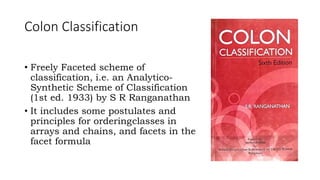
Colon Classification
• Freely Faceted scheme of
classification, i.e. an Analytico-
Synthetic Scheme of Classification
(1st ed. 1933) by S R Ranganathan
• It includes some postulates and
principles for orderingclasses in
arrays and chains, and facets in the
facet formula
Division of Knowledge in CC
• Ranganathan identified three types of subjects in the
universe of knowledge: Basic, Compound and Complex
• Basic Subjects are unitary subjects like Physics,
Economics, Library Science
• Compound Subjects are basic subjects with subdivisions
or additional facets. E.g.: velocity of light,Libraries in
India
• Complex Subjects are mostly interdisciplinary in nature.
E.g.: Mathematics for librarians, psychology for nurses
Basic Principles in CC
• “The CC, like- other schemes of classification, starts with a set of main
classes which form the first order array, of classes. Each main class is
divided into facets. All facets are regarded as manifestations of five
fundamental categories.”
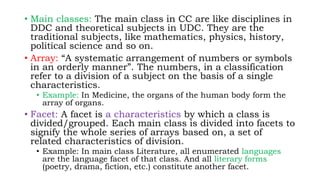
• Main classes: The main class in CC are like disciplines in
DDC and theoretical subjects in UDC. They are the
traditional subjects, like mathematics, physics, history,
political science and so on.
• Array: “A systematic arrangement of numbers or symbols
in an orderly manner”. The numbers, in a classification
refer to a division of a subject on the basis of a single
characteristics.
• Example: In Medicine, the organs of the human body form the
array of organs.
• Facet: A facet is a characteristics by which a class is
divided/grouped. Each main class is divided into facets to
signify the whole series of arrays based on, a set of
related characteristics of division.
• Example: In main class Literature, all enumerated languages
are the language facet of that class. And all literary forms
(poetry, drama, fiction, etc.) constitute another facet.
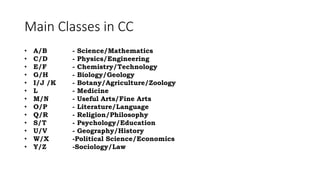
Main Classes in CC
• A/B - Science/Mathematics
• C/D - Physics/Engineering
• E/F - Chemistry/Technology
• G/H - Biology/Geology
• I/J /K - Botany/Agriculture/Zoology
• L - Medicine
• M/N - Useful Arts/Fine Arts
• O/P - Literature/Language
• Q/R - Religion/Philosophy
• S/T - Psychology/Education
• U/V - Geography/History
• W/X -Political Science/Economics
• Y/Z -Sociology/Law
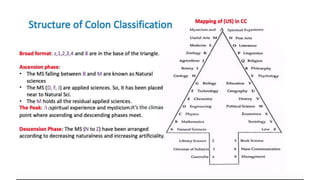
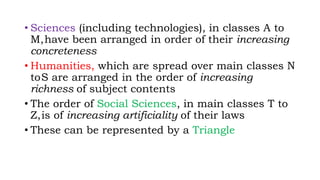
• Sciences (including technologies), in classes A to
M,have been arranged in order of their increasing
concreteness
• Humanities, which are spread over main classes N
toS are arranged in the order of increasing
richness of subject contents
• The order of Social Sciences, in main classes T to
Z,is of increasing artificiality of their laws
• These can be represented by a Triangle
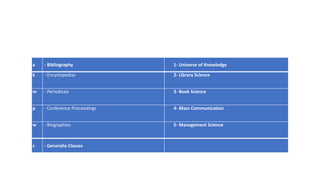
a - Bibliography 1- Universe of Knowledge
k - Encyclopedias 2- Library Science
m - Periodicals 3- Book Science
p - Conference Proceedings 4- Mass Communication
w - Biographies 5- Management Science
z - Generalia Classes
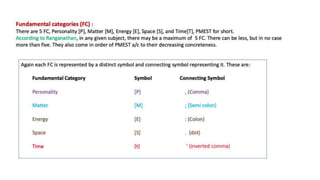
Fundamental Categories
• The FIVE Fundamental Categories represented as
Personality, Matter, Energy, Space and Time
• This set of (FC) is represented collectively by the
abbreviation PMEST
• It is connected with the symbols

Mapping of KNowledge in CC.pptx

  • 1.
    Mapping of Knowledgein Colon Classification Dr. Yesan Sellan, Ph.D., Assistant Professor, DLIS Bishop Heber College
  • 2.
    Introduction  Knowledge hasbeen defined as the sum total of recorded ideas, facts, myths, experiences and expressed emotions conserved by the society  In simple words, what is known to the society and is held in its collective memory is knowledge • Knowledge classification is a cognitive map of knowledge, but classification is absolute or value free
  • 3.
    Mapping of Knowledge •The essential function of classification is to so organizeUniverse of subjects as to make the retrieval of any desired subject or any filiatory sequence of subjects pinpointed, exhaustive, and expeditious • Such a classification of subjects essentially involves the arrangement of the components of Compound subjects in a linear sequence and representing each subject uniquely using a language of ordinal numbers.
  • 4.
    Principles of Mappingof the Universe of Knowledge • D.W. Langridge, a well-known English librarian, identifies four principles for mapping of the universe of knowledge. These, however, are not mutually exclusive.  Ideological principle  Principle of social purpose  Scientific order  Principle arrangement by disciplines
  • 5.
    Ideological Principle  Tosome extend every scheme is based on someideology  No classification scheme can be value free or independent of the time and culture of its origin  Christian schemes of middle ages are the examples
  • 6.
    Principle of SocialPurpose • Arranges knowledge in an order of decreasing current social utility and in the increasing potential for future use. • Eg. In the Vedas (1500BC) the division of knowledge into categories of Dharm (normative principles), Arth ( social sciences), Kam ( pure sciences and art) and Moksh (spiritual knowledge)
  • 7.
    Scientific Order • Anorder based on some natural and logical order ofsubjects • According to C A Cutter, “order of sciences is the orderof things, and order of things is the order of their complexity” • C A Cutter used the evolutionary order of main classes in his Expansive Classification (1893) • The arrangement of classes in the Library of Congress Classification (1904) is also based on this principle
  • 8.
    Principle arrangement bydiscipline • A discipline is a major and cohesive chunk of knowledge formed by a single mode, or has similar objects of study • The DDC glossary defines a discipline as “an organized field of study or branch of learning dealing with specific kinds of subjects and/or subjects considered from specific points of view” • The division by discipline offers better solutions to the problems in information retrieval faced by present library users
  • 9.
    Contd., • Francis Bacon(1561-1626), famous English philosopher, suggested there are three kinds of knowledge based upon three faculties of mind namely Memory, Imagination and Reason • This produces correspondingly three major disciplines: • History, • Arts and • Sciences
  • 10.
    Colon Classification • FreelyFaceted scheme of classification, i.e. an Analytico- Synthetic Scheme of Classification (1st ed. 1933) by S R Ranganathan • It includes some postulates and principles for orderingclasses in arrays and chains, and facets in the facet formula
  • 11.
    Division of Knowledgein CC • Ranganathan identified three types of subjects in the universe of knowledge: Basic, Compound and Complex • Basic Subjects are unitary subjects like Physics, Economics, Library Science • Compound Subjects are basic subjects with subdivisions or additional facets. E.g.: velocity of light,Libraries in India • Complex Subjects are mostly interdisciplinary in nature. E.g.: Mathematics for librarians, psychology for nurses
  • 12.
    Basic Principles inCC • “The CC, like- other schemes of classification, starts with a set of main classes which form the first order array, of classes. Each main class is divided into facets. All facets are regarded as manifestations of five fundamental categories.”
  • 13.
    • Main classes:The main class in CC are like disciplines in DDC and theoretical subjects in UDC. They are the traditional subjects, like mathematics, physics, history, political science and so on. • Array: “A systematic arrangement of numbers or symbols in an orderly manner”. The numbers, in a classification refer to a division of a subject on the basis of a single characteristics. • Example: In Medicine, the organs of the human body form the array of organs. • Facet: A facet is a characteristics by which a class is divided/grouped. Each main class is divided into facets to signify the whole series of arrays based on, a set of related characteristics of division. • Example: In main class Literature, all enumerated languages are the language facet of that class. And all literary forms (poetry, drama, fiction, etc.) constitute another facet.
  • 16.
    Main Classes inCC • A/B - Science/Mathematics • C/D - Physics/Engineering • E/F - Chemistry/Technology • G/H - Biology/Geology • I/J /K - Botany/Agriculture/Zoology • L - Medicine • M/N - Useful Arts/Fine Arts • O/P - Literature/Language • Q/R - Religion/Philosophy • S/T - Psychology/Education • U/V - Geography/History • W/X -Political Science/Economics • Y/Z -Sociology/Law
  • 17.
    • Sciences (includingtechnologies), in classes A to M,have been arranged in order of their increasing concreteness • Humanities, which are spread over main classes N toS are arranged in the order of increasing richness of subject contents • The order of Social Sciences, in main classes T to Z,is of increasing artificiality of their laws • These can be represented by a Triangle
  • 18.
    a - Bibliography1- Universe of Knowledge k - Encyclopedias 2- Library Science m - Periodicals 3- Book Science p - Conference Proceedings 4- Mass Communication w - Biographies 5- Management Science z - Generalia Classes
  • 19.
    Fundamental Categories • TheFIVE Fundamental Categories represented as Personality, Matter, Energy, Space and Time • This set of (FC) is represented collectively by the abbreviation PMEST • It is connected with the symbols