Dr. BRAOU Online Classes For BLISc:
Unit -2
Species and Schemes of General Classification
By
Dr.M.ANJAIAH, Associate Professor. (Retd.)
Dept. of Library and Information Science
Dravidian University-Kuppam, A.P.
&
Library Science Counselor, Dr,BRAOU,
Study Center:
University Arts & Science College, Warangal.
Email: anjaiahlib@gmail.com
Mobile No.: 9908694950
Date: 23rd May,2024
5/30/2024 1
I N T R O D U C T I O N
• This unit explains the features of various
schemes of library classification, different types
of classification schemes.
• A Classification system is a structural
arrangement of selected classes (subjects) in a
systematic and purposeful order.
• This unit provide brief descriptions of the Laws,
Canons, Principles proposed by J.D.Brown, E.C.
Richardson, E.W. Hulme, W.C.B. Sayers, H.E.
Bliss and; S.R.Ranganathan, towards “The
General Theory of Library Classification”.
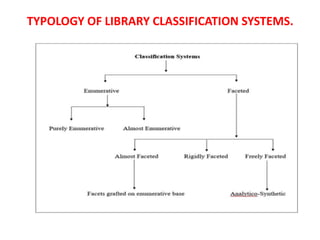
TYPOLOGY OF LIBRARY CLASSIFICATION SYSTEMS.
“Every Knowledge is Classification". John Dewey
Based on area of knowledge, depth, and functions, there
are broadly divided into TWO.
1. Special Classifications, and General Classifications
2. Broad Classifications and Depth Classifications
According to Dr.S.R. Ranganathan Species of Classifications
(6) They are:
1. Purely Enumerative
2. Almost Enumerative
3. Almost Faceted
4. Fully but, Rigidly Faceted
5. Almost Freely Faceted
6. Freely Faceted schemes of library classification.
I. PURELY ENUMERATIVE
• According to Ranganathan ‘A scheme of classification is
enumerative, if it enumerates all possible specific
subjects in a preferred helpful order along with their
respective class numbers’.
• An enumerative classification scheme lists all the
subjects of the past, present and anticipated in the
future.
• Ranganathan has recognized the following Two species
of Enumerative Classification schemes
1. Purely Enumerative Scheme
2. Almost Enumerative Scheme
1. Purely Enumerative Scheme
Purely Enumerative schemes for classification
consists essentially of a Single Schedule
Enumerating All Subjects
Example:
1. Library of Congress Classification – 13 Volumes.
2. Rider’s International Classification.
2. ALMOST ENUMERATIVE SCHEME
An Almost Enumerative Scheme for
classification consists of a large schedule
enumerating most of the subjects of the past,
the present and the anticipated future, and in
addition a few schedules of common isolates.
Example:
1. J.D. Brown: SUBJECT CLASSIFICATION:
2. Melvil Dewey: DECIMAL CLASSIFICATION
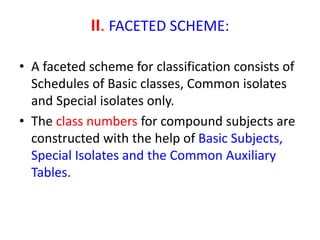
II. FACETED SCHEME:
• A faceted scheme for classification consists of
Schedules of Basic classes, Common isolates
and Special isolates only.
• The class numbers for compound subjects are
constructed with the help of Basic Subjects,
Special Isolates and the Common Auxiliary
Tables.
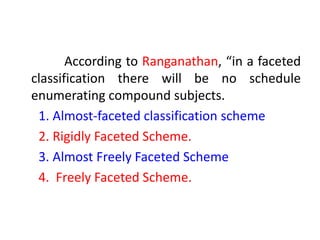
According to Ranganathan, “in a faceted
classification there will be no schedule
enumerating compound subjects.
1. Almost-faceted classification scheme
2. Rigidly Faceted Scheme.
3. Almost Freely Faceted Scheme
4. Freely Faceted Scheme.
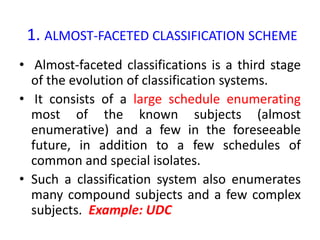
1. ALMOST-FACETED CLASSIFICATION SCHEME
• Almost-faceted classifications is a third stage
of the evolution of classification systems.
• It consists of a large schedule enumerating
most of the known subjects (almost
enumerative) and a few in the foreseeable
future, in addition to a few schedules of
common and special isolates.
• Such a classification system also enumerates
many compound subjects and a few complex
subjects. Example: UDC
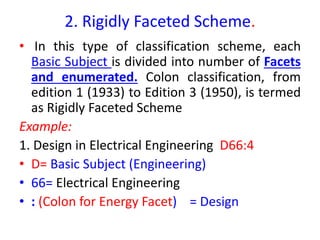
2. Rigidly Faceted Scheme.
• In this type of classification scheme, each
Basic Subject is divided into number of Facets
and enumerated. Colon classification, from
edition 1 (1933) to Edition 3 (1950), is termed
as Rigidly Faceted Scheme
Example:
1. Design in Electrical Engineering D66:4
• D= Basic Subject (Engineering)
• 66= Electrical Engineering
• : (Colon for Energy Facet) = Design
3. Almost Freely Faceted Scheme
• In this version the postulates of five
Fundamental Categories, Rounds And Levels,
use of different connecting digits in place of
one single connecting digit : (Colon) used in
version 1 (CC 1st edition to 3rd edition) were
introduced.
• Colon Classification (6th Edition) has become a
freely Faceted scheme.
4. Freely Faceted Scheme.
• A freely faceted scheme is analytico-synthetic
classification guided by postulates and
principles.
• The main features of freely faceted
classification scheme.
• Colon classification 7th edition (1987)
incorporated all the findings of dynamic
theory of library classification developed by a
research team in DRTC from 1962 to 1986
Analytico-Synthetic Classification Scheme:
• According to Ranganathan,‘ The term
analytico-synthetic scheme is a generic term
to denote any scheme in which a compound
subject is first analyzed into its facets.
• Colon Classification due to its faceted feature
has also been termed as Analytico-synthetic
classification scheme.
SCHEMES OF LIBRARY CLASSIFICATION
• Expansive Classification (EC)-Charles Ammi Cutter
(1879) (CA CUTTER)
• Subject Classification (SC)-James Duff Brown (1906).
• Subject classification (SC)-James Duff Brown 1906.
• Bibliographic Classification-Henry Evenly Bliss (1870-
1955)
• Library of Congress Classification (LC), USA
• Bibliothecal Bibliographical Classification (BBK)
• Popular Schemes of Library Classification : DDC,
UDC and CC
EXPANSIVE CLASSIFICATION (EC)-
Charles Ammi Cutter (1879)
• Expansive Classification (EC) used the Mixed
Notation and Decimal point was used as a
notational device.
• EC also made provision for use of Language and
Literature list, Cutter Author Marks and
Cumulative Alphabetical Index.
Subject Classification (SC)-1906
• The subject classification (SC) was designed by
James Duff Brown and first published in 1906.
• Prior to the design of this Subject
Classification he made two attempts. The first
one was in 1984.
• He published Quinn-Brown Classification in
collaboration with John Henry Quinn and
Secondly, the Adjustable Classification in
1898.
•
• During this period the Dewey Decimal
Classification was becoming popular which is an
American oriented system.
• So, he wants to develop a British oriented
system to meet the needs of British libraries of
all kinds and sizes with the aim-To make the
scheme simple, logical and practical in use.
BIBLIOGRAPHIC CLASSIFICATION
• Henry Evenly Bliss (1870-1955) devised the
Bibliographic Classification devoted a large part
of his life to the study of Theory of classification.
• A System of Bibliographic Classification (1935)
and the first full edition of the Scheme
appeared in Four Volumes (4).
• Bibliographic Classification is based on five
sound theoretical principles. They are
Consensus, Subordination, Collocation,
Alternative Locations and Notation.
• The main classes of BC are represented by
Roman alphabets and consists of large
schedule enumerating basic and compound
subjects.

Spcies of Lib Classification Schemes.ppt

  • 1.
    Dr. BRAOU OnlineClasses For BLISc: Unit -2 Species and Schemes of General Classification By Dr.M.ANJAIAH, Associate Professor. (Retd.) Dept. of Library and Information Science Dravidian University-Kuppam, A.P. & Library Science Counselor, Dr,BRAOU, Study Center: University Arts & Science College, Warangal. Email: anjaiahlib@gmail.com Mobile No.: 9908694950 Date: 23rd May,2024 5/30/2024 1
  • 2.
    I N TR O D U C T I O N • This unit explains the features of various schemes of library classification, different types of classification schemes. • A Classification system is a structural arrangement of selected classes (subjects) in a systematic and purposeful order. • This unit provide brief descriptions of the Laws, Canons, Principles proposed by J.D.Brown, E.C. Richardson, E.W. Hulme, W.C.B. Sayers, H.E. Bliss and; S.R.Ranganathan, towards “The General Theory of Library Classification”.
  • 3.
    TYPOLOGY OF LIBRARYCLASSIFICATION SYSTEMS.
  • 4.
    “Every Knowledge isClassification". John Dewey Based on area of knowledge, depth, and functions, there are broadly divided into TWO. 1. Special Classifications, and General Classifications 2. Broad Classifications and Depth Classifications According to Dr.S.R. Ranganathan Species of Classifications (6) They are: 1. Purely Enumerative 2. Almost Enumerative 3. Almost Faceted 4. Fully but, Rigidly Faceted 5. Almost Freely Faceted 6. Freely Faceted schemes of library classification.
  • 5.
    I. PURELY ENUMERATIVE •According to Ranganathan ‘A scheme of classification is enumerative, if it enumerates all possible specific subjects in a preferred helpful order along with their respective class numbers’. • An enumerative classification scheme lists all the subjects of the past, present and anticipated in the future. • Ranganathan has recognized the following Two species of Enumerative Classification schemes 1. Purely Enumerative Scheme 2. Almost Enumerative Scheme
  • 6.
    1. Purely EnumerativeScheme Purely Enumerative schemes for classification consists essentially of a Single Schedule Enumerating All Subjects Example: 1. Library of Congress Classification – 13 Volumes. 2. Rider’s International Classification.
  • 7.
    2. ALMOST ENUMERATIVESCHEME An Almost Enumerative Scheme for classification consists of a large schedule enumerating most of the subjects of the past, the present and the anticipated future, and in addition a few schedules of common isolates. Example: 1. J.D. Brown: SUBJECT CLASSIFICATION: 2. Melvil Dewey: DECIMAL CLASSIFICATION
  • 8.
    II. FACETED SCHEME: •A faceted scheme for classification consists of Schedules of Basic classes, Common isolates and Special isolates only. • The class numbers for compound subjects are constructed with the help of Basic Subjects, Special Isolates and the Common Auxiliary Tables.
  • 9.
    According to Ranganathan,“in a faceted classification there will be no schedule enumerating compound subjects. 1. Almost-faceted classification scheme 2. Rigidly Faceted Scheme. 3. Almost Freely Faceted Scheme 4. Freely Faceted Scheme.
  • 10.
    1. ALMOST-FACETED CLASSIFICATIONSCHEME • Almost-faceted classifications is a third stage of the evolution of classification systems. • It consists of a large schedule enumerating most of the known subjects (almost enumerative) and a few in the foreseeable future, in addition to a few schedules of common and special isolates. • Such a classification system also enumerates many compound subjects and a few complex subjects. Example: UDC
  • 11.
    2. Rigidly FacetedScheme. • In this type of classification scheme, each Basic Subject is divided into number of Facets and enumerated. Colon classification, from edition 1 (1933) to Edition 3 (1950), is termed as Rigidly Faceted Scheme Example: 1. Design in Electrical Engineering D66:4 • D= Basic Subject (Engineering) • 66= Electrical Engineering • : (Colon for Energy Facet) = Design
  • 12.
    3. Almost FreelyFaceted Scheme • In this version the postulates of five Fundamental Categories, Rounds And Levels, use of different connecting digits in place of one single connecting digit : (Colon) used in version 1 (CC 1st edition to 3rd edition) were introduced. • Colon Classification (6th Edition) has become a freely Faceted scheme.
  • 13.
    4. Freely FacetedScheme. • A freely faceted scheme is analytico-synthetic classification guided by postulates and principles. • The main features of freely faceted classification scheme. • Colon classification 7th edition (1987) incorporated all the findings of dynamic theory of library classification developed by a research team in DRTC from 1962 to 1986
  • 14.
    Analytico-Synthetic Classification Scheme: •According to Ranganathan,‘ The term analytico-synthetic scheme is a generic term to denote any scheme in which a compound subject is first analyzed into its facets. • Colon Classification due to its faceted feature has also been termed as Analytico-synthetic classification scheme.
  • 15.
    SCHEMES OF LIBRARYCLASSIFICATION • Expansive Classification (EC)-Charles Ammi Cutter (1879) (CA CUTTER) • Subject Classification (SC)-James Duff Brown (1906). • Subject classification (SC)-James Duff Brown 1906. • Bibliographic Classification-Henry Evenly Bliss (1870- 1955) • Library of Congress Classification (LC), USA • Bibliothecal Bibliographical Classification (BBK) • Popular Schemes of Library Classification : DDC, UDC and CC
  • 16.
    EXPANSIVE CLASSIFICATION (EC)- CharlesAmmi Cutter (1879) • Expansive Classification (EC) used the Mixed Notation and Decimal point was used as a notational device. • EC also made provision for use of Language and Literature list, Cutter Author Marks and Cumulative Alphabetical Index.
  • 17.
    Subject Classification (SC)-1906 •The subject classification (SC) was designed by James Duff Brown and first published in 1906. • Prior to the design of this Subject Classification he made two attempts. The first one was in 1984. • He published Quinn-Brown Classification in collaboration with John Henry Quinn and Secondly, the Adjustable Classification in 1898. •
  • 18.
    • During thisperiod the Dewey Decimal Classification was becoming popular which is an American oriented system. • So, he wants to develop a British oriented system to meet the needs of British libraries of all kinds and sizes with the aim-To make the scheme simple, logical and practical in use.
  • 19.
    BIBLIOGRAPHIC CLASSIFICATION • HenryEvenly Bliss (1870-1955) devised the Bibliographic Classification devoted a large part of his life to the study of Theory of classification. • A System of Bibliographic Classification (1935) and the first full edition of the Scheme appeared in Four Volumes (4). • Bibliographic Classification is based on five sound theoretical principles. They are Consensus, Subordination, Collocation, Alternative Locations and Notation.
  • 20.
    • The mainclasses of BC are represented by Roman alphabets and consists of large schedule enumerating basic and compound subjects.