Dr. BRAOU Online Classes For BLISc:
Unit-6:
DDC-CC and UDC
By
Dr.M.ANJAIAH, Associate Professor. (Retd.)
Dept. of Library and Information Science
Dravidian University-Kuppam, A.P.
&
Library Science Counselor, Dr,BRAOU,
Study Center:
University Arts & Science College, Warangal.
Email: anjaiahlib@gmail.com
Mobile No.: 9908694950
Date: 30th May,2024
5/30/2024 1
• Today`s lecture will be about the world
renowned Library Classification Schemes. They
are:
• Dewey Decimal Schemes-DDC (1876)
• Universal Decimal Schemes-UDC (1895)
• Colon Classification –CC (1933)
INTRODUCTION
The Dewey Decimal Classification (DDC)
system is a general knowledge organization
tool that is continuously revised to keep
pace with knowledge.
The system was conceived by Melvil Dewey
in 1873 and first published in 1876.
DDC is published by OCLC Online Computer
Library Center, Inc. OCLC owns all copyright
rights in the Dewey Decimal Classification,
and licenses the system for a variety of
uses.
• Universal Decimal Classification is generally
considered as the first faceted scheme of
classification to be developed.
• It is a scheme for classifying information on all
subjects and in all forms.
• Colon Classification is the best example of
Analytico-Synthetic Classification scheme.
• S.R.Ranganathan has designed it, to meet the
challenges of ever growing knowledge and to
make it possible to classify all types of
documents.
1. The Dewey Decimal Classification (DDC)
• Melvil Louis Kossuth Dewey is the full name of
the designer of the classification scheme which is
popularly known as Dewey Decimal
Classification.
• He was born in Adams Centre, New York on 10th
December. 1851.
• The DDC is the most widely used classification
system in the world.
• Libraries in more than 140 countries and 2,00,000; use
the DDC- to organize and provide access to their
collections.
DDC: Structure and Notation
• The DDC is built on sound principles that make it
ideal as a general knowledge organization tool:
• meaningful notation in universally recognized
Arabic numerals, well-defined categories,
• well-developed hierarchies, and a rich network
of relationships among topics.
• In the DDC, basic classes are organized by
disciplines or fields of study.
• At the broadest level, the DDC is divided into
ten main classes, which together cover the
entire world of knowledge.
• Each main class is further divided into ten
divisions, and each division into ten sections
(not all the numbers for the divisions and
sections have been used).
• The main structure of the DDC is presented in
THREE Summaries following this introduction.
• We will discuss in slide no.8.
• In the DDC, basic classes are organized by
disciplines or fields of study.
• The DDC is divided into Ten Main Classes,
which together cover the entire World of
Knowledge.
• Each Main Class is further divided into Ten
Divisions, and:
• Each Division Into Ten Sections.
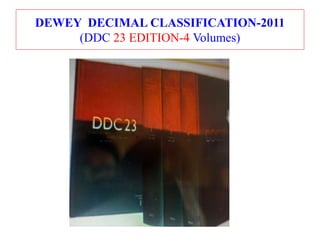
DEWEY DECIMAL CLASSIFICATION-2011
(DDC 23 EDITION-4 Volumes)
SALIENT FEATURES OF DDC 23
• Decimal Classification is an almost
enumerative scheme of classification.
• DC has been translated into many languages,
such as Chinese, Spanish, Danish, Turkish,
Japanese, Hindi, Portuguese, Sinhalese, etc.,
• Dewey introduced the idea of using notation
for the subject in his scheme and applying the
notation to the book.
• The 23rd edition of DDC is published IN FOUR
VOLUMES.
Volume 1 – Introduction, Manual, Tables
Volume 2 – Schedules of classes 000 – 599
Volume 3 – Schedules of classes 600 – 999
Volume 4 – Relative index
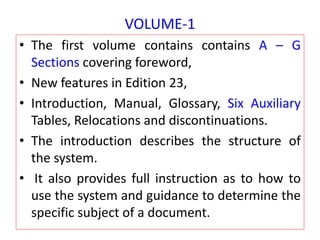
VOLUME-1
• The first volume contains contains A – G
Sections covering foreword,
• New features in Edition 23,
• Introduction, Manual, Glossary, Six Auxiliary
Tables, Relocations and discontinuations.
• The introduction describes the structure of
the system.
• It also provides full instruction as to how to
use the system and guidance to determine the
specific subject of a document.
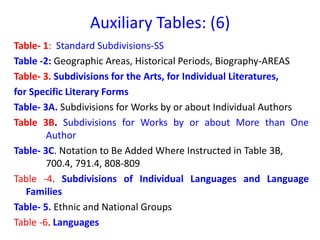
Auxiliary Tables: (6)
Table- 1: Standard Subdivisions-SS
Table -2: Geographic Areas, Historical Periods, Biography-AREAS
Table- 3. Subdivisions for the Arts, for Individual Literatures,
for Specific Literary Forms
Table- 3A. Subdivisions for Works by or about Individual Authors
Table 3B. Subdivisions for Works by or about More than One
Author
Table- 3C. Notation to Be Added Where Instructed in Table 3B,
700.4, 791.4, 808-809
Table -4. Subdivisions of Individual Languages and Language
Families
Table- 5. Ethnic and National Groups
Table -6. Languages
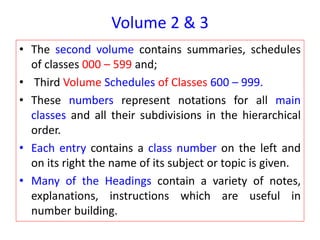
Volume 2 & 3
• The second volume contains summaries, schedules
of classes 000 – 599 and;
• Third Volume Schedules of Classes 600 – 999.
• These numbers represent notations for all main
classes and all their subdivisions in the hierarchical
order.
• Each entry contains a class number on the left and
on its right the name of its subject or topic is given.
• Many of the Headings contain a variety of notes,
explanations, instructions which are useful in
number building.
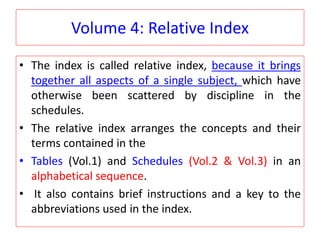
Volume 4: Relative Index
• The index is called relative index, because it brings
together all aspects of a single subject, which have
otherwise been scattered by discipline in the
schedules.
• The relative index arranges the concepts and their
terms contained in the
• Tables (Vol.1) and Schedules (Vol.2 & Vol.3) in an
alphabetical sequence.
• It also contains brief instructions and a key to the
abbreviations used in the index.
SUMMARIES OF DDC
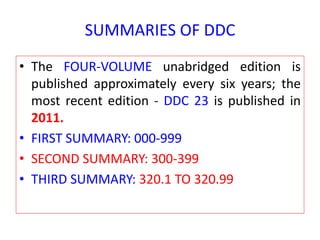
• The FOUR-VOLUME unabridged edition is
published approximately every six years; the
most recent edition - DDC 23 is published in
2011.
• FIRST SUMMARY: 000-999
• SECOND SUMMARY: 300-399
• THIRD SUMMARY: 320.1 TO 320.99
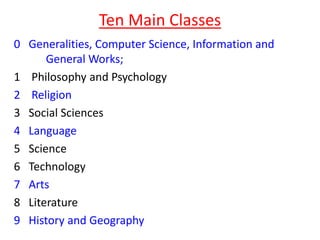
Ten Main Classes
0 Generalities, Computer Science, Information and
General Works;
1 Philosophy and Psychology
2 Religion
3 Social Sciences
4 Language
5 Science
6 Technology
7 Arts
8 Literature
9 History and Geography
Dewey Decimal Classification-DDC
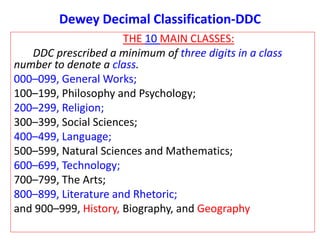
THE 10 MAIN CLASSES:
DDC prescribed a minimum of three digits in a class
number to denote a class.
000–099, General Works;
100–199, Philosophy and Psychology;
200–299, Religion;
300–399, Social Sciences;
400–499, Language;
500–599, Natural Sciences and Mathematics;
600–699, Technology;
700–799, The Arts;
800–899, Literature and Rhetoric;
and 900–999, History, Biography, and Geography
Hierarchy
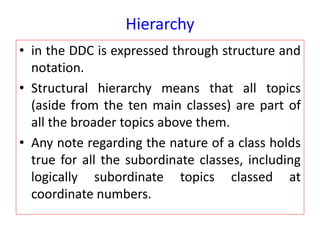
• in the DDC is expressed through structure and
notation.
• Structural hierarchy means that all topics
(aside from the ten main classes) are part of
all the broader topics above them.
• Any note regarding the nature of a class holds
true for all the subordinate classes, including
logically subordinate topics classed at
coordinate numbers.
Example
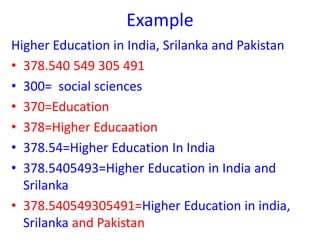
Higher Education in India, Srilanka and Pakistan
• 378.540 549 305 491
• 300= social sciences
• 370=Education
• 378=Higher Educaation
• 378.54=Higher Education In India
• 378.5405493=Higher Education in India and
Srilanka
• 378.540549305491=Higher Education in india,
Srilanka and Pakistan
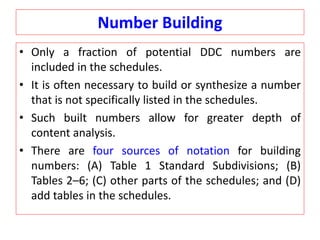
Number Building
• Only a fraction of potential DDC numbers are
included in the schedules.
• It is often necessary to build or synthesize a number
that is not specifically listed in the schedules.
• Such built numbers allow for greater depth of
content analysis.
• There are four sources of notation for building
numbers: (A) Table 1 Standard Subdivisions; (B)
Tables 2–6; (C) other parts of the schedules; and (D)
add tables in the schedules.
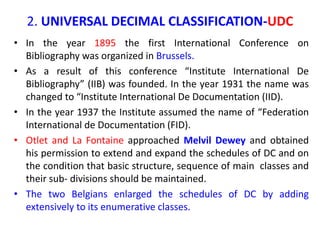
2. UNIVERSAL DECIMAL CLASSIFICATION-UDC
• In the year 1895 the first International Conference on
Bibliography was organized in Brussels.
• As a result of this conference “Institute International De
Bibliography” (IIB) was founded. In the year 1931 the name was
changed to “Institute International De Documentation (IID).
• In the year 1937 the Institute assumed the name of “Federation
International de Documentation (FID).
• Otlet and La Fontaine approached Melvil Dewey and obtained
his permission to extend and expand the schedules of DC and on
the condition that basic structure, sequence of main classes and
their sub- divisions should be maintained.
• The two Belgians enlarged the schedules of DC by adding
extensively to its enumerative classes.
CONTI….
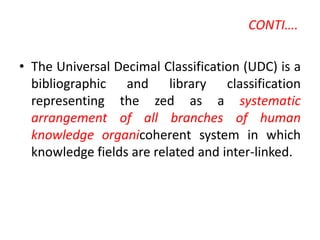
• The Universal Decimal Classification (UDC) is a
bibliographic and library classification
representing the zed as a systematic
arrangement of all branches of human
knowledge organicoherent system in which
knowledge fields are related and inter-linked.
Purpose of UDC
UDC was designed to serve following two
purposes.
• To provide a method for arranging books on
library shelves in an order which would be
helpful to the users, i.e. shelf arrangement,
• To provide a method of arranging substitutes
of the books themselves in a card catalogue
and printed bibliographies.
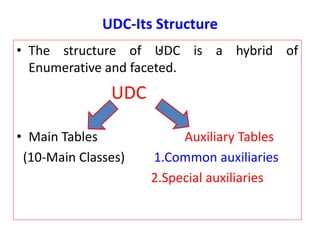
UDC-Its Structure
.
• The structure of UDC is a hybrid of
Enumerative and faceted.
UDC
• Main Tables Auxiliary Tables
(10-Main Classes) 1.Common auxiliaries
2.Special auxiliaries
Meaning of symbols
Symbol + (Plus ) for coordination , addition
Symbol + (Plus ) for coordination , addition .
When a compound subject cannot be denoted by a single number,
this symbol connects (or coordinates) two or more separated
non-consecutive UDC numbers to signify the concept, e.g
53 + 54 Physics and Chemistry
(54 + 549)India and Pakistan
When no number exists for a compound subject comprising a rage
of concepts, it can be denoted by the extension sign ( /) which
connects two or more separated (non- consecutive) UDC
number, e.g.
548/549 Mineralogical Sciences, Crystallography, Mineralogy
562/569 Systematic Palaeo zoology
Relation Sign (:)
A general, coordination and reversible relation is indicated
where the concepts involved are of equal significance, e.g.
11 : 2 Metaphysics in relation to religion
2 : 53 Religion in relation to physics
327 (44 : 54 ) Foreign policy of France in relation to India
327 (54 : 44 )Foreign policy of India in relation to France
This [ ] Symbol is used for sub-grouping the concepts, e.g.
061 . 25 [ ] International Federation
061 : 027 Library Associations
IFLA International Federation of Library Associations
061 .25 [100] : 061 : 027
: : Symbol For order fixing
• IFLA International Federation of Library Associations
061 .25 [100] : : 061 : 027
Symbol = (equals ) denotes languages
• When a main UDC number expresses the subject of a
document, its linguistic form or language is denoted by
these auxiliaries.
• It will be prefixed or suffixed depends on the treatment of
subject components of a document. If the document has
to be filed by language, the sign is prefixed, e.g.
• = 10 (061.055.2) Women’s magazine in French language
• When necessary, the auxiliary may be separated from the
main number by colon, e.g.
= 30 : 621.386.2 (030) Guidebook to X-ray tubes in German
language.
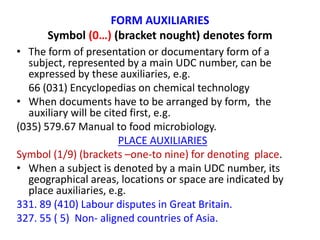
FORM AUXILIARIES
Symbol (0…) (bracket nought) denotes form
• The form of presentation or documentary form of a
subject, represented by a main UDC number, can be
expressed by these auxiliaries, e.g.
66 (031) Encyclopedias on chemical technology
• When documents have to be arranged by form, the
auxiliary will be cited first, e.g.
(035) 579.67 Manual to food microbiology.
PLACE AUXILIARIES
Symbol (1/9) (brackets –one-to nine) for denoting place.
• When a subject is denoted by a main UDC number, its
geographical areas, locations or space are indicated by
place auxiliaries, e.g.
331. 89 (410) Labour disputes in Great Britain.
327. 55 ( 5) Non- aligned countries of Asia.
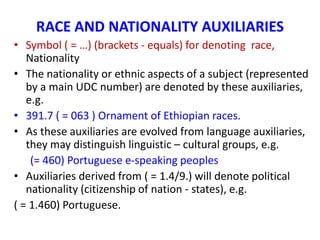
RACE AND NATIONALITY AUXILIARIES
• Symbol ( = …) (brackets - equals) for denoting race,
Nationality
• The nationality or ethnic aspects of a subject (represented
by a main UDC number) are denoted by these auxiliaries,
e.g.
• 391.7 ( = 063 ) Ornament of Ethiopian races.
• As these auxiliaries are evolved from language auxiliaries,
they may distinguish linguistic – cultural groups, e.g.
(= 460) Portuguese e-speaking peoples
• Auxiliaries derived from ( = 1.4/9.) will denote political
nationality (citizenship of nation - states), e.g.
( = 1.460) Portuguese.
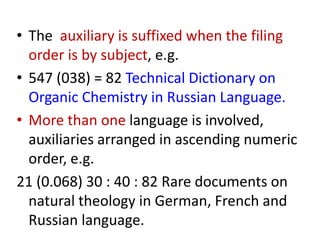
• The auxiliary is suffixed when the filing
order is by subject, e.g.
• 547 (038) = 82 Technical Dictionary on
Organic Chemistry in Russian Language.
• More than one language is involved,
auxiliaries arranged in ascending numeric
order, e.g.
21 (0.068) 30 : 40 : 82 Rare documents on
natural theology in German, French and
Russian language.
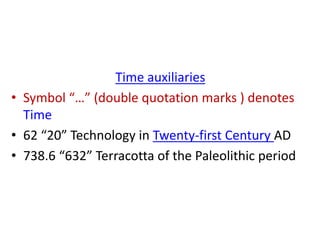
Time auxiliaries
• Symbol “…” (double quotation marks ) denotes
Time
• 62 “20” Technology in Twenty-first Century AD
• 738.6 “632” Terracotta of the Paleolithic period
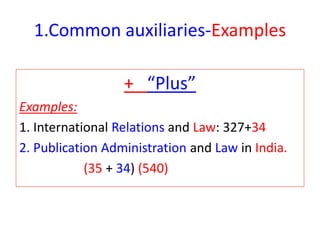
1.Common auxiliaries-Examples
+ “Plus”
Examples:
1. International Relations and Law: 327+34
2. Publication Administration and Law in India.
(35 + 34) (540)
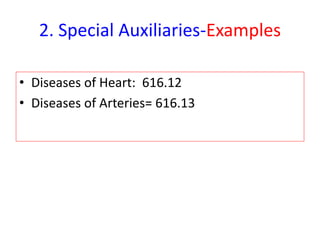
2. Special Auxiliaries-Examples
• Diseases of Heart: 616.12
• Diseases of Arteries= 616.13
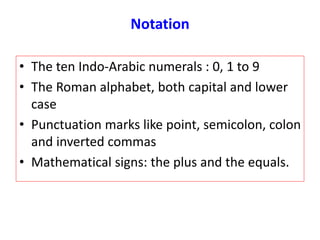
Notation
• The ten Indo-Arabic numerals : 0, 1 to 9
• The Roman alphabet, both capital and lower
case
• Punctuation marks like point, semicolon, colon
and inverted commas
• Mathematical signs: the plus and the equals.
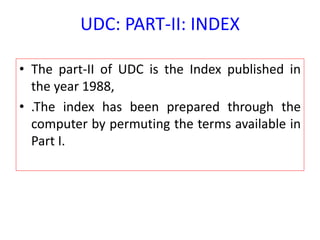
UDC: PART-II: INDEX
• The part-II of UDC is the Index published in
the year 1988,
• .The index has been prepared through the
computer by permuting the terms available in
Part I.
COLON CLASSIFICATION (CC)
• Dr S.R.Ranganathan was born in 1882, at Shiyali,
Tanjore District in Tamil Nadu.
• He was basically a teacher in Mathematics.
• His interest towards books and librarianship made
him to become the Librarian of the Madras
University Library in 1924.
• While on tour, he also attended a few classes in the
School of Librarianship, University of London. all
types of documents. While in search of methodology,
once he happened to visit a departmental store in
London where he found a clue for evolving a scheme
of classification.
• During his observational tours he visited many
libraries and found lacunae in existing schemes
of classification in use then.
• He thought of designing a better scheme of
classification which may help to classify all
types of documents.
• While in search of methodology, once he
happened to visit a departmental store in
London where he found a clue for evolving a
scheme of classification.
• He observed a demonstration of a toy called
Meccano set.
• The first edition of CC was published in the
year 1933 with Three parts.
• Part-I: 127 pages of rules explaining the
underlying principles;
• Part – II : 175 pages of schedules and
• Part – III : 106 pages of Index.
• The notation used was mixed and the colon
( : ) was used as the connecting symbol for
joining the facets.
UNIVERSE OF KNOWLEDGE
• Finite Universe: A universe with a finite number
of entities.
Example: Students in a Classroom.
• Infinite Universe: A universe with an infinite
number of entities.
Example: Universe of Integers.
• Rising Universe: A universe with new entities
added to it or emerging, in it from time to
time.
Example: Subjects of Revise
The FOURTH EDITION-PMEST
• The fourth edition of CC has radical changes
over its previous editions.
• It can be said a freely-faceted classification.
Five indicator digits to indicate Five
Fundamental Categories were introduced.
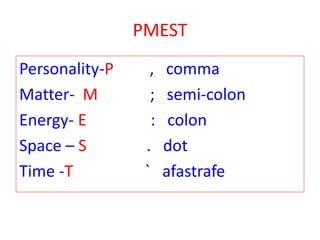
PMEST
Personality-P , comma
Matter- M ; semi-colon
Energy- E : colon
Space – S . dot
Time -T ` afastrafe
What is CANON ?
• Ranganathan has used the term in context of
division of the first order of the major
discipline such as cataloguing, classification,
book selection etc.
• Canon refers; to being a rule or a body of
rules.
• Canon means, a general principle or standard
by which judgment may be formed.
CANONS
• Canons means, a rule, regulation or law. It can
also be defined as a principle, model, standard or
criterion hence various models, principles, test
used for the working and efficiency of different
schemes of classification are called canons of
classification.
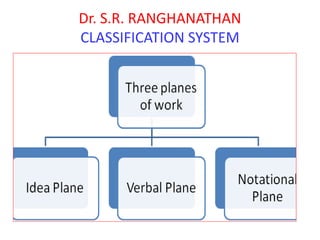
• Ranganathan recognised three plane of work; to
explain the design and application of work, he
provided a specific norms for designing a scheme
of classification and classify the documents
according to it. In designing a scheme for
classification ,
• it has to deal with dynamics, infinite and multi-
dimentional universe knowledge which need to
be clearly and thoroughly analysed thereafter it
is required to be transformed into an artificial
language for smooth and convenient use of the
scheme as well as systematic and helpful
arrangement of documents.
• To make this complicated system smooth
Ranganathan has formulated a separate set of
canons for work into THREE PLANE, they are-
1. Idea Plane, 2. Verbal Plane, 3. Notational
Plane
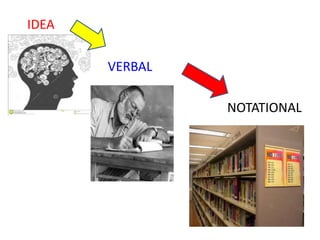
IDEA
NOTATIONAL
VERBAL
Dr. S.R. RANGHANATHAN
CLASSIFICATION SYSTEM
• With the identification of three planes of work -
Idea, Verbal and Notational Plane, work of
classification has become objective.
• It is still a best and sound example of an
Analytico- Synthetic Classification.
• The Colon Classification is now in its seventh
edition (1987).
• It is used in some special and academic
libraries in India.
5/30/2024
54

Library Classifiction- Schemes-DDC-UDC-CC.ppt

  • 1.
    Dr. BRAOU OnlineClasses For BLISc: Unit-6: DDC-CC and UDC By Dr.M.ANJAIAH, Associate Professor. (Retd.) Dept. of Library and Information Science Dravidian University-Kuppam, A.P. & Library Science Counselor, Dr,BRAOU, Study Center: University Arts & Science College, Warangal. Email: anjaiahlib@gmail.com Mobile No.: 9908694950 Date: 30th May,2024 5/30/2024 1
  • 2.
    • Today`s lecturewill be about the world renowned Library Classification Schemes. They are: • Dewey Decimal Schemes-DDC (1876) • Universal Decimal Schemes-UDC (1895) • Colon Classification –CC (1933)
  • 3.
    INTRODUCTION The Dewey DecimalClassification (DDC) system is a general knowledge organization tool that is continuously revised to keep pace with knowledge. The system was conceived by Melvil Dewey in 1873 and first published in 1876. DDC is published by OCLC Online Computer Library Center, Inc. OCLC owns all copyright rights in the Dewey Decimal Classification, and licenses the system for a variety of uses.
  • 4.
    • Universal DecimalClassification is generally considered as the first faceted scheme of classification to be developed. • It is a scheme for classifying information on all subjects and in all forms. • Colon Classification is the best example of Analytico-Synthetic Classification scheme. • S.R.Ranganathan has designed it, to meet the challenges of ever growing knowledge and to make it possible to classify all types of documents.
  • 5.
    1. The DeweyDecimal Classification (DDC) • Melvil Louis Kossuth Dewey is the full name of the designer of the classification scheme which is popularly known as Dewey Decimal Classification. • He was born in Adams Centre, New York on 10th December. 1851. • The DDC is the most widely used classification system in the world. • Libraries in more than 140 countries and 2,00,000; use the DDC- to organize and provide access to their collections.
  • 6.
    DDC: Structure andNotation • The DDC is built on sound principles that make it ideal as a general knowledge organization tool: • meaningful notation in universally recognized Arabic numerals, well-defined categories, • well-developed hierarchies, and a rich network of relationships among topics. • In the DDC, basic classes are organized by disciplines or fields of study.
  • 7.
    • At thebroadest level, the DDC is divided into ten main classes, which together cover the entire world of knowledge. • Each main class is further divided into ten divisions, and each division into ten sections (not all the numbers for the divisions and sections have been used). • The main structure of the DDC is presented in THREE Summaries following this introduction. • We will discuss in slide no.8.
  • 8.
    • In theDDC, basic classes are organized by disciplines or fields of study. • The DDC is divided into Ten Main Classes, which together cover the entire World of Knowledge. • Each Main Class is further divided into Ten Divisions, and: • Each Division Into Ten Sections.
  • 9.
  • 10.
  • 11.
    • Decimal Classificationis an almost enumerative scheme of classification. • DC has been translated into many languages, such as Chinese, Spanish, Danish, Turkish, Japanese, Hindi, Portuguese, Sinhalese, etc., • Dewey introduced the idea of using notation for the subject in his scheme and applying the notation to the book.
  • 12.
    • The 23rdedition of DDC is published IN FOUR VOLUMES. Volume 1 – Introduction, Manual, Tables Volume 2 – Schedules of classes 000 – 599 Volume 3 – Schedules of classes 600 – 999 Volume 4 – Relative index
  • 13.
    VOLUME-1 • The firstvolume contains contains A – G Sections covering foreword, • New features in Edition 23, • Introduction, Manual, Glossary, Six Auxiliary Tables, Relocations and discontinuations. • The introduction describes the structure of the system. • It also provides full instruction as to how to use the system and guidance to determine the specific subject of a document.
  • 14.
    Auxiliary Tables: (6) Table-1: Standard Subdivisions-SS Table -2: Geographic Areas, Historical Periods, Biography-AREAS Table- 3. Subdivisions for the Arts, for Individual Literatures, for Specific Literary Forms Table- 3A. Subdivisions for Works by or about Individual Authors Table 3B. Subdivisions for Works by or about More than One Author Table- 3C. Notation to Be Added Where Instructed in Table 3B, 700.4, 791.4, 808-809 Table -4. Subdivisions of Individual Languages and Language Families Table- 5. Ethnic and National Groups Table -6. Languages
  • 15.
    Volume 2 &3 • The second volume contains summaries, schedules of classes 000 – 599 and; • Third Volume Schedules of Classes 600 – 999. • These numbers represent notations for all main classes and all their subdivisions in the hierarchical order. • Each entry contains a class number on the left and on its right the name of its subject or topic is given. • Many of the Headings contain a variety of notes, explanations, instructions which are useful in number building.
  • 16.
    Volume 4: RelativeIndex • The index is called relative index, because it brings together all aspects of a single subject, which have otherwise been scattered by discipline in the schedules. • The relative index arranges the concepts and their terms contained in the • Tables (Vol.1) and Schedules (Vol.2 & Vol.3) in an alphabetical sequence. • It also contains brief instructions and a key to the abbreviations used in the index.
  • 17.
    SUMMARIES OF DDC •The FOUR-VOLUME unabridged edition is published approximately every six years; the most recent edition - DDC 23 is published in 2011. • FIRST SUMMARY: 000-999 • SECOND SUMMARY: 300-399 • THIRD SUMMARY: 320.1 TO 320.99
  • 18.
    Ten Main Classes 0Generalities, Computer Science, Information and General Works; 1 Philosophy and Psychology 2 Religion 3 Social Sciences 4 Language 5 Science 6 Technology 7 Arts 8 Literature 9 History and Geography
  • 19.
    Dewey Decimal Classification-DDC THE10 MAIN CLASSES: DDC prescribed a minimum of three digits in a class number to denote a class. 000–099, General Works; 100–199, Philosophy and Psychology; 200–299, Religion; 300–399, Social Sciences; 400–499, Language; 500–599, Natural Sciences and Mathematics; 600–699, Technology; 700–799, The Arts; 800–899, Literature and Rhetoric; and 900–999, History, Biography, and Geography
  • 20.
    Hierarchy • in theDDC is expressed through structure and notation. • Structural hierarchy means that all topics (aside from the ten main classes) are part of all the broader topics above them. • Any note regarding the nature of a class holds true for all the subordinate classes, including logically subordinate topics classed at coordinate numbers.
  • 21.
    Example Higher Education inIndia, Srilanka and Pakistan • 378.540 549 305 491 • 300= social sciences • 370=Education • 378=Higher Educaation • 378.54=Higher Education In India • 378.5405493=Higher Education in India and Srilanka • 378.540549305491=Higher Education in india, Srilanka and Pakistan
  • 22.
    Number Building • Onlya fraction of potential DDC numbers are included in the schedules. • It is often necessary to build or synthesize a number that is not specifically listed in the schedules. • Such built numbers allow for greater depth of content analysis. • There are four sources of notation for building numbers: (A) Table 1 Standard Subdivisions; (B) Tables 2–6; (C) other parts of the schedules; and (D) add tables in the schedules.
  • 23.
    2. UNIVERSAL DECIMALCLASSIFICATION-UDC • In the year 1895 the first International Conference on Bibliography was organized in Brussels. • As a result of this conference “Institute International De Bibliography” (IIB) was founded. In the year 1931 the name was changed to “Institute International De Documentation (IID). • In the year 1937 the Institute assumed the name of “Federation International de Documentation (FID). • Otlet and La Fontaine approached Melvil Dewey and obtained his permission to extend and expand the schedules of DC and on the condition that basic structure, sequence of main classes and their sub- divisions should be maintained. • The two Belgians enlarged the schedules of DC by adding extensively to its enumerative classes.
  • 24.
    CONTI…. • The UniversalDecimal Classification (UDC) is a bibliographic and library classification representing the zed as a systematic arrangement of all branches of human knowledge organicoherent system in which knowledge fields are related and inter-linked.
  • 26.
    Purpose of UDC UDCwas designed to serve following two purposes. • To provide a method for arranging books on library shelves in an order which would be helpful to the users, i.e. shelf arrangement, • To provide a method of arranging substitutes of the books themselves in a card catalogue and printed bibliographies.
  • 27.
    UDC-Its Structure . • Thestructure of UDC is a hybrid of Enumerative and faceted. UDC • Main Tables Auxiliary Tables (10-Main Classes) 1.Common auxiliaries 2.Special auxiliaries
  • 29.
    Meaning of symbols Symbol+ (Plus ) for coordination , addition Symbol + (Plus ) for coordination , addition . When a compound subject cannot be denoted by a single number, this symbol connects (or coordinates) two or more separated non-consecutive UDC numbers to signify the concept, e.g 53 + 54 Physics and Chemistry (54 + 549)India and Pakistan When no number exists for a compound subject comprising a rage of concepts, it can be denoted by the extension sign ( /) which connects two or more separated (non- consecutive) UDC number, e.g. 548/549 Mineralogical Sciences, Crystallography, Mineralogy 562/569 Systematic Palaeo zoology
  • 30.
    Relation Sign (:) Ageneral, coordination and reversible relation is indicated where the concepts involved are of equal significance, e.g. 11 : 2 Metaphysics in relation to religion 2 : 53 Religion in relation to physics 327 (44 : 54 ) Foreign policy of France in relation to India 327 (54 : 44 )Foreign policy of India in relation to France This [ ] Symbol is used for sub-grouping the concepts, e.g. 061 . 25 [ ] International Federation 061 : 027 Library Associations IFLA International Federation of Library Associations 061 .25 [100] : 061 : 027
  • 31.
    : : SymbolFor order fixing • IFLA International Federation of Library Associations 061 .25 [100] : : 061 : 027 Symbol = (equals ) denotes languages • When a main UDC number expresses the subject of a document, its linguistic form or language is denoted by these auxiliaries. • It will be prefixed or suffixed depends on the treatment of subject components of a document. If the document has to be filed by language, the sign is prefixed, e.g. • = 10 (061.055.2) Women’s magazine in French language • When necessary, the auxiliary may be separated from the main number by colon, e.g. = 30 : 621.386.2 (030) Guidebook to X-ray tubes in German language.
  • 32.
    FORM AUXILIARIES Symbol (0…)(bracket nought) denotes form • The form of presentation or documentary form of a subject, represented by a main UDC number, can be expressed by these auxiliaries, e.g. 66 (031) Encyclopedias on chemical technology • When documents have to be arranged by form, the auxiliary will be cited first, e.g. (035) 579.67 Manual to food microbiology. PLACE AUXILIARIES Symbol (1/9) (brackets –one-to nine) for denoting place. • When a subject is denoted by a main UDC number, its geographical areas, locations or space are indicated by place auxiliaries, e.g. 331. 89 (410) Labour disputes in Great Britain. 327. 55 ( 5) Non- aligned countries of Asia.
  • 34.
    RACE AND NATIONALITYAUXILIARIES • Symbol ( = …) (brackets - equals) for denoting race, Nationality • The nationality or ethnic aspects of a subject (represented by a main UDC number) are denoted by these auxiliaries, e.g. • 391.7 ( = 063 ) Ornament of Ethiopian races. • As these auxiliaries are evolved from language auxiliaries, they may distinguish linguistic – cultural groups, e.g. (= 460) Portuguese e-speaking peoples • Auxiliaries derived from ( = 1.4/9.) will denote political nationality (citizenship of nation - states), e.g. ( = 1.460) Portuguese.
  • 35.
    • The auxiliaryis suffixed when the filing order is by subject, e.g. • 547 (038) = 82 Technical Dictionary on Organic Chemistry in Russian Language. • More than one language is involved, auxiliaries arranged in ascending numeric order, e.g. 21 (0.068) 30 : 40 : 82 Rare documents on natural theology in German, French and Russian language.
  • 36.
    Time auxiliaries • Symbol“…” (double quotation marks ) denotes Time • 62 “20” Technology in Twenty-first Century AD • 738.6 “632” Terracotta of the Paleolithic period
  • 37.
    1.Common auxiliaries-Examples + “Plus” Examples: 1.International Relations and Law: 327+34 2. Publication Administration and Law in India. (35 + 34) (540)
  • 38.
    2. Special Auxiliaries-Examples •Diseases of Heart: 616.12 • Diseases of Arteries= 616.13
  • 39.
    Notation • The tenIndo-Arabic numerals : 0, 1 to 9 • The Roman alphabet, both capital and lower case • Punctuation marks like point, semicolon, colon and inverted commas • Mathematical signs: the plus and the equals.
  • 40.
    UDC: PART-II: INDEX •The part-II of UDC is the Index published in the year 1988, • .The index has been prepared through the computer by permuting the terms available in Part I.
  • 41.
    COLON CLASSIFICATION (CC) •Dr S.R.Ranganathan was born in 1882, at Shiyali, Tanjore District in Tamil Nadu. • He was basically a teacher in Mathematics. • His interest towards books and librarianship made him to become the Librarian of the Madras University Library in 1924. • While on tour, he also attended a few classes in the School of Librarianship, University of London. all types of documents. While in search of methodology, once he happened to visit a departmental store in London where he found a clue for evolving a scheme of classification.
  • 42.
    • During hisobservational tours he visited many libraries and found lacunae in existing schemes of classification in use then. • He thought of designing a better scheme of classification which may help to classify all types of documents. • While in search of methodology, once he happened to visit a departmental store in London where he found a clue for evolving a scheme of classification. • He observed a demonstration of a toy called Meccano set.
  • 43.
    • The firstedition of CC was published in the year 1933 with Three parts. • Part-I: 127 pages of rules explaining the underlying principles; • Part – II : 175 pages of schedules and • Part – III : 106 pages of Index. • The notation used was mixed and the colon ( : ) was used as the connecting symbol for joining the facets.
  • 44.
    UNIVERSE OF KNOWLEDGE •Finite Universe: A universe with a finite number of entities. Example: Students in a Classroom. • Infinite Universe: A universe with an infinite number of entities. Example: Universe of Integers. • Rising Universe: A universe with new entities added to it or emerging, in it from time to time. Example: Subjects of Revise
  • 45.
    The FOURTH EDITION-PMEST •The fourth edition of CC has radical changes over its previous editions. • It can be said a freely-faceted classification. Five indicator digits to indicate Five Fundamental Categories were introduced.
  • 46.
    PMEST Personality-P , comma Matter-M ; semi-colon Energy- E : colon Space – S . dot Time -T ` afastrafe
  • 47.
    What is CANON? • Ranganathan has used the term in context of division of the first order of the major discipline such as cataloguing, classification, book selection etc. • Canon refers; to being a rule or a body of rules. • Canon means, a general principle or standard by which judgment may be formed.
  • 48.
    CANONS • Canons means,a rule, regulation or law. It can also be defined as a principle, model, standard or criterion hence various models, principles, test used for the working and efficiency of different schemes of classification are called canons of classification. • Ranganathan recognised three plane of work; to explain the design and application of work, he provided a specific norms for designing a scheme of classification and classify the documents according to it. In designing a scheme for classification ,
  • 49.
    • it hasto deal with dynamics, infinite and multi- dimentional universe knowledge which need to be clearly and thoroughly analysed thereafter it is required to be transformed into an artificial language for smooth and convenient use of the scheme as well as systematic and helpful arrangement of documents. • To make this complicated system smooth Ranganathan has formulated a separate set of canons for work into THREE PLANE, they are- 1. Idea Plane, 2. Verbal Plane, 3. Notational Plane
  • 51.
  • 52.
  • 53.
    • With theidentification of three planes of work - Idea, Verbal and Notational Plane, work of classification has become objective. • It is still a best and sound example of an Analytico- Synthetic Classification. • The Colon Classification is now in its seventh edition (1987). • It is used in some special and academic libraries in India.
  • 54.