data & content design
Frieda Brioschi - frieda.brioschi@gmail.com
Emma Tracanella - emma.tracanella@gmail.com
INFORMATION CLASSIFICATION
LESSON 3 - 2019/20
WITH YOUR DATA MANIPULATION
LET’S START
data & content design
LESSON 3
3
PRESENT YOUR DATA(SET)
data & content design
LESSON 3
NEXT STEP
4
data & content design
LESSON 3
DATA ORGANIZATION
Organizing data is very difficult. There are many ways that you can do it. Actually,
there is an infinite number of options that you can take to organize the data
properly. There are people who have issues with data organization simply
because of the huge volumes that it presents itself in.
There is a world of difference between designing the database and the data
organization itself. How will the data be organized in the database?
5
data & content design
LESSON 3
METHODS
1. location
2. alphabetically
3. chronologically
4. with hierarchies
5. using categories
6
data & content design
LESSON 3
LOCATION
7
data & content design
LESSON 3
LOCATION
8
data & content design
LESSON 3
ALPHABETICALLY
9
data & content design
LESSON 3
CHRONOLOGICALLY
10
data & content design
LESSON 3
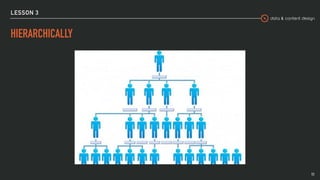
HIERARCHICALLY
11
data & content design
LESSON 3
WITH CATEGORIES
12
LIBRARIES
A JUMP INTO THE HISTORY OF
PHOTO BY JAREDD CRAIG ON UNSPLASH
data & content design
LESSON 3
HISTORY
The history of libraries began with the first efforts to organize collections
of documents. 

Topics of interest include accessibility of the collection, acquisition of materials,
arrangement and finding tools, the book trade, the influence of the physical
properties of the different writing materials, language distribution, role in education,
rates of literacy, budgets, staffing, libraries for specially targeted audiences,
architectural merit, patterns of usage, and the role of libraries in a nation's cultural
heritage, and the role of government, church or private sponsorship. 

Since the 1960s, issues of computerization and digitization have arisen.
14
data & content design
LESSON 3
CATALOGING
The function of the catalog is to identify all the items in a collection and to group
like items together.
All the great libraries of the ancient world seem to have had lists and inventories,
whether kept on clay, stone, papyrus, parchment, palm leaves, or bamboo strips.
15
data & content design
LESSON 3
LIBRARY OF ASHURBANIPAL 
Ashurbanipal (reigned 668–c. 627 BC), the last of the great
kings of Assyria, maintained an archive of some 25,000
tablets, comprising transcripts and texts systematically
collected from temples throughout his kingdom.
The tablets were stored in a variety of containers such as
wooden boxes, woven baskets of reeds, or clay shelves. The
"libraries" were cataloged using colophons, which are a
publisher's imprint on the spine of a book, or in this case a
tablet. The colophons stated the series name, the title of the
tablet, and any extra information the scribe needed to indicate.
Eventually, the clay tablets were organized by subject and size. 
16
data & content design
LESSON 3
ANCIENT CHINA
In ancient China the emperor Shih huang-ti, a member of the Ch’in dynasty and ruler of
the first unified Chinese empire, ordered that historical records other than those of the
Ch’in be destroyed so that history might be seen to begin with his dynasty.
Repression of history was lifted, however, under the Han dynasty, which succeeded the
Ch’in in 206 BC and classification schemes were developed.
Some favoured a seven-part classification, which included the Confucian
classics, philosophy, rhymed work (both prose and poetry), military prose, scientific and
occult writings, summaries, and medicine. 

A later system categorized writings into four types: the classics, history, philosophy, and
miscellaneous works.
17
data & content design
LESSON 3
ORGANIZING
For many centuries the feature that gave a work its unique identity was the name
of the writer, and users of the library were expected to know the names of the
authors whose works they wished to consult.
Since the late 19th century far more attention has been paid to cataloging the
subject contents of books as well as the names of their authors.
18
data & content design
LESSON 3
LIBRARY CLASSIFICATION IN USE
While catalogs aim to identify and list items in a collection, schemes
of classification have a more general application in arranging documents in a
sequence that will make sense and be helpful to the user. 
19
data & content design
LESSON 3
LIBRARY CLASSIFICATION IN USE
Classification systems can be divided into three types depending on how they are used:
▸ Universal schemes 

Covers all subjects, e.g. the Dewey Decimal Classification, Universal Decimal
Classification and Library of Congress Classification.
▸ Specific classification schemes

Covers particular subjects or types of materials, e.g. Iconclass, British Catalogue of
Music Classification, and Dickinson classification, or the NLM Classification.
▸ National schemes

Specially created for certain countries, e.g. the Swedish library classification system,
SAB (Sveriges Allmänna Biblioteksförening).
20
data & content design
LESSON 3
DEWEY DECIMAL CLASSIFICATION
The Dewey Decimal Classification (DDC) is
a general knowledge organisation tool first
published in the United States by Melvil
Dewey in 1876 and until now it and revised
through 23 major editions.
Basic classes are organised by disciplines
or fields of study.
The scheme comprises ten classes, each
divided into ten divisions, each having ten
sections.
21
data & content design
LESSON 3
DEWEY DECIMAL CLASSIFICATION
The system's notation uses Arabic numbers, with three whole numbers making up the main classes
and sub-classes and decimals designating further divisions. 

For example:
500 Natural sciences and mathematics
510 Mathematics
516 Geometry
516.3 Analytic geometries
516.37 Metric differential geometries
516.375 Finsler geometry
22
CLASSIFICATION
DATA
data & content design
LESSON 3
LINNAEUS CLASSIFICATION SYSTEM
Linnaeus described a particular form of biological classification (taxonomy) in his
Systema Naturae (1735) and subsequent works. In the taxonomy of Linnaeus
there are three kingdoms, divided into classes, and they, in turn, into orders,
genera and species.
24
data & content design
LESSON 3
MODERN CLASSIFICATION
25
data & content design
LESSON 3
VOLCANOS
▸ Active
▸ Dormant
▸ Extinct
or by eruption type.
26
data & content design
LESSON 3
ERUPTION CLASSIFICATION
27IMG BY CHIARA CINGOTTINI, DENSITYDESIGN RESEARCH LAB - CC-BY-SA
data & content design
LESSON 3
STELLAR CLASSIFICATION
28IMG BY RURSUS AT ENGLISH WIKIPEDIA - CC-BY-SA
data & content design
LESSON 3
SATELLITE CLASSIFICATION
29
data & content design
LESSON 3
LANGUAGE FAMILIES
30
data & content design
LESSON 3
ADMINISTRATIVE DIVISION
31
data & content design
LESSON 3
32
COUNTRY & SCHOOL
YOU
IMG BY GURCH AT ENGLISH WIKIPEDIA - CC-BY
data & content design
LESSON 3
YOUR COUNTRY
▸ Italy - 9
▸ South Korea - 3
▸ Egypt
▸ Mexico
▸ Serbia
▸ The Netherlands
35
▸ Norway
▸ Taiwan
▸ Costa Rica
▸ Macedonia
▸ Turkey
▸ Australia
Your name Where are you from?
How many years did you spend at
school till now?
Greta Scuto Italy 20
Vittoria Italy 20
Soonji Kwun South Korea 17
Rewan Egypt 15
Aurora Italy 16
Neithan Mexico 17
Nadja Serbia 14
Andrea Italy 17
Nadia van 't Klooster The Netherlands 19
Yeso Lee South Korea 15
Hanne Heimdal Norway 16
Hsin Yi Chen Taiwan 14
Yuri Michieletti Costa Rica 18
Alessandro Calzoni Italy 19
Giulia Filippi Italy 15
Elena Fantini Italy 19
Stasha Macedonia 15
Eugenio Tonoli Italy 18
Ahmet Karan Oner Turkey 16
Eileen Australia 20
Matteo Italy 17
Yeso Lee South Korea 15
WIKIPEDIA
DATA ORGANIZATION IN
IMG BY GURCH AT ENGLISH WIKIPEDIA - CC-BY
https://en.wikipedia.org/wiki/Wikipedia:Categorization

Information Classification

  • 1.
    data & contentdesign Frieda Brioschi - frieda.brioschi@gmail.com Emma Tracanella - emma.tracanella@gmail.com INFORMATION CLASSIFICATION LESSON 3 - 2019/20
  • 2.
    WITH YOUR DATAMANIPULATION LET’S START
  • 3.
    data & contentdesign LESSON 3 3 PRESENT YOUR DATA(SET)
  • 4.
    data & contentdesign LESSON 3 NEXT STEP 4
  • 5.
    data & contentdesign LESSON 3 DATA ORGANIZATION Organizing data is very difficult. There are many ways that you can do it. Actually, there is an infinite number of options that you can take to organize the data properly. There are people who have issues with data organization simply because of the huge volumes that it presents itself in. There is a world of difference between designing the database and the data organization itself. How will the data be organized in the database? 5
  • 6.
    data & contentdesign LESSON 3 METHODS 1. location 2. alphabetically 3. chronologically 4. with hierarchies 5. using categories 6
  • 7.
    data & contentdesign LESSON 3 LOCATION 7
  • 8.
    data & contentdesign LESSON 3 LOCATION 8
  • 9.
    data & contentdesign LESSON 3 ALPHABETICALLY 9
  • 10.
    data & contentdesign LESSON 3 CHRONOLOGICALLY 10
  • 11.
    data & contentdesign LESSON 3 HIERARCHICALLY 11
  • 12.
    data & contentdesign LESSON 3 WITH CATEGORIES 12
  • 13.
    LIBRARIES A JUMP INTOTHE HISTORY OF PHOTO BY JAREDD CRAIG ON UNSPLASH
  • 14.
    data & contentdesign LESSON 3 HISTORY The history of libraries began with the first efforts to organize collections of documents. 
 Topics of interest include accessibility of the collection, acquisition of materials, arrangement and finding tools, the book trade, the influence of the physical properties of the different writing materials, language distribution, role in education, rates of literacy, budgets, staffing, libraries for specially targeted audiences, architectural merit, patterns of usage, and the role of libraries in a nation's cultural heritage, and the role of government, church or private sponsorship. 
 Since the 1960s, issues of computerization and digitization have arisen. 14
  • 15.
    data & contentdesign LESSON 3 CATALOGING The function of the catalog is to identify all the items in a collection and to group like items together. All the great libraries of the ancient world seem to have had lists and inventories, whether kept on clay, stone, papyrus, parchment, palm leaves, or bamboo strips. 15
  • 16.
    data & contentdesign LESSON 3 LIBRARY OF ASHURBANIPAL  Ashurbanipal (reigned 668–c. 627 BC), the last of the great kings of Assyria, maintained an archive of some 25,000 tablets, comprising transcripts and texts systematically collected from temples throughout his kingdom. The tablets were stored in a variety of containers such as wooden boxes, woven baskets of reeds, or clay shelves. The "libraries" were cataloged using colophons, which are a publisher's imprint on the spine of a book, or in this case a tablet. The colophons stated the series name, the title of the tablet, and any extra information the scribe needed to indicate. Eventually, the clay tablets were organized by subject and size.  16
  • 17.
    data & contentdesign LESSON 3 ANCIENT CHINA In ancient China the emperor Shih huang-ti, a member of the Ch’in dynasty and ruler of the first unified Chinese empire, ordered that historical records other than those of the Ch’in be destroyed so that history might be seen to begin with his dynasty. Repression of history was lifted, however, under the Han dynasty, which succeeded the Ch’in in 206 BC and classification schemes were developed. Some favoured a seven-part classification, which included the Confucian classics, philosophy, rhymed work (both prose and poetry), military prose, scientific and occult writings, summaries, and medicine. 
 A later system categorized writings into four types: the classics, history, philosophy, and miscellaneous works. 17
  • 18.
    data & contentdesign LESSON 3 ORGANIZING For many centuries the feature that gave a work its unique identity was the name of the writer, and users of the library were expected to know the names of the authors whose works they wished to consult. Since the late 19th century far more attention has been paid to cataloging the subject contents of books as well as the names of their authors. 18
  • 19.
    data & contentdesign LESSON 3 LIBRARY CLASSIFICATION IN USE While catalogs aim to identify and list items in a collection, schemes of classification have a more general application in arranging documents in a sequence that will make sense and be helpful to the user.  19
  • 20.
    data & contentdesign LESSON 3 LIBRARY CLASSIFICATION IN USE Classification systems can be divided into three types depending on how they are used: ▸ Universal schemes 
 Covers all subjects, e.g. the Dewey Decimal Classification, Universal Decimal Classification and Library of Congress Classification. ▸ Specific classification schemes
 Covers particular subjects or types of materials, e.g. Iconclass, British Catalogue of Music Classification, and Dickinson classification, or the NLM Classification. ▸ National schemes
 Specially created for certain countries, e.g. the Swedish library classification system, SAB (Sveriges Allmänna Biblioteksförening). 20
  • 21.
    data & contentdesign LESSON 3 DEWEY DECIMAL CLASSIFICATION The Dewey Decimal Classification (DDC) is a general knowledge organisation tool first published in the United States by Melvil Dewey in 1876 and until now it and revised through 23 major editions. Basic classes are organised by disciplines or fields of study. The scheme comprises ten classes, each divided into ten divisions, each having ten sections. 21
  • 22.
    data & contentdesign LESSON 3 DEWEY DECIMAL CLASSIFICATION The system's notation uses Arabic numbers, with three whole numbers making up the main classes and sub-classes and decimals designating further divisions. 
 For example: 500 Natural sciences and mathematics 510 Mathematics 516 Geometry 516.3 Analytic geometries 516.37 Metric differential geometries 516.375 Finsler geometry 22
  • 23.
  • 24.
    data & contentdesign LESSON 3 LINNAEUS CLASSIFICATION SYSTEM Linnaeus described a particular form of biological classification (taxonomy) in his Systema Naturae (1735) and subsequent works. In the taxonomy of Linnaeus there are three kingdoms, divided into classes, and they, in turn, into orders, genera and species. 24
  • 25.
    data & contentdesign LESSON 3 MODERN CLASSIFICATION 25
  • 26.
    data & contentdesign LESSON 3 VOLCANOS ▸ Active ▸ Dormant ▸ Extinct or by eruption type. 26
  • 27.
    data & contentdesign LESSON 3 ERUPTION CLASSIFICATION 27IMG BY CHIARA CINGOTTINI, DENSITYDESIGN RESEARCH LAB - CC-BY-SA
  • 28.
    data & contentdesign LESSON 3 STELLAR CLASSIFICATION 28IMG BY RURSUS AT ENGLISH WIKIPEDIA - CC-BY-SA
  • 29.
    data & contentdesign LESSON 3 SATELLITE CLASSIFICATION 29
  • 30.
    data & contentdesign LESSON 3 LANGUAGE FAMILIES 30
  • 31.
    data & contentdesign LESSON 3 ADMINISTRATIVE DIVISION 31
  • 32.
    data & contentdesign LESSON 3 32
  • 33.
  • 34.
    IMG BY GURCH ATENGLISH WIKIPEDIA - CC-BY
  • 35.
    data & contentdesign LESSON 3 YOUR COUNTRY ▸ Italy - 9 ▸ South Korea - 3 ▸ Egypt ▸ Mexico ▸ Serbia ▸ The Netherlands 35 ▸ Norway ▸ Taiwan ▸ Costa Rica ▸ Macedonia ▸ Turkey ▸ Australia
  • 36.
    Your name Whereare you from? How many years did you spend at school till now? Greta Scuto Italy 20 Vittoria Italy 20 Soonji Kwun South Korea 17 Rewan Egypt 15 Aurora Italy 16 Neithan Mexico 17 Nadja Serbia 14 Andrea Italy 17 Nadia van 't Klooster The Netherlands 19 Yeso Lee South Korea 15 Hanne Heimdal Norway 16 Hsin Yi Chen Taiwan 14 Yuri Michieletti Costa Rica 18 Alessandro Calzoni Italy 19 Giulia Filippi Italy 15 Elena Fantini Italy 19 Stasha Macedonia 15 Eugenio Tonoli Italy 18 Ahmet Karan Oner Turkey 16 Eileen Australia 20 Matteo Italy 17 Yeso Lee South Korea 15
  • 37.
  • 38.
    IMG BY GURCH ATENGLISH WIKIPEDIA - CC-BY https://en.wikipedia.org/wiki/Wikipedia:Categorization