Nature of bibliographic control systems (Dewey) IST 603 November 15, 2006 Denise A. Garofalo
Bibliographic control systems Allow for the organization of the bibliographic universe into some systematic order In libraries, provide the systematic arrangement by subject of materials in a manner most useful for retrieval
What is classification? A bibliographic control system A system of arranging a library’s collection on the shelves which provides formal and orderly access to the materials shelved A means of bringing together related items in a useful sequence from general to specific A way to lead the user to the needed items
Shelf types--open stacks Open stacks : allows for a direct search of the shelves by a user encourage browsing stimulate awareness of collection require comprehensible classification system
Shelf types--closed stacks Closed stacks : a library staff member retrieves requested items from the shelves   only staff are permitted in the stacks lessen chance that items will be mishandled, misplaced or taken require patron to limit searching to the catalog and wait for staff to retrieve items
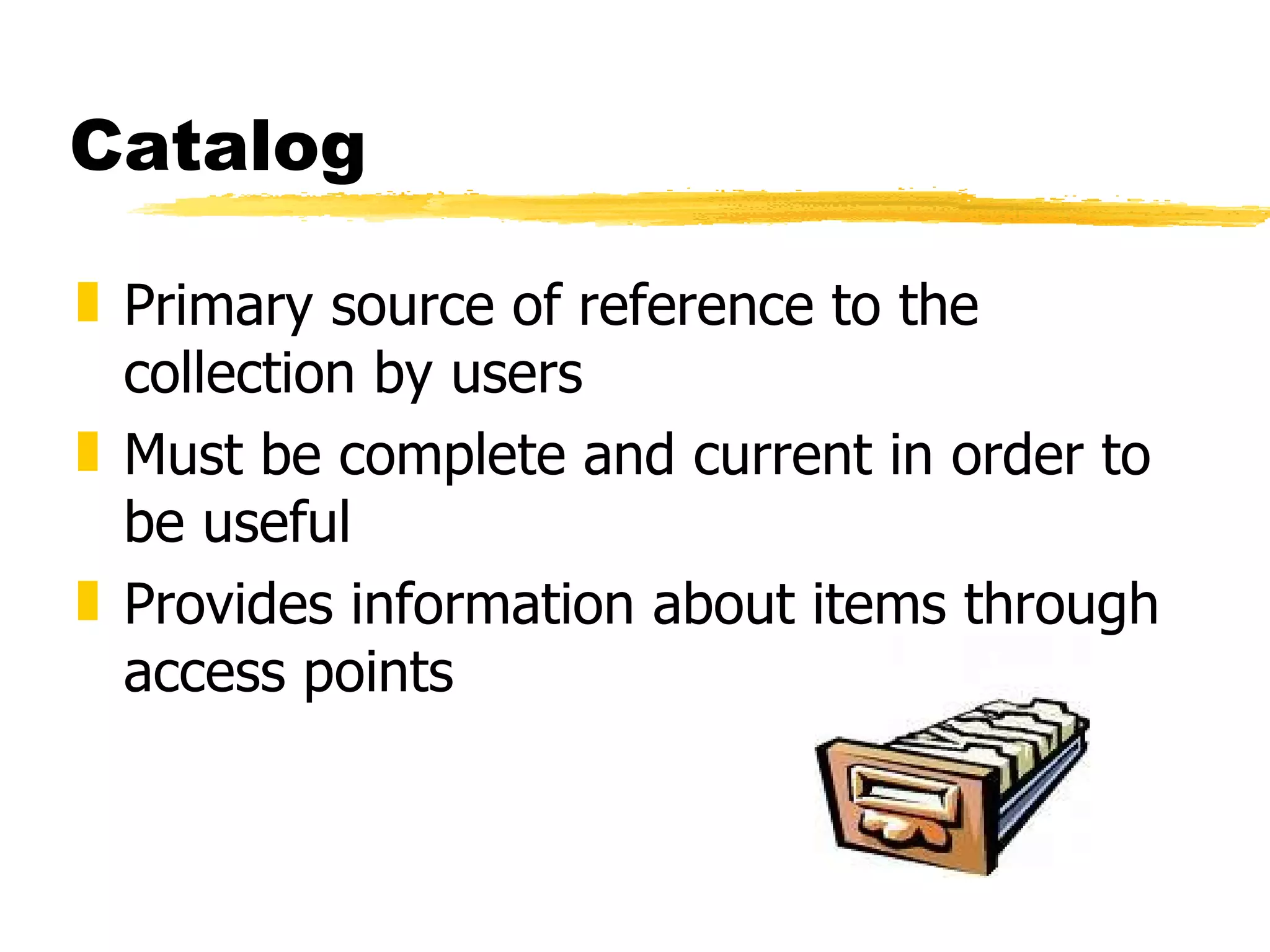
Catalog Primary source of reference to the collection by users Must be complete and current in order to be useful Provides information about items through access points
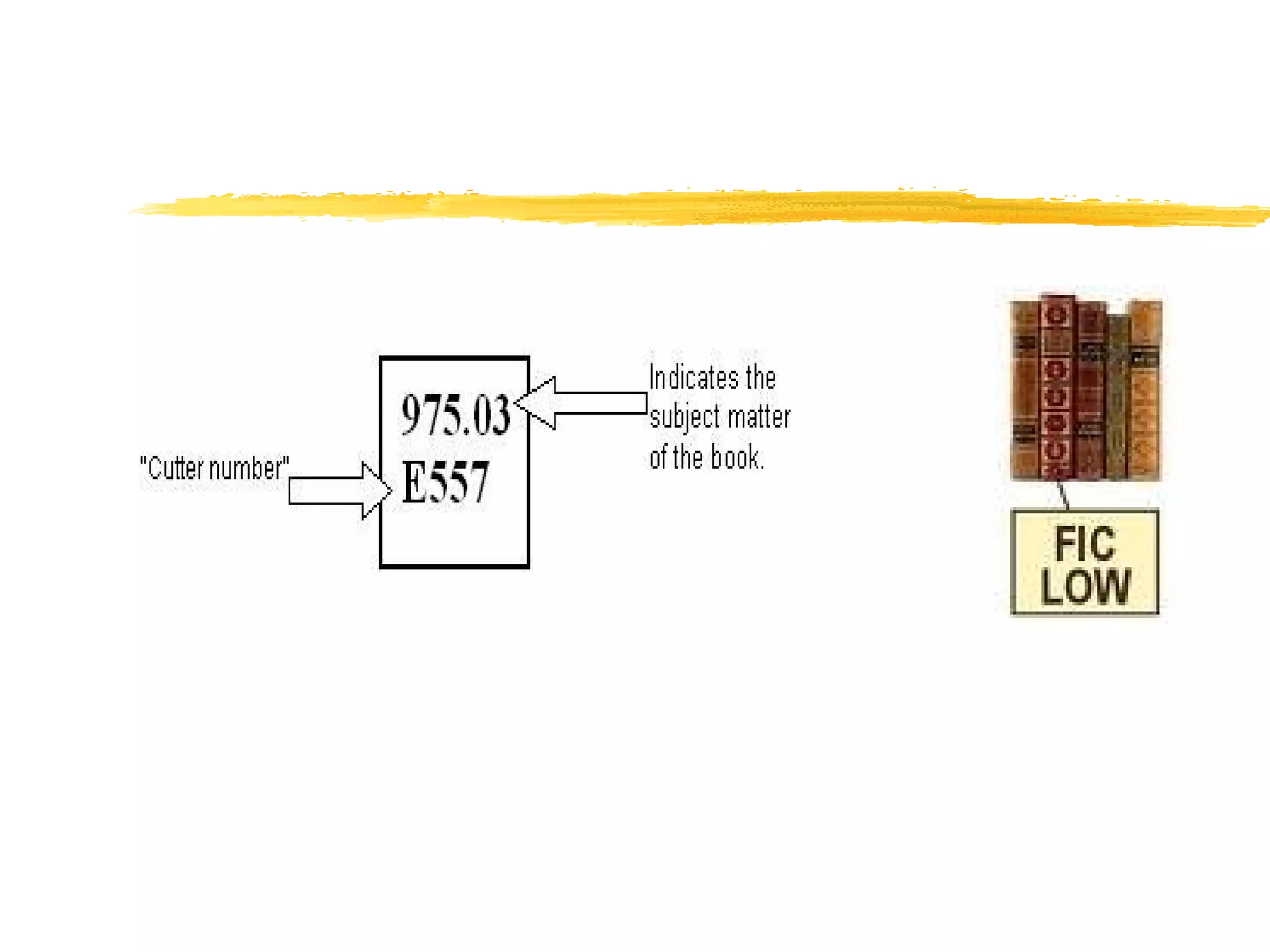
Call number The call number contains the information about where the item is shelved May have a location or collection prefix--j or REF or VIDEO Next element is the classification number--736 or 917.3 or PZ4 Next is the Cutter number, an alpha-numeric related to the main entry or author--H74 or Q14 May include a copy or accession number as the final element
 
Classification--background Collections have always had some sort of arrangement groupings by title or broad subject or date or size, etc. arrangements generally involved a fixed shelf location for materials Substantive developments in library collection arrangement occurred in the 19th century
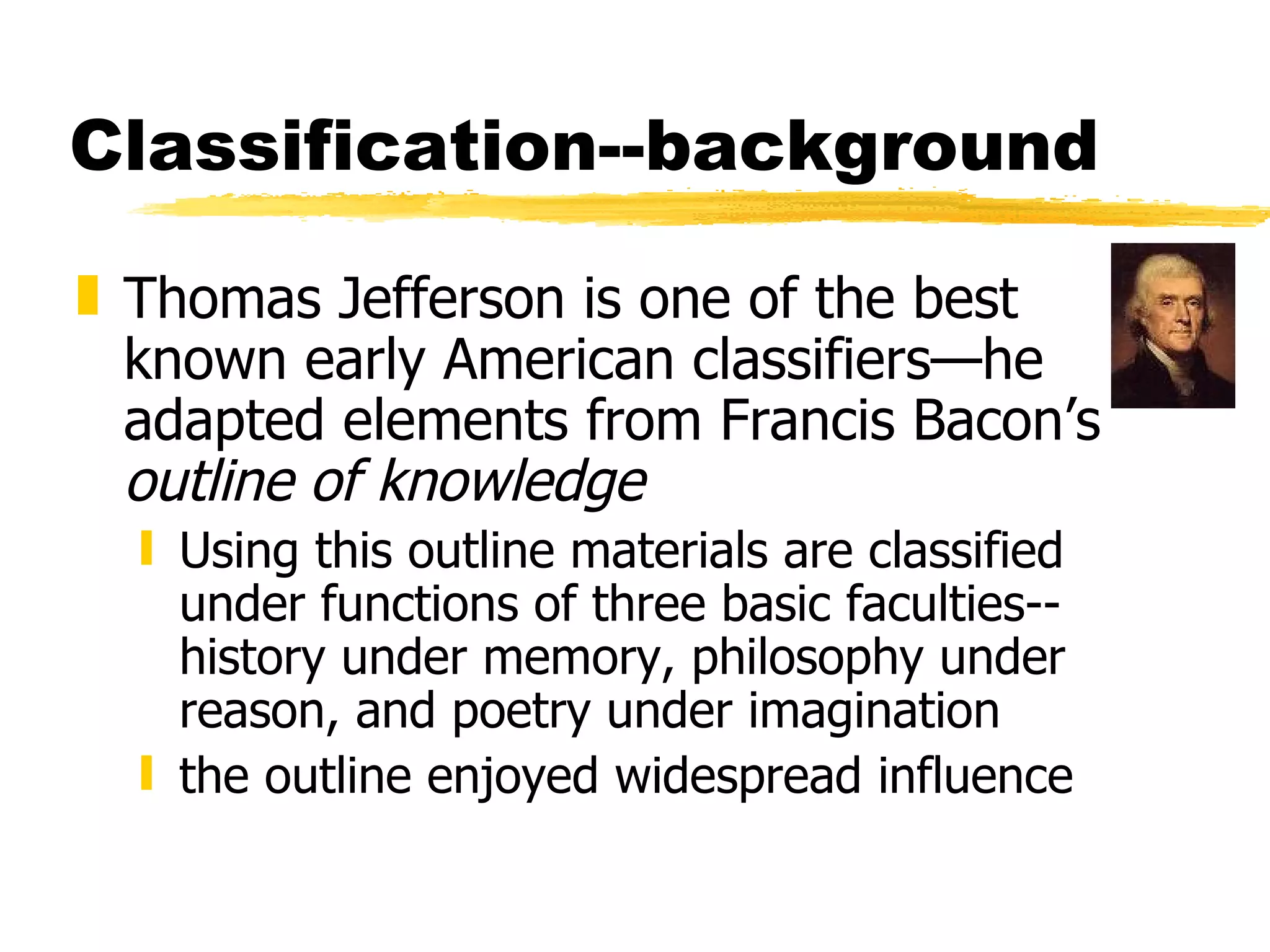
Classification--background Thomas Jefferson is one of the best known early American classifiers—he adapted elements from Francis Bacon’s  outline of knowledge Using this outline materials are classified under functions of three basic faculties--history under memory, philosophy under reason, and poetry under imagination the outline enjoyed widespread influence
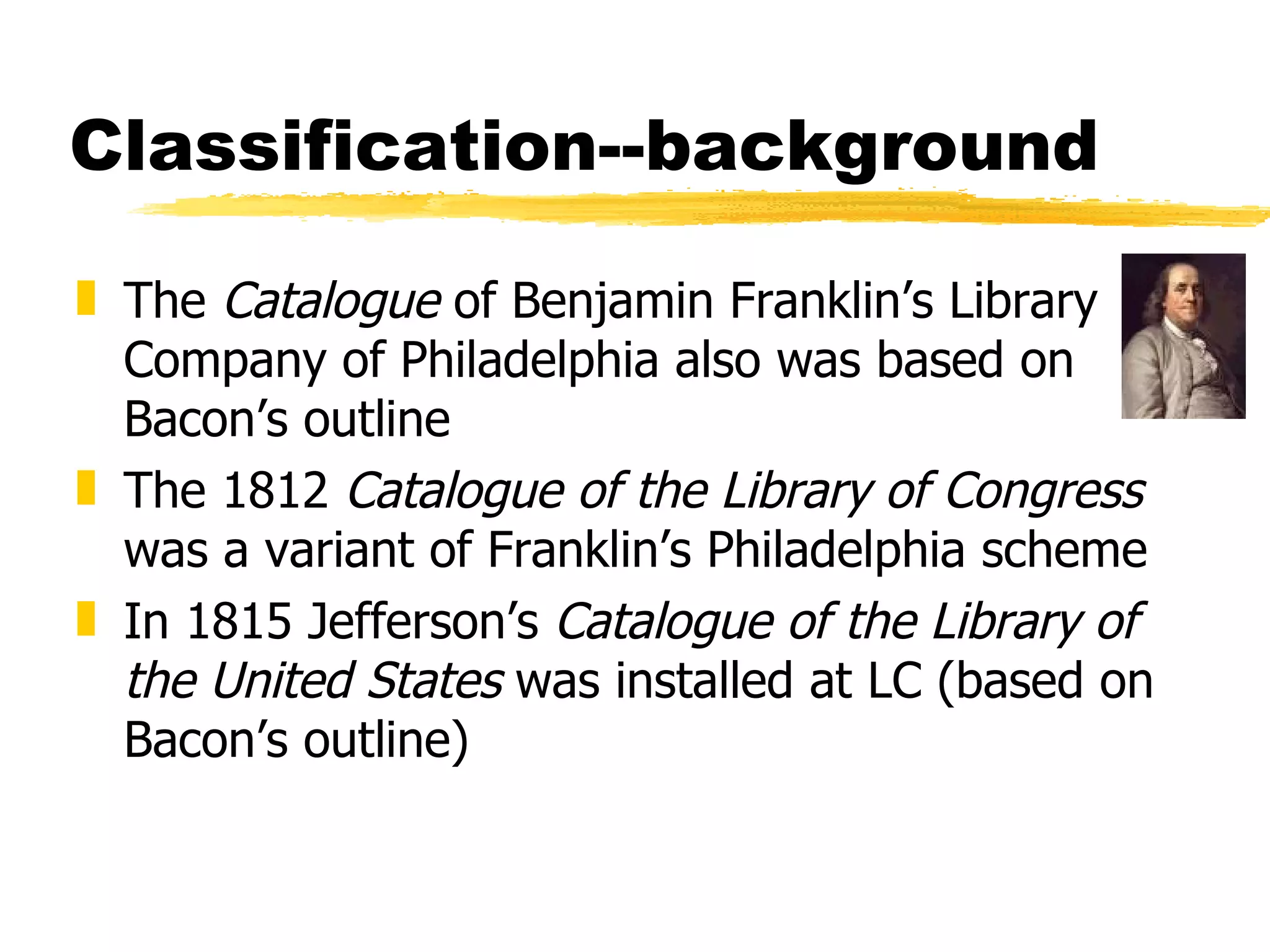
Classification--background The  Catalogue  of Benjamin Franklin’s Library Company of Philadelphia also was based on Bacon’s outline The 1812  Catalogue of the Library of Congress  was a variant of Franklin’s Philadelphia scheme In 1815 Jefferson’s  Catalogue of the Library of the United States  was installed at LC (based on Bacon’s outline)
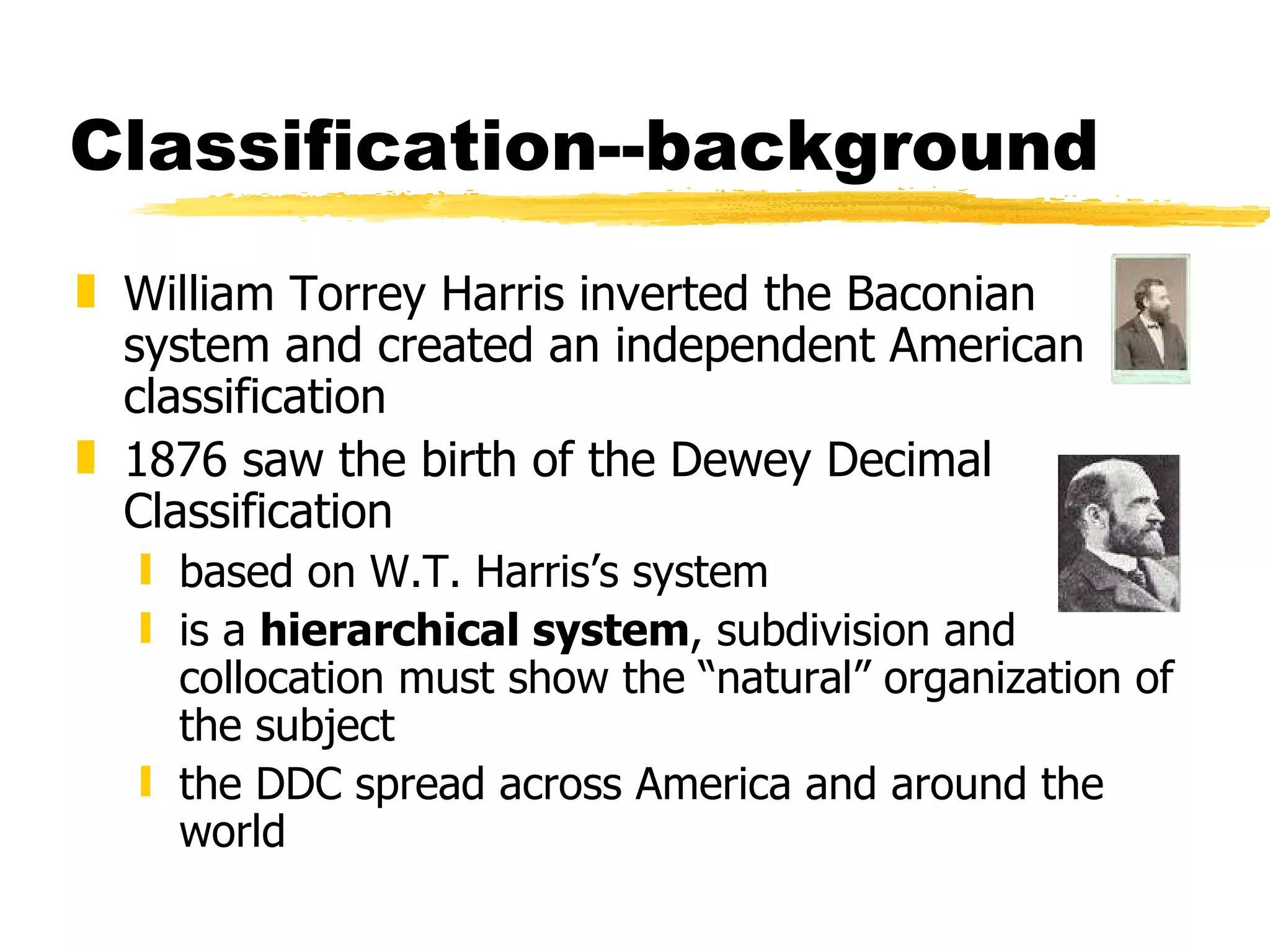
Classification--background William Torrey Harris inverted the Baconian system and created an independent American classification 1876 saw the birth of the Dewey Decimal Classification based on W.T. Harris’s system is a  hierarchical system , subdivision and collocation must show the “natural” organization of the subject the DDC spread across America and around the world
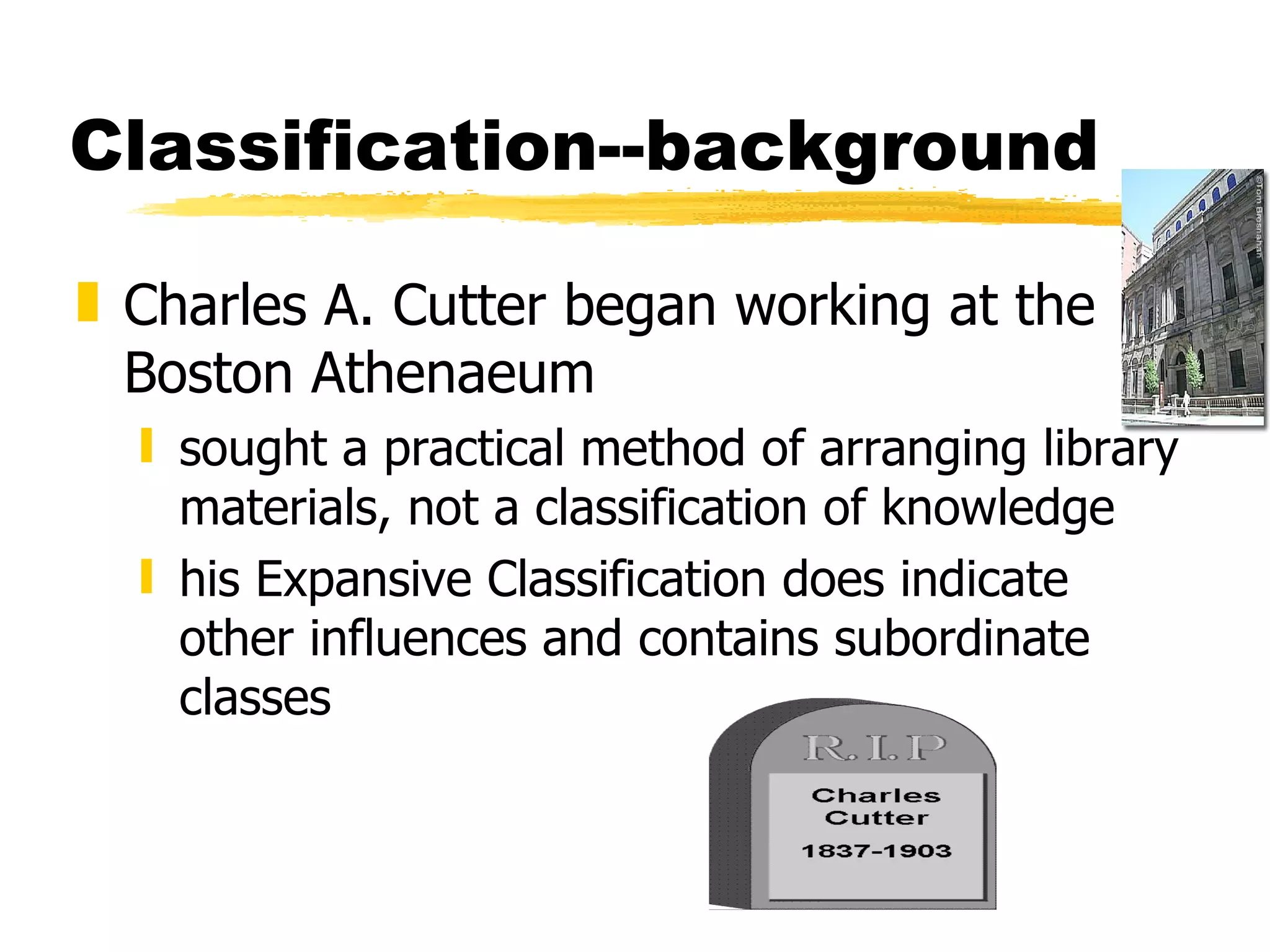
Classification--background Charles A. Cutter began working at the Boston Athenaeum sought a practical method of arranging library materials, not a classification of knowledge his Expansive Classification does indicate other influences and contains subordinate classes
Classification--background By the early 1900s LC’s collection had grown to almost 1 million items The DDC was not robust enough for LC J.C.M. Hanson and Charles Martel designed an independent system governed by the actual content of the collection--the LC classification system not a philosophic approach is an  enumerative classification  because it seeks to assign designations (to enumerate) all the subject concepts required in the system
Classification--background Another type of classification is synthetic, where lists of designations are confined to single, unsubdivided concepts and providing generalized rules from which to construct headings for composite subjects
Classification schemes Most traditional schemes are enumerative Recent schemes are synthetic Note that materials on shelves or in files are arranged in a single order may have multiple access points (subject, author, title, etc.) can only by organized by one of these at a time
Questions?
Classification schemes--overview A  general works class  accommodates items so broad in scope that no one class can be chosen--encyclopedias, dictionaries Form classes  organize materials according to how information is presented rather than content--poetry, plays, fiction, scores Form divisions  group items according to form--philosophical treatments, biographies Includes an index for an alpha approach to the classified part of the scheme
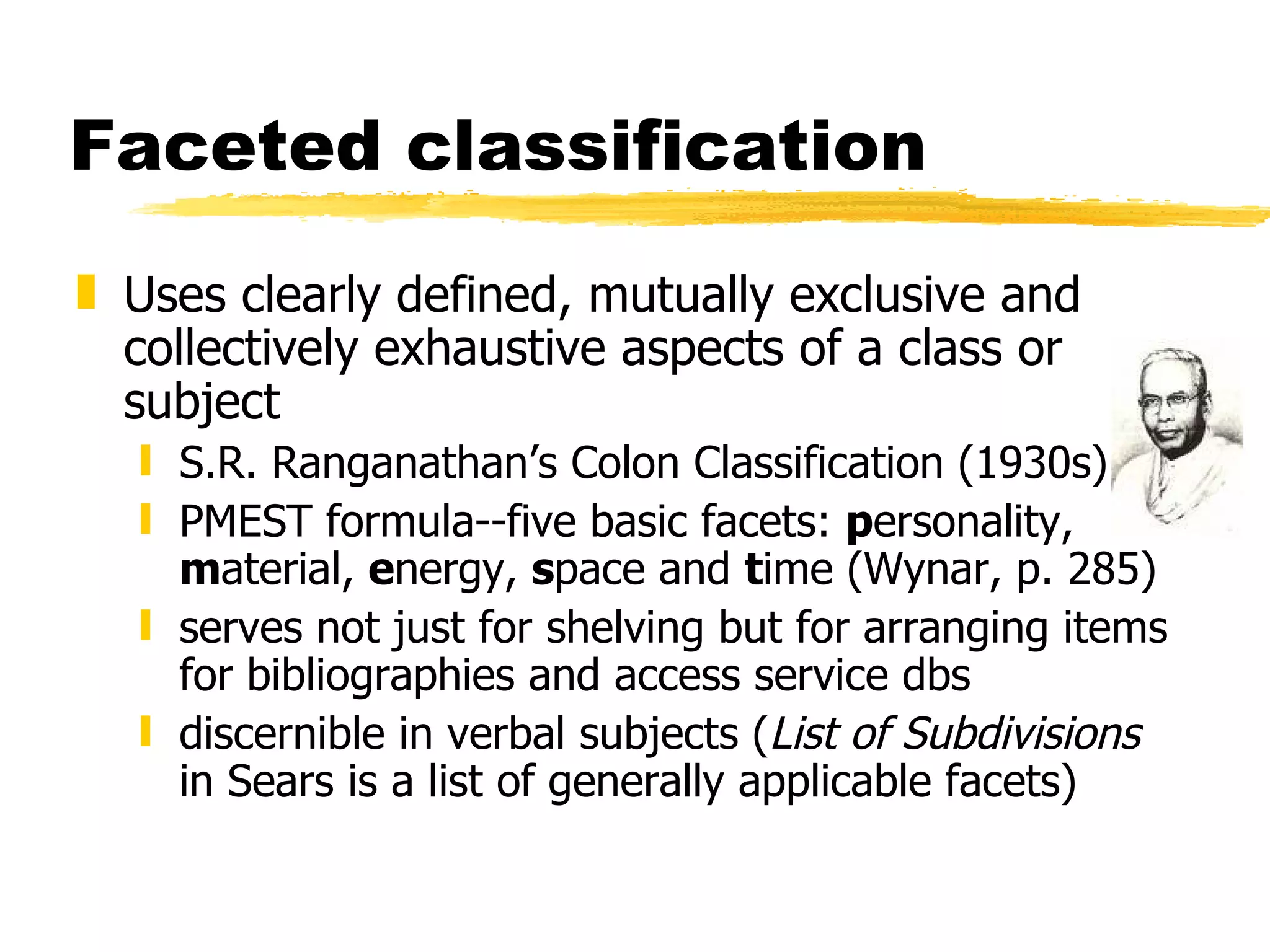
Faceted classification Uses clearly defined, mutually exclusive and collectively exhaustive aspects of a class or subject S.R. Ranganathan’s Colon Classification (1930s) PMEST formula--five basic facets:  p ersonality,  m aterial,  e nergy,  s pace and  t ime (Wynar, p. 285) serves not just for shelving but for arranging items for bibliographies and access service dbs discernible in verbal subjects ( List of Subdivisions  in Sears is a list of generally applicable facets)
Classification criteria Inclusive as well as comprehensive (encompass the whole field of knowledge) Systematic (bring together related topics in logical fashion) Flexible and expansible (new subjects can be inserted with dislocating the general sequence) Employ clear and descriptive terminology
Classification--broad, close Close classification : classing each work as specifically as possible, using all available subdivisions (LC classification) Broad classification : groups works under the main divisions and subdivisions, without using breakdowns into narrower concepts (most useful in smaller collections; DDC)
General principles
Choosing the best location Please note : Classification schemes vary in their flexibility regarding local manipulation Try to be consistent to avoid confusion
General precepts Class first according to subject, then by form (except in generals, where form may be paramount) Class where it will be most useful Place it in the most specific subject division that will contain it, rather than with the general topic If it deals with 2 or 3 subjects, place it with the predominant subject or the one treated first. More than 3 subjects--place it in the general class which combines all of the subjects
Refining precepts A work discussing the Spanish influence on Portuguese literature should be classed with Portuguese literature--class works dealing with two subjects where one influences another are placed in the subject acted upon or influenced Monographic sets--class either all together under a broad number or class separately under each individual volume’s subject
No classification is perfect Each classification scheme is limited A scheme can be logical within itself but have inconsistencies language is separate from literature and history from social sciences in DDC language is classed with literature and history close to social sciences in LCC DDC and LCC are linear and uni-dimensional
More limitations Reorganization and relocation cause problems new numbers for new concepts moving concepts to more logical locations Notations become more complex when keeping a scheme up-to-date Purchased cataloging is only as good as the vendor’s catalogers
Questions?
Break time
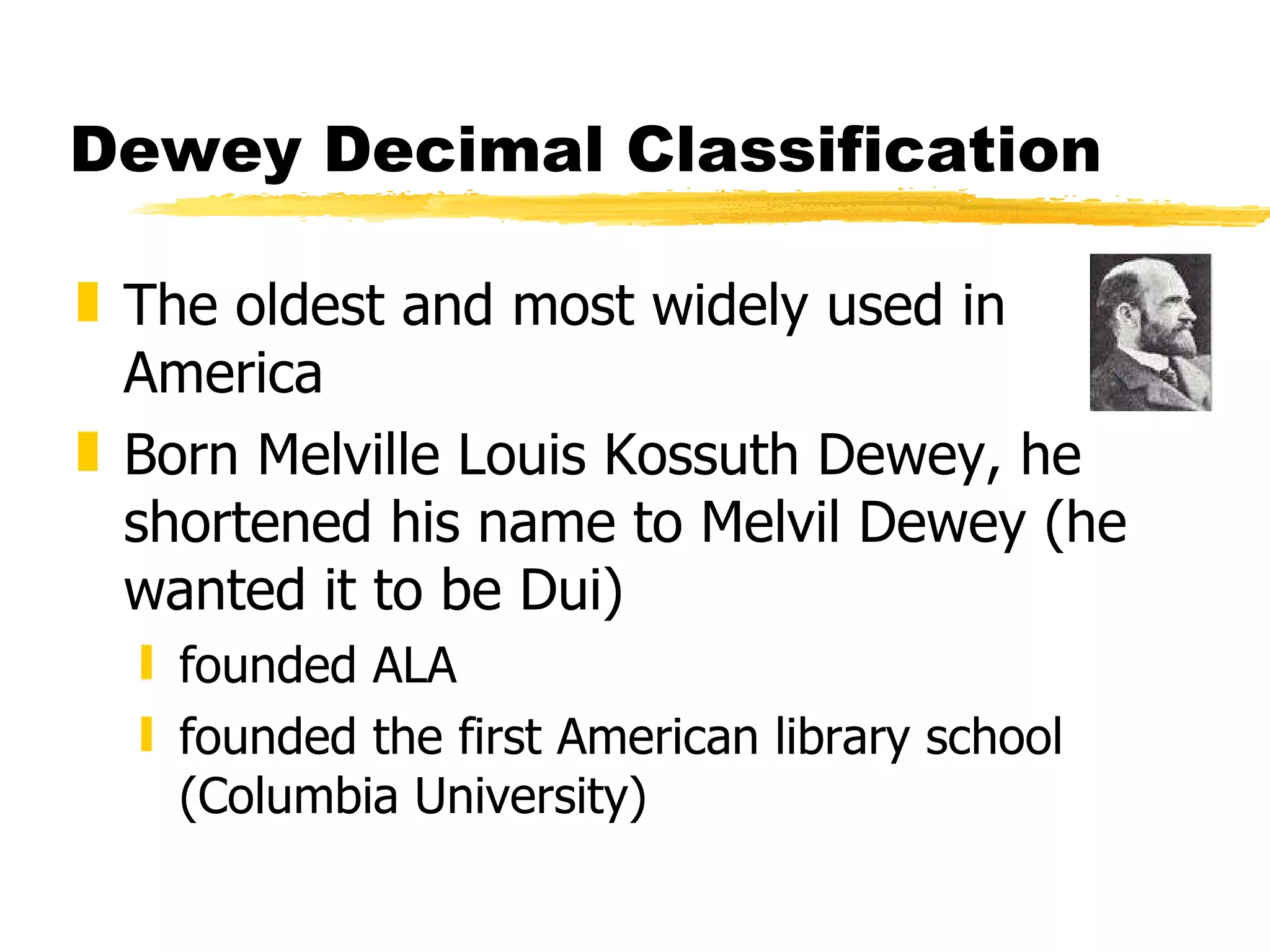
Dewey Decimal Classification The oldest and most widely used in America Born Melville Louis Kossuth Dewey, he shortened his name to Melvil Dewey (he wanted it to be Dui) founded ALA founded the first American library school (Columbia University)
Dewey Decimal Classification Dewey never claimed to have originated decimals His relative index was his claim to originality in his classification a key to the diverse material included in his tables however his most significant contribution  IS  decimals, in the hierarchical divisions
Dewey Decimal Classification First DDC came out anonymously in 1876 and was titled  A Classification and Subject Index for Cataloguing and Arranging the Books and Pamphlets of a Library The second, revised and greatly enlarged, edition came out in 1885 under Dewey’s name UDC ( U niversal  D ecimal  C lassification) is based on the DDC
DDC--basic concepts Arranges all knowledge (library materials) into 10 broad subject classes numbered from 000-900 Numbers can be expanded to cover aspects of general subjects The more specific the item being classified the longer the number grows Long numbers may be accurate but are impractical and unwieldy
DDC--basic concepts A compact scheme--4 volumes total (22 nd ) Incorporates mnemonic devices transferred from one class to another (-03 at the end of a class number of any length indicates a dictionary of the subject at hand) Allows for a great detail of specification Arranges subjects from the general to the specific
DDC--basic premise Under Dewey there is no one class for any given subject Primary arrangement is by discipline Any specific topic may appear in any number of disciplines Aspects of a topic are brought together in the relative index
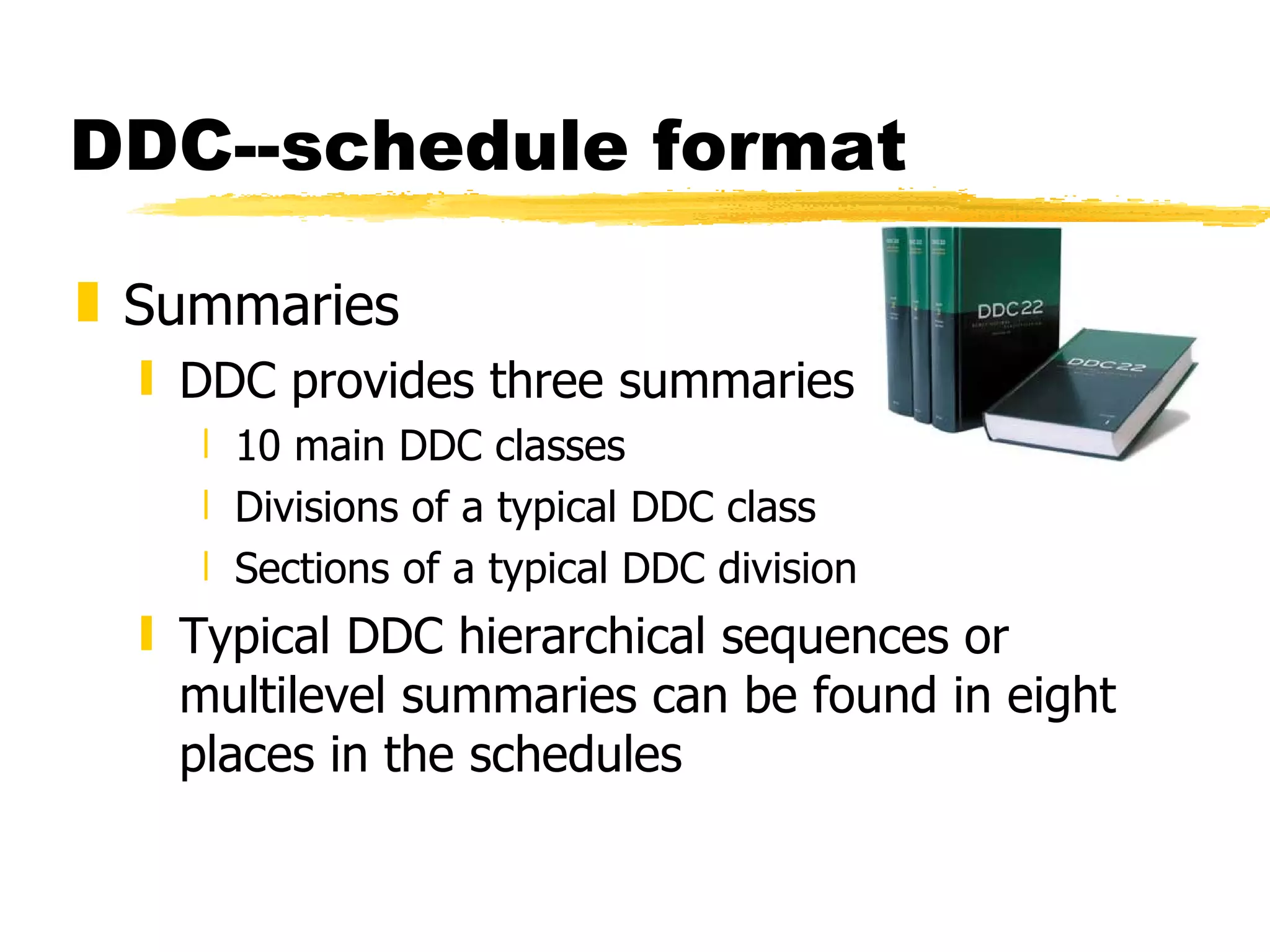
DDC--schedule format Summaries DDC provides three summaries 10 main DDC classes Divisions of a typical DDC class Sections of a typical DDC division Typical DDC hierarchical sequences or multilevel summaries can be found in eight places in the schedules
DDC--basic concepts Notes are a helpful source of information notes that tell what is found at a class # notes that tell what is found at other class #s notes that ID topics in “standing room” (topics that don’t have enough works about them to justify a separate number--computers were like this for awhile, 001.6 then 004-006) notes that explain changes in schedules and tables notes that instruct in number building notes that prescribe precedence order notes that explain options
DDC--basic concepts Number building way to expand existing numbers in the schedules in tables these numbers are preceded by a “-” to indicate they cannot stand alone (omit the dash when attaching to a number)
Standard subdivisions  Originally “Form divisions” Some treat format Others represent modes of treatment which cover theoretical or historical aspects of the subject (such as philosophy and theory, history, etc.) Unless specific instructions indicate otherwise, these can be used with any number if application is meaningful More info available
Geographic areas When a given heading can be subdivided geographically and the library has many books dealing on the subject use Table 2 (area table) The number can be expanded by region or site The bulkiest table
Individual literatures Table 3 is actually three tables They are never used alone but under the instructions given at 808-809 and 810-890
Individual languages Table 4 is used with base numbers for individual languages See 420-490 for explanation Does provide mnemonic form divisions  -1 for writing systems -2 for etymology -3 for dictionaries
Racial, ethnic groups Table 5 is used according to specific instructions in the schedules or other tables May also be used through -89 interposition Use is parallel to that of Table 2
Languages Table 6 is a basic mnemonic table to indicate the particular language of the work or the language which is the subject
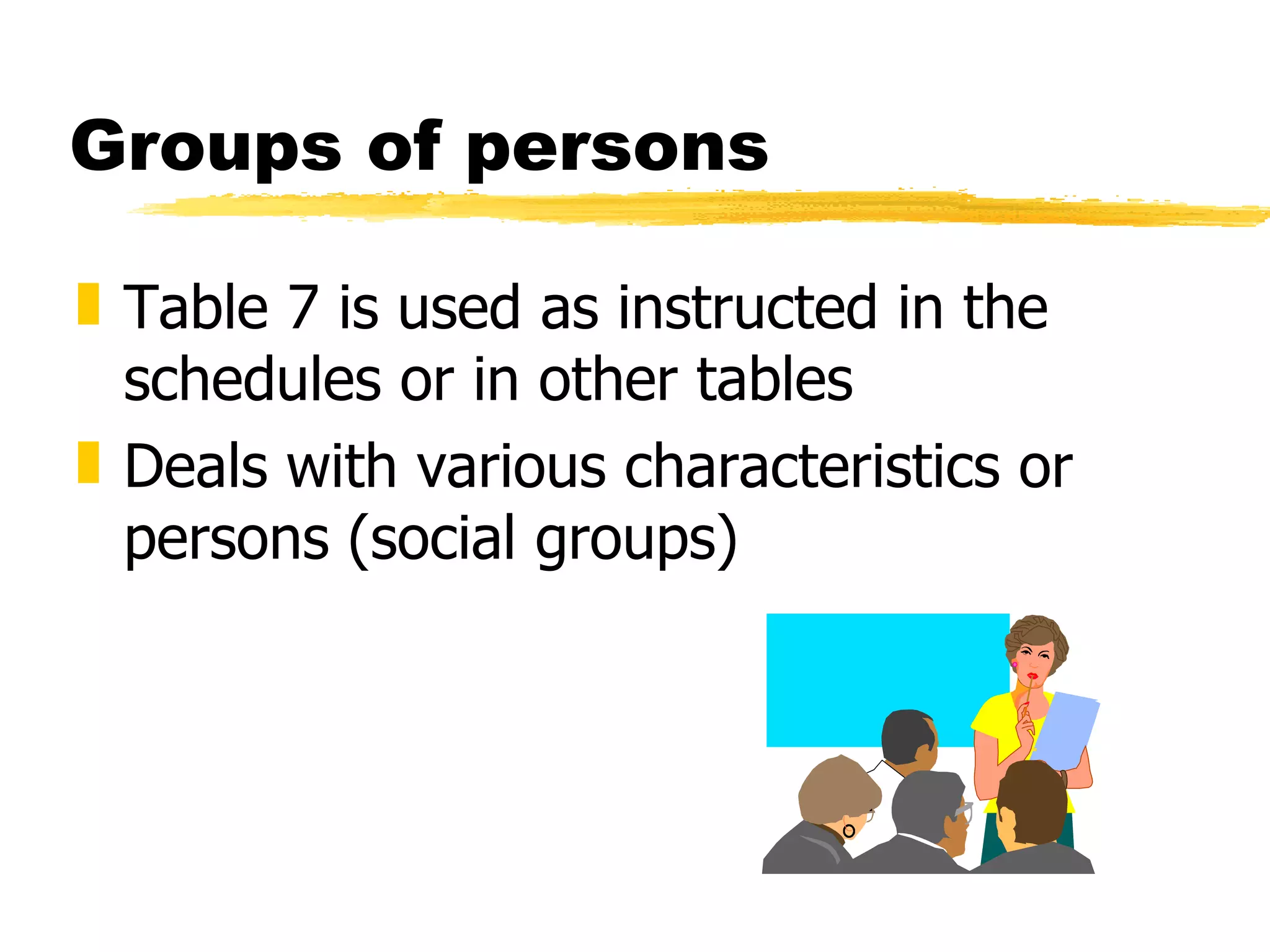
Groups of persons Table 7 is used as instructed in the schedules or in other tables Deals with various characteristics or persons (social groups)
Adding from other parts There are many places in the DDC schedules where the classifier is directed to find a number elsewhere in the schedule and add it whole to the number at hand Check DDC itself for examples
Relative index Claimed to show relationships of each specific topic to one or more disciplines and to other topics Contains terms found in the schedules and tables and synonyms for those terms Also has names of states, provinces, cities, geographic features, some personal names Does not contain phrases that begin with adjectival phrases (Portuguese plays)
Relative index Enumerates alphabetically all the main headings in the class schedules Also contains certain specific entries not actually listed in the schedules  Index terminology varies from that found in the schedules (Perspiration) Should never become a substitute for the schedules
Other DDC info DDC segments 636.6/01 small libraries may just use 636.6 larger libraries would use 636.601 Updating--new edition every 8 years or so Abridged editions are available for the very small libraries (can “grow” into full DDC) (14 th )
Questions?
Assignment Do DDC classification assignment Read Wynar Brown cover—Chapters 14, 16,17 Blue cover—Chapters 9, 11, 12

Dewey Classification

  • 1.
    Nature of bibliographiccontrol systems (Dewey) IST 603 November 15, 2006 Denise A. Garofalo
  • 2.
    Bibliographic control systemsAllow for the organization of the bibliographic universe into some systematic order In libraries, provide the systematic arrangement by subject of materials in a manner most useful for retrieval
  • 3.
    What is classification?A bibliographic control system A system of arranging a library’s collection on the shelves which provides formal and orderly access to the materials shelved A means of bringing together related items in a useful sequence from general to specific A way to lead the user to the needed items
  • 4.
    Shelf types--open stacksOpen stacks : allows for a direct search of the shelves by a user encourage browsing stimulate awareness of collection require comprehensible classification system
  • 5.
    Shelf types--closed stacksClosed stacks : a library staff member retrieves requested items from the shelves only staff are permitted in the stacks lessen chance that items will be mishandled, misplaced or taken require patron to limit searching to the catalog and wait for staff to retrieve items
  • 6.
    Catalog Primary sourceof reference to the collection by users Must be complete and current in order to be useful Provides information about items through access points
  • 7.
    Call number Thecall number contains the information about where the item is shelved May have a location or collection prefix--j or REF or VIDEO Next element is the classification number--736 or 917.3 or PZ4 Next is the Cutter number, an alpha-numeric related to the main entry or author--H74 or Q14 May include a copy or accession number as the final element
  • 8.
  • 9.
    Classification--background Collections havealways had some sort of arrangement groupings by title or broad subject or date or size, etc. arrangements generally involved a fixed shelf location for materials Substantive developments in library collection arrangement occurred in the 19th century
  • 10.
    Classification--background Thomas Jeffersonis one of the best known early American classifiers—he adapted elements from Francis Bacon’s outline of knowledge Using this outline materials are classified under functions of three basic faculties--history under memory, philosophy under reason, and poetry under imagination the outline enjoyed widespread influence
  • 11.
    Classification--background The Catalogue of Benjamin Franklin’s Library Company of Philadelphia also was based on Bacon’s outline The 1812 Catalogue of the Library of Congress was a variant of Franklin’s Philadelphia scheme In 1815 Jefferson’s Catalogue of the Library of the United States was installed at LC (based on Bacon’s outline)
  • 12.
    Classification--background William TorreyHarris inverted the Baconian system and created an independent American classification 1876 saw the birth of the Dewey Decimal Classification based on W.T. Harris’s system is a hierarchical system , subdivision and collocation must show the “natural” organization of the subject the DDC spread across America and around the world
  • 13.
    Classification--background Charles A.Cutter began working at the Boston Athenaeum sought a practical method of arranging library materials, not a classification of knowledge his Expansive Classification does indicate other influences and contains subordinate classes
  • 14.
    Classification--background By theearly 1900s LC’s collection had grown to almost 1 million items The DDC was not robust enough for LC J.C.M. Hanson and Charles Martel designed an independent system governed by the actual content of the collection--the LC classification system not a philosophic approach is an enumerative classification because it seeks to assign designations (to enumerate) all the subject concepts required in the system
  • 15.
    Classification--background Another typeof classification is synthetic, where lists of designations are confined to single, unsubdivided concepts and providing generalized rules from which to construct headings for composite subjects
  • 16.
    Classification schemes Mosttraditional schemes are enumerative Recent schemes are synthetic Note that materials on shelves or in files are arranged in a single order may have multiple access points (subject, author, title, etc.) can only by organized by one of these at a time
  • 17.
  • 18.
    Classification schemes--overview A general works class accommodates items so broad in scope that no one class can be chosen--encyclopedias, dictionaries Form classes organize materials according to how information is presented rather than content--poetry, plays, fiction, scores Form divisions group items according to form--philosophical treatments, biographies Includes an index for an alpha approach to the classified part of the scheme
  • 19.
    Faceted classification Usesclearly defined, mutually exclusive and collectively exhaustive aspects of a class or subject S.R. Ranganathan’s Colon Classification (1930s) PMEST formula--five basic facets: p ersonality, m aterial, e nergy, s pace and t ime (Wynar, p. 285) serves not just for shelving but for arranging items for bibliographies and access service dbs discernible in verbal subjects ( List of Subdivisions in Sears is a list of generally applicable facets)
  • 20.
    Classification criteria Inclusiveas well as comprehensive (encompass the whole field of knowledge) Systematic (bring together related topics in logical fashion) Flexible and expansible (new subjects can be inserted with dislocating the general sequence) Employ clear and descriptive terminology
  • 21.
    Classification--broad, close Closeclassification : classing each work as specifically as possible, using all available subdivisions (LC classification) Broad classification : groups works under the main divisions and subdivisions, without using breakdowns into narrower concepts (most useful in smaller collections; DDC)
  • 22.
  • 23.
    Choosing the bestlocation Please note : Classification schemes vary in their flexibility regarding local manipulation Try to be consistent to avoid confusion
  • 24.
    General precepts Classfirst according to subject, then by form (except in generals, where form may be paramount) Class where it will be most useful Place it in the most specific subject division that will contain it, rather than with the general topic If it deals with 2 or 3 subjects, place it with the predominant subject or the one treated first. More than 3 subjects--place it in the general class which combines all of the subjects
  • 25.
    Refining precepts Awork discussing the Spanish influence on Portuguese literature should be classed with Portuguese literature--class works dealing with two subjects where one influences another are placed in the subject acted upon or influenced Monographic sets--class either all together under a broad number or class separately under each individual volume’s subject
  • 26.
    No classification isperfect Each classification scheme is limited A scheme can be logical within itself but have inconsistencies language is separate from literature and history from social sciences in DDC language is classed with literature and history close to social sciences in LCC DDC and LCC are linear and uni-dimensional
  • 27.
    More limitations Reorganizationand relocation cause problems new numbers for new concepts moving concepts to more logical locations Notations become more complex when keeping a scheme up-to-date Purchased cataloging is only as good as the vendor’s catalogers
  • 28.
  • 29.
  • 30.
    Dewey Decimal ClassificationThe oldest and most widely used in America Born Melville Louis Kossuth Dewey, he shortened his name to Melvil Dewey (he wanted it to be Dui) founded ALA founded the first American library school (Columbia University)
  • 31.
    Dewey Decimal ClassificationDewey never claimed to have originated decimals His relative index was his claim to originality in his classification a key to the diverse material included in his tables however his most significant contribution IS decimals, in the hierarchical divisions
  • 32.
    Dewey Decimal ClassificationFirst DDC came out anonymously in 1876 and was titled A Classification and Subject Index for Cataloguing and Arranging the Books and Pamphlets of a Library The second, revised and greatly enlarged, edition came out in 1885 under Dewey’s name UDC ( U niversal D ecimal C lassification) is based on the DDC
  • 33.
    DDC--basic concepts Arrangesall knowledge (library materials) into 10 broad subject classes numbered from 000-900 Numbers can be expanded to cover aspects of general subjects The more specific the item being classified the longer the number grows Long numbers may be accurate but are impractical and unwieldy
  • 34.
    DDC--basic concepts Acompact scheme--4 volumes total (22 nd ) Incorporates mnemonic devices transferred from one class to another (-03 at the end of a class number of any length indicates a dictionary of the subject at hand) Allows for a great detail of specification Arranges subjects from the general to the specific
  • 35.
    DDC--basic premise UnderDewey there is no one class for any given subject Primary arrangement is by discipline Any specific topic may appear in any number of disciplines Aspects of a topic are brought together in the relative index
  • 36.
    DDC--schedule format SummariesDDC provides three summaries 10 main DDC classes Divisions of a typical DDC class Sections of a typical DDC division Typical DDC hierarchical sequences or multilevel summaries can be found in eight places in the schedules
  • 37.
    DDC--basic concepts Notesare a helpful source of information notes that tell what is found at a class # notes that tell what is found at other class #s notes that ID topics in “standing room” (topics that don’t have enough works about them to justify a separate number--computers were like this for awhile, 001.6 then 004-006) notes that explain changes in schedules and tables notes that instruct in number building notes that prescribe precedence order notes that explain options
  • 38.
    DDC--basic concepts Numberbuilding way to expand existing numbers in the schedules in tables these numbers are preceded by a “-” to indicate they cannot stand alone (omit the dash when attaching to a number)
  • 39.
    Standard subdivisions Originally “Form divisions” Some treat format Others represent modes of treatment which cover theoretical or historical aspects of the subject (such as philosophy and theory, history, etc.) Unless specific instructions indicate otherwise, these can be used with any number if application is meaningful More info available
  • 40.
    Geographic areas Whena given heading can be subdivided geographically and the library has many books dealing on the subject use Table 2 (area table) The number can be expanded by region or site The bulkiest table
  • 41.
    Individual literatures Table3 is actually three tables They are never used alone but under the instructions given at 808-809 and 810-890
  • 42.
    Individual languages Table4 is used with base numbers for individual languages See 420-490 for explanation Does provide mnemonic form divisions -1 for writing systems -2 for etymology -3 for dictionaries
  • 43.
    Racial, ethnic groupsTable 5 is used according to specific instructions in the schedules or other tables May also be used through -89 interposition Use is parallel to that of Table 2
  • 44.
    Languages Table 6is a basic mnemonic table to indicate the particular language of the work or the language which is the subject
  • 45.
    Groups of personsTable 7 is used as instructed in the schedules or in other tables Deals with various characteristics or persons (social groups)
  • 46.
    Adding from otherparts There are many places in the DDC schedules where the classifier is directed to find a number elsewhere in the schedule and add it whole to the number at hand Check DDC itself for examples
  • 47.
    Relative index Claimedto show relationships of each specific topic to one or more disciplines and to other topics Contains terms found in the schedules and tables and synonyms for those terms Also has names of states, provinces, cities, geographic features, some personal names Does not contain phrases that begin with adjectival phrases (Portuguese plays)
  • 48.
    Relative index Enumeratesalphabetically all the main headings in the class schedules Also contains certain specific entries not actually listed in the schedules Index terminology varies from that found in the schedules (Perspiration) Should never become a substitute for the schedules
  • 49.
    Other DDC infoDDC segments 636.6/01 small libraries may just use 636.6 larger libraries would use 636.601 Updating--new edition every 8 years or so Abridged editions are available for the very small libraries (can “grow” into full DDC) (14 th )
  • 50.
  • 51.
    Assignment Do DDCclassification assignment Read Wynar Brown cover—Chapters 14, 16,17 Blue cover—Chapters 9, 11, 12