
Submitted To:
Ms. Anjali Patil
(Lecturer)
Submitted By:
MR. Harsimran .S. Bhatia
B.L. I.Sc. (Ist sem)
Roll no. – B-04
Dewey Decimal Classification System (DDC)
Course-502 (Knowledge Organisation and processing(theory)
SCHOOL OF LIBRARY AND INFORMATION
SCIENCE
Devi Ahilya Vishwavidhyalaya, Indore
CONTENT
 Introduction
 About Melvil Dewey.
 Dewey Decimal Classification Scheme.
 DDC History.
 All editions of DDC.
 Features of DDC.
 Reference.
INTRODUCTION
• Melvil Dewey devised the system in 1873 while he was a
student at Amherst College.
• First published in 1876.
• as “A Classification and Subject Index for Cataloguing and
Arranging the Books and Pamphlets of a Library”.
• It appeared in the form of a small book of 44 pages.
• The Decimal Classification Editorial Policy Committee
(EPC) was established in 1937.
• In 1988, (OCLC) acquired the DDC. .
• Both the full and abridged editions are available in print
as well as in electronic version.
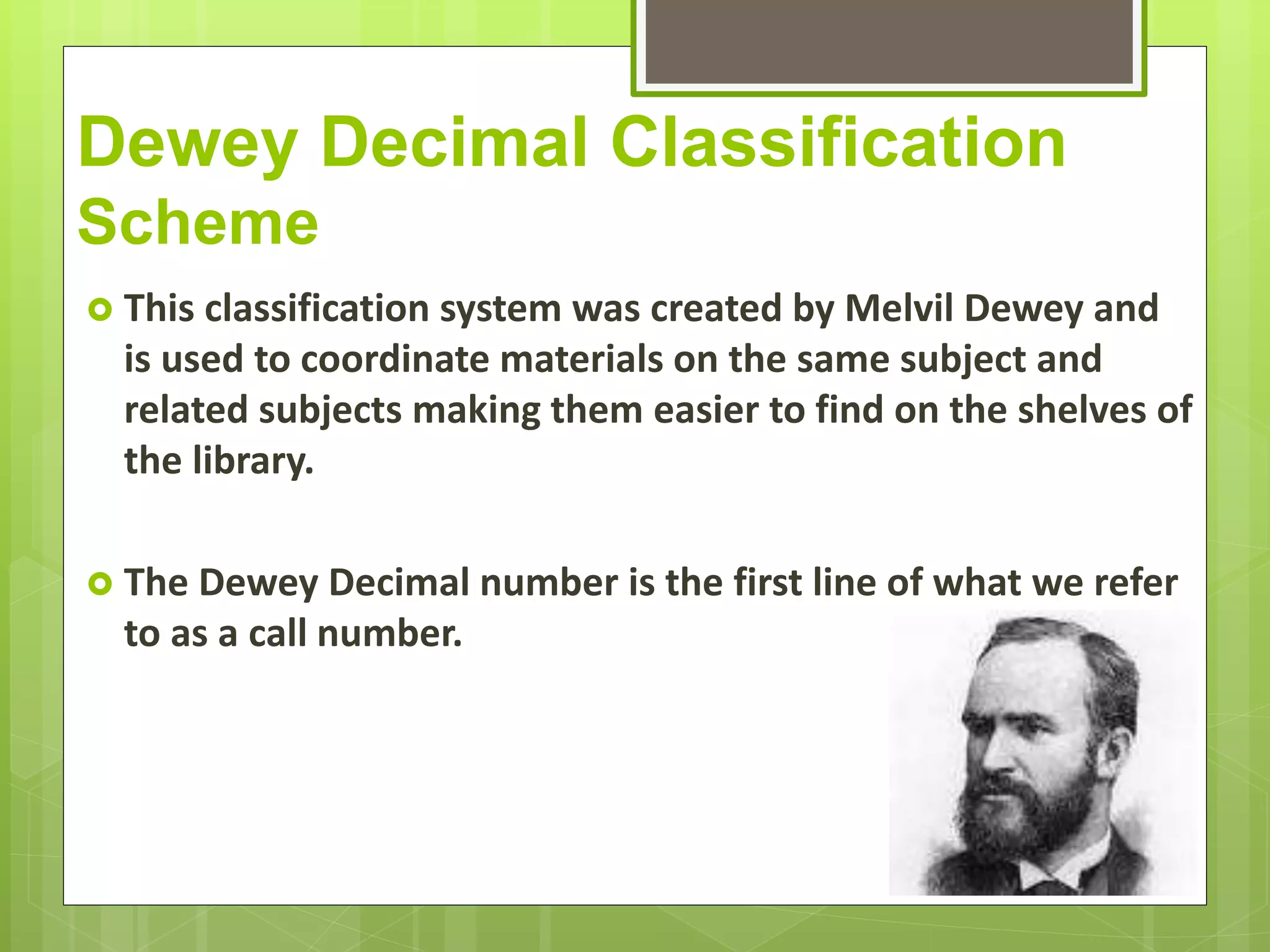
Melvil Dewey
• Melvil Louis Kossuth Dewey
• Dewey was born in Adams Centre,
New York
• Born in 10 December, 1851
• Established the American Library
Association in 1876
• Co-founded and edited Library
Journal
• Died 26 December, 1931 at age 80
Dewey Decimal Classification
Scheme
 This classification system was created by Melvil Dewey and
is used to coordinate materials on the same subject and
related subjects making them easier to find on the shelves of
the library.
 The Dewey Decimal number is the first line of what we refer
to as a call number.
 10 major classes
 000 Generalities
 100 Philosophy and related disciplines
 200 Religion
 300 Social Science
 400 Language
 500 Pure Science
 600 Technology (Applied Sciences)
 700 The Arts
 800 Literature
 900 Geography and History
 Each of the ten classes is broken down
into ten divisions
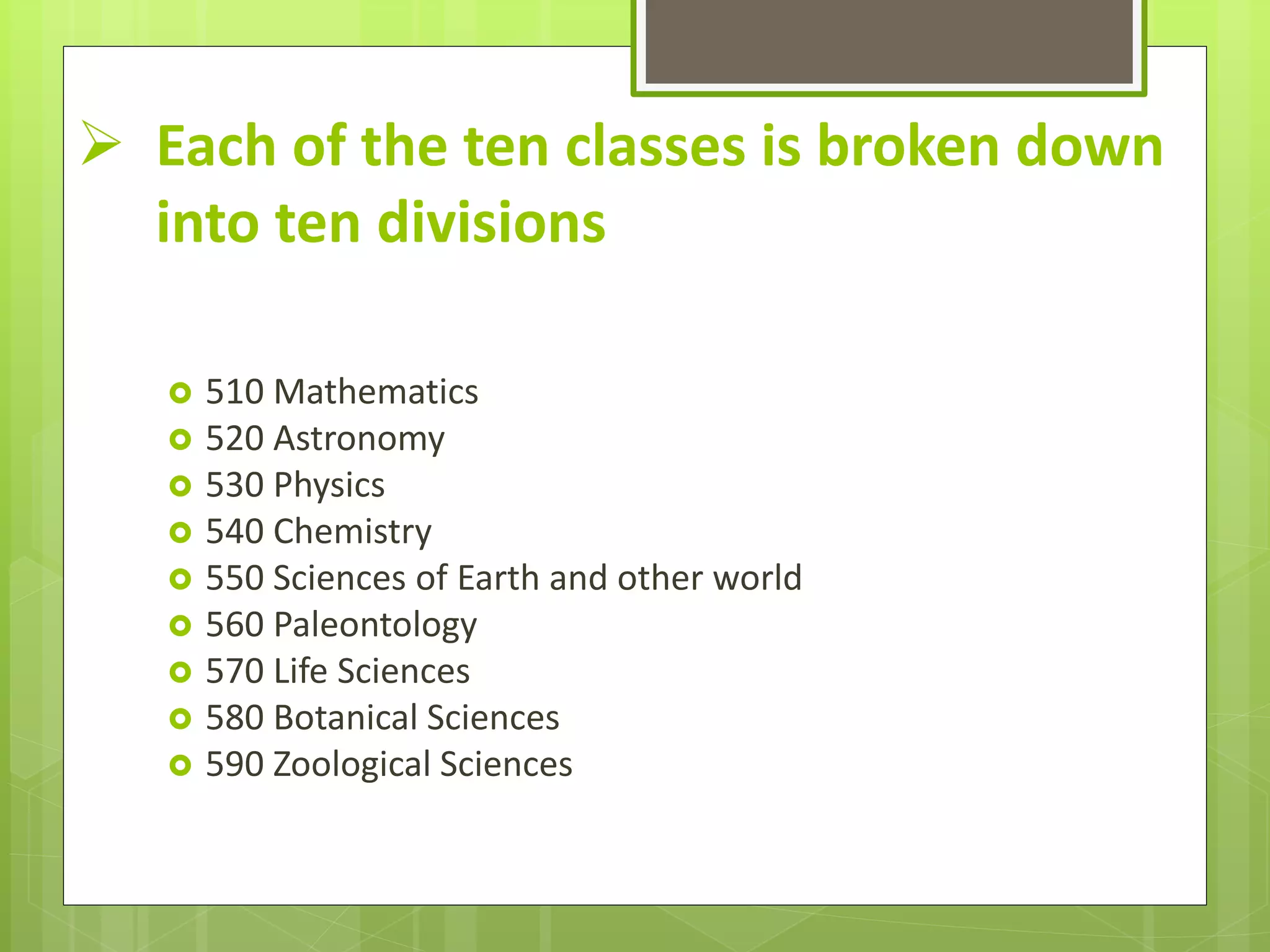
 510 Mathematics
 520 Astronomy
 530 Physics
 540 Chemistry
 550 Sciences of Earth and other world
 560 Paleontology
 570 Life Sciences
 580 Botanical Sciences
 590 Zoological Sciences
 Each of those divisions is broken down into
another ten more specific sections
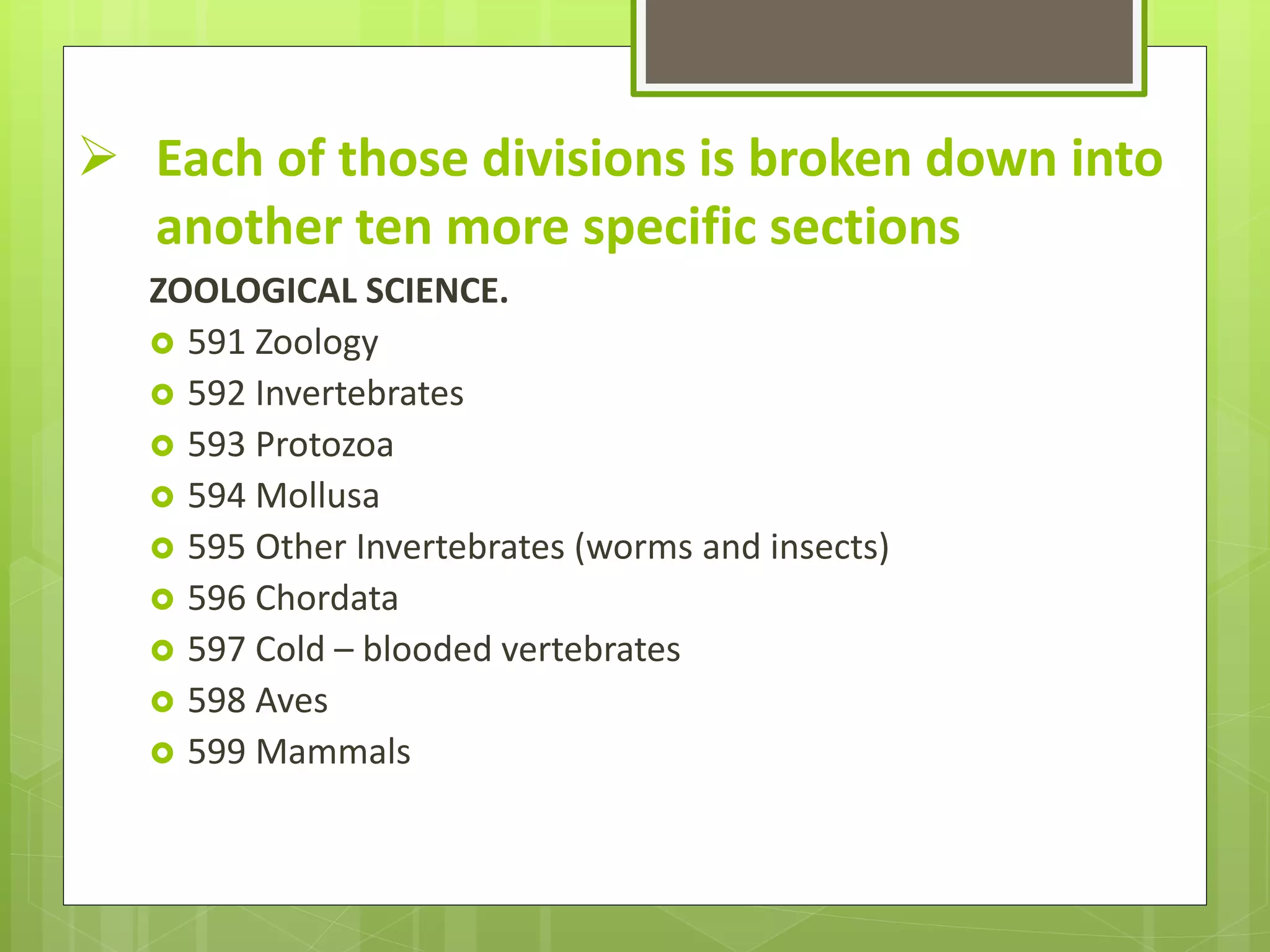
ZOOLOGICAL SCIENCE.
 591 Zoology
 592 Invertebrates
 593 Protozoa
 594 Mollusa
 595 Other Invertebrates (worms and insects)
 596 Chordata
 597 Cold – blooded vertebrates
 598 Aves
 599 Mammals
DDC HISTORY
Full edition Publication year Abridged edition Publication year
1st 1876
2nd 1885
3rd 1888
4th 1891
5th 1894 1st 1895
6th 1899
7th 1911
8th 1913 2nd 1915
9th 1915
10th 1919
11th 1922 3rd 1926
12th 1927 4th 1929
13th 1932 5th 1936
14th 1942 6th 1945
15th 1951 7th 1953
16th 1958 8th 1959
17th 1965 9th 1965
18th 1971 10th 1971
19th 1979 11th 1979
20th 1989 12th 1990
21st 1996 13th 1997
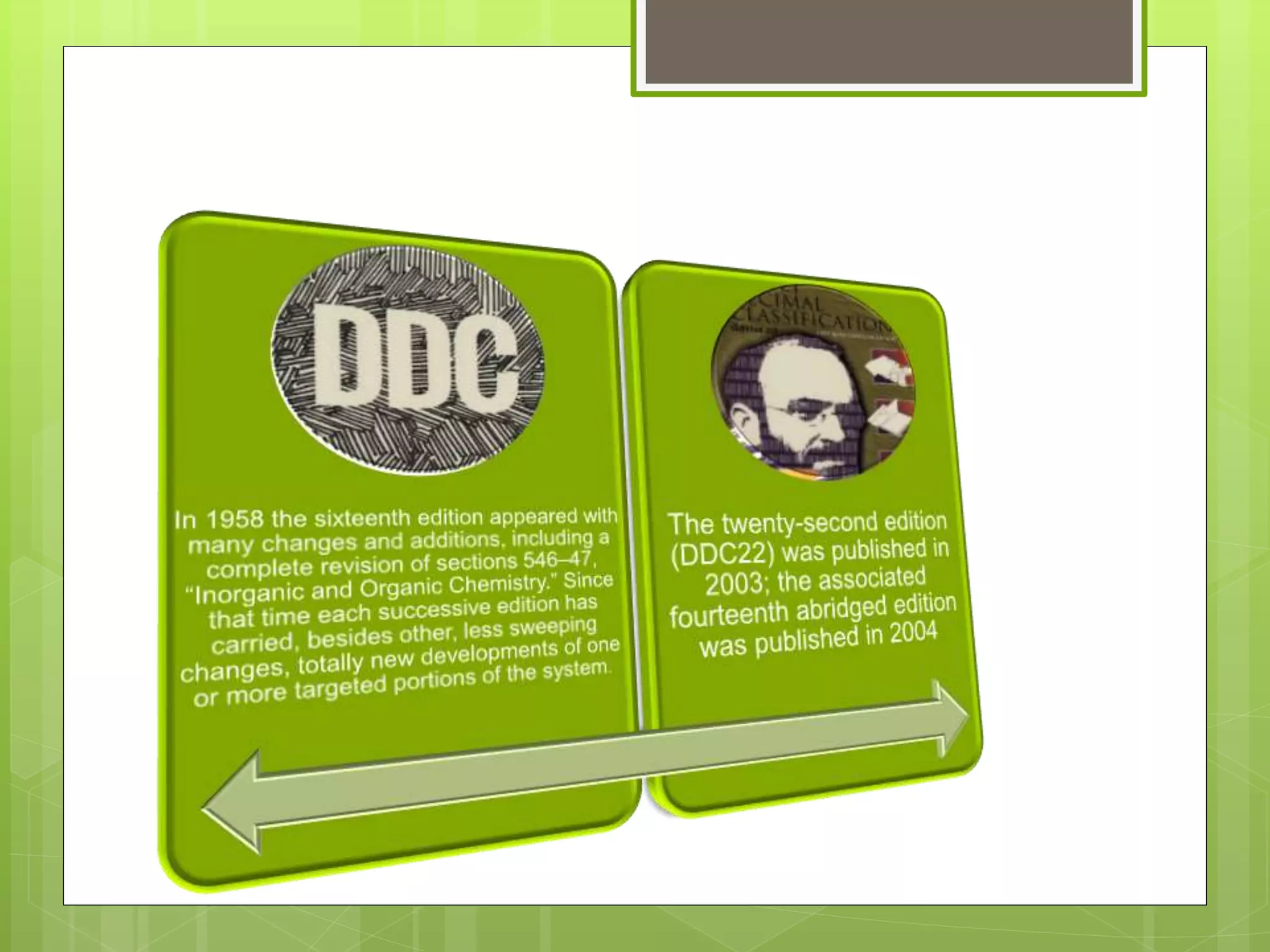
22nd 2003 14th 2004
23rd 2011 15th 2012
ALL EDITIONS OF DDC
The first edition was issued without
Dewey’s name, but having the
“copyright”, in 1876, in Amherst,
Massachusetts: “A Classification and
43 Subject Index for Cataloguing and
Arranging the Books and Pamphlets
of a Library” having 42 pages:
introduction (12 pages), the scheme
of 1000 index terms (12 pages) and
an index (18 pages), in a number of
1000 copies.
The second, “revised and
greatly enlarged” edition was
published under Dewey’s
name in 1885. Since that
time 20 more full editions
and 14 abridgments have
appeared.
The fourteenth edition,
published in 1942, remained
the standard edition for many
years because an
experimental index to the
fifteenth edition, published in
1951, was unsuccessful.
DDC 23rd – LATEST EDITION
Edition 23 is the product of a new approach to
development of print editions of the Dewey
Decimal Classification. Like its predecessor
Edition 22, it was prepared in the context of the
web, but Edition 23 is the first to be produced as
a by-product of the underlying database instead
of as the sole focus of editorial development.
Editorial development efforts since the
publication of Edition 22 have focused on short-
term and long-term updates. overall goal of
keeping pace with knowledge, changes have
been motivated by classifier efficiency and
emerging requirements in machine
representation and application. Our efforts have
been informed by interaction with the worldwide
community of Dewey users
Edition 23 features a complete overhaul of
the representation of groups of people,
significant revisions to several standard
subdivisions, numerous updates throughout
the tables and schedules, and some
structural changes. During the production
cycle for Edition 23, we have migrated to a
new editorial support system, adopted a
different underlying data format, and
introduced a new data distribution model.
Features of DDC
 Enumerative Scheme.
 Hierarchical Notation.
 Mnemonics.
 Updating policy.
 Facet analysis and synthesis.
 Pure notation.
13
Conclusion
• World’s most widely used library classification system
• More then 135 countries use DDC
• DDC numbers are featured in the national bibliographies of more then
60 countries
• DDC has been translated into over 30 languages
– E.g. Arabic, Chinese, French, German, Greek
• DDC is maintained in a national bibliographic agency, Library of
Congress
• DDC’s basic classes are organized by disciplines or fields of study
• A subject may appear in more than one class
REFRENCE
 http://www.netugc.com/
 http://www.slideshare.net/
Ddc

Ddc

  • 1.
    Submitted To: Ms. AnjaliPatil (Lecturer) Submitted By: MR. Harsimran .S. Bhatia B.L. I.Sc. (Ist sem) Roll no. – B-04 Dewey Decimal Classification System (DDC) Course-502 (Knowledge Organisation and processing(theory) SCHOOL OF LIBRARY AND INFORMATION SCIENCE Devi Ahilya Vishwavidhyalaya, Indore
  • 2.
    CONTENT  Introduction  AboutMelvil Dewey.  Dewey Decimal Classification Scheme.  DDC History.  All editions of DDC.  Features of DDC.  Reference.
  • 3.
    INTRODUCTION • Melvil Deweydevised the system in 1873 while he was a student at Amherst College. • First published in 1876. • as “A Classification and Subject Index for Cataloguing and Arranging the Books and Pamphlets of a Library”. • It appeared in the form of a small book of 44 pages. • The Decimal Classification Editorial Policy Committee (EPC) was established in 1937. • In 1988, (OCLC) acquired the DDC. . • Both the full and abridged editions are available in print as well as in electronic version.
  • 4.
    Melvil Dewey • MelvilLouis Kossuth Dewey • Dewey was born in Adams Centre, New York • Born in 10 December, 1851 • Established the American Library Association in 1876 • Co-founded and edited Library Journal • Died 26 December, 1931 at age 80
  • 5.
    Dewey Decimal Classification Scheme This classification system was created by Melvil Dewey and is used to coordinate materials on the same subject and related subjects making them easier to find on the shelves of the library.  The Dewey Decimal number is the first line of what we refer to as a call number.
  • 6.
     10 majorclasses  000 Generalities  100 Philosophy and related disciplines  200 Religion  300 Social Science  400 Language  500 Pure Science  600 Technology (Applied Sciences)  700 The Arts  800 Literature  900 Geography and History
  • 7.
     Each ofthe ten classes is broken down into ten divisions  510 Mathematics  520 Astronomy  530 Physics  540 Chemistry  550 Sciences of Earth and other world  560 Paleontology  570 Life Sciences  580 Botanical Sciences  590 Zoological Sciences
  • 8.
     Each ofthose divisions is broken down into another ten more specific sections ZOOLOGICAL SCIENCE.  591 Zoology  592 Invertebrates  593 Protozoa  594 Mollusa  595 Other Invertebrates (worms and insects)  596 Chordata  597 Cold – blooded vertebrates  598 Aves  599 Mammals
  • 9.
    DDC HISTORY Full editionPublication year Abridged edition Publication year 1st 1876 2nd 1885 3rd 1888 4th 1891 5th 1894 1st 1895 6th 1899 7th 1911 8th 1913 2nd 1915 9th 1915 10th 1919 11th 1922 3rd 1926 12th 1927 4th 1929 13th 1932 5th 1936 14th 1942 6th 1945 15th 1951 7th 1953 16th 1958 8th 1959 17th 1965 9th 1965 18th 1971 10th 1971 19th 1979 11th 1979 20th 1989 12th 1990 21st 1996 13th 1997 22nd 2003 14th 2004 23rd 2011 15th 2012
  • 10.
    ALL EDITIONS OFDDC The first edition was issued without Dewey’s name, but having the “copyright”, in 1876, in Amherst, Massachusetts: “A Classification and 43 Subject Index for Cataloguing and Arranging the Books and Pamphlets of a Library” having 42 pages: introduction (12 pages), the scheme of 1000 index terms (12 pages) and an index (18 pages), in a number of 1000 copies. The second, “revised and greatly enlarged” edition was published under Dewey’s name in 1885. Since that time 20 more full editions and 14 abridgments have appeared. The fourteenth edition, published in 1942, remained the standard edition for many years because an experimental index to the fifteenth edition, published in 1951, was unsuccessful.
  • 12.
    DDC 23rd –LATEST EDITION Edition 23 is the product of a new approach to development of print editions of the Dewey Decimal Classification. Like its predecessor Edition 22, it was prepared in the context of the web, but Edition 23 is the first to be produced as a by-product of the underlying database instead of as the sole focus of editorial development. Editorial development efforts since the publication of Edition 22 have focused on short- term and long-term updates. overall goal of keeping pace with knowledge, changes have been motivated by classifier efficiency and emerging requirements in machine representation and application. Our efforts have been informed by interaction with the worldwide community of Dewey users Edition 23 features a complete overhaul of the representation of groups of people, significant revisions to several standard subdivisions, numerous updates throughout the tables and schedules, and some structural changes. During the production cycle for Edition 23, we have migrated to a new editorial support system, adopted a different underlying data format, and introduced a new data distribution model.
  • 13.
    Features of DDC Enumerative Scheme.  Hierarchical Notation.  Mnemonics.  Updating policy.  Facet analysis and synthesis.  Pure notation. 13
  • 14.
    Conclusion • World’s mostwidely used library classification system • More then 135 countries use DDC • DDC numbers are featured in the national bibliographies of more then 60 countries • DDC has been translated into over 30 languages – E.g. Arabic, Chinese, French, German, Greek • DDC is maintained in a national bibliographic agency, Library of Congress • DDC’s basic classes are organized by disciplines or fields of study • A subject may appear in more than one class
  • 15.