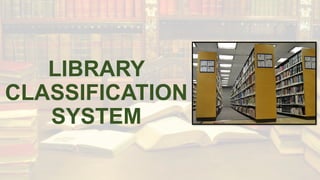
Describes of the method and way in which a library is classified. That is, the arrangement of books on shelves or descriptions of them, in the manner which is most useful to those who read.
INTRODUCTION
• Involves placingtogether in classes the objects which contain
characteristics in common.
• Also considered as a process of putting books and other reading
material on a subject in a logical sequence on the shelf, which could
be of immense help to the users.
• Classification is called the “Foundation of Librarianship.”
3.
DEFINITIONS
Berwick Sayers- “thearrangement of books on shelves or descriptions of them, in
the manner which is most useful to those who read.”
Dr. S R Ranganathan- “the translation of the name of the subject of a book into a
preferred artificial language of ordinal numbers, and the individualization of the
several books dealing with the same specific subject by means of further set of
ordinal numbers which represent some features of the book other than their
thought content.”
4.
H.E. Bliss- Classificationis a series or system of classes arranged
in some order according to some principle or conception , purpose or
interest or some combination of such.
Margaret Mann- Classification in its simplest statement is, the
putting together of similar things or more fully described, it is the
arranging of things according to likeness and unlikeness
(contd)
5.
FUNCTIONS
Helpful Sequence -The basic idea
is to bring the like classes together
and separate these from unlike
classes.
Correct Replacement - It is
essential that library classification
should enable the correct
replacement of documents after they
have been returned from use.
Mechanized Arrangement - It
means to adopt a particular
arrangement suitable for the library
so that the arrangement remains
permanent
Addition of New Document - Library would
acquire new documents from time to time
therefore library classification should help in
finding the most helpful place for each of
those among the existing collection of the
library.
Withdrawal of Document from Stock –
When the need arises to withdraw a
document from the library collection for some
reason, and then library classification should
facilitate such a withdrawal with ease.
6.
COMPONENTS
• It isa set of symbols which stands for a class or a
subject.
NOTATION
• Knowledge may be presented in one form of the other, the form
could be text book, manual, history, dictionary and
encyclopedia. The numbers representing the forms of books are
called form divisions.
FORM DIVISION
• Those which cannot be classified under any specific subject.
GENERALIA CLASS
• In classifying, each book is provided with a distinguished number
specified to it which can be used for calling the book from the stats and
replacing it on its return to its right place. It is known as a Call Number.
CALL NUMBER
7.
TYPES OF CLASSIFICATION
DEWEYDECIMAL
CLASSIFICATION
(DDC)
UNIVERSAL
DECIMAL
CLASSIFICATION
(UDC)
LIBRARY OF
CONGRESS
CLASSIFICATION.
COLON
CLASSIFICATION
(CC)
8.
DEWEY DECIMAL CLASSIFICATION
•It provides a systematic arrangement of all the materials mechanized
by notation of great simplicity and apparent flexibility.
• It was devised by Melville Dewey in 1876.
• It replaced the existing practice of a fixed location, when a certain
number of shelves were allotted to each subject and each book was
identified by the shelf number and its position on the shelf.
• It is used in school, public and small academic libraries.
ADVANTAGES
•The DDC breaksdown into relatively
well structured and ordered disciplines,
divisions, and sections. Thus, the
scheme is hierarchical, like a family
tree, showing the relationship of specific
subjects to the parent subject.
•The class numbers are easy to write,
type and remember
DISADVANTAGES
• The DDC is not as easily
when new subjects or
technologies emerge.
• Tendency towards long
notation.
12.
COLON CLASSIFICATION
• Itis one of the most systematic schemes of Library Classifications used in
many libraries in India and a few libraries abroad as well.
• This was devised by the Indian librarian late Dr. S.R. Ranganathan in 1933.
• It analyses the subject in its various components and places them under five
fundamental categories known as personality, matter, energy, space and
time.
• Colon Classification involves analysis and synthesis that is why it is known
as the `Analytico-synthetic’ scheme of classification.
13.
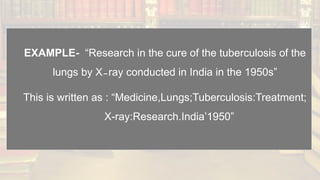
EXAMPLE- “Research inthe cure of the tuberculosis of the
lungs by X ray conducted in India in the 1950s”
̵
This is written as : “Medicine,Lungs;Tuberculosis:Treatment;
X-ray:Research.India’1950”
14.
ADVANTAGES
• CC iscapable of giving a unique number for almost
every subject.
• The systematic order and the degree of detail due to
analysis and synthesis are two great virtues of CC.
• As a result, it has achieved two objectives:
i) provision of a helpful order in each class
ii) facility in locating a given topic whether it is simple,
compound or complex.
• It is claimed that CC can be effectively used in a
computer-aide document finding system.
DISADVANTAGES
• The major drawback of CC is that there exists
no machinery to keep up the revision work as
in the case of DDC and UDC.
• It calls for a manual with numerous examples
to explain the application of various rules.
• It is far from simple and has long and complex
notation.
15.
Universal Decimal Classification
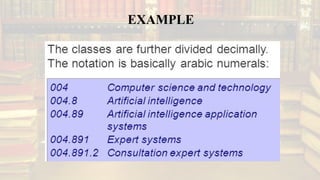
•It was developed in the year 1895 by the Belgium Barrister Paul Otlet and Nobel Prize winner Henri
La Fountaine.
• It consists of a combination of both enumerative and faceted character of the schemes and hence it
is also known as an Almost-Faceted Scheme of Classification.
• It was developed for the purpose of indexing and arranging an enormous card bibliography which
not only includes books but also all kinds of documents, periodical articles, patents, trade
catalogues, abstracts and other micro documents in more than 28 different international languages.
16.
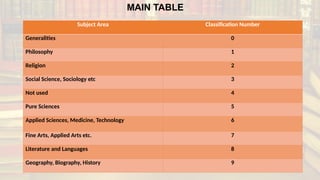
MAIN TABLE
Subject AreaClassification Number
Generalities 0
Philosophy 1
Religion 2
Social Science, Sociology etc 3
Not used 4
Pure Sciences 5
Applied Sciences, Medicine, Technology 6
Fine Arts, Applied Arts etc. 7
Literature and Languages 8
Geography, Biography, History 9
ADVANTAGES
• The UDClends itself very well to
applications in other languages and scripts.
• Due to its abbreviated nature and
vocabulary it is easily updated and enables
worldwide standardized indexing.
• It’s notation overcomes all language and
provides worldwide use.
• The UDC like the DDC has been published
in Full, Abridged, and Web formats.
DISADVANTAGES
• The notation often tends to be long
and appears clumsy. As a result, its
use on the shelves becomes
difficult.
• The UDC lacks conformity and
exhibits a lack of uniformity across
libraries that use it.
20.
LIBRARY OF CONGRESSCLASSIFICATION SYSTEM
• In 1899, the United States Library of Congress created a
classification scheme for books called the Library of Congress
Classification system (LC for short).
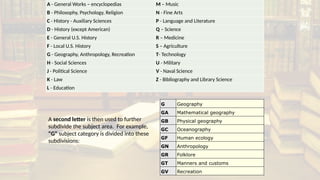
• All knowledge is divided into 21 broad subject areas by letters of
the alphabet (I, O, W, X, and Y are not used).
• Mostly used in college and university libraries.
21.
A - GeneralWorks – encyclopedias M – Music
B - Philosophy, Psychology, Religion N - Fine Arts
C - History - Auxiliary Sciences P - Language and Literature
D - History (except American) Q – Science
E - General U.S. History R – Medicine
F - Local U.S. History S – Agriculture
G - Geography, Anthropology, Recreation T- Technology
H - Social Sciences U - Military
J - Political Science V - Naval Science
K - Law Z - Bibliography and Library Science
L - Education
A second letter is then used to further
subdivide the subject area. For example,
"G" subject category is divided into these
subdivisions:
G Geography
GA Mathematical geography
GB Physical geography
GC Oceanography
GF Human ecology
GN Anthropology
GR Folklore
GT Manners and customs
GV Recreation