
Liquid dosage forms ppt
•Download as PPTX, PDF•
6 likes•8,284 views

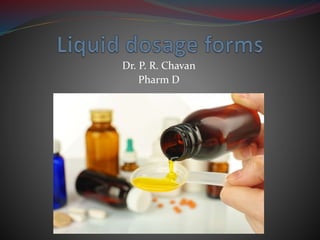
Liquid dosage forms are effective pharmaceutical products containing a mixture of active pharmaceutical ingredients (API/Drug) and non drug components (excipients). It is a dose of a drug used as a medicine for consumption or administration. Many liquid dosage forms are used in the pharmacy, but the most commonly used are syrup, suspension, and elixirs. The general category of liquid oral doses includes a broad range of dosage forms, broadly classified as monophasic and biphasic. Whereas dosage forms in both types comprise at least one drug, monophasic forms are homogeneous and completely dissolve in liquid, whereas biphasic forms in a vehicle do not dissolve.

Recommended
More Related Content
What's hot
What's hot (20)
Similar to Liquid dosage forms ppt
Similar to Liquid dosage forms ppt (20)
More from PranatiChavan
More from PranatiChavan (20)
Recently uploaded
Recently uploaded (20)
Liquid dosage forms ppt
- 1. Dr. P. R. Chavan Pharm D
- 3. 1. Collodions: Liquid preparations for external use having nitro cellulose used to protect the skin
- 4. 2. Droughts: Liquid preparations for oral containing medicaments available in single dose or multiple dose
- 5. 3. Elixirs: Liquid preparation for oral containing medicaments with suitable excipients
- 6. 4. Emulsions: Biphasic liquid dosage form for oral containing medicaments in which fine oil globules dispersed in continuous phase
- 7. 5. Suspensions: Biphasic liquid dosage form for oral containing medicaments in which fine solid particles suspended in continuous phase
- 8. 6. Enemas: Liquid preparation for rectal containing medicaments
- 9. 7. Gargles: Concentrated aqueous solutions for external use used to treat throat infections
- 10. 8. Gels: Aqueous colloidal suspensions containing medicaments used as antacids
- 11. 9. Linctuses: Viscous, liquid oral preparations used to relief cough
- 12. 10. Lotions: Liquid preparations for external application usually applied without friction
- 13. 11. Liniments: Liquid preparations for external application usually applied with friction
- 14. 12. Mixtures: Liquid oral preparations containing one or more medicaments
- 15. 13. Mouth washes: Concentrated aqueous solutions for external use used to treat mouth infections and oral hygienic
- 16. 14. Nasal drops: Liquid preparations containing medicaments that are instilled in to the nose with a dropper used to treat nose infections and blockage of nose
- 17. 15. Paints: Liquid preparations for external application to the skin or mucous membrane with soft brush
- 18. 16. Solutions : Clear liquid preparation containing with or without medicaments used to internal or external preparations
- 19. 17. Syrups: Sweet, viscous, concentrated liquid preparations containing with or without sugar and medicaments
- 20. 18. Eye drops Eye drops are accessible in the forms of water and oil solutions, emulsions, or suspensions of one or more active ingredients, which may contain preservatives if stored in multiuse packaging.
- 21. Advantages of liquid dosage form: The major advantage of the liquid dosage method is that it is better for patients who have difficulty swallowing solid medicines because it is easier to swallow than solid dosage forms. Liquid dosage forms have faster absorption than solid dosage forms. It is suitable for use patients with infants, geriatric, and mental health problems.
- 22. Cont.. Doses may vary from per tablespoon to milliliter, which is difficult in solid dosage forms. Liquid dosage forms are absorbed faster than solid dosage forms because APIs are already dissolved. This may provide greater flexibility in achieving the appropriate dose of the drug.
- 23. Cont.. It can be designed for any route of administration. It is the best choice for children and old people. This can be attractive by container and color. Flavors (sweetening agents/sugar) can be added to mask the bitter or unpleasant taste and odor.
- 24. Disadvantages : The major disadvantage of the liquid dosage form is that, is less stable than other doses and has a shorter shelf life which is due to the nature of being in a liquid. The liquid dosage form is more susceptible to bacterial microorganisms than tablets and capsules. Some drugs are poorly soluble hence difficult to formulate. It is bulky so it is difficult to handle, transport and store.
- 25. It requires special storage conditions because it is less stable. Its manufacturing process is complex, so the production cost is high. It is easily affected by temperature, light, and microorganisms. Each time of dose needs to be measured, so the accuracy of the dose may vary each time. A loss can occur as the container breaks and falls. Difficult to mask the unpleasant taste or odor compared to tablets and capsules.