D R . P . R . C H A V A N
P H A R M D
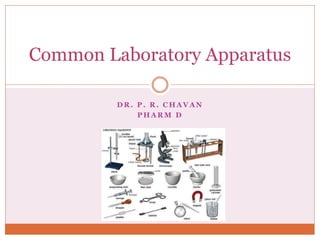
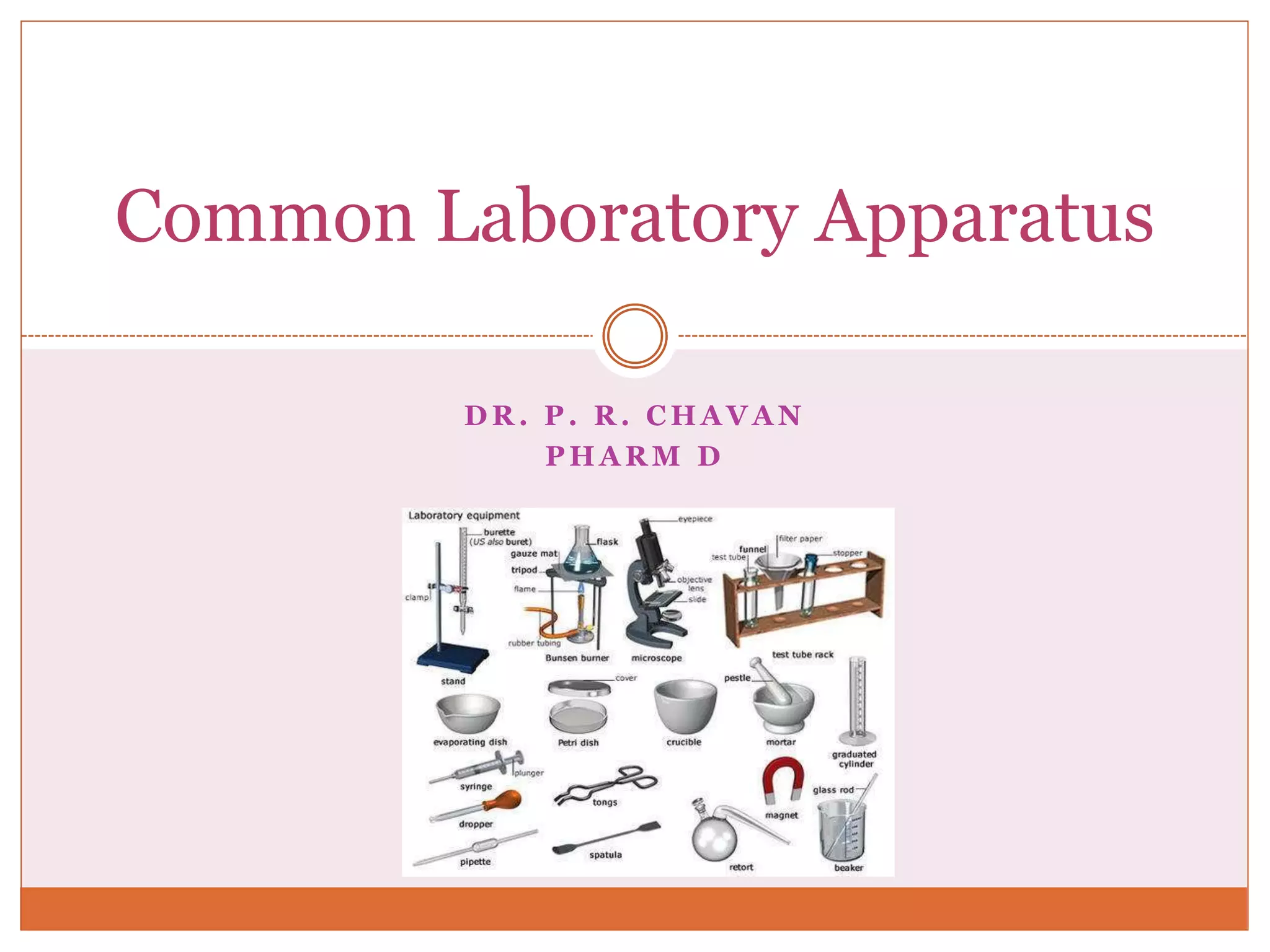
Common Laboratory Apparatus
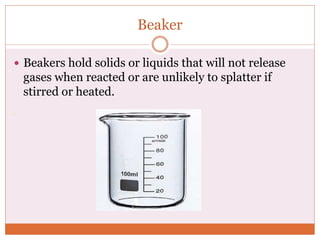
Beaker
 Beakers hold solids or liquids that will not release
gases when reacted or are unlikely to splatter if
stirred or heated.
Conical flask
 Conical (or Erlenmeyer) flasks hold solids or liquids
that may release gases during a reaction or that are
likely to splatter if stirred or heated.
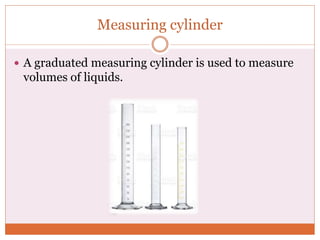
Measuring cylinder
 A graduated measuring cylinder is used to measure
volumes of liquids.
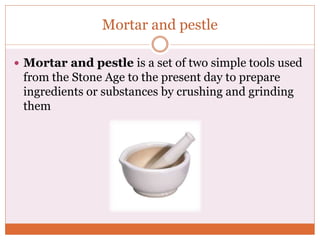
Mortar and pestle
 Mortar and pestle is a set of two simple tools used
from the Stone Age to the present day to prepare
ingredients or substances by crushing and grinding
them
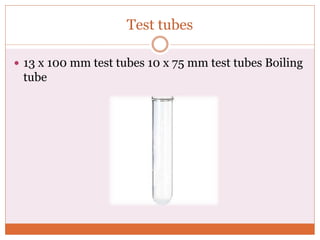
Test tubes
 13 x 100 mm test tubes 10 x 75 mm test tubes Boiling
tube
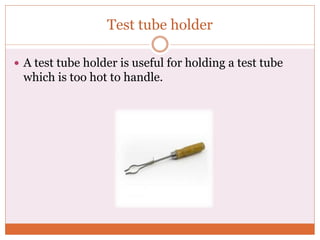
Test tube holder
 A test tube holder is useful for holding a test tube
which is too hot to handle.
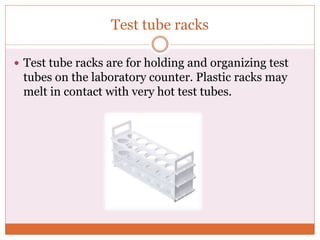
Test tube racks
 Test tube racks are for holding and organizing test
tubes on the laboratory counter. Plastic racks may
melt in contact with very hot test tubes.
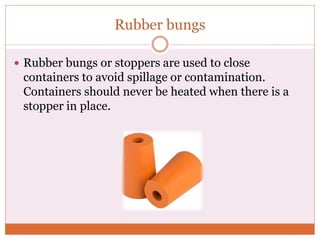
Rubber bungs
 Rubber bungs or stoppers are used to close
containers to avoid spillage or contamination.
Containers should never be heated when there is a
stopper in place.
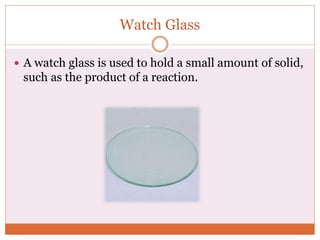
Watch Glass
 A watch glass is used to hold a small amount of solid,
such as the product of a reaction.
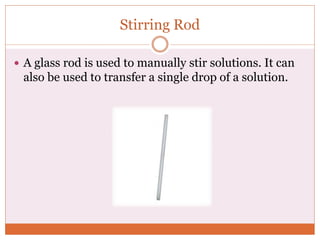
Stirring Rod
 A glass rod is used to manually stir solutions. It can
also be used to transfer a single drop of a solution.
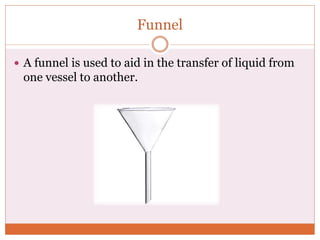
Funnel
 A funnel is used to aid in the transfer of liquid from
one vessel to another.
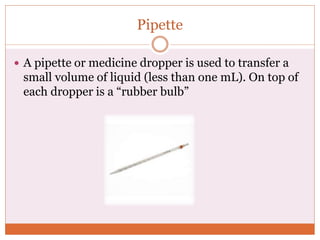
Pipette
 A pipette or medicine dropper is used to transfer a
small volume of liquid (less than one mL). On top of
each dropper is a “rubber bulb”
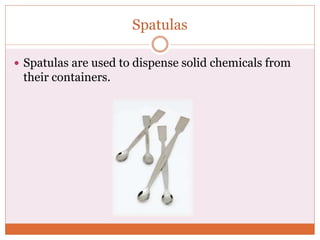
Spatulas
 Spatulas are used to dispense solid chemicals from
their containers.
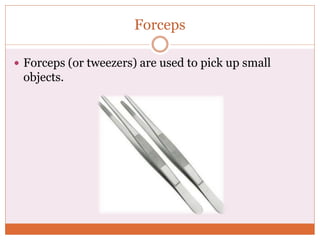
Forceps
 Forceps (or tweezers) are used to pick up small
objects.
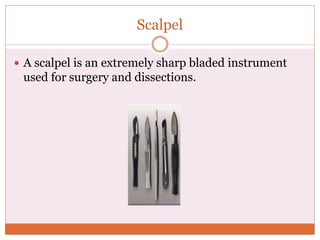
Scalpel
 A scalpel is an extremely sharp bladed instrument
used for surgery and dissections.
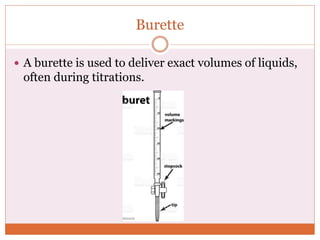
Burette
 A burette is used to deliver exact volumes of liquids,
often during titrations.
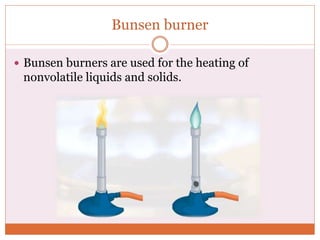
Bunsen burner
 Bunsen burners are used for the heating of
nonvolatile liquids and solids.
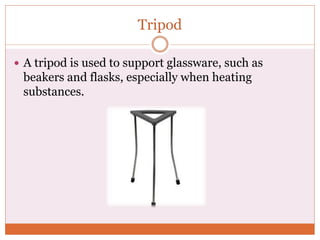
Tripod
 A tripod is used to support glassware, such as
beakers and flasks, especially when heating
substances.
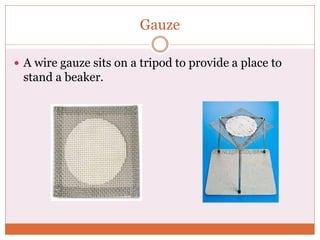
Gauze
 A wire gauze sits on a tripod to provide a place to
stand a beaker.
Heatproof mat
 A heat proof mat is used to prevent damage to a work
surface from a hot object.
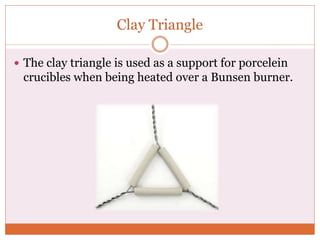
Clay Triangle
 The clay triangle is used as a support for porcelein
crucibles when being heated over a Bunsen burner.
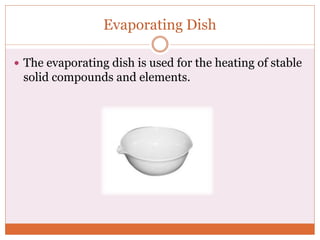
Evaporating Dish
 The evaporating dish is used for the heating of stable
solid compounds and elements.
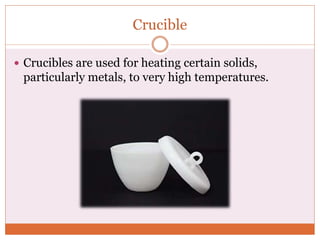
Crucible
 Crucibles are used for heating certain solids,
particularly metals, to very high temperatures.
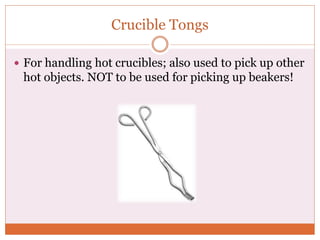
Crucible Tongs
 For handling hot crucibles; also used to pick up other
hot objects. NOT to be used for picking up beakers!
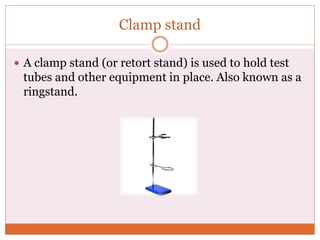
Clamp stand
 A clamp stand (or retort stand) is used to hold test
tubes and other equipment in place. Also known as a
ringstand.
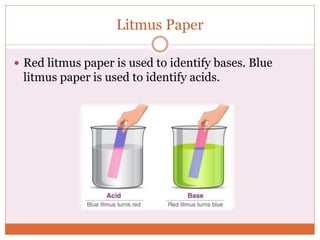
Litmus Paper
 Red litmus paper is used to identify bases. Blue
litmus paper is used to identify acids.
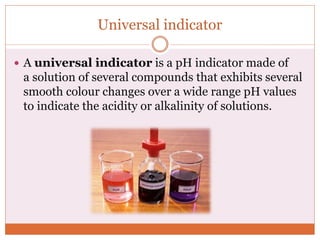
Universal indicator
 A universal indicator is a pH indicator made of
a solution of several compounds that exhibits several
smooth colour changes over a wide range pH values
to indicate the acidity or alkalinity of solutions.
common laboratory apparatus ppt

common laboratory apparatus ppt

  • 1.
    D R .P . R . C H A V A N P H A R M D Common Laboratory Apparatus
  • 2.
    Beaker  Beakers holdsolids or liquids that will not release gases when reacted or are unlikely to splatter if stirred or heated.
  • 3.
    Conical flask  Conical(or Erlenmeyer) flasks hold solids or liquids that may release gases during a reaction or that are likely to splatter if stirred or heated.
  • 4.
    Measuring cylinder  Agraduated measuring cylinder is used to measure volumes of liquids.
  • 5.
    Mortar and pestle Mortar and pestle is a set of two simple tools used from the Stone Age to the present day to prepare ingredients or substances by crushing and grinding them
  • 6.
    Test tubes  13x 100 mm test tubes 10 x 75 mm test tubes Boiling tube
  • 7.
    Test tube holder A test tube holder is useful for holding a test tube which is too hot to handle.
  • 8.
    Test tube racks Test tube racks are for holding and organizing test tubes on the laboratory counter. Plastic racks may melt in contact with very hot test tubes.
  • 9.
    Rubber bungs  Rubberbungs or stoppers are used to close containers to avoid spillage or contamination. Containers should never be heated when there is a stopper in place.
  • 10.
    Watch Glass  Awatch glass is used to hold a small amount of solid, such as the product of a reaction.
  • 11.
    Stirring Rod  Aglass rod is used to manually stir solutions. It can also be used to transfer a single drop of a solution.
  • 12.
    Funnel  A funnelis used to aid in the transfer of liquid from one vessel to another.
  • 13.
    Pipette  A pipetteor medicine dropper is used to transfer a small volume of liquid (less than one mL). On top of each dropper is a “rubber bulb”
  • 14.
    Spatulas  Spatulas areused to dispense solid chemicals from their containers.
  • 15.
    Forceps  Forceps (ortweezers) are used to pick up small objects.
  • 16.
    Scalpel  A scalpelis an extremely sharp bladed instrument used for surgery and dissections.
  • 17.
    Burette  A buretteis used to deliver exact volumes of liquids, often during titrations.
  • 18.
    Bunsen burner  Bunsenburners are used for the heating of nonvolatile liquids and solids.
  • 19.
    Tripod  A tripodis used to support glassware, such as beakers and flasks, especially when heating substances.
  • 20.
    Gauze  A wiregauze sits on a tripod to provide a place to stand a beaker.
  • 21.
    Heatproof mat  Aheat proof mat is used to prevent damage to a work surface from a hot object.
  • 22.
    Clay Triangle  Theclay triangle is used as a support for porcelein crucibles when being heated over a Bunsen burner.
  • 23.
    Evaporating Dish  Theevaporating dish is used for the heating of stable solid compounds and elements.
  • 24.
    Crucible  Crucibles areused for heating certain solids, particularly metals, to very high temperatures.
  • 25.
    Crucible Tongs  Forhandling hot crucibles; also used to pick up other hot objects. NOT to be used for picking up beakers!
  • 26.
    Clamp stand  Aclamp stand (or retort stand) is used to hold test tubes and other equipment in place. Also known as a ringstand.
  • 27.
    Litmus Paper  Redlitmus paper is used to identify bases. Blue litmus paper is used to identify acids.
  • 28.
    Universal indicator  Auniversal indicator is a pH indicator made of a solution of several compounds that exhibits several smooth colour changes over a wide range pH values to indicate the acidity or alkalinity of solutions.