Solid dosage forms
Dr. P. R. Chavan
Pharm D
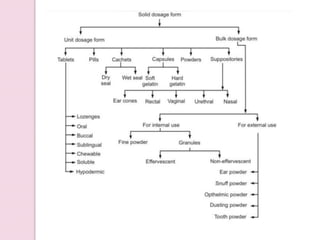
Solid dosage form classification
as per use
 The bulk forms meant for internal use
are supplied either as granules or fine
powder.
 The bulk powders meant for external
use are dusting powders, insufflations,
snuffs and tooth powders.
Powders
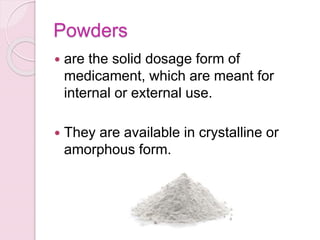
 are the solid dosage form of
medicament, which are meant for
internal or external use.
 They are available in crystalline or
amorphous form.
The powders are generally used in the
following forms:
1. Bulk powder for internal use e.g. fine
powders or granules
2. Bulk powder for external use e.g. snuffs,
dusting powders and tooth powders.
3. Simple and compound powders for internal
use.
4. Powders in the form of compressed tablets
and tablet triturates.
5. Powders enclosed in cachets and capsules
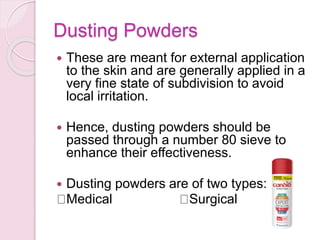
Dusting Powders
 These are meant for external application
to the skin and are generally applied in a
very fine state of subdivision to avoid
local irritation.
 Hence, dusting powders should be
passed through a number 80 sieve to
enhance their effectiveness.
 Dusting powders are of two types:
Medical Surgical
 Medical dusting powders are used
mainly for superficial skin conditions.
 Surgical dusting powders are used in
body cavities and also on major wounds
as a result of burns and umbilical cords
of infants.
 Surgical dusting powders must be
sterilised before their use, whereas
medical dusting powders must be free
from dangerous pathogenic
microorganisms.
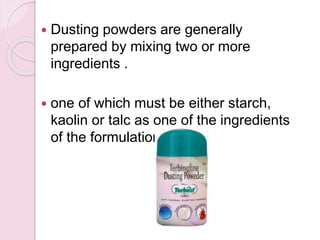
 Dusting powders are generally
prepared by mixing two or more
ingredients .
 one of which must be either starch,
kaolin or talc as one of the ingredients
of the formulation.'
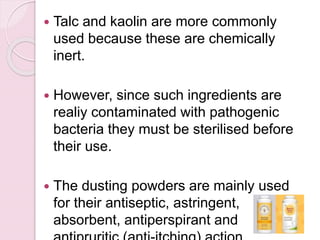
 Talc and kaolin are more commonly
used because these are chemically
inert.
 However, since such ingredients are
realiy contaminated with pathogenic
bacteria they must be sterilised before
their use.
 The dusting powders are mainly used
for their antiseptic, astringent,
absorbent, antiperspirant and
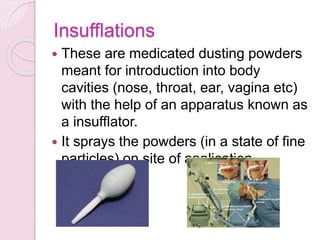
Insufflations
 These are medicated dusting powders
meant for introduction into body
cavities (nose, throat, ear, vagina etc)
with the help of an apparatus known as
a insufflator.
 It sprays the powders (in a state of fine
particles) on site of application.
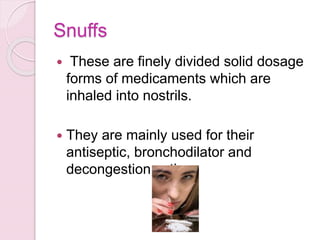
Snuffs
 These are finely divided solid dosage
forms of medicaments which are
inhaled into nostrils.
 They are mainly used for their
antiseptic, bronchodilator and
decongestion action.
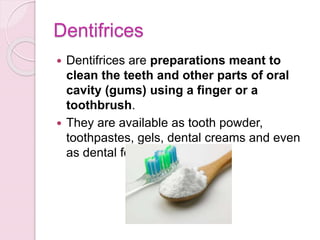
Dentifrices
 Dentifrices are preparations meant to
clean the teeth and other parts of oral
cavity (gums) using a finger or a
toothbrush.
 They are available as tooth powder,
toothpastes, gels, dental creams and even
as dental foams.
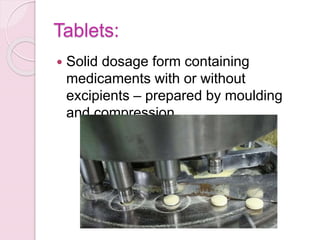
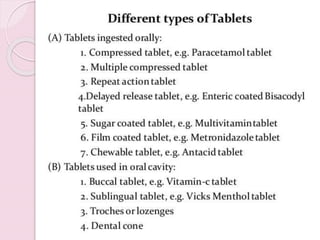
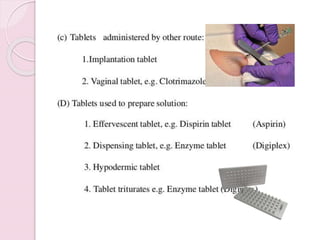
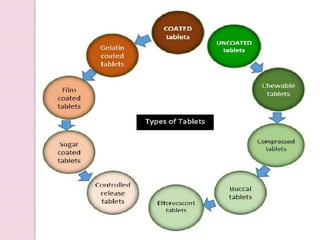
Tablets:
 Solid dosage form containing
medicaments with or without
excipients – prepared by moulding
and compression.
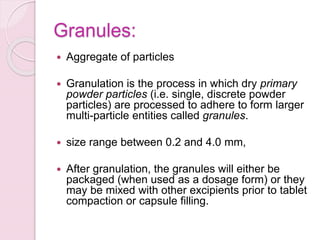
Granules:
 Aggregate of particles
 Granulation is the process in which dry primary
powder particles (i.e. single, discrete powder
particles) are processed to adhere to form larger
multi-particle entities called granules.
 size range between 0.2 and 4.0 mm,
 After granulation, the granules will either be
packaged (when used as a dosage form) or they
may be mixed with other excipients prior to tablet
compaction or capsule filling.
Reasons For Granulation
 To prevent segregation of the
constituents of the powder mix
 To improve the flow properties of the
mix
 To improve the compaction
characteristics of the mix
Types of granules
 There are several categories of
granules:
• effervescent granules
• coated granules
• gastro-resistant granules
• modified-release granules.
Effervescent granules.
 Effervescent granules are uncoated
granules generally containing acid
substances and carbonates or
hydrogen carbonates which react
rapidly in the presence of water to
release carbon dioxide.
 They are intended to be dissolved or
dispersed in water before
administration.
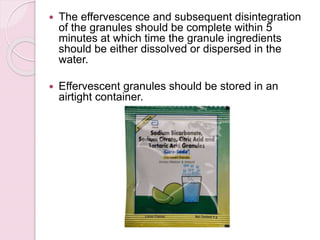
 The effervescence and subsequent disintegration
of the granules should be complete within 5
minutes at which time the granule ingredients
should be either dissolved or dispersed in the
water.
 Effervescent granules should be stored in an
airtight container.
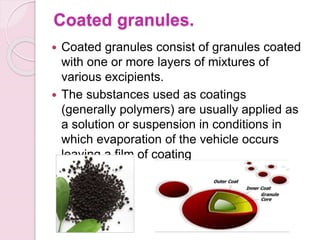
Coated granules.
 Coated granules consist of granules coated
with one or more layers of mixtures of
various excipients.
 The substances used as coatings
(generally polymers) are usually applied as
a solution or suspension in conditions in
which evaporation of the vehicle occurs
leaving a film of coating
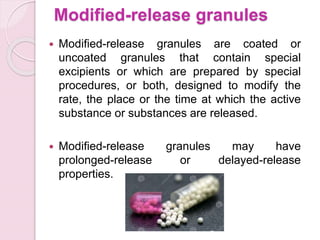
Modified-release granules
 Modified-release granules are coated or
uncoated granules that contain special
excipients or which are prepared by special
procedures, or both, designed to modify the
rate, the place or the time at which the active
substance or substances are released.
 Modified-release granules may have
prolonged-release or delayed-release
properties.
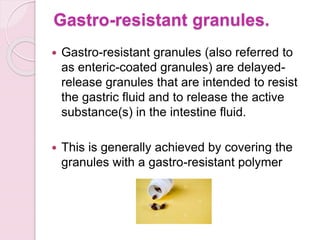
Gastro-resistant granules.
 Gastro-resistant granules (also referred to
as enteric-coated granules) are delayed-
release granules that are intended to resist
the gastric fluid and to release the active
substance(s) in the intestine fluid.
 This is generally achieved by covering the
granules with a gastro-resistant polymer
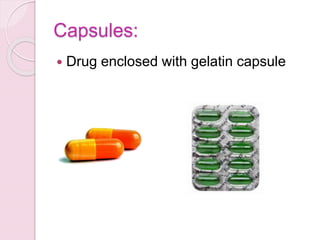
Capsules:
 Drug enclosed with gelatin capsule
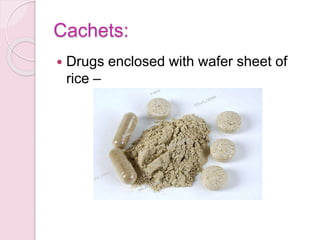
Cachets:
 Drugs enclosed with wafer sheet of
rice –
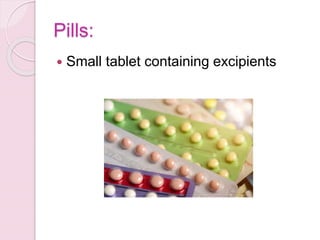
Pills:
 Small tablet containing excipients
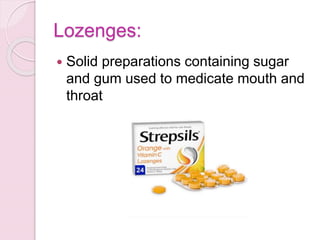
Lozenges:
 Solid preparations containing sugar
and gum used to medicate mouth and
throat
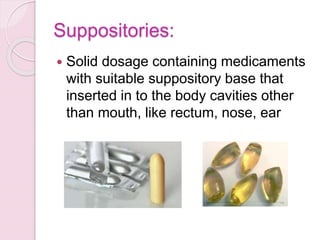
Suppositories:
 Solid dosage containing medicaments
with suitable suppository base that
inserted in to the body cavities other
than mouth, like rectum, nose, ear
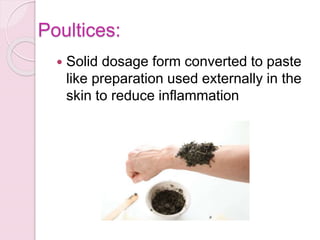
Poultices:
 Solid dosage form converted to paste
like preparation used externally in the
skin to reduce inflammation
Advantages of solid dosage
form:
 The major advantage of solid dosage
forms is a high precision, lowest
variability, stable and accurate dosing.
 The formulation of solid dosage forms
is simpler than liquid and semi-solid
dosage forms.
 Solid dosage forms have a strong
onset of action.
 Several medicines and excipients or
ingredients can combine, making it easier
for the patient to avoid having to
administer multiple doses.
 The liquid form of the drug can be
converted into a solid form using a
capsule.
 Doses are available according to the
patient's requirements.
 These are easy for packaging, transport
and it does not require special conditions
for storage.
 It is easy to swallow and can be
attractive to children.
 It is very simple to swallow with water.
 It is useful whenever partial doses are
required. It is easy to divide it into
parts.
 As it is easy and rapidly digested it
does not harm the gastrointestinal
tract.
 Unpleasant taste and odor of drugs can
be masked using the capsules and sugar
coating for tablets.
 It can be manufactured in custom sizes,
shapes, and colors as per requirement.
 It can protect the API from atmospheric
conditions such as moisture, temperature,
and light, etc.
 Solid dosage forms are stable in
chemical, physical, and microbiological
properties.
Disadvantages of solid dosage
form:
 The main disadvantage of the solid dosage
form is that it is not easy to swallow,
particularly for children, and the elderly, and it
cannot be given to the unconscious patient.
 An API that has slow dissolution rates, low
solubility in water, low density, amorphous
and high absorption in the gastrointestinal
tract, they are difficult to prepare.
 Several medicines cause gastric irritation
when administered in the form of a tablet.
 Hygroscopic drugs are not suitable for
these types of dosage forms.
 Sometimes patients experience
discomfort due to unpleasant taste and
smell and avoid swallowing it.
 Coating, encapsulation of tablets, and
complex process of capsules may
increase production costs in the
pharmaceutical industry.
Solid dosage forms ppt

Solid dosage forms ppt

  • 1.
    Solid dosage forms Dr.P. R. Chavan Pharm D
  • 4.
    Solid dosage formclassification as per use  The bulk forms meant for internal use are supplied either as granules or fine powder.  The bulk powders meant for external use are dusting powders, insufflations, snuffs and tooth powders.
  • 5.
    Powders  are thesolid dosage form of medicament, which are meant for internal or external use.  They are available in crystalline or amorphous form.
  • 6.
    The powders aregenerally used in the following forms: 1. Bulk powder for internal use e.g. fine powders or granules 2. Bulk powder for external use e.g. snuffs, dusting powders and tooth powders. 3. Simple and compound powders for internal use. 4. Powders in the form of compressed tablets and tablet triturates. 5. Powders enclosed in cachets and capsules
  • 7.
    Dusting Powders  Theseare meant for external application to the skin and are generally applied in a very fine state of subdivision to avoid local irritation.  Hence, dusting powders should be passed through a number 80 sieve to enhance their effectiveness.  Dusting powders are of two types: Medical Surgical
  • 8.
     Medical dustingpowders are used mainly for superficial skin conditions.  Surgical dusting powders are used in body cavities and also on major wounds as a result of burns and umbilical cords of infants.  Surgical dusting powders must be sterilised before their use, whereas medical dusting powders must be free from dangerous pathogenic microorganisms.
  • 9.
     Dusting powdersare generally prepared by mixing two or more ingredients .  one of which must be either starch, kaolin or talc as one of the ingredients of the formulation.'
  • 10.
     Talc andkaolin are more commonly used because these are chemically inert.  However, since such ingredients are realiy contaminated with pathogenic bacteria they must be sterilised before their use.  The dusting powders are mainly used for their antiseptic, astringent, absorbent, antiperspirant and
  • 11.
    Insufflations  These aremedicated dusting powders meant for introduction into body cavities (nose, throat, ear, vagina etc) with the help of an apparatus known as a insufflator.  It sprays the powders (in a state of fine particles) on site of application.
  • 12.
    Snuffs  These arefinely divided solid dosage forms of medicaments which are inhaled into nostrils.  They are mainly used for their antiseptic, bronchodilator and decongestion action.
  • 13.
    Dentifrices  Dentifrices arepreparations meant to clean the teeth and other parts of oral cavity (gums) using a finger or a toothbrush.  They are available as tooth powder, toothpastes, gels, dental creams and even as dental foams.
  • 14.
    Tablets:  Solid dosageform containing medicaments with or without excipients – prepared by moulding and compression.
  • 18.
    Granules:  Aggregate ofparticles  Granulation is the process in which dry primary powder particles (i.e. single, discrete powder particles) are processed to adhere to form larger multi-particle entities called granules.  size range between 0.2 and 4.0 mm,  After granulation, the granules will either be packaged (when used as a dosage form) or they may be mixed with other excipients prior to tablet compaction or capsule filling.
  • 19.
    Reasons For Granulation To prevent segregation of the constituents of the powder mix  To improve the flow properties of the mix  To improve the compaction characteristics of the mix
  • 20.
    Types of granules There are several categories of granules: • effervescent granules • coated granules • gastro-resistant granules • modified-release granules.
  • 21.
    Effervescent granules.  Effervescentgranules are uncoated granules generally containing acid substances and carbonates or hydrogen carbonates which react rapidly in the presence of water to release carbon dioxide.  They are intended to be dissolved or dispersed in water before administration.
  • 22.
     The effervescenceand subsequent disintegration of the granules should be complete within 5 minutes at which time the granule ingredients should be either dissolved or dispersed in the water.  Effervescent granules should be stored in an airtight container.
  • 23.
    Coated granules.  Coatedgranules consist of granules coated with one or more layers of mixtures of various excipients.  The substances used as coatings (generally polymers) are usually applied as a solution or suspension in conditions in which evaporation of the vehicle occurs leaving a film of coating
  • 24.
    Modified-release granules  Modified-releasegranules are coated or uncoated granules that contain special excipients or which are prepared by special procedures, or both, designed to modify the rate, the place or the time at which the active substance or substances are released.  Modified-release granules may have prolonged-release or delayed-release properties.
  • 25.
    Gastro-resistant granules.  Gastro-resistantgranules (also referred to as enteric-coated granules) are delayed- release granules that are intended to resist the gastric fluid and to release the active substance(s) in the intestine fluid.  This is generally achieved by covering the granules with a gastro-resistant polymer
  • 26.
    Capsules:  Drug enclosedwith gelatin capsule
  • 27.
    Cachets:  Drugs enclosedwith wafer sheet of rice –
  • 28.
    Pills:  Small tabletcontaining excipients
  • 29.
    Lozenges:  Solid preparationscontaining sugar and gum used to medicate mouth and throat
  • 30.
    Suppositories:  Solid dosagecontaining medicaments with suitable suppository base that inserted in to the body cavities other than mouth, like rectum, nose, ear
  • 31.
    Poultices:  Solid dosageform converted to paste like preparation used externally in the skin to reduce inflammation
  • 32.
    Advantages of soliddosage form:  The major advantage of solid dosage forms is a high precision, lowest variability, stable and accurate dosing.  The formulation of solid dosage forms is simpler than liquid and semi-solid dosage forms.  Solid dosage forms have a strong onset of action.
  • 33.
     Several medicinesand excipients or ingredients can combine, making it easier for the patient to avoid having to administer multiple doses.  The liquid form of the drug can be converted into a solid form using a capsule.  Doses are available according to the patient's requirements.  These are easy for packaging, transport and it does not require special conditions for storage.
  • 34.
     It iseasy to swallow and can be attractive to children.  It is very simple to swallow with water.  It is useful whenever partial doses are required. It is easy to divide it into parts.  As it is easy and rapidly digested it does not harm the gastrointestinal tract.
  • 35.
     Unpleasant tasteand odor of drugs can be masked using the capsules and sugar coating for tablets.  It can be manufactured in custom sizes, shapes, and colors as per requirement.  It can protect the API from atmospheric conditions such as moisture, temperature, and light, etc.  Solid dosage forms are stable in chemical, physical, and microbiological properties.
  • 36.
    Disadvantages of soliddosage form:  The main disadvantage of the solid dosage form is that it is not easy to swallow, particularly for children, and the elderly, and it cannot be given to the unconscious patient.  An API that has slow dissolution rates, low solubility in water, low density, amorphous and high absorption in the gastrointestinal tract, they are difficult to prepare.  Several medicines cause gastric irritation when administered in the form of a tablet.
  • 37.
     Hygroscopic drugsare not suitable for these types of dosage forms.  Sometimes patients experience discomfort due to unpleasant taste and smell and avoid swallowing it.  Coating, encapsulation of tablets, and complex process of capsules may increase production costs in the pharmaceutical industry.