Pharmaceutics
B. Pharma
1st Semester
Unit -3
Chapter -1
Monophasic Liquid Dosage form
Presented by – Nikita Gupta
(Assistant Professor )
Syllabus
• Monophasic liquids:
• Definitions and preparations
of -
Gargles
Mounth washes
Throat paint
Eardrops
Nasal drops
Enemas
Syrups
Elixirs
Liniments
Lotions.
Monophasic liquid dosage form :-
One or more soluble chemical substance dissolved in a
suitable solvent. (homogenous solution)
Advantage of MLDF :
1) Suitable for paediatric & geriatric patients
2) Enhance oral bioavalability
3) More rapid absorption of drug in solution
4) Also provide ease in dosing & administration
Disadvantage of MLDF:
1) Formulation of MLDF – technical problem to industry
pharmacist since some drug are unstable in solution form
2) Problem for poorly soluble drugs
3) Also consider pharmaceutical elegance with regard to taste
appearance & viscosity
4) Microbial contamination (water as a solvent), & short shelf
life as compare to solid dosage form.
1. Syrup –
1. Saturated , concentrated & viscous solution of sucrose in
purified water.
2. Syrup - IP :- 66.7% W/W
USP:- 85% W/V
3. Syrup may contain
medicinal substance – medicated syrup – cough syrup
flavoured/aromatic-nonmedicates /flavoured syrup-cheery
& raspberry syrup
Advantages of Syrup
❖ Retard oxidation-sucrose partially hydrolyzed into dextrose
& levulose ( reducing sugar ) so prevent decomposition of
many substance – no need of antioxidant
❖ Exert high osmotic pressure- prevent groeth of Mos (
bacteria , fungi etc )
❖ Palatable sweet :- vehicle for bitter/nauseous drugs
2. Elixirs –
1. Clear , sweetened , aromatic , hydro-alcoholic ( water +alcohol )
liquid intended for oral use
2. Other ingredients: glycol , flavouring agent & preservative (
20% alcohol )
3. Non medicated elixirs are used as flavours & vehicles to se
solubility of drug substance
3. Lintus -
1. Viscous liquid oral preparation generally prescribed for the
relief of cough
2. Contains demulcent , sedative or expectorant
3. Taken with small doses , sipped & swallowed slowly without
diluting in order to max. & prolonged effect of medicaments.
4. Liniment -
1. Meant for application to skin with friction & Rubbing of the
skin ▪ May contain alcohol or oily solution or emulsion
2. Liniment should not applied to broken skin or broken skin
3. Liniment should be dispersed in colored fluted Bottles in
order to distinguish it from preparation meant for internal
use
4. Label - External Use only; shake well before use & not to
be applied to open wound and broken skin
Ex. Turpentine linimenmt
5. Lotion
1. Meant for external application without friction with the help
of absorbent material like cotton wool or gauze soaked in it.
2. Used for local action cooling, soothing, protective, antiseptic
3. Dispensed in Fluted bottles.
4. External Use only; shake well before use
Ex. Calamine lotion, baby lotion
6. Gargles -
1. Aqueous Concentrated solution used to prevent/ treat
throat infection
2. Dilute with water before use Diluted solution are brought
into intimate contact with mucous membrane of the throat
& allowed to remain contact with it for few sec. before
they are thrown out of the mouth
3. Releived soreness of throat infection
4. Potassium chlorate-used in gargle for its weak astringent
effect to tone relaxed throat
5. Fluted glass bottles
6. External Use only; Dilute before use
7. Mouth wash
Aq. Solution with a pleasant taste & odour used to make clean
& deodorize the buccal cavity. ▪ Contain sweetening,
antibacterial flavoring agent, alcohol & coloring agents ▪
Mouth wash are dispersed in white fluted bottles ▪ Eg.
Listerine
8. Throat paints
❖ Viscous liquid preparation used for mouth & throat
infection
❖ Base- Glycerine (most common used)- provide Adheres to
mucous membrane for long period
❖ Note: Linctuses- viscous and for internal use
❖ Flutted bottle
❖ Example: Gum paint
9. Douches - Douches is a medicated solution used for rinsing
or irrigate a body cavities (sterile) for cleaning or removing
foreign particles or discharges from them.
❖ Douches word is often used for vaginal irrigation & vaginal
douches must be sterile
❖ Douches are generally used for following purposes:
Cleansing agents (Isotonic NaCl solution) Sterile
❖ Antiseptic (HgCl₂ 0.001%, KMnO4 0.025%, Lactic acid
0.5 - 29%, Chlorhexidine 0.02%)
10. Ear Drops - These are solution that are instilled into
the ear with a dropper (prepared in water, Anhydrous
glycerine, propylene glycon & dilute alcohol (vehicles).
Ear drops are used for -
• Cleaning the ear
• Softening the wax
• Treating the infection
Containers = coloured of fluted glass bottle with a dropper
in cap or suitable plastic container.
11. Nasal Drops - These are isotonic solution that are instilled
into the nose with a dropper.
Oily vehicles: Not used because oily drops inhibit the
movement of cilia in nasal mucosa & may cause lipoid
pneumonia if used for long period.
Nasal drops: -
• Isotonic with 0.9% NaCl
• pH (phosphate buffer of pH 6.5 as a vehicle)
• Viscosity similar to nasal secretion by using 0.5% methyl
cellulose.
Preparation must not interfere with the cleansing action of
epithelial cilia of nasal mucosa.
12. Nasal spray - Nasal spray are used to reduce nasal
congestion & to treat infections.
❖ Nasal spray/solution is sprayed using scent spray type of
Atomizer or plastic squeeze bottle in the coarse droplets form
❖ Should be Isotonic & buffered at pH 6.2 ( phosphate
.buffer)
Additives for liquid preparation –
a) Solvent –
❖ water
❖ Alcohol
❖ Glycerine
❖ Propylene glycol
Evaluation of liquid dosage form
❖ Organoleptic preparation
❖ Assay of content
❖ Uniformity of content
❖ Uniformity of weight/volume
❖ Ph
❖ Microbial contamination
Pharmaceutics
B. Pharma
1st Semester
Unit -3
Chapter - 2
Suspension
Presented by – Nikita Gupta
Syllabus
• Suspensions - Definition
• Advantages
• Disadvantages
• Classifications
• Preparation of suspensions
• Flocculated suspension
• Stability problems and methods to overcome.
Definition - A suspension is biphasic system in which a
dispersed state is solid while continuous phase is liquid
(oily/aqueous), the system is stabilized by addition of
"Suspending agent.“
Or
A Pharmaceutical suspension is a coarse dispersion in which
internal phase (therapeutically active ingredient) is dispersed
uniformly throughout the external phase.
Internal phase :- The internal phase consisting of insoluble solid
particles having a range of size(0.5 to 5 microns) which is
maintained uniformly through out the suspending vehicle with
aid of single or combination of suspending agent.
External phase :The external phase (suspending medium) is
generally aqueous in some instance, may be an organic or oily
liquid for non oral use.
Advantages –
• Suspension can improve chemical stability of certain drug.
E.g. Procaine penicillin G.
• Drug in suspension exhibits higher rate of bioavailability than
other dosage forms
Disadvantages –
• Physical stability, sedimentation and compaction can causes
problems.
• It is bulky and sufficient care must be taken during handling
and transport.
• It is difficult to formulate.
• Uniform and accurate dose can not be achieved unless
suspension are packed in unit dosage form.
Classifications –
Based On General Classes
1. Oral suspension eg: Paracetamol suspension antacids,
Tetracycline HCl.
2. Externally applied suspension eg:Calamine lotion.
3. Parenteral suspension eg: Procaine penicillin G Insulin Zinc
Suspension
Based on Proportion of Solid Particles :-
1. Dilute suspension :Concentration ranges from 2 to 10% w/v
solid.
Eg: cortisone acetate, predinisolone acetate
2. Concentrated suspension: Concentration ranges from 50%w/v
solid.
Eg: zinc oxide suspension
Based on Size of Solid Particles
1. Colloidal suspensions :- Suspensions having particle sizes of
suspended solid less than about 1 micron in size are called as
colloidal suspensions.
2. Coarse suspensions :- Suspensions having particle sizes of
greater than about 1 micron in diameter are called as coarse
suspensions.
3. Nano suspensions (10 ng) Suspensions are the biphasic
colloidal dispersions of nanosized drug particles stabilized by
surfactants. Size of the drug particles is less than 1mm.
Properties of Suspension Sedimentation -
Sedimentation means settling of particle ( or ) floccules occur
under gravitational force in liquid dosage form.
Stokes equation -
Sedimentation Parameters:
1. Sedimentation volume (F) or height (H) for flocculated
suspensions: Sedimentation volume is a ratio of the ultimate
volume of sediment (V) to the original volume of sediment
(Vo) before settling .
F=V/Vo
Where, V = final or ultimate volume of sediment
Vo=original volume of suspension before settling
• F has values ranging from less than one to greater than one .
• When The system is in flocculated equilibrium and show no
clear supernatant on standing.
• When F>I then V > V.
• Sediment volume is greater than the original volume due to the
network of flocs formed in the suspension.
2. Degree of flocculation (B) - It is the ratio of the sedimentation
volume of the flocculated suspension, to the sedimentation volume of
the deflocculated suspension.
B = F/Fo (V/ V)
The minimum value of B is 1,when flocculated suspension
sedimentation volume is equal to the sedimentation volume of
deflocculated suspension
3. Brownian movement –
If particle size is about 2 to 5mm.
When the size of the dispersed particle approach that of colloidal
dimensions Brownian movement sets in.
Preparation of Suspensions
The formulation of a suspension depends on whether the suspension
is flocculated or deflocculated.
Three approaches are commonly involved –
1. Use of structured vehicle
2. Use of controlled flocculation
3. Combination of both of the methods
Preparation of Suspensions
The step involved and their sequence in the manufacture.
Step -1• Grinding or levigating of insoluble material.
Step -2• All soluble ingredients are dissolved in same portion of the
vehicle and added to the smooth paste to step1 to get slurry.
Step-3 The slurry is transformed to a graduated cylinder, the mortar is
rinsed with successive portion of the vehicle.
Step -4 Decide whether solids are:
suspended in structured vehicle
Flocculated
Flocculated and then suspended
Step -5 Make up the dispersion to the final volume by adding suitable
suspending agent.
Packaging of Suspensions
❖ Pharmaceutical suspensions for oral use are generally packed in
wide mouth container having adequate space above the liquid to ensure
proper mixing.
❖ Parenteral suspensions are packed in either glass ampoules or vials.
Stability problems and methods to overcome
• It is important to understand that suspensions are kinetically
stable, but thermodynamically unstable, system.
• Physical stability is defined as the condition in which the
particles remain uniformly distributed throughout the
dispersion without any signs of sedimentation.
Effect of particles size on stability-
When left undisturbed for a long period of time the suspension
particles will aggregate, sediment, eventually cake. When a
suspension is very well dispersed (i.e., deflocculated), the particles
will settle as small individual particles. This settling will be very
slow and will result in a low-volume, high-density sediment that
may be difficult or impossible to redisperse. When the particles are
held together in a loose open structure, the system is said to be in
the state of flocculation. Particle size of the active agent plays a
key role in the physical stability and bioavailability of the drug
product.
The rate of sedimentation, agglomeration, is affected by particle size.
The most efficient method of producing small particle size is dry
milling. However, wet milling may be desirable for potentially
explosive ingredients.
Deflocculated Suspension
In this system solids are present as individual particles. These system
have a shorter shelf life ,but have greater bioavailability when
compared to flocculated systems.
Pharmaceutics
B. Pharma
1st Semester
Unit -3
Chapter - 3
Emulsion
Presented by – Nikita Gupta
Syllabus
• Emulsions :- Definition
• Classification
• Emulsifying agent
• Test for the identification of type of emulsion
• Methods of preparation
• Stability problems and methods to overcome.
Emulsions
An emulsion is a two phase system consisting of two incompletely
miscible liquids, one of which is dispersed as finite globules in the
other. The particle size of the globules range from 0.25 to 25 μm.
Classification
1. Oil in water ( o/w) emulsion
Water is the dispersion medium and oil is the dispersed phase.
non greasy and easily removable from the skin.
Used externally to provide cooling effect e.g. vanishing cream.
Preferred for internal use as bitter taste of oils can be masked.
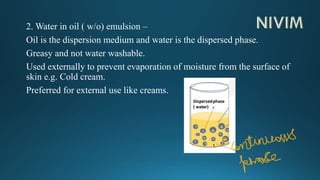
2. Water in oil ( w/o) emulsion –
Oil is the dispersion medium and water is the dispersed phase.
Greasy and not water washable.
Used externally to prevent evaporation of moisture from the surface of
skin e.g. Cold cream.
Preferred for external use like creams.
3. Multiple Emulsion
Multiple emulsions are the emulsion system in which the dispersed
phase contain smaller droplets that have the same composition as
the external phase.
The multiple emulsions are also considered to be of two types.
1. Oil-in-Water-in-Oil (O/W/O) emulsion system.
2. Water-in-Oil-In-Water (W/O/W) emulsion system
Test for the identification of type of emulsion
1. Dilution test :- This test is based on the solubility of external phase
of emulsion.
A. o/w emulsion can be diluted with water.
B. w/o emulsion can be diluted with oil.
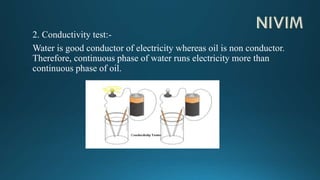
2. Conductivity test:-
Water is good conductor of electricity whereas oil is non conductor.
Therefore, continuous phase of water runs electricity more than
continuous phase of oil.
3. Dye-solubility test:-
When an emulsion is mixed with a water soluble dye such as amaranth
and observed under the microscope. If the continuous phase appears
red, then it means that the emulsion is o/w type as water is the external
phase
4. Fluorescence test:-
Oils give fluorescence under UV light, while water doesn’t. Therefore,
O/W emulsion shows spotty pattern while W/O emulsion fluoresces.
Formation of emulsion:-
1. Selection of Emulsifying agents (emulsifiers) :-
An emulsifying agent is any material that enhances the
stability of an emulsion (i.e. Prevention of coalescence
and reducing creaming).
The ideal emulsifying agent is colorless, odorless,
tasteless, non-toxic, non-irritant and able to produce stable
emulsions at low concentrations.
Examples of Emulsifying agent
1. Carbohydrate Materials: Acacia, Tragacanth, Agar, Pectin. (o/w
emulsion)
2. Protein Substances: -Gelatin, Egg yolk, Casein (o/w emulsion).
3. High Molecular Weight Alcohols:- Stearyl Alcohol, Cetyl Alcohol,
Glyceryl Mono stearate (o/w emulsion) cholesterol (w/o emulsion).
4. Wetting Agents-Anionic, Cationic, Nonionic - (o/w emulsion -w/o
emulsion)
5. Finely divided solids- Bentonite, Magnesium Hydroxide,
Aluminum Hydroxide (o/w emulsion).
Methods of preparation
1. Trituration Method
Dry gum method - In this method the oil is first triturated with gum
with a little amount of water to form the primary emulsion. The
trituration is continued till a characteristic 'clicking' sound is heard
and a thick white cream is formed. Once the primary emulsion is
formed, the remaining quantity of water is slowly added to form the
final emulsion.
This method consist of "4:2:1" formula i.e. 4 parts (volumes) of oil, 2
parts of water, 1 part of gum.
Wet gum method – The order of mixing is different: The acacia is
first mixed with water, and then the water is triturated rapidly to
produce mucilage. Adding oil in small portions to the mucilage
(gradually) is based on a dry measuring cylinder. An emulsion of
thick primary thickness must be constantly triturated after each
addition.
Bottle Method - This method is employed for preparing emulsions
containing volatile and other non viscous oils. Both dry gum and
wet gum methods can be employed for the preparation. As volatile
oils have a low viscosity as compared to fixed oils, they require
comparatively large quantity of gum for emulsification
Stability problems and methods to overcome
• An emulsion is said to be stable if it remains as such after its
preparation, that is the dispersed globules are uniformly distributed
through out the dispersion medium during its storage.
• The emulsion should be chemically stable and there should not be
any bacterial growth during it shelf life.
• Emulsion instability may either reversible or irreversible and
manifest in the following ways:
1) Cracking (irreversible instability)
2) Flocculation
3) Creaming
4) Phase inversion
1) Cracking (irreversible instability) - Cracking means the separation of
two layers of disperse and continuous phase, due to the coalescence of
disperse phase, globules which are difficult to redisperse by shaking.
Cracking may occurs due to following reasons:
i. By addition of emulsifying agent of opposite type
ii. By decomposition or precipitation of emulsifying agent
iii. By addition of common solventiv
iv. By microorganismsv
v. Change in temperature
vi. By creaming
2) Flocculation - In flocculation, the small spheres of dispersed phase
join together to form clumps or flocks which rise or settle in the
emulsion more rapidly than individual particles
Application of shearing stress to the formulation (shaking) will
redisperse these droplets to form a homogeneous formulation.
Although flocculation may stabilize the formulation, there is also
possibility that the close location of droplets would enable droplet
coalescence to occur if the mechanical properties of the interfacial film
are compromised.
Creaming - Creaming derives its name from the most commonly
known example of a de-emulsification process – the separation of milk
into its separate cream (curd) and skim milk (whey) components.
Creaming is not an actual breaking but a separation of the emulsion
into two emulsions, one of which (the cream) is richer in the disperse
phase than the other. Creaming is the principal process by which the
disperse phase separates from an emulsion and is typically the
precursor to actual coalescence.
Disproportionation is a process – often referred to as Ostwald
ripening – dependent on the diffusion of disperse phase molecules
from smaller to larger droplets through the continuous phase. The
pressure of dispersed material is greater for smaller droplets than
larger droplets.
Phase inversion - In phase inversion o/w type emulsion changes
into w/o type and vice versa. It is a physical instability. It may be
brought about - ✓ By the addition of an electrolyte e.g. addition of
CaCl2 into o/w emulsion formed by sodium stearate can be
inverted to w/o. ✓by changing the phase volume ratio ✓ by
temperature changes.
ThankYou

Pharmaceutics Unit -3.pptx

  • 1.
    Pharmaceutics B. Pharma 1st Semester Unit-3 Chapter -1 Monophasic Liquid Dosage form Presented by – Nikita Gupta (Assistant Professor )
  • 2.
    Syllabus • Monophasic liquids: •Definitions and preparations of - Gargles Mounth washes Throat paint Eardrops Nasal drops Enemas Syrups Elixirs Liniments Lotions.
  • 3.
    Monophasic liquid dosageform :- One or more soluble chemical substance dissolved in a suitable solvent. (homogenous solution)
  • 4.
    Advantage of MLDF: 1) Suitable for paediatric & geriatric patients 2) Enhance oral bioavalability 3) More rapid absorption of drug in solution 4) Also provide ease in dosing & administration
  • 5.
    Disadvantage of MLDF: 1)Formulation of MLDF – technical problem to industry pharmacist since some drug are unstable in solution form 2) Problem for poorly soluble drugs 3) Also consider pharmaceutical elegance with regard to taste appearance & viscosity 4) Microbial contamination (water as a solvent), & short shelf life as compare to solid dosage form.
  • 7.
    1. Syrup – 1.Saturated , concentrated & viscous solution of sucrose in purified water. 2. Syrup - IP :- 66.7% W/W USP:- 85% W/V 3. Syrup may contain medicinal substance – medicated syrup – cough syrup flavoured/aromatic-nonmedicates /flavoured syrup-cheery & raspberry syrup
  • 8.
    Advantages of Syrup ❖Retard oxidation-sucrose partially hydrolyzed into dextrose & levulose ( reducing sugar ) so prevent decomposition of many substance – no need of antioxidant ❖ Exert high osmotic pressure- prevent groeth of Mos ( bacteria , fungi etc ) ❖ Palatable sweet :- vehicle for bitter/nauseous drugs
  • 9.
    2. Elixirs – 1.Clear , sweetened , aromatic , hydro-alcoholic ( water +alcohol ) liquid intended for oral use 2. Other ingredients: glycol , flavouring agent & preservative ( 20% alcohol ) 3. Non medicated elixirs are used as flavours & vehicles to se solubility of drug substance
  • 10.
    3. Lintus - 1.Viscous liquid oral preparation generally prescribed for the relief of cough 2. Contains demulcent , sedative or expectorant 3. Taken with small doses , sipped & swallowed slowly without diluting in order to max. & prolonged effect of medicaments.
  • 11.
    4. Liniment - 1.Meant for application to skin with friction & Rubbing of the skin ▪ May contain alcohol or oily solution or emulsion 2. Liniment should not applied to broken skin or broken skin 3. Liniment should be dispersed in colored fluted Bottles in order to distinguish it from preparation meant for internal use 4. Label - External Use only; shake well before use & not to be applied to open wound and broken skin Ex. Turpentine linimenmt
  • 12.
    5. Lotion 1. Meantfor external application without friction with the help of absorbent material like cotton wool or gauze soaked in it. 2. Used for local action cooling, soothing, protective, antiseptic 3. Dispensed in Fluted bottles. 4. External Use only; shake well before use Ex. Calamine lotion, baby lotion
  • 13.
    6. Gargles - 1.Aqueous Concentrated solution used to prevent/ treat throat infection 2. Dilute with water before use Diluted solution are brought into intimate contact with mucous membrane of the throat & allowed to remain contact with it for few sec. before they are thrown out of the mouth
  • 14.
    3. Releived sorenessof throat infection 4. Potassium chlorate-used in gargle for its weak astringent effect to tone relaxed throat 5. Fluted glass bottles 6. External Use only; Dilute before use
  • 15.
    7. Mouth wash Aq.Solution with a pleasant taste & odour used to make clean & deodorize the buccal cavity. ▪ Contain sweetening, antibacterial flavoring agent, alcohol & coloring agents ▪ Mouth wash are dispersed in white fluted bottles ▪ Eg. Listerine
  • 16.
    8. Throat paints ❖Viscous liquid preparation used for mouth & throat infection ❖ Base- Glycerine (most common used)- provide Adheres to mucous membrane for long period ❖ Note: Linctuses- viscous and for internal use ❖ Flutted bottle ❖ Example: Gum paint
  • 17.
    9. Douches -Douches is a medicated solution used for rinsing or irrigate a body cavities (sterile) for cleaning or removing foreign particles or discharges from them. ❖ Douches word is often used for vaginal irrigation & vaginal douches must be sterile ❖ Douches are generally used for following purposes: Cleansing agents (Isotonic NaCl solution) Sterile ❖ Antiseptic (HgCl₂ 0.001%, KMnO4 0.025%, Lactic acid 0.5 - 29%, Chlorhexidine 0.02%)
  • 18.
    10. Ear Drops- These are solution that are instilled into the ear with a dropper (prepared in water, Anhydrous glycerine, propylene glycon & dilute alcohol (vehicles). Ear drops are used for - • Cleaning the ear • Softening the wax • Treating the infection Containers = coloured of fluted glass bottle with a dropper in cap or suitable plastic container.
  • 19.
    11. Nasal Drops- These are isotonic solution that are instilled into the nose with a dropper. Oily vehicles: Not used because oily drops inhibit the movement of cilia in nasal mucosa & may cause lipoid pneumonia if used for long period.
  • 20.
    Nasal drops: - •Isotonic with 0.9% NaCl • pH (phosphate buffer of pH 6.5 as a vehicle) • Viscosity similar to nasal secretion by using 0.5% methyl cellulose. Preparation must not interfere with the cleansing action of epithelial cilia of nasal mucosa.
  • 21.
    12. Nasal spray- Nasal spray are used to reduce nasal congestion & to treat infections. ❖ Nasal spray/solution is sprayed using scent spray type of Atomizer or plastic squeeze bottle in the coarse droplets form ❖ Should be Isotonic & buffered at pH 6.2 ( phosphate .buffer)
  • 22.
    Additives for liquidpreparation – a) Solvent – ❖ water ❖ Alcohol ❖ Glycerine ❖ Propylene glycol
  • 23.
    Evaluation of liquiddosage form ❖ Organoleptic preparation ❖ Assay of content ❖ Uniformity of content ❖ Uniformity of weight/volume ❖ Ph ❖ Microbial contamination
  • 24.
    Pharmaceutics B. Pharma 1st Semester Unit-3 Chapter - 2 Suspension Presented by – Nikita Gupta
  • 25.
    Syllabus • Suspensions -Definition • Advantages • Disadvantages • Classifications • Preparation of suspensions • Flocculated suspension • Stability problems and methods to overcome.
  • 26.
    Definition - Asuspension is biphasic system in which a dispersed state is solid while continuous phase is liquid (oily/aqueous), the system is stabilized by addition of "Suspending agent.“ Or A Pharmaceutical suspension is a coarse dispersion in which internal phase (therapeutically active ingredient) is dispersed uniformly throughout the external phase.
  • 27.
    Internal phase :-The internal phase consisting of insoluble solid particles having a range of size(0.5 to 5 microns) which is maintained uniformly through out the suspending vehicle with aid of single or combination of suspending agent. External phase :The external phase (suspending medium) is generally aqueous in some instance, may be an organic or oily liquid for non oral use.
  • 28.
    Advantages – • Suspensioncan improve chemical stability of certain drug. E.g. Procaine penicillin G. • Drug in suspension exhibits higher rate of bioavailability than other dosage forms
  • 29.
    Disadvantages – • Physicalstability, sedimentation and compaction can causes problems. • It is bulky and sufficient care must be taken during handling and transport. • It is difficult to formulate. • Uniform and accurate dose can not be achieved unless suspension are packed in unit dosage form.
  • 30.
    Classifications – Based OnGeneral Classes 1. Oral suspension eg: Paracetamol suspension antacids, Tetracycline HCl. 2. Externally applied suspension eg:Calamine lotion. 3. Parenteral suspension eg: Procaine penicillin G Insulin Zinc Suspension
  • 31.
    Based on Proportionof Solid Particles :- 1. Dilute suspension :Concentration ranges from 2 to 10% w/v solid. Eg: cortisone acetate, predinisolone acetate 2. Concentrated suspension: Concentration ranges from 50%w/v solid. Eg: zinc oxide suspension
  • 32.
    Based on Sizeof Solid Particles 1. Colloidal suspensions :- Suspensions having particle sizes of suspended solid less than about 1 micron in size are called as colloidal suspensions. 2. Coarse suspensions :- Suspensions having particle sizes of greater than about 1 micron in diameter are called as coarse suspensions. 3. Nano suspensions (10 ng) Suspensions are the biphasic colloidal dispersions of nanosized drug particles stabilized by surfactants. Size of the drug particles is less than 1mm.
  • 33.
    Properties of SuspensionSedimentation - Sedimentation means settling of particle ( or ) floccules occur under gravitational force in liquid dosage form. Stokes equation -
  • 34.
    Sedimentation Parameters: 1. Sedimentationvolume (F) or height (H) for flocculated suspensions: Sedimentation volume is a ratio of the ultimate volume of sediment (V) to the original volume of sediment (Vo) before settling . F=V/Vo Where, V = final or ultimate volume of sediment Vo=original volume of suspension before settling
  • 35.
    • F hasvalues ranging from less than one to greater than one . • When The system is in flocculated equilibrium and show no clear supernatant on standing. • When F>I then V > V. • Sediment volume is greater than the original volume due to the network of flocs formed in the suspension.
  • 36.
    2. Degree offlocculation (B) - It is the ratio of the sedimentation volume of the flocculated suspension, to the sedimentation volume of the deflocculated suspension. B = F/Fo (V/ V) The minimum value of B is 1,when flocculated suspension sedimentation volume is equal to the sedimentation volume of deflocculated suspension
  • 37.
    3. Brownian movement– If particle size is about 2 to 5mm. When the size of the dispersed particle approach that of colloidal dimensions Brownian movement sets in.
  • 38.
    Preparation of Suspensions Theformulation of a suspension depends on whether the suspension is flocculated or deflocculated. Three approaches are commonly involved – 1. Use of structured vehicle 2. Use of controlled flocculation 3. Combination of both of the methods
  • 39.
    Preparation of Suspensions Thestep involved and their sequence in the manufacture. Step -1• Grinding or levigating of insoluble material. Step -2• All soluble ingredients are dissolved in same portion of the vehicle and added to the smooth paste to step1 to get slurry. Step-3 The slurry is transformed to a graduated cylinder, the mortar is rinsed with successive portion of the vehicle.
  • 40.
    Step -4 Decidewhether solids are: suspended in structured vehicle Flocculated Flocculated and then suspended Step -5 Make up the dispersion to the final volume by adding suitable suspending agent. Packaging of Suspensions ❖ Pharmaceutical suspensions for oral use are generally packed in wide mouth container having adequate space above the liquid to ensure proper mixing. ❖ Parenteral suspensions are packed in either glass ampoules or vials.
  • 42.
    Stability problems andmethods to overcome • It is important to understand that suspensions are kinetically stable, but thermodynamically unstable, system. • Physical stability is defined as the condition in which the particles remain uniformly distributed throughout the dispersion without any signs of sedimentation.
  • 43.
    Effect of particlessize on stability- When left undisturbed for a long period of time the suspension particles will aggregate, sediment, eventually cake. When a suspension is very well dispersed (i.e., deflocculated), the particles will settle as small individual particles. This settling will be very slow and will result in a low-volume, high-density sediment that may be difficult or impossible to redisperse. When the particles are held together in a loose open structure, the system is said to be in the state of flocculation. Particle size of the active agent plays a key role in the physical stability and bioavailability of the drug product.
  • 44.
    The rate ofsedimentation, agglomeration, is affected by particle size. The most efficient method of producing small particle size is dry milling. However, wet milling may be desirable for potentially explosive ingredients. Deflocculated Suspension In this system solids are present as individual particles. These system have a shorter shelf life ,but have greater bioavailability when compared to flocculated systems.
  • 45.
    Pharmaceutics B. Pharma 1st Semester Unit-3 Chapter - 3 Emulsion Presented by – Nikita Gupta
  • 46.
    Syllabus • Emulsions :-Definition • Classification • Emulsifying agent • Test for the identification of type of emulsion • Methods of preparation • Stability problems and methods to overcome.
  • 47.
    Emulsions An emulsion isa two phase system consisting of two incompletely miscible liquids, one of which is dispersed as finite globules in the other. The particle size of the globules range from 0.25 to 25 μm.
  • 48.
  • 49.
    1. Oil inwater ( o/w) emulsion Water is the dispersion medium and oil is the dispersed phase. non greasy and easily removable from the skin. Used externally to provide cooling effect e.g. vanishing cream. Preferred for internal use as bitter taste of oils can be masked.
  • 50.
    2. Water inoil ( w/o) emulsion – Oil is the dispersion medium and water is the dispersed phase. Greasy and not water washable. Used externally to prevent evaporation of moisture from the surface of skin e.g. Cold cream. Preferred for external use like creams.
  • 51.
    3. Multiple Emulsion Multipleemulsions are the emulsion system in which the dispersed phase contain smaller droplets that have the same composition as the external phase. The multiple emulsions are also considered to be of two types. 1. Oil-in-Water-in-Oil (O/W/O) emulsion system. 2. Water-in-Oil-In-Water (W/O/W) emulsion system
  • 53.
    Test for theidentification of type of emulsion 1. Dilution test :- This test is based on the solubility of external phase of emulsion. A. o/w emulsion can be diluted with water. B. w/o emulsion can be diluted with oil.
  • 54.
    2. Conductivity test:- Wateris good conductor of electricity whereas oil is non conductor. Therefore, continuous phase of water runs electricity more than continuous phase of oil.
  • 55.
    3. Dye-solubility test:- Whenan emulsion is mixed with a water soluble dye such as amaranth and observed under the microscope. If the continuous phase appears red, then it means that the emulsion is o/w type as water is the external phase
  • 56.
    4. Fluorescence test:- Oilsgive fluorescence under UV light, while water doesn’t. Therefore, O/W emulsion shows spotty pattern while W/O emulsion fluoresces.
  • 57.
    Formation of emulsion:- 1.Selection of Emulsifying agents (emulsifiers) :- An emulsifying agent is any material that enhances the stability of an emulsion (i.e. Prevention of coalescence and reducing creaming). The ideal emulsifying agent is colorless, odorless, tasteless, non-toxic, non-irritant and able to produce stable emulsions at low concentrations.
  • 58.
    Examples of Emulsifyingagent 1. Carbohydrate Materials: Acacia, Tragacanth, Agar, Pectin. (o/w emulsion) 2. Protein Substances: -Gelatin, Egg yolk, Casein (o/w emulsion). 3. High Molecular Weight Alcohols:- Stearyl Alcohol, Cetyl Alcohol, Glyceryl Mono stearate (o/w emulsion) cholesterol (w/o emulsion). 4. Wetting Agents-Anionic, Cationic, Nonionic - (o/w emulsion -w/o emulsion) 5. Finely divided solids- Bentonite, Magnesium Hydroxide, Aluminum Hydroxide (o/w emulsion).
  • 59.
    Methods of preparation 1.Trituration Method Dry gum method - In this method the oil is first triturated with gum with a little amount of water to form the primary emulsion. The trituration is continued till a characteristic 'clicking' sound is heard and a thick white cream is formed. Once the primary emulsion is formed, the remaining quantity of water is slowly added to form the final emulsion. This method consist of "4:2:1" formula i.e. 4 parts (volumes) of oil, 2 parts of water, 1 part of gum.
  • 60.
    Wet gum method– The order of mixing is different: The acacia is first mixed with water, and then the water is triturated rapidly to produce mucilage. Adding oil in small portions to the mucilage (gradually) is based on a dry measuring cylinder. An emulsion of thick primary thickness must be constantly triturated after each addition. Bottle Method - This method is employed for preparing emulsions containing volatile and other non viscous oils. Both dry gum and wet gum methods can be employed for the preparation. As volatile oils have a low viscosity as compared to fixed oils, they require comparatively large quantity of gum for emulsification
  • 61.
    Stability problems andmethods to overcome • An emulsion is said to be stable if it remains as such after its preparation, that is the dispersed globules are uniformly distributed through out the dispersion medium during its storage. • The emulsion should be chemically stable and there should not be any bacterial growth during it shelf life. • Emulsion instability may either reversible or irreversible and manifest in the following ways: 1) Cracking (irreversible instability) 2) Flocculation 3) Creaming 4) Phase inversion
  • 63.
    1) Cracking (irreversibleinstability) - Cracking means the separation of two layers of disperse and continuous phase, due to the coalescence of disperse phase, globules which are difficult to redisperse by shaking. Cracking may occurs due to following reasons: i. By addition of emulsifying agent of opposite type ii. By decomposition or precipitation of emulsifying agent iii. By addition of common solventiv iv. By microorganismsv v. Change in temperature vi. By creaming
  • 64.
    2) Flocculation -In flocculation, the small spheres of dispersed phase join together to form clumps or flocks which rise or settle in the emulsion more rapidly than individual particles
  • 65.
    Application of shearingstress to the formulation (shaking) will redisperse these droplets to form a homogeneous formulation. Although flocculation may stabilize the formulation, there is also possibility that the close location of droplets would enable droplet coalescence to occur if the mechanical properties of the interfacial film are compromised. Creaming - Creaming derives its name from the most commonly known example of a de-emulsification process – the separation of milk into its separate cream (curd) and skim milk (whey) components. Creaming is not an actual breaking but a separation of the emulsion into two emulsions, one of which (the cream) is richer in the disperse phase than the other. Creaming is the principal process by which the disperse phase separates from an emulsion and is typically the precursor to actual coalescence.
  • 66.
    Disproportionation is aprocess – often referred to as Ostwald ripening – dependent on the diffusion of disperse phase molecules from smaller to larger droplets through the continuous phase. The pressure of dispersed material is greater for smaller droplets than larger droplets. Phase inversion - In phase inversion o/w type emulsion changes into w/o type and vice versa. It is a physical instability. It may be brought about - ✓ By the addition of an electrolyte e.g. addition of CaCl2 into o/w emulsion formed by sodium stearate can be inverted to w/o. ✓by changing the phase volume ratio ✓ by temperature changes.
  • 67.