Powders
1
Powders
 Simple Powders
 Definition of powders
 Types of powders
 Formulation of powders
 Methods of preparation
 Packaging and labeling of powders
 Compound Powders In Bulk
 Compound Powders In Single Doses
Powder & granules
 The term 'powder' when used to
describe a dosage form describes a
formulation in which a drug powder has
been mixed with other powdered
excipients to produce the final product.
 A Pharmaceutical powder is a mixture of
finely divided drugs or chemicals in a dry
form meant for internal or external use.
 Granules which are used as a dosage
form consist of powder particles that
have been aggregated to form a larger
particle, which is usually 2-4 mm in
diameter.
3
Advantages of powders DF
 Good chemical stability compared with fluids
 useful for bulky drugs with large dose, e.g.
indigestion powder.
 The smaller particle size of powders causes more
rapid dissolution in body fluids, increases drug
bioavailability, and decreases gastric irritation
compared with tablets
4
Disadvantages of powders DF
1. Bulk powders are far less convenient for the
patient to carry than a small container of
tablets or capsules,
2. The masking of unpleasant tastes may be a
problem with this type of preparation.
3. Powders are not a suitable method for the
administration of drugs which are inactivated
in, or cause damage to, the stomach; these
should be presented as enteric-coated
4. It is difficult to protect powders containing
hygroscopic, deliquescent (tending to melt or
dissolve in humid environment), or aromatic
materials from decomposition
5
Types of powders
 bulk powders for external use – termed dusting
powders
 bulk oral powders
 divided powders/individual unit dose powders-
Single Dose
 unit dose capsules.
Other preparations which are presented as
powders or granules include:
 insufflations for administration to ear, nose or
throat
 antibiotic syrups to be reconstituted before use
 powders for reconstitution into injections
 dry powder inhalers.
6
Bulk powders for external us
7
 These are dry, free-flowing preparations consisting
of one or a mixture of finely powdered substances
and intended for external application.
The advantages of dusting powders
 They are easy to apply.
 They are pleasant to use.
 They absorb skin moisture leads to reduced
friction btn skin surfaces
The disadvantages of dusting powders
 They may block pores, causing irritation
 There is a possibility of contamination
 Light fluffy powders may be inhaled by infants,
causing breathing difficulties.
 They are not suitable for application to broken
skin.
Bulk oral powders
8
 Bulk oral powders resemble dusting powders with
the exception that they are intended for oral
administration.
 The dose to be taken is measured with a 5mL
spoon, stirred into a quantity of water and then
swallowed.
 Consequently, this formulation is restricted to use
in preparations consisting of relatively non-potent
medicaments such as Kaolin BP and Magnesium
Trisilicate BP, where such products are intended
for the symptomatic relief of minor ailments
9
The advantages of bulk oral powders
 dry powders may be more stable than their liquid
equivalent
 large doses of bulky powders may be
administered with relative ease (e.g. indigestion
powders)
 absorption from the gastrointestinal tract will be
quicker than with capsules or tablets.
The disadvantages of bulk oral powders
 the accuracy of dosage is not guaranteed,
therefore it is not a suitable dosage form for
potent medication
 the large size container means that they may be
inconvenient to carry
Individual unit dose (Divided)
powders
10
 Single-dose powders usually consist of one or
more powdered active medicaments, together
with an inert diluent, and wrapped as single
doses in white demy paper, folded to a uniform
shape and size.
The disadvantage with bulk oral powders is that the
dosage problem, it is overcome by providing
the patient with a set of separate doses, each
of which has been individually wrapped packets,
cachets, capsules
 Traditionally, single doses were wrapped in paper.
Modern packaging materials of foil and plastic
laminates have replaced such paper wrappings
11
Advantages
 More stable than liquid dosage forms
 Accurate dosing flavours
 Easy to administer
 Small particle size of drug
 Acceptable to patients
Disadvantages
 May be difficult to swallow
 Hard to mask unpleasant
Unit dose capsules
12
 Capsules are a further development from unit
dose powders in that each dose of powder is
enclosed in n edible gelatin capsule, which is
swallowed whole with a water
 The powder is not released from its container
until it is in the stomach. This type of presentation
is more convenient for the patient, and is
particularly useful for medicaments which have an
unpleasant taste
13
Advantages
 Powders show greater stability
than liquid dosage forms
 Accurate dosage is possible.
 They are easy to administer –
capsules are relatively easy to
swallow (suitable shape and
slippery when moistened).
 Unpleasant tastes can be easily
masked.
 The release characteristics of the
drugs can be controlled.
 The smaller particle size of
powdered drugs leads to more
rapid absorption from the
gastrointestinal tract compared to
tablets.
 They are well accepted by patients,
attractive to patients and
convenient to carry
The disadvantages
 They may be
difficult to swallow.
Capsules are
unsuitable for very
small children.
Patients with strict
religious beliefs and
vegetarians may
object to the use of
animal gelatin
(although non-animal
gelatin capsules may
be available).
14
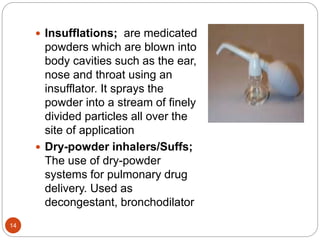
 Insufflations; are medicated
powders which are blown into
body cavities such as the ear,
nose and throat using an
insufflator. It sprays the
powder into a stream of finely
divided particles all over the
site of application
 Dry-powder inhalers/Suffs;
The use of dry-powder
systems for pulmonary drug
delivery. Used as
decongestant, bronchodilator
Formulation of powders
15
 Bulking agents- like starch, lactose,
chalk
 Absorbent agents; bentonite, kaolin
 Adhesives; Aluminium Stearate, Zinc
Stearate
 Coloring agents
 flavouring and sweetening agents, for
example, may be added to powders for
oral use.
16
Preparation of Powders
1- Reduction of particle size using;
trituration, pulverization and levigation.
2- Sieving.
3- Weighing of each ingredient.
4- Mixing
5- Packaging and labeling- packed in air
tight containers, pressurized containers,
plastic or metal
17
 Zinc Starch and Talc Dusting Powder BPC
 Compound Magnesium Trisilicate Oral Powder
BP

powders notes for pharmaceutics one-1.pptx

  • 1.
  • 2.
    Powders  Simple Powders Definition of powders  Types of powders  Formulation of powders  Methods of preparation  Packaging and labeling of powders  Compound Powders In Bulk  Compound Powders In Single Doses
  • 3.
    Powder & granules The term 'powder' when used to describe a dosage form describes a formulation in which a drug powder has been mixed with other powdered excipients to produce the final product.  A Pharmaceutical powder is a mixture of finely divided drugs or chemicals in a dry form meant for internal or external use.  Granules which are used as a dosage form consist of powder particles that have been aggregated to form a larger particle, which is usually 2-4 mm in diameter. 3
  • 4.
    Advantages of powdersDF  Good chemical stability compared with fluids  useful for bulky drugs with large dose, e.g. indigestion powder.  The smaller particle size of powders causes more rapid dissolution in body fluids, increases drug bioavailability, and decreases gastric irritation compared with tablets 4
  • 5.
    Disadvantages of powdersDF 1. Bulk powders are far less convenient for the patient to carry than a small container of tablets or capsules, 2. The masking of unpleasant tastes may be a problem with this type of preparation. 3. Powders are not a suitable method for the administration of drugs which are inactivated in, or cause damage to, the stomach; these should be presented as enteric-coated 4. It is difficult to protect powders containing hygroscopic, deliquescent (tending to melt or dissolve in humid environment), or aromatic materials from decomposition 5
  • 6.
    Types of powders bulk powders for external use – termed dusting powders  bulk oral powders  divided powders/individual unit dose powders- Single Dose  unit dose capsules. Other preparations which are presented as powders or granules include:  insufflations for administration to ear, nose or throat  antibiotic syrups to be reconstituted before use  powders for reconstitution into injections  dry powder inhalers. 6
  • 7.
    Bulk powders forexternal us 7  These are dry, free-flowing preparations consisting of one or a mixture of finely powdered substances and intended for external application. The advantages of dusting powders  They are easy to apply.  They are pleasant to use.  They absorb skin moisture leads to reduced friction btn skin surfaces The disadvantages of dusting powders  They may block pores, causing irritation  There is a possibility of contamination  Light fluffy powders may be inhaled by infants, causing breathing difficulties.  They are not suitable for application to broken skin.
  • 8.
    Bulk oral powders 8 Bulk oral powders resemble dusting powders with the exception that they are intended for oral administration.  The dose to be taken is measured with a 5mL spoon, stirred into a quantity of water and then swallowed.  Consequently, this formulation is restricted to use in preparations consisting of relatively non-potent medicaments such as Kaolin BP and Magnesium Trisilicate BP, where such products are intended for the symptomatic relief of minor ailments
  • 9.
    9 The advantages ofbulk oral powders  dry powders may be more stable than their liquid equivalent  large doses of bulky powders may be administered with relative ease (e.g. indigestion powders)  absorption from the gastrointestinal tract will be quicker than with capsules or tablets. The disadvantages of bulk oral powders  the accuracy of dosage is not guaranteed, therefore it is not a suitable dosage form for potent medication  the large size container means that they may be inconvenient to carry
  • 10.
    Individual unit dose(Divided) powders 10  Single-dose powders usually consist of one or more powdered active medicaments, together with an inert diluent, and wrapped as single doses in white demy paper, folded to a uniform shape and size. The disadvantage with bulk oral powders is that the dosage problem, it is overcome by providing the patient with a set of separate doses, each of which has been individually wrapped packets, cachets, capsules  Traditionally, single doses were wrapped in paper. Modern packaging materials of foil and plastic laminates have replaced such paper wrappings
  • 11.
    11 Advantages  More stablethan liquid dosage forms  Accurate dosing flavours  Easy to administer  Small particle size of drug  Acceptable to patients Disadvantages  May be difficult to swallow  Hard to mask unpleasant
  • 12.
    Unit dose capsules 12 Capsules are a further development from unit dose powders in that each dose of powder is enclosed in n edible gelatin capsule, which is swallowed whole with a water  The powder is not released from its container until it is in the stomach. This type of presentation is more convenient for the patient, and is particularly useful for medicaments which have an unpleasant taste
  • 13.
    13 Advantages  Powders showgreater stability than liquid dosage forms  Accurate dosage is possible.  They are easy to administer – capsules are relatively easy to swallow (suitable shape and slippery when moistened).  Unpleasant tastes can be easily masked.  The release characteristics of the drugs can be controlled.  The smaller particle size of powdered drugs leads to more rapid absorption from the gastrointestinal tract compared to tablets.  They are well accepted by patients, attractive to patients and convenient to carry The disadvantages  They may be difficult to swallow. Capsules are unsuitable for very small children. Patients with strict religious beliefs and vegetarians may object to the use of animal gelatin (although non-animal gelatin capsules may be available).
  • 14.
    14  Insufflations; aremedicated powders which are blown into body cavities such as the ear, nose and throat using an insufflator. It sprays the powder into a stream of finely divided particles all over the site of application  Dry-powder inhalers/Suffs; The use of dry-powder systems for pulmonary drug delivery. Used as decongestant, bronchodilator
  • 15.
    Formulation of powders 15 Bulking agents- like starch, lactose, chalk  Absorbent agents; bentonite, kaolin  Adhesives; Aluminium Stearate, Zinc Stearate  Coloring agents  flavouring and sweetening agents, for example, may be added to powders for oral use.
  • 16.
    16 Preparation of Powders 1-Reduction of particle size using; trituration, pulverization and levigation. 2- Sieving. 3- Weighing of each ingredient. 4- Mixing 5- Packaging and labeling- packed in air tight containers, pressurized containers, plastic or metal
  • 17.
    17  Zinc Starchand Talc Dusting Powder BPC  Compound Magnesium Trisilicate Oral Powder BP