LN2 Certification
Level 4: LN2 Use for Overclocking “in public”
Prepared by
Our Mission
• Evangelize overclocking
• Convert enthusiasts in to passionate overclockers
• Support the community
• Further professionalize extreme overclocking
Copyright HWBOT 2015
Disclaimer
HWBOT or any of its representatives accepts no liability for the content of this presentation, or for
the consequences of any actions taken on the basis of the information provided.
HWBOT shall not be liable for any loss or damage of whatever nature (direct, indirect,
consequential, or other) whether arising in contract, tort or otherwise, which may arise as a result
of the use of (or inability to use) cryogenic gases and/or liquids of any kind.
This presentation is published for general information purposes. Any use made of the information in
this presentation by the reader is their sole responsibility. These safety information have been
prepared by HWBOT based upon established industry safety standards and recognized resources.
Although HWBOT deems the data in these documents accurate, HWBOT cannot be held liable
should their content fail to meet the legal stipulations applicable in any jurisdictions it may be
applied into.
The HWBOT LN2 Certification presentations are subject to revision. Visit our website to ensure that
you have the latest version.
Copyright HWBOT 2015
Course summary
1. About Liquid Nitrogen (reminder)
2. LN2 for Overclocking & Safe Use (reminder)
3. LN2 for Overclocking in Public
a. Storage
b. Workspace
c. Safety
4. To go further
Copyright HWBOT 2015
About Liquid Nitrogen (reminder)
• LN2 = Liquid Nitrogen
• Cryogenic liquid
• Boiling point < -150°C
• Most used : nitrogen(LN2) & helium(LHe)
• Evaporation volume ratio 1:700
• Colourless, Odourless, Tasteless
• LN2 boiling point: -196°C or -320°F
• Non flammable, non explosive, non toxic
Copyright HWBOT 2015
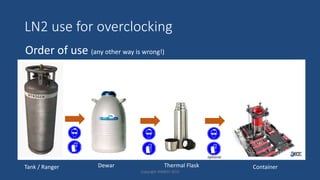
LN2 use for overclocking
Order of use (any other way is wrong!)
Copyright HWBOT 2015
Tank / Ranger Dewar Thermal Flask Container
optional
LN2 in public: LN2 Storage
Store
• Safe and ventilated area
• Large quantities : prefer outdoor storage
• Secure access
• Keep it clean and tidy
• Easily accessible at all times
Restrict access
• Trained personnel only
• Limit direct access by the public
Consider the weight
• Distribution: on higher floors, limit weight footprint
• Manipulation: Use the right tools to move tanks
Copyright HWBOT 2015
LN2 in public: Workspace
• Keep it clean
• Keep it organized
• Mount all containers properly
• Use a stable table / booth / stage
• Show what’s going on
• Use TVs to duplicate your screen
• Use cameras to display your rig
• Avoid people getting too close to see better
Copyright HWBOT 2015
LN2 in public: Safety
Safety distance
• Rig <> public = 1 meter (recommended)
• Adjust fan direction
• Do not blow toward public
Electric equipment
• 110V or 220V ?
• Use label to avoid mistakes!
• “Proper” cabling
• Avoid daisy-chain of power bar, DIY extensions etc.
Torch usage
• Check regulations at location
• If Torches, plan for an Extinguisher
Copyright HWBOT 2015
LN2 in public: Safety
• Wear the required PPE
• Follow the safety procedures for use and refilling
• Local emergency number
• Note and share before starting the session
• Don’t make “the show” by spitting LN2
• Don’t throw LN2 into the crowd
• Don’t pour LN2 on the floor
• The public might be wearing open shoes!
• No alcohol, No drugs!
Copyright HWBOT 2015
To go Further
Train others
• Become a certified trainer and educate others to the safe
use of LN2 for overclocking
• Contact us to learn more about this option
Copyright HWBOT 2015
Thanks
Questions? Contact us.
Pieter Jan-Plaisier
+886 970 726 470
pieter@hwbot.org
Copyright HWBOT 2015
Timothée Pineau
xyala@hwbot.org
+886 970 203 741
References
• Air Liquid Encyclopedia, Physical properties of Cryogenics. Retrieved on December 2014 from http://encyclopedia.airliquide.com/help.asp?LanguageID=11
• D.R. LIDE, Handbook of Chemistry and Physics, 88th Ed, Editor CRC Press, 2007-2008.
• Gas Encyclopedia, Air Liquide, Editor Elsevier, 1976.
• Handbook of Compressed Gases, 4th Ed, Editor Kluwer Academic Pub, 1999.
• International standards: Gas cylinders - Compatibility of cylinder and valve materials with gas contents -- Part 1: ISO 11114-1 (May 2012), Part 2: ISO 11114-2 (March 2001).
• Linde Group, Handling of Cryogenic liquefied gases. Retrieved on December 2014 from http://www.linde-
gas.fr/internet.lg.lg.fra/fr/images/Handling%20of%20cryogenic%20liquefied%20gases201_72930.pdf
• Linde Group, Handling of Gas Cylinder. Retrieved on December 2014 from http://www.linde-
gas.fr/internet.lg.lg.fra/fr/images/Handling%20of%20Gas%20Cylinders%20at%20and%20after%20Fire%20or%20Heat%20Exposure201_72931.pdf
• Linde Group, Oxygen deficiency. Retrieved December on 2014 from http://www.linde-gas.fr/internet.lg.lg.fra/fr/images/Oxygen%20deficiency201_72932.pdf
• Linde Group, Handling refrigerated liquefied nitrogen in transportable cryogenic receptacles. Retrieved on December 2014 from http://www.linde-
gas.fr/internet.lg.lg.fra/fr/images/Handling%20refrigerated%20liquefied%20nitrogen%20in%20transportable%20cryogenic%20receptables201_72944.pdf
• Mayoclininc.org, Frostbite: first aid. Retrieved on January 2015 from http://www.mayoclinic.org/first-aid/first-aid-frostbite/basics/art-20056653
• Praxair, Nitrogen Refrigerated Liquid. Retrieved on January 2015 from
http://www.praxair.com/~/media/North%20America/US/Documents/SDS/Liquid%20Nitrogen%20Medipure%20Gas%20N2%20Safety%20Data%20Sheet%20SDS%20P4630.pdf
• The university of Auckland, Safe storage of liquid nitrogen. Retrieved on February 2015 from https://cdn.auckland.ac.nz/assets/science/for/current-students/HR/health-safety-
wellness/documents/SMOU%2021%20Safe%20Storage%20of%20Liquid%20Nitrogen%20(2)%20(2).pdf
• The University of Auckland, Cryogenic Liquids. Retrieved on February 2015 form https://cdn.auckland.ac.nz/assets/science/for/current-students/HR/health-safety-
wellness/documents/SMOU18-Cryogenic%20Liquids.pdf
• The University of Auckland, Safety guidelines for cryogenic materials. Retrieved on February 2015 from https://cdn.auckland.ac.nz/assets/science/for/current-students/HR/health-
safety-wellness/documents/cryogenic_materials_guide.doc
• Web Health Center, Different Kinds of Asphyxia. Retrieved on January 2015 from http://www.webhealthcentre.com/HealthyLiving/first_aid_drown.aspx
Copyright HWBOT 2015

HWBOT LN2 Certification Level 4: LN2 Use for overclocking “in public”

  • 1.
    LN2 Certification Level 4:LN2 Use for Overclocking “in public” Prepared by Our Mission • Evangelize overclocking • Convert enthusiasts in to passionate overclockers • Support the community • Further professionalize extreme overclocking Copyright HWBOT 2015
  • 2.
    Disclaimer HWBOT or anyof its representatives accepts no liability for the content of this presentation, or for the consequences of any actions taken on the basis of the information provided. HWBOT shall not be liable for any loss or damage of whatever nature (direct, indirect, consequential, or other) whether arising in contract, tort or otherwise, which may arise as a result of the use of (or inability to use) cryogenic gases and/or liquids of any kind. This presentation is published for general information purposes. Any use made of the information in this presentation by the reader is their sole responsibility. These safety information have been prepared by HWBOT based upon established industry safety standards and recognized resources. Although HWBOT deems the data in these documents accurate, HWBOT cannot be held liable should their content fail to meet the legal stipulations applicable in any jurisdictions it may be applied into. The HWBOT LN2 Certification presentations are subject to revision. Visit our website to ensure that you have the latest version. Copyright HWBOT 2015
  • 3.
    Course summary 1. AboutLiquid Nitrogen (reminder) 2. LN2 for Overclocking & Safe Use (reminder) 3. LN2 for Overclocking in Public a. Storage b. Workspace c. Safety 4. To go further Copyright HWBOT 2015
  • 4.
    About Liquid Nitrogen(reminder) • LN2 = Liquid Nitrogen • Cryogenic liquid • Boiling point < -150°C • Most used : nitrogen(LN2) & helium(LHe) • Evaporation volume ratio 1:700 • Colourless, Odourless, Tasteless • LN2 boiling point: -196°C or -320°F • Non flammable, non explosive, non toxic Copyright HWBOT 2015
  • 5.
    LN2 use foroverclocking Order of use (any other way is wrong!) Copyright HWBOT 2015 Tank / Ranger Dewar Thermal Flask Container optional
  • 6.
    LN2 in public:LN2 Storage Store • Safe and ventilated area • Large quantities : prefer outdoor storage • Secure access • Keep it clean and tidy • Easily accessible at all times Restrict access • Trained personnel only • Limit direct access by the public Consider the weight • Distribution: on higher floors, limit weight footprint • Manipulation: Use the right tools to move tanks Copyright HWBOT 2015
  • 7.
    LN2 in public:Workspace • Keep it clean • Keep it organized • Mount all containers properly • Use a stable table / booth / stage • Show what’s going on • Use TVs to duplicate your screen • Use cameras to display your rig • Avoid people getting too close to see better Copyright HWBOT 2015
  • 8.
    LN2 in public:Safety Safety distance • Rig <> public = 1 meter (recommended) • Adjust fan direction • Do not blow toward public Electric equipment • 110V or 220V ? • Use label to avoid mistakes! • “Proper” cabling • Avoid daisy-chain of power bar, DIY extensions etc. Torch usage • Check regulations at location • If Torches, plan for an Extinguisher Copyright HWBOT 2015
  • 9.
    LN2 in public:Safety • Wear the required PPE • Follow the safety procedures for use and refilling • Local emergency number • Note and share before starting the session • Don’t make “the show” by spitting LN2 • Don’t throw LN2 into the crowd • Don’t pour LN2 on the floor • The public might be wearing open shoes! • No alcohol, No drugs! Copyright HWBOT 2015
  • 10.
    To go Further Trainothers • Become a certified trainer and educate others to the safe use of LN2 for overclocking • Contact us to learn more about this option Copyright HWBOT 2015
  • 11.
    Thanks Questions? Contact us. PieterJan-Plaisier +886 970 726 470 pieter@hwbot.org Copyright HWBOT 2015 Timothée Pineau xyala@hwbot.org +886 970 203 741
  • 12.
    References • Air LiquidEncyclopedia, Physical properties of Cryogenics. Retrieved on December 2014 from http://encyclopedia.airliquide.com/help.asp?LanguageID=11 • D.R. LIDE, Handbook of Chemistry and Physics, 88th Ed, Editor CRC Press, 2007-2008. • Gas Encyclopedia, Air Liquide, Editor Elsevier, 1976. • Handbook of Compressed Gases, 4th Ed, Editor Kluwer Academic Pub, 1999. • International standards: Gas cylinders - Compatibility of cylinder and valve materials with gas contents -- Part 1: ISO 11114-1 (May 2012), Part 2: ISO 11114-2 (March 2001). • Linde Group, Handling of Cryogenic liquefied gases. Retrieved on December 2014 from http://www.linde- gas.fr/internet.lg.lg.fra/fr/images/Handling%20of%20cryogenic%20liquefied%20gases201_72930.pdf • Linde Group, Handling of Gas Cylinder. Retrieved on December 2014 from http://www.linde- gas.fr/internet.lg.lg.fra/fr/images/Handling%20of%20Gas%20Cylinders%20at%20and%20after%20Fire%20or%20Heat%20Exposure201_72931.pdf • Linde Group, Oxygen deficiency. Retrieved December on 2014 from http://www.linde-gas.fr/internet.lg.lg.fra/fr/images/Oxygen%20deficiency201_72932.pdf • Linde Group, Handling refrigerated liquefied nitrogen in transportable cryogenic receptacles. Retrieved on December 2014 from http://www.linde- gas.fr/internet.lg.lg.fra/fr/images/Handling%20refrigerated%20liquefied%20nitrogen%20in%20transportable%20cryogenic%20receptables201_72944.pdf • Mayoclininc.org, Frostbite: first aid. Retrieved on January 2015 from http://www.mayoclinic.org/first-aid/first-aid-frostbite/basics/art-20056653 • Praxair, Nitrogen Refrigerated Liquid. Retrieved on January 2015 from http://www.praxair.com/~/media/North%20America/US/Documents/SDS/Liquid%20Nitrogen%20Medipure%20Gas%20N2%20Safety%20Data%20Sheet%20SDS%20P4630.pdf • The university of Auckland, Safe storage of liquid nitrogen. Retrieved on February 2015 from https://cdn.auckland.ac.nz/assets/science/for/current-students/HR/health-safety- wellness/documents/SMOU%2021%20Safe%20Storage%20of%20Liquid%20Nitrogen%20(2)%20(2).pdf • The University of Auckland, Cryogenic Liquids. Retrieved on February 2015 form https://cdn.auckland.ac.nz/assets/science/for/current-students/HR/health-safety- wellness/documents/SMOU18-Cryogenic%20Liquids.pdf • The University of Auckland, Safety guidelines for cryogenic materials. Retrieved on February 2015 from https://cdn.auckland.ac.nz/assets/science/for/current-students/HR/health- safety-wellness/documents/cryogenic_materials_guide.doc • Web Health Center, Different Kinds of Asphyxia. Retrieved on January 2015 from http://www.webhealthcentre.com/HealthyLiving/first_aid_drown.aspx Copyright HWBOT 2015

Editor's Notes

  • #5 LN2 boiling point at atmospherique pressure (abt 1bar)
  • #7 Secure access of storage loc Keep storage area clean and tidy Indoors or outdoors consider barriers to limit direct access by the public
  • #8 Clean and clear empty drinks and trash throughout the session Make sure the public can see what’s going on Use TVs to duplicate your screen Use cameras to display your rig Avoids people getting too close to see better
  • #9 Orient your system fans so they don’t blow towards the public Check voltage 110V or 220V Label which current is available when 2 options exist Ensure that the cabling is “proper” Avoid daisy-chain of power bar, DIY extensions etc. Check regulations for the use of Torches at location If Torches, plan for an Extinguisher
  • #10 Wear the required PPE Follow the safety procedures for use and refilling Note and share the local emergency number at location before starting the session Don’t make “the show” by spitting LN2 Don’t throw LN2 into the crowd Don’t pour LN2 on the floor The public might be wearing open shoes! No Alcohol, No drugs! This is a public demo, please be professional and behave like professionnals. 