1
•Lipids (Greek: lipos–fat) are of great
importance to the body as the chief
concentrated storage form of energy
•Lipids may be regarded as organic substances
relatively insoluble in water, soluble in
organic solvents (alcohol, ether etc.), related to
fatty acids and utilized by the living cells.
2
•Lipids are broadly classified into simple, complex, derived
and miscellaneous lipids, which are further subdivided into
different groups.
3
•1. Simple lipids : Esters of fatty acids with alcohols.
•These are mainly of two types
(a)Fats and oils (triacylglycerols) : These are esters of
fatty acids with glycerol. The difference between fat and
oil is only physical. Thus, oil is a liquid while fat is a solid
at room temperature.
(b) Waxes : Esters of fatty acids (usually long chain) with
alcohols other than glycerol. These alcohols may be
aliphatic or alicyclic.
4
•2. Complex (or compound) lipids : These are esters of fatty acids
with alcohols containing additional groups such as phosphate,
nitrogenous base, carbohydrate, protein etc. They are further divided
as follows
(a) Phospholipids : They contain phosphoric acid and frequently a
nitrogenous base. This is in addition to alcohol and fatty acids.
(b) Glycolipids : These lipids contain a fatty acid, carbohydrate and
nitrogenous base.
(c) Lipoproteins : Macromolecular complexes of lipids with proteins.
(d) Other complex lipids : Sulfolipids, aminolipids and
lipopolysaccharides are among the other complex lipids.
5
3. Derived lipids : These are the derivatives obtained on the
hydrolysis of group 1 and group 2 lipids which possess the
characteristics of lipids.
•These include glycerol and other alcohols, fatty acids, mono- and
diacylglycerols, lipid (fat) soluble vitamins, steroid hormones,
hydrocarbons and ketone bodies.
4. Miscellaneous lipids : These include a large number of
compounds possessing the characteristics of lipids e.g., carotenoids,,
hydrocarbons such as pentacosane (in bees wax), terpenes etc.
6
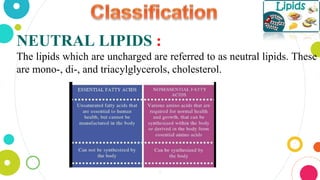
NEUTRAL LIPIDS :
The lipids which are uncharged are referred to as neutral lipids. These
are mono-, di-, and triacylglycerols, cholesterol.
7
8
9
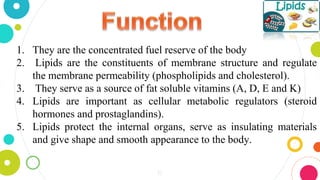
1. They are the concentrated fuel reserve of the body
2. Lipids are the constituents of membrane structure and regulate
the membrane permeability (phospholipids and cholesterol).
3. They serve as a source of fat soluble vitamins (A, D, E and K)
4. Lipids are important as cellular metabolic regulators (steroid
hormones and prostaglandins).
5. Lipids protect the internal organs, serve as insulating materials
and give shape and smooth appearance to the body.
10
11
END …..
13
14
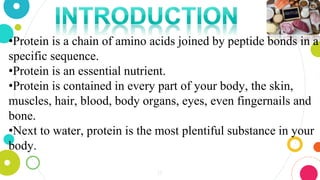
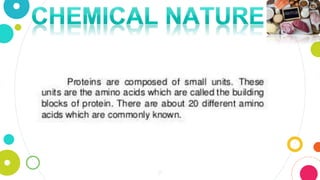
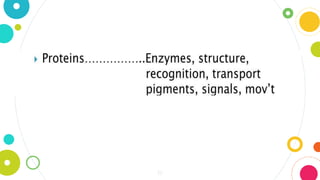
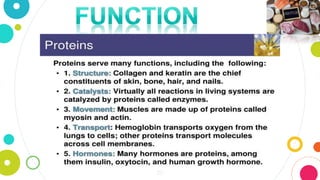
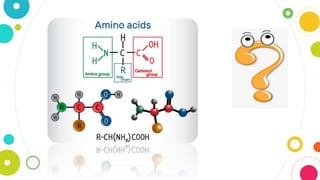
•Protein is a chain of amino acids joined by peptide bonds in a
specific sequence.
•Protein is an essential nutrient.
•Protein is contained in every part of your body, the skin,
muscles, hair, blood, body organs, eyes, even fingernails and
bone.
•Next to water, protein is the most plentiful substance in your
body.
15
16
17
18
19
20
21
END

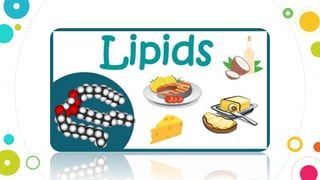
LIPIDS UNIT ONE BIOMOLECULE PRESENTATION

  • 1.
  • 2.
    •Lipids (Greek: lipos–fat)are of great importance to the body as the chief concentrated storage form of energy •Lipids may be regarded as organic substances relatively insoluble in water, soluble in organic solvents (alcohol, ether etc.), related to fatty acids and utilized by the living cells. 2
  • 3.
    •Lipids are broadlyclassified into simple, complex, derived and miscellaneous lipids, which are further subdivided into different groups. 3
  • 4.
    •1. Simple lipids: Esters of fatty acids with alcohols. •These are mainly of two types (a)Fats and oils (triacylglycerols) : These are esters of fatty acids with glycerol. The difference between fat and oil is only physical. Thus, oil is a liquid while fat is a solid at room temperature. (b) Waxes : Esters of fatty acids (usually long chain) with alcohols other than glycerol. These alcohols may be aliphatic or alicyclic. 4
  • 5.
    •2. Complex (orcompound) lipids : These are esters of fatty acids with alcohols containing additional groups such as phosphate, nitrogenous base, carbohydrate, protein etc. They are further divided as follows (a) Phospholipids : They contain phosphoric acid and frequently a nitrogenous base. This is in addition to alcohol and fatty acids. (b) Glycolipids : These lipids contain a fatty acid, carbohydrate and nitrogenous base. (c) Lipoproteins : Macromolecular complexes of lipids with proteins. (d) Other complex lipids : Sulfolipids, aminolipids and lipopolysaccharides are among the other complex lipids. 5
  • 6.
    3. Derived lipids: These are the derivatives obtained on the hydrolysis of group 1 and group 2 lipids which possess the characteristics of lipids. •These include glycerol and other alcohols, fatty acids, mono- and diacylglycerols, lipid (fat) soluble vitamins, steroid hormones, hydrocarbons and ketone bodies. 4. Miscellaneous lipids : These include a large number of compounds possessing the characteristics of lipids e.g., carotenoids,, hydrocarbons such as pentacosane (in bees wax), terpenes etc. 6
  • 7.
    NEUTRAL LIPIDS : Thelipids which are uncharged are referred to as neutral lipids. These are mono-, di-, and triacylglycerols, cholesterol. 7
  • 8.
  • 9.
  • 10.
    1. They arethe concentrated fuel reserve of the body 2. Lipids are the constituents of membrane structure and regulate the membrane permeability (phospholipids and cholesterol). 3. They serve as a source of fat soluble vitamins (A, D, E and K) 4. Lipids are important as cellular metabolic regulators (steroid hormones and prostaglandins). 5. Lipids protect the internal organs, serve as insulating materials and give shape and smooth appearance to the body. 10
  • 11.
  • 12.
  • 13.
  • 14.
  • 15.
    •Protein is achain of amino acids joined by peptide bonds in a specific sequence. •Protein is an essential nutrient. •Protein is contained in every part of your body, the skin, muscles, hair, blood, body organs, eyes, even fingernails and bone. •Next to water, protein is the most plentiful substance in your body. 15
  • 16.
  • 17.
  • 18.
  • 19.
  • 20.
  • 21.
  • 22.