INTRODUCTION
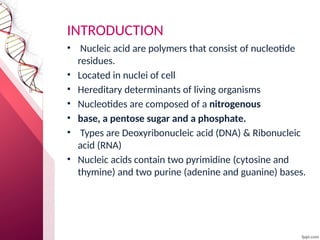
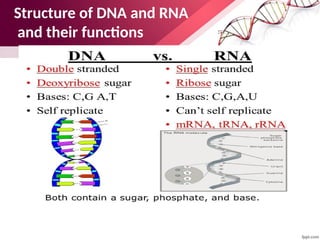
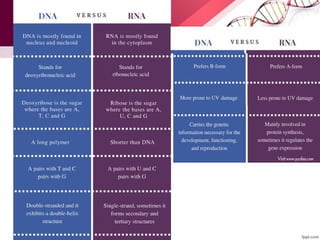
• Nucleic acidare polymers that consist of nucleotide
residues.
• Located in nuclei of cell
• Hereditary determinants of living organisms
• Nucleotides are composed of a nitrogenous
• base, a pentose sugar and a phosphate.
• Types are Deoxyribonucleic acid (DNA) & Ribonucleic
acid (RNA)
• Nucleic acids contain two pyrimidine (cytosine and
thymine) and two purine (adenine and guanine) bases.
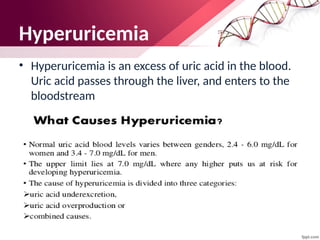
Hyperuricemia
• Hyperuricemia isan excess of uric acid in the blood.
Uric acid passes through the liver, and enters to the
bloodstream
9.
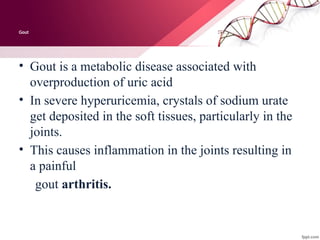
Gout
• Gout isa metabolic disease associated with
overproduction of uric acid
• In severe hyperuricemia, crystals of sodium urate
get deposited in the soft tissues, particularly in the
joints.
• This causes inflammation in the joints resulting in
a painful
gout arthritis.
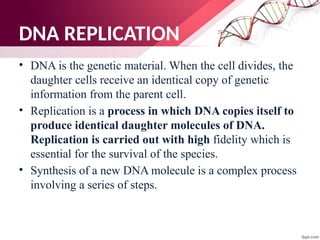
DNA REPLICATION
• DNAis the genetic material. When the cell divides, the
daughter cells receive an identical copy of genetic
information from the parent cell.
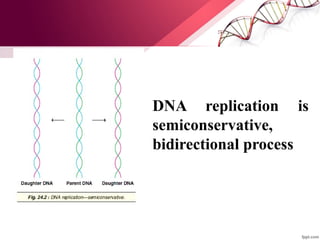
• Replication is a process in which DNA copies itself to
produce identical daughter molecules of DNA.
Replication is carried out with high fidelity which is
essential for the survival of the species.
• Synthesis of a new DNA molecule is a complex process
involving a series of steps.
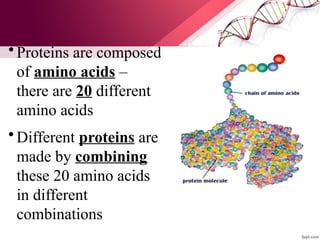
• Proteins arecomposed
of amino acids –
there are 20 different
amino acids
• Different proteins are
made by combining
these 20 amino acids
in different
combinations
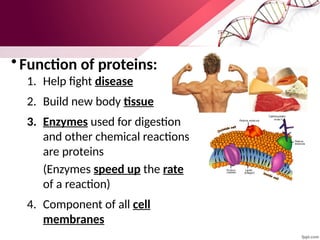
• Function ofproteins:
1. Help fight disease
2. Build new body tissue
3. Enzymes used for digestion
and other chemical reactions
are proteins
(Enzymes speed up the rate
of a reaction)
4. Component of all cell
membranes
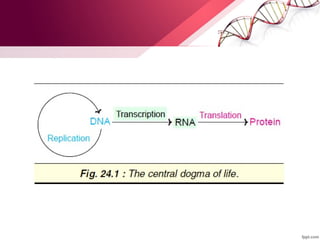
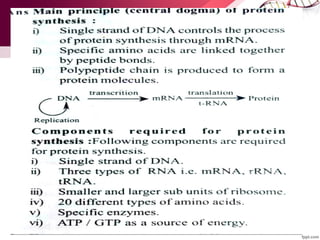
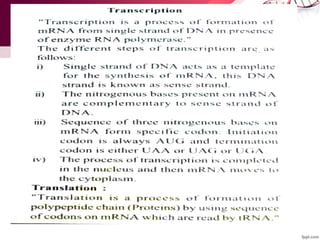
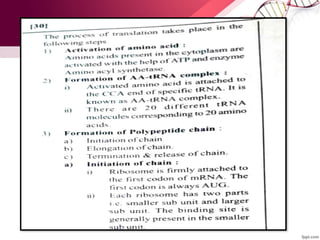
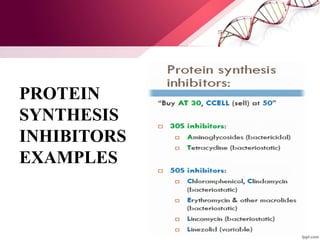
PROTEIN SYNTHESIS
INHIBITORS
• Aprotein synthesis inhibitor is a
substance that stops or slows the growth
or proliferation of cells by disrupting the
processes that lead directly to the
generation of new proteins.