BIOCHEMISTRY
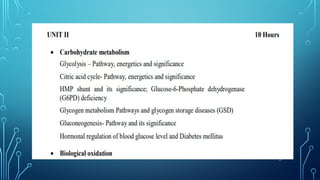
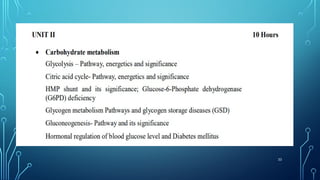
UNIT II
2
3
4
Carbohydrates are the major source
of energy for the living cells
Glucose is the central molecule in
Carbohydrate metabolism
5
Major pathways of
carbohydrate metabolism
6
1. Glycolysis (Embden-Meyerhof pathway)
2. Citric acid cycle (Krebs cycle or tricarboxylic
acid cycle)
3. Gluconeogenesis
4. Glycogenesis
5. Glycogenolysis
6. Hexose monophosphate shunt (pentose
phosphate pathway or direct oxidative
pathway
LETS LEARN
8
1. Glycolysis (Embden-Meyerhof
pathway) :
The oxidation of glucose to pyruvate
and lactate.
9
2. Citric acid cycle (Krebs cycle or tricarboxylic
acid cycle) :
The oxidation of acetyl CoA to CO2.
Krebs cycle is the final common oxidative
pathway for carbohydrates, fats or amino acids,
through acetyl CoA
10
3. Gluconeogenesis :
The synthesis of glucose from non-
carbohydrate precursors (e.g. amino acids,
glycerol etc.).
11
4. Glycogenesis : The formation of
glycogen from glucose.
12
5. Glycogenolysis :
The breakdown of glycogen to
glucose.
13
6. Hexose monophosphate shunt (pentose phosphate
pathway or direct oxidative pathway) : This pathway is an
alternative to glycolysis and TCA cycle for the oxidation of
glucose (directly to carbon dioxide and water).
14
GLYCOLYSIS – PATHWAY,
ENERGETICS AND SIGNIFICANCE
16
• Glycolysis is derived from the Greek words
glycose—sweet or sugar; lysis—dissolution.
• This pathway is often referred to as Embden-
Meyerhof pathway (E.M. pathway).
17
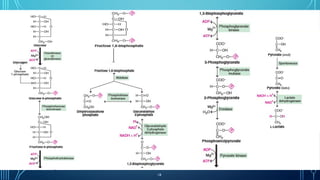
Glycolysis is defined as the sequence of
reactions converting glucose (or
glycogen) to pyruvate or lactate, with the
production of ATP.
18
PENTOSE PHOSPHATE
PATHWAY (PPP) OR
HEXOSE MONO-
PHOSPHATE (HMP)
SHUNT
20
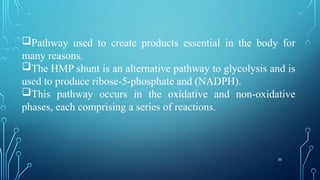
Pathway used to create products essential in the body for
many reasons.
The HMP shunt is an alternative pathway to glycolysis and is
used to produce ribose-5-phosphate and (NADPH).
This pathway occurs in the oxidative and non-oxidative
phases, each comprising a series of reactions.
21
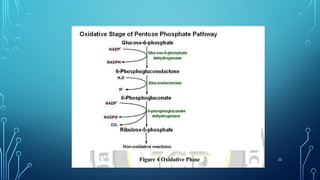
The sequence of reactions are divided into two
types.
I) oxidative reaction phase
II) Non-oxidative reaction phase
22
23
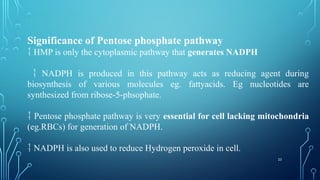
Significance of Pentose phosphate pathway
 HMP is only the cytoplasmic pathway that generates NADPH
 NADPH is produced in this pathway acts as reducing agent during
biosynthesis of various molecules eg. fattyacids. Eg nucleotides are
synthesized from ribose-5-phsophate.
 Pentose phosphate pathway is very essential for cell lacking mitochondria
(eg.RBCs) for generation of NADPH.
 NADPH is also used to reduce Hydrogen peroxide in cell.
24
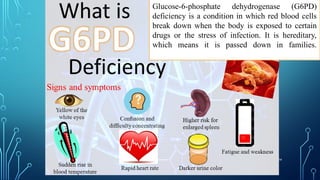
Glucose-6-phosphate dehydrogenase (G6PD)
deficiency is a condition in which red blood cells
break down when the body is exposed to certain
drugs or the stress of infection. It is hereditary,
which means it is passed down in families.
25
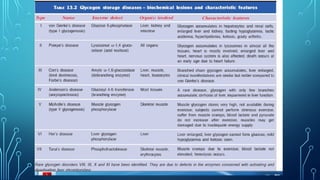
A glycogen storage is a metabolic disorder caused
by an enzyme deficiency affecting glycogen
synthesis, glycogen breakdown, or glucose
breakdown, typically in muscles and/or liver
cells.
26
27
Gluconeogenesis (GNG) is a metabolic pathway that results in
the generation of glucose from certain non-carbohydrate
carbon substrates.
Although most gluconeogenesis occurs in the liver
28
29
30
31
32
33

UNIT 2_CARBOHYDRATE METABOLISM_BIOCHEMISTRY

  • 1.
  • 2.
  • 3.
  • 4.
    4 Carbohydrates are themajor source of energy for the living cells Glucose is the central molecule in Carbohydrate metabolism
  • 5.
  • 6.
    6 1. Glycolysis (Embden-Meyerhofpathway) 2. Citric acid cycle (Krebs cycle or tricarboxylic acid cycle) 3. Gluconeogenesis 4. Glycogenesis 5. Glycogenolysis 6. Hexose monophosphate shunt (pentose phosphate pathway or direct oxidative pathway
  • 7.
  • 8.
    8 1. Glycolysis (Embden-Meyerhof pathway): The oxidation of glucose to pyruvate and lactate.
  • 9.
    9 2. Citric acidcycle (Krebs cycle or tricarboxylic acid cycle) : The oxidation of acetyl CoA to CO2. Krebs cycle is the final common oxidative pathway for carbohydrates, fats or amino acids, through acetyl CoA
  • 10.
    10 3. Gluconeogenesis : Thesynthesis of glucose from non- carbohydrate precursors (e.g. amino acids, glycerol etc.).
  • 11.
    11 4. Glycogenesis :The formation of glycogen from glucose.
  • 12.
    12 5. Glycogenolysis : Thebreakdown of glycogen to glucose.
  • 13.
    13 6. Hexose monophosphateshunt (pentose phosphate pathway or direct oxidative pathway) : This pathway is an alternative to glycolysis and TCA cycle for the oxidation of glucose (directly to carbon dioxide and water).
  • 14.
  • 15.
  • 16.
    16 • Glycolysis isderived from the Greek words glycose—sweet or sugar; lysis—dissolution. • This pathway is often referred to as Embden- Meyerhof pathway (E.M. pathway).
  • 17.
    17 Glycolysis is definedas the sequence of reactions converting glucose (or glycogen) to pyruvate or lactate, with the production of ATP.
  • 18.
  • 19.
    PENTOSE PHOSPHATE PATHWAY (PPP)OR HEXOSE MONO- PHOSPHATE (HMP) SHUNT
  • 20.
    20 Pathway used tocreate products essential in the body for many reasons. The HMP shunt is an alternative pathway to glycolysis and is used to produce ribose-5-phosphate and (NADPH). This pathway occurs in the oxidative and non-oxidative phases, each comprising a series of reactions.
  • 21.
    21 The sequence ofreactions are divided into two types. I) oxidative reaction phase II) Non-oxidative reaction phase
  • 22.
  • 23.
    23 Significance of Pentosephosphate pathway  HMP is only the cytoplasmic pathway that generates NADPH  NADPH is produced in this pathway acts as reducing agent during biosynthesis of various molecules eg. fattyacids. Eg nucleotides are synthesized from ribose-5-phsophate.  Pentose phosphate pathway is very essential for cell lacking mitochondria (eg.RBCs) for generation of NADPH.  NADPH is also used to reduce Hydrogen peroxide in cell.
  • 24.
    24 Glucose-6-phosphate dehydrogenase (G6PD) deficiencyis a condition in which red blood cells break down when the body is exposed to certain drugs or the stress of infection. It is hereditary, which means it is passed down in families.
  • 25.
    25 A glycogen storageis a metabolic disorder caused by an enzyme deficiency affecting glycogen synthesis, glycogen breakdown, or glucose breakdown, typically in muscles and/or liver cells.
  • 26.
  • 27.
    27 Gluconeogenesis (GNG) isa metabolic pathway that results in the generation of glucose from certain non-carbohydrate carbon substrates. Although most gluconeogenesis occurs in the liver
  • 28.
  • 29.
  • 30.
  • 31.
  • 32.
  • 33.