PHARMACEUTICAL
QUALITY ASSURANCE
2
3
4
5
•The quality of the packaging of
pharmaceutical products plays a very
important role in the quality products.
•According to USFDA - A container
closure system refers to the sum of
packaging components that together
contain and protect the dosage form.
6
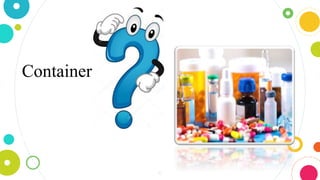
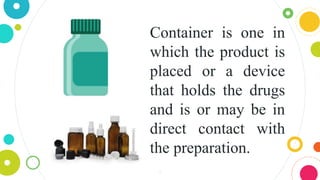
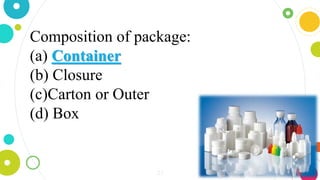
Container is one in which the product
is placed or a device that holds the
drugs and is or may be in direct
contact with the preparation
7
Container is one in
which the product is
placed or a device
that holds the drugs
and is or may be in
direct contact with
the preparation.
8
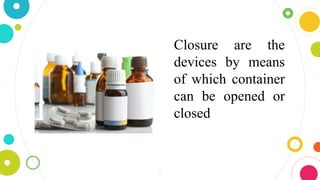
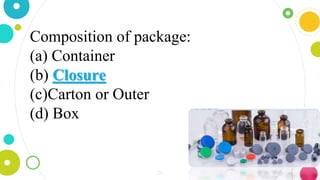
Closure are the devices by
means of which container
can be opened or closed
9
Closure are the
devices by means
of which container
can be opened or
closed
ROLE OF PACKAGING
11
ROLE OF PACKAGING:
PROTECTION
PRESENTATION
IDENTIFICATION
INFORMATION
COMPATIBLE
CONVENIENCE
12
ROLE OF PACKAGING:
PROTECTION
PRESENTATION
IDENTIFICATION
INFORMATION
COMPATIBLE
CONVENIENCE
13
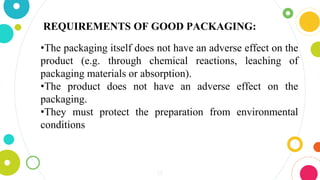
REQUIREMENTS OF GOOD PACKAGING:
•The packaging itself does not have an adverse effect on the
product (e.g. through chemical reactions, leaching of
packaging materials or absorption).
•The product does not have an adverse effect on the
packaging.
•They must protect the preparation from environmental
conditions
14
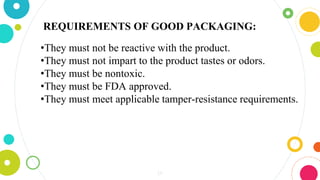
REQUIREMENTS OF GOOD PACKAGING:
•They must not be reactive with the product.
•They must not impart to the product tastes or odors.
•They must be nontoxic.
•They must be FDA approved.
•They must meet applicable tamper-resistance requirements.
15
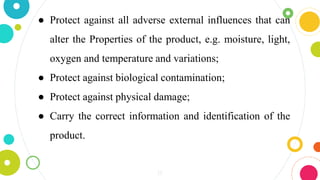
● Protect against all adverse external influences that can
alter the Properties of the product, e.g. moisture, light,
oxygen and temperature and variations;
● Protect against biological contamination;
● Protect against physical damage;
● Carry the correct information and identification of the
product.
16
17
18
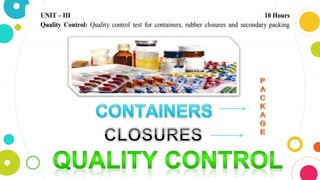
QUALITY CONTROL TESTING
OF CONTAINER
20
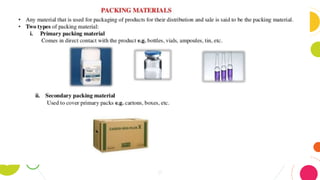
Packaging may be defined as the art and science
which involves preparing the articles for transport,
storage display and use.
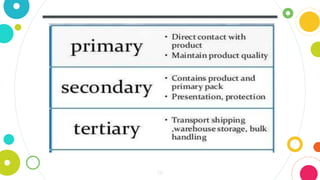
Pharmaceutical packaging is the means of providing
protection, presentation, identification, information
and convenience to encourage compliance with a
course of therapy.
21
Packaging may be defined as the art and science
which involves preparing the articles for transport,
storage display and use.
Pharmaceutical packaging is the means of providing
protection, presentation, identification, information
and convenience to encourage compliance with a
course of therapy.
22
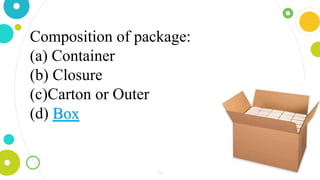
Composition of package:
(a) Container
(b) Closure
(c)Carton or Outer
(d) Box
23
Composition of package:
(a) Container
(b) Closure
(c)Carton or Outer
(d) Box
24
Composition of package:
(a) Container
(b) Closure
(c)Carton or Outer
(d) Box
25
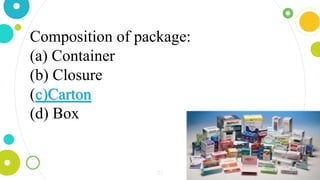
Composition of package:
(a) Container
(b) Closure
(c)Carton
(d) Box
26
Composition of package:
(a) Container
(b) Closure
(c)Carton or Outer
(d) Box
27
Based on the utility for different pharmaceutical doses
forms, containers are divided as following.
1. Well closed Containers
⏺ Protects the content from loss due to
transportation, handling, sale and Storage.
28
Based on the utility for different pharmaceutical doses
forms, containers are divided as following.
2. Air-tight containers
⏺ Also called hermetic containers.
⏺ These have air-tight sealings or closings to avoid
air contact.
⏺ Protect the product from dust, moisture and air.
Air-tight sealed containers are used for injectables. Air-tight closed
containers are used for other products i.e thyroxine tablets.
29
Based on the utility for different pharmaceutical doses
forms, containers are divided as following.
3. Tightly-closed containers:
⏺ These containers are capable of being tightly re-closed after
use i.e. gas cylinder, which is a metallic tightly-closed container
and holds gas under pressure.
⏺ Protects the contents from contamination by liquids, solids
or vapours, from loss or deterioration of the material from
effervescence, deliquescence, or evaporation under normal
condition of handling, storage and distribution.
30
Based on the utility for different pharmaceutical doses
forms, containers are divided as following.
4. Single dose containers:
⏺ Single dose containers are generally used to
hold parenteral products (injectables) i.e. ampoules
and vials.
⏺ single dose containers are used to supply only
one dose of medicaments.
31
Based on the utility for different pharmaceutical doses
forms, containers are divided as following.
5. Multi-dose containers :
⏺ Hold more than one dose and allow withdrawal of
dose at various intervals without changing the
strength, quality, and purity of the remaining portion.
⏺ Multi-dose containers are used for injectables i.e.
ampoules.
32
Based on the utility for different pharmaceutical doses
forms, containers are divided as following.
6. Light-resistant containers:
⏺ Protect the medicaments from the harmful
effect of light.
⏺ These are used to store medicaments which are
photo-sensitive.
33
Based on the utility for different pharmaceutical doses
forms, containers are divided as following.
7. Aerosol containers
⏺ Used to hold aerosol products.
⏺ These containers should have adequate
mechanical strength in order to bear the pressure of
aerosol packaging.
34
Based on the utility for different pharmaceutical doses
forms, containers are divided as following.
8. Temper evident containers
⏺ These Containers are fitted with a device or
mechanism which irreversibly reveals whether
the container is opened or closed.

UNIT 3 QUALITY ASSURANCE LECTURE 3.pptx

  • 1.
  • 2.
  • 3.
  • 4.
  • 5.
    5 •The quality ofthe packaging of pharmaceutical products plays a very important role in the quality products. •According to USFDA - A container closure system refers to the sum of packaging components that together contain and protect the dosage form.
  • 6.
    6 Container is onein which the product is placed or a device that holds the drugs and is or may be in direct contact with the preparation
  • 7.
    7 Container is onein which the product is placed or a device that holds the drugs and is or may be in direct contact with the preparation.
  • 8.
    8 Closure are thedevices by means of which container can be opened or closed
  • 9.
    9 Closure are the devicesby means of which container can be opened or closed
  • 10.
  • 11.
  • 12.
  • 13.
    13 REQUIREMENTS OF GOODPACKAGING: •The packaging itself does not have an adverse effect on the product (e.g. through chemical reactions, leaching of packaging materials or absorption). •The product does not have an adverse effect on the packaging. •They must protect the preparation from environmental conditions
  • 14.
    14 REQUIREMENTS OF GOODPACKAGING: •They must not be reactive with the product. •They must not impart to the product tastes or odors. •They must be nontoxic. •They must be FDA approved. •They must meet applicable tamper-resistance requirements.
  • 15.
    15 ● Protect againstall adverse external influences that can alter the Properties of the product, e.g. moisture, light, oxygen and temperature and variations; ● Protect against biological contamination; ● Protect against physical damage; ● Carry the correct information and identification of the product.
  • 16.
  • 17.
  • 18.
  • 19.
  • 20.
    20 Packaging may bedefined as the art and science which involves preparing the articles for transport, storage display and use. Pharmaceutical packaging is the means of providing protection, presentation, identification, information and convenience to encourage compliance with a course of therapy.
  • 21.
    21 Packaging may bedefined as the art and science which involves preparing the articles for transport, storage display and use. Pharmaceutical packaging is the means of providing protection, presentation, identification, information and convenience to encourage compliance with a course of therapy.
  • 22.
    22 Composition of package: (a)Container (b) Closure (c)Carton or Outer (d) Box
  • 23.
    23 Composition of package: (a)Container (b) Closure (c)Carton or Outer (d) Box
  • 24.
    24 Composition of package: (a)Container (b) Closure (c)Carton or Outer (d) Box
  • 25.
    25 Composition of package: (a)Container (b) Closure (c)Carton (d) Box
  • 26.
    26 Composition of package: (a)Container (b) Closure (c)Carton or Outer (d) Box
  • 27.
    27 Based on theutility for different pharmaceutical doses forms, containers are divided as following. 1. Well closed Containers ⏺ Protects the content from loss due to transportation, handling, sale and Storage.
  • 28.
    28 Based on theutility for different pharmaceutical doses forms, containers are divided as following. 2. Air-tight containers ⏺ Also called hermetic containers. ⏺ These have air-tight sealings or closings to avoid air contact. ⏺ Protect the product from dust, moisture and air. Air-tight sealed containers are used for injectables. Air-tight closed containers are used for other products i.e thyroxine tablets.
  • 29.
    29 Based on theutility for different pharmaceutical doses forms, containers are divided as following. 3. Tightly-closed containers: ⏺ These containers are capable of being tightly re-closed after use i.e. gas cylinder, which is a metallic tightly-closed container and holds gas under pressure. ⏺ Protects the contents from contamination by liquids, solids or vapours, from loss or deterioration of the material from effervescence, deliquescence, or evaporation under normal condition of handling, storage and distribution.
  • 30.
    30 Based on theutility for different pharmaceutical doses forms, containers are divided as following. 4. Single dose containers: ⏺ Single dose containers are generally used to hold parenteral products (injectables) i.e. ampoules and vials. ⏺ single dose containers are used to supply only one dose of medicaments.
  • 31.
    31 Based on theutility for different pharmaceutical doses forms, containers are divided as following. 5. Multi-dose containers : ⏺ Hold more than one dose and allow withdrawal of dose at various intervals without changing the strength, quality, and purity of the remaining portion. ⏺ Multi-dose containers are used for injectables i.e. ampoules.
  • 32.
    32 Based on theutility for different pharmaceutical doses forms, containers are divided as following. 6. Light-resistant containers: ⏺ Protect the medicaments from the harmful effect of light. ⏺ These are used to store medicaments which are photo-sensitive.
  • 33.
    33 Based on theutility for different pharmaceutical doses forms, containers are divided as following. 7. Aerosol containers ⏺ Used to hold aerosol products. ⏺ These containers should have adequate mechanical strength in order to bear the pressure of aerosol packaging.
  • 34.
    34 Based on theutility for different pharmaceutical doses forms, containers are divided as following. 8. Temper evident containers ⏺ These Containers are fitted with a device or mechanism which irreversibly reveals whether the container is opened or closed.